Sunday, January 18, 2015

The Outlaw Josey Wales

SPOILER ALERT! The plot will be discussed.


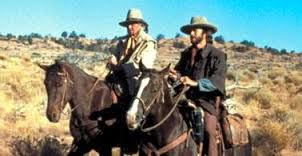
Well this film definitely does not fit the typical John Wayne style western, pilgrim. (Did Wayne actually ever say “pilgrim”? Let me know if he did). It shows how war, especially the American Civil War, can subvert civilization. The title alone tells you something. We're dealing with someone outside the established system of government. He became this way when renegade Union soldiers killed his wife and child and burned down his house. He and his family are collateral damage in this universe. This movie shows a topsy-turvy world. There’s a lot of that going on in 1970’s films – this one came out in 1976. Here, the Union army is as bad as the Confederate. At first, Josey joins up with the Confederates for revenge. But, the man who recruited him, Fletcher, becomes a traitor and, for money, convinces everyone except Josey to surrender. After the Confederates are double-crossed and killed, Josey kills the Union soldiers. He is now an outlaw. Fletcher hunts Josey, probably to obliterate the person whose existence makes him feel guilty for his own betrayal.


The actions and words of the film show the inverse reality created by war. Josey, while placing a wood cross on his wife's grave, starts to angrily slam it into the ground, knocking it over, as much an act of defiance as of reverence for God. At one point, Josey says about being dragged "all over hell's creation" – instead of using the familiar phrase "God's creation."  In this film, Josey, a white man, joins forces with an Indian, played by Chief Dan George. When they first encounter each other, it is the white man who sneaks up and gets the drop on the Indian. George dressed not as a Native American but in white man's clothes, looks like, as George says, sarcastically, a "civilized man." The white man’s world is being satirized here.

There is a ferryman who transports Union and Confederate passengers alternately, for money, singing Dixie, for Josey's sake, when ferrying him. He almost seems like Brecht's Mother Courage, switching flags for practical purposes. In another scene, after his identity is discovered in a town, Josey confronts Union soldiers by saying "Are you going to pull out your pistols or whistle Dixie," – not what you would think Union men would sing. But, in this world, allegiances can fluctuate. When Josey and his new family of Native Americans, left behind townspeople, and displaced Kansans defend their new home, the house has crosses cut out of the windows, looking, ironically, religious, but actually useful for shooting side to side and up and down in the last battle with those pursuing Josey.


In the end, Josey makes peace with the local Native Americans, saying that governments took everything from both of them, and now peace can only be made between people – not governments. When Fletcher finally catches up with Josey, he lets him go, as the two make an unspoken agreement, outside the laws of governments.

This film upholds the traditional western value system which exalts strong individualism, but, in this case, as the way to heal society.

Any other Eastwood films you would like discussed?

Next week’s film is a more recent one: The Place Beyond the Pines.

Sunday, January 11, 2015

The Verdict
(A version of this post first appeared on the Bryn Mawr Film Institute Blog)

SPOILER ALERT! The plot of the movie will be discussed.

I say that the verdict is in on this movie -- it’s a masterpiece. We lost one of our most gifted and prolific directors not too long ago. Sidney Lumet made such great films as: Long Day's Journey into Night; Fail-Safe; The Pawnbroker; and Network.  However, a number of his films deal with crime and the legal system.  These include: 12 Angry Men; Serpico; Murder on the Orient Express; Dog Day Afternoon; and Prince of the City.


My favorite movie of his in this area is The Verdict. You cannot find another title of a movie which has so much to do with what the film is about. The word "verdict" is derived from the Latin and means "to speak the truth." This movie shows how lies can have tragic consequences, and how outward appearances are not good indicators as to who is the most reliable source of truth. It is here where the marriage of Lumet with writer David Mamet is a match made in screenwriting heaven. Mamet, too, deals with the line between justice and injustice, society's rules and the breaking of those rules, in such films as House of Games, The Spanish Prisoner, Glengarry Glen Ross, and The Edge.


The Verdict, a 1982 film, showcases Paul Newman as Frank Galvin, in maybe his best performance, as a promising lawyer who has fallen from legal and ethical grace in the Catholic world of Boston's jurisprudence. We first see him as an alcoholic who tries to fund his visits at his favorite bar by browsing the obituaries and soliciting representation from grieving families at funerals, pretending to be a friend of the deceased. He is so ashamed and angry at what he has become that while intoxicated he slams his framed law diploma against his desk, and a glass fragment hits him near his eye. This action symbolizes how the legal institution has become subverted in his world, and how this corruption has undermined Frank's moral vision. 

His concerned, although foul mouthed and sometimes racial slurring mentor Mick, played by Jack Warden, throws a potentially lucrative malpractice case Frank's way. At first, Frank is just out for the money, looking for a quick settlement. He reassures the family of the comatose victim while not revealing his dilapidated office (an expressionistic touch which mirrors his life) under the pretense that it is filled with paper for another case (a lie). He hangs a sheet of paper on his door that says he is meeting with the judge (untrue).

The way setting is presented in this film is important to depict who has power and who are the downtrodden. In his book, Making Movies, Lumet says "In The Verdict we used a very narrow color selection and older architecture. No modern buildings were seen in the movie." St. Catherine's (the Catholic hospital), the courtroom, the office of James Mason's defending lawyer Concannon (whose name implies he is a big shot), Frank's sleazy apartment, even the bar Frank frequents, are old fashioned in style, but are differentiated as to level of refinement by those who populate them. You can feel the heft of the dark hardwood weighing everything down, emphasizing how difficult it is to alter society's entrenched power structure. Lumet emphasizes the disparity as to the opposing sides as he cuts between the old legal library where Frank and Mick prepare for the case alone, and the army of litigators in the opulent conference room presided over by Concannon.


Editing is essential in showing Frank gravitating back to his ethical base (and living up to his name which means "free from guile"). As Lumet says in his book, "In The Verdict, the most important transition in the movie was illuminated by the close-ups of Paul Newman examining a Polaroid photograph. He had taken the picture of the victim, and he watched it develop. As the photograph took on life, he did too. I could feel the present breaking through for a man who, up until then, had been trapped in the detritus of his past life. It was the intercutting between the developing Polaroid and the close-ups of Newman that made the transition palpable." When Frank meets the Bishop (played by Edward Binns) he cannot accept the low offer of $210,000 because "no one will know the truth" that those who should have looked after his client failed her. If he takes the hush money, he will be "lost."

Past lies derailed Frank before and hinder his forward movement in the present. Mick tells Frank's new girlfriend, Laura, played by Charlotte Rampling, that Frank was forced to lie and take the fall for his law firm's jury tampering after he threatened to expose his partners. He lost his job and his wife. In the current case, he has a doctor willing to testify against a peer, but that physician is forced out of the country by the powers-that-be, so he cannot tell the truth. Even Frank is not honest with the relatives of the patient about no longer wanting to settle out of court. Cocannon is always one step ahead of Frank and we find out why:  Mick finds Concannon's check made out to Laura, who is a spy, feeding information to Concannon. How Ironic, since on their second meeting Frank tells Laura, "Tell me the truth. You can't lie to me." But, she has fallen for Frank, and does not tell Concannon about the admitting nurse (played by Lindsay Crouse), who Frank convinces to testify. The esteemed doctor who is the defendant had not read that the patient had a full meal one hour prior to the delivery of her baby. The close time of the meal to the delivery caused her to aspirate vomit into her mask, causing her to lose oxygen, creating the vegetative state. The doctor then coerced the nurse to lie about the time of the meal, changing the "1" to a "9." The lies of the powerful spread like a virus to infect those working for them.

It is also ironic to see Concannon, who has been duplicitous with Laura, lecture Crouse's character about perjury. Even though the photocopy of the original admitting form is tossed out, the testimony is heard by the jury. The Bishop asks an underling, after the nurse's testimony, that despite Concannon's legal prowess, did he believe her? The other's silence shows that the jury saw the truth. The irony that the supposedly trustworthy Catholic Church is behind such a distasteful cover-up is evident here. Earlier in the film, Frank tells Laura, "The jury wants to believe. I mean they want to believe." In his summation, Frank says that we hear so many lies that we doubt our institutions. We feel powerless, and we become victims. But, he tells the jury that today they are the law, and he believes that there is justice in our hearts. Of course, he wins big, but the huge settlement is not as important as is the moral victory.

The film ends enigmatically with the guilt-ridden Rampling repeatedly calling Newman.  He appears that he may answer the phone (while now only drinking coffee), but just can't do it. Truth may bring redemption, but it does not erase the betrayal of lies.

Newman lost the Oscar to Ben Kingsley for Gandhi. Do you think that the right choice was made? What are your favorite Paul Newman roles?

Next week’s film is The Outlaw Josey Wales.

Sunday, January 4, 2015

Midnight Cowboy

SPOILER ALERT! The plot of the movie will be discussed.


I'm a big Dustin Hoffman fan as you can tell by my previous selections. He chose to do this film because he wanted something very different from his star-making role in The Graduate. His acting versatility is demonstrated here. This movie, like literature and film before it, explores the themes of "east" versus "west," and the "frontier" versus the "city" in America. The wilderness was first seen as evil, a place where transgressions occurred outside of the law. Then the western frontier was idolized as "The New Eden," where human individuality flourished and freedom was king. It was the place for redemption, to start over. The city became the place of urban industrialization, where slums grew and people became oppressed and impoverished. Theodore Dreiser wrote novels which descried the city. The Great Gatsby talks about the loss of that western ideal, the loss of innocence. But then comes a novel and a film called Deliverance which explodes the bucolic myth, showing the brutality of living in the uncivilized wilderness, where man becomes an animal.


Best Picture Oscar winner Midnight Cowboy is more in the Gatsby camp. The traditional cowboy in films is seen riding in the great open spaces on his horse in the daytime, or into the sunset after heroic deeds are done. Here, we have a "midnight cowboy," a traveler of dark places. In this film, the cowboy has degenerated to the form of Jon Voight's Joe Buck, who, although naïve, has had his innocence corrupted even before he goes to New York. The town in Texas that he leaves has nothing of the grandeur of the Old West. It is a bleak, boring place, from which Joe wants to escape from his menial dish washing job at the local diner. In flashbacks, his girlfriend would say "you're the only one." But she and Joe are jumped by a local gang of boys, who rape both of them. In her shock she just keeps saying that Joe was "the only one," and it appears that he was blamed for the assault. The flashbacks also show how Joe was abandoned by his mother and dropped off to be raised by his grandmother. She is promiscuous, and is seen in bed with Joe and a gentleman caller. She shows inappropriate affection toward her grandson. She also has religious pictures all over the house and takes him to become baptized (supposedly cleaning him of the original sin of the knowledge of good and evil – the Bible equates "knowing" with sexuality). Joe cannot reconcile religion’s rules and individual sexual practices, and is shown as having disdain for evangelical preachers. 

Joe leaves his rural home with a suitcase that has markings like a branded cowhide. He comes to New York to ride women, not horses, and make money as a hustler (not a rustler). He is a different type of “Buck” -ing bronco. The city is a place of prostitutes, male and female, and of filth and apathy, as people ignore a collapsed man on the street (in front of Tiffany's to emphasize the disparity between the classes in America). Joe looks out of place with his tacky cowboy outfit. He is a fallen cowboy where the only shooting he does is at an arcade game. On the radio that Joe carries we hear a woman say that her idea of a man is Gary Cooper (the hero of High Noon), and the response to that is that he's dead – implying that the myth of the western hero is also dead. He strikes out trying to hustle women, and out of desperation lets a gay man (a young Bob Balaban) perform oral sex on him. However, the youth has no money. The film came out in 1969, and is not enlightened as to its attitude toward homosexuality, with slurs being used and gay self-loathing shown. But, then again, it shows an accurate view toward the topic of that time.


Joe meets Ratso Rizzo (Hoffman), who promises to hook him up with someone who will help him make money as a stud. He scams Joe, and sends him to a disturbed religious fanatic instead (played by John McGiver). There is no spiritual redemption to be found here. Joe catches up with Ratso, who invites him to live with him in his condemned building room with no heat. Rizzo pulls down a shredded shade over a filthy window in a scene that makes him look like a parody of a happy homemaker. Rizzo becomes Joe's urban sidekick, but he is no Ward Bond to John Wayne (who ironically won the Oscar that year for playing a cowboy in True Grit). Hoffman's Rizzo is a limping panhandler, who even looks like a rat, with pointed features accented by slicked back hair looking like wet fur. At one point it totally defies the straightening attempts of a comb.  Hoffman's Ratso is great with his rodent high-pitched voice, who instinctively reaches for leftover change from public phones. Ratso tries to become Joe's manager. He has a deadly respiratory illness. He fantasizes about living the American dream of retiring to warm Florida. But we hear the commercial slogan in the background for "orange juice on ice," implying that for him, in wintry New York, the closest he'll get to Florida is a cold fruit drink. 

Joe finally looks like he is going to make some money as a sexual hustler after meeting Brenda Vaccaro's character at an underground artist party, and being paid for sex by her.  She sets him up with a date with another woman. But, Ratso is very sick, and can't even walk anymore. These two, who have become unlikely friends, are now dependent on each other. Joe robs a gay man (played by Bernard Hughes) and takes Ratso on a bus to Florida. After they reach Florida, Joe stops at a rest stop and dresses them in colorful clothes. He sheds his cowboy outfit and says he's no hustler and should be able to get a regular job. He is seen as trying to move on and adapt to the real world so he can provide for Ratso.  But, his friend is too far gone, and dies on the bus.

In the end this film is about trying to connect with another human being. Joe comes from a dysfunctional world, warped by a twisted upbringing and violent events.  Ratso sees his dead shoe-shining father as a loser, and is an outcast hustling cripple. Yet these two social misfits find emotional sustenance from each other in a dehumanized world.

What are your favorite Hoffman and Voight performances?

Next week's film is The Verdict.

Sunday, December 28, 2014

The Wild One

SPOILER ALERT! The plot of the movie will be discussed.

Sorry, I don’t have a holiday movie to discuss. But you’re probably tired of seeing them on TV at this time of the year anyway.

Marlon Brando is the original rebel without a cause in this 1954 motorcycle gang film.  The actor plays the pack's leader, Johnny, who speaks few words in this movie, but conveys a great deal with his face and actions. He shows his cool with his detached manner, but shows his anger toward the "squares" who make up society, and in particular with the police. 


Although the movie seems dated now with its lingo and relative lack of violence, it does mirror the conflicts that were gestating during the 1950's between the established authority and the discontented youth. When the gang drives into town, they disrupt a motorcycle race sanctioned by the citizens. The same activity is either accepted or rejected depending on who is running the event. The bikers mock the race's organizers who want to tell them what they can't do. As they ride in, the youth of the town are shown to be excited as they watch the cool looking bikes. The faces of their elders reflect fear. The local bartender is an exception because he is willing to forget their anti-establishment ways if he can make a buck off of them by selling beer. 


Small actions or words illustrate the themes of the film. The slang and music show the lack of communication between the generations. When Johnny is given a glass for his beer, he ignores it, and drinks from the bottle. Somebody asks Johnny, "What are you rebelling against?" His total rejection of society is revealed when he responds, "What've you got?" Johnny is attracted to the police chief's daughter, Kathy. He asks her what happens in her town. She says that roses grow, people get married, and her father once promised to take her fishing, but it didn't happen. The banal life she is leading makes her attracted to the bad boy Johnny. He tells his friends that they will stay in the town for a while to "wait for crazy." He and his gang can only exist in chaos.


The bikers' rowdy behavior creates destruction at the bar and a hair salon. They are noisy and harass girls. Ironically, they are accused of crimes they do not commit. A double legal standard exists in the town. The citizens want Lee Marvin's rival biker to go to jail during a confrontation, but want the driver of a car who hits a biker to be set free.  Kathy's father keeps trying to smooth things over, taking the path of least resistance, and only arrests Marvin. The bikers exact justice by putting the civilian in jail, too. They take the place of the ineffective police. Then, the citizens go outside the law as vigilantes when the police don't crack down. They throw a tire iron at Johnny, who falls off his bike. The out-of-control bike (symbolizing the whole town at this point) kills one of its elderly citizens. Johnny is wrongly accused of killing the man, until a few fair citizens come to his rescue.

 When Kathy is harassed by the gang, Johnny rescues her, and rides her away into a park area, a kind of sanctuary far from the confrontations. He is a torn individual. He admits during a beating that his father hit him hard, so we get a glimpse of an abused childhood that may have set him on his path. He may reject society, yet he clings to a stolen motorcycle race trophy, showing his desire to be accepted by society. He rejects a biker girl in favor of the "square" Kathy, but he treats her roughly, despite her admitting her attraction to him and his life. She is a policeman's daughter, and he says "you think you're too good for me." She represents what he wants, acceptance, and what he despises, the authority of the "square" world.

Since they are from worlds at war, they cannot be together. But, Johnny finds some peace with the fact that he is justly set free and has found a person in Kathy from the other camp who understands him. Since he feels accepted for the moment at least, he no longer needs the trophy, gives it to Kathy, and shows his only smile in the film as he rides off.

Many actors feel that Brando was the ultimate actor. Do you agree with them?

Next week’s film is Midnight Cowboy.

Sunday, December 21, 2014

Marathon Man

SPOILER ALERT! The plot of the movie will be discussed.

The making of this film has an anecdotal story attached to it. Laurence Olivier apparently chastised Dustin Hoffman for his zealous devotion to "the method." The British legend told Hoffman that instead of mimicking exhaustion by staying up all night, he should just "try acting."


Both actors are quite good here, using their respective techniques. Olivier’s Nazi dentist is actually quite restrained, emanating menace by just repeating the words "is it safe?" to the restrained Hoffman over and over in a subdued tone, referring to the diamond stash he exploited from Jewish prisoners. This sociopath is not interested in the safety of people, only his precious stones. If you don't like going to the dentist, definitely don't watch this movie close to an office visit. 


Which brings us to an interesting motif in the film. Olivier was a torturer/experimenter at a WWII concentration camp. But the medical axiom "to do no harm" is alien to this health care practitioner. But, Hoffman's brother (Roy Scheider) is ironically called "Doc," since he is a spy who collaborates with Olivier, delivering the diamonds from the dentist's safe deposit box in Manhattan by way of the ex-Nazi's brother. The German brother is killed in a car accident, causing Olivier to come out of hiding in South America to access the diamonds himself. Scheider says to Hoffman that he should forget about the past.  Obviously he has, letting go of his Jewish background to do business with the Nazi.  Hoffman's character is doing his doctoral thesis on the effect of McCarthyism and how it destroyed his father, so he is very much aware of the past. This movie is not a simple story of good brothers versus bad ones.


Outside of Hoffman's character, the others are not what they seem on the outside. Olivier looks like a harmless old man, but he has a spring blade dagger attached to his arm under his coat, slashing away at anyone who tries to expose him. He wanders around the jewelry section of Manhattan where almost all of the Jews are unaware of the Nazi killer from their past. In that district he ironically tries to determine the price of the diamonds he took from the Jews he threatened in the war. Scheider is supposed to be a businessman, but really is a spy who is a Jew associated with a Nazi and a spy network that should be benevolent, but isn't. William Devane's character as Scheider's boss pretends to want to help Hoffman, but double-crosses him. The girl who becomes Hoffman romantic interest is also working for the bad guys.

In the climactic scene between Hoffman and Olivier, the Nazi accuses the former of being weak, like the rest of his family. But Hoffman is anything but weak. He is a marathon runner who says early on that you forget about the pain while striving toward the finish. Even though Olivier has caused him excruciating agony by drilling into his teeth, Hoffman throws away the pain killing essence of cloves.  He does not want to be numbed into passivity, but lets the pain keep him sharp. He is the one who out of all of the characters survives in the end and triumphs.

Olivier interestingly played a character on the other side of the spectrum in The Boys from Brazil. In that film he was a Jewish Nazi-hunter.

What are your favorite Olivier and Hoffman roles?

Next week’s movie is The Wild One.

Sunday, December 14, 2014

Sweet Smell of Success

SPOILER ALERT! The plot of the movie will be discussed.


I regret that I only came to this film recently. I sought it out after seeing other great motion pictures, such as All the King's Men, and A Face in the Crowd, which deal with power and celebrity in America. The film has some of the qualities of the film noir genre, such as numerous dark scenes which reflect the sleaziness of the underbelly of society, and witty, stylized dialogue. But it connects more with the tone of a film noir by showing how corruption has poisoned the human souls of some people. 

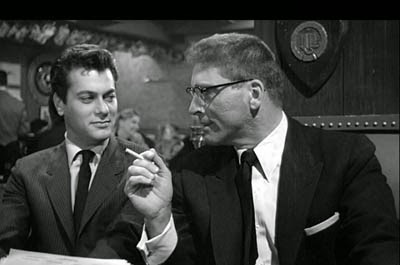
It is amazing how one little line can carry so much weight. Early on in this movie, Tony Curtis' Sidney Falco, a lowly press agent in New York, goes to a restaurant to ask Burt Lancaster's J. J. Hunsecker, a powerful NY columnist, for resumed plugs in his writings.  At the table, Hunsecker, holding up a cigarette, says to Falco, "Match me, Sidney." Falco says not right now. Hunsecker, probably modeled after gossip columnist Walter Winchell, wields so much power that he can exalt or destroy anybody with his words. For example, at the table he humiliates a U.S. Senator into submission by exposing his lust for a young female wannabe sitting next to him. Falco wants, as he says later, to use Hunsecker to climb "the golden ladder to the place I want to get." So, "match me" isn't just about lighting a cigarette, it's about a fight, like a match in a ring. And, it can be a question, as "Can you match me?"  Falco can't "match" Hunsecker at this point in his cold hearted manipulations. That is why he can't respond to the request. There is a scene which shows their contrasting levels of “success.” Hunsecker receives a phone call from Falco while sitting in a luxurious room in his apartment. He is in a comfortable bathrobe while sipping coffee at a well- appointed table. Falco talks from a dingy room next to a bottle of Alka Seltzer, illustrating that he is the one under pressure to please J. J. Their relationship approaches one of sadomasochism.

Hunsecker has given Falco the cold shoulder because the latter hasn't quashed a budding romance between his sister, Susan (Susan Harrison), and a jazz musician, Steve Dallas (Martin Milner), who is a decent man in contrast to J. J. Now Hunsecker's feelings toward his sister are way beyond the normal bounds of brotherly protection. He wants her for himself, and the subtext is incestual.  There is one point where Susan seems to cringe at his closeness. It may be that she represents the one part of innocence in his past life that he is reluctant to leave behind.  Hunsecker uses Falco to discredit Dallas at a distance through a rival writer. Falco lures a cigarette girl, who thinks he is attracted to her, into sleeping with the other columnist, because she has a boy in military school and needs the money. He gives the girl to the writer so that the columnist will write that Dallas is a Communist. This last point stresses the McCarthyism at the time in which the film was made, and how people seeking power used the media to slander others so they could gain notoriety. Hunsecker also has the goods on a crooked cop, and uses him to plant marijuana on Dallas, which again emphasizes the corrupt nature of this part of the urban world represented by New York City

Falco initially cringes at Hunsecker's extreme ways of going after Dallas, but gets on board when Hunsecker promises him the chance to write his column while he is away. Falco has descended so low in the end that when Susan is contemplating suicide by jumping off of Hunsecker's high rise apartment, (the opening credits of Mad Men come to mind), his only concern is that he will get blamed for her death. Falco grabs her before she leaps, and Hunsecker enters, seething because Falco is holding his sister. It is then that Falco lets out of the bag that Hunsecker was framing Dallas, leading to the break with his sister. The Hunsecker-Falco relationship reminds me of the Gecko-Fox one in Wall Street, only Fox realizes the evil of his ways. Success in this film has a smell, for sure, but it is not sweet.

Early on in the film, Falco won't wear an overcoat, to save hatcheck tips. But, at the end, he is wearing a coat, just like Hunsecker, because he has graduated to that level of "success." Susan through most of the film is cloaked in the mink coat that her brother gave her, symbolizing his dominion over her. But, once she breaks with him, she walks out of his life without the weight of that coat. Since the story centers on J. J.'s attempt to dominate his sister, and depicts the abusive way Hunsecker  and Falco treat women, the movie exposes how men demean and exploit women around them. Also noteworthy is that the film is shot mostly at night. Men like Hunsecker and his minions are predators who do dark deeds, preying on the hidden secrets of others. But, the last scene has Susan walking away from the black world of her brother into the dawn of a new day. She will probably be joining Dallas, a name that suggests the idealistic Old West, far away from the sinful city, and the two may ride off, not into the sunset, but into the sunrise toward a bright future. 


Next week’s movie is Marathon Man. 

Sunday, December 7, 2014

Tootsie

SPOILER ALERT! The plot will be discussed.

I never liked Tootsie Roll candies. They weren't that tasty and they always became stuck between my teeth. But the film Tootsie is a delectable treat to watch. 1982 was an exceptional year for Oscar caliber films. Ghandi is a sweeping, intelligent epic, and the eventual Academy Award winner for best film, director, and actor, Ben Kingsley, in a totally believable performance as the title character. Another film, The Verdict, could also have won in any other year for its performance by Paul Newman and the enduring greatness of the script by David Mamet. And, of course, there was that creature who everyone hoped would phone home, ET. But, Tootsie was another terrific film that year, which, although a comedy, has many thought provoking insights into male/female relationships. It is also a movie that shows how the overwhelming majority of actors are unemployed and desperate to practice their craft. But, it transcends on the theme of identity, and poses questions about who we are.


Dustin Hoffman's character, Michael Dorsey, is a struggling New York actor. Because he needs money to produce the play by his roommate, played by an unbilled Bill Murray, and is perceived as too difficult to work with, he dresses up as a woman and lands a role as a strong-willed hospital administrator. The ironies pile up. As Dorothy Michaels, he is at first considered too genteel, too feminine to get the role until Dorothy asserts herself later in the audition. Dorothy becomes very popular on the show as a breakthrough “woman” who will not be dominated in a man's world. Her strength influences the woman Michael falls in love with, Julie Nichols, played by Jessica Lange in an Oscar-winning supporting actress role. She leaves her two-timing boyfriend, the soap director, Ron, played by Dabney Coleman. Michael starts to understand women in this new role, and says he knows what it's like to get rejected just because he doesn't have the right "look" for a part. Because he is an actor, he realizes what it's like to be a woman, waiting for the phone to ring. He tells his agent (played by director Sydney Pollack) that he has something to say to women like him, but Pollack points out that there are no women like him. 


We see Michael at the onset of the film on the make, just like most. He later lies to Teri Garr's character, Sandy, because he doesn't want to reveal that he has taken the part for which she auditioned. He goes to bed with her to cover up why he is caught half-undressed, ready to try on her clothes. He then stands her up so he can be with Julie. Thus, he is not unlike the director, because he uses women, too. As Dorothy, seeing how the director treats Julie, and calls women "Babe," "Hon," and "Tootsie," he tells Coleman that he understands him better than he thinks, because he realizes now that there is no excuse for how Michael has treated women. It is when he experiences the condescension that women must endure that he changes his outlook.


Early in the film, Murray's character, Ted, tells Michael, who is making money being a waiter, just one role he plays, to stop being Michael Dorsey the waiter, or the actor, just be yourself. At that point, he isn't sure who that really is. It is through the film’s narrative that he learns to become a better man by being a woman.

Julie's dad, Wes, played by Charles Durning, becomes interested in Dorothy romantically. When he later finds out that “she” is a he, Wes is able to admit that he found Michael good company, and they are on their way to becoming friends as they shoot a game of pool together at the end of the movie. So, Les actually likes the person under the costume. He connects to the essence of the other person based on what is below the surface appearance. 

There are some insightful scenes in the film. As Dorothy, Hoffman can't get a cab to stop, but when he uses his real male voice, the cab stops. In that small scene, volumes are spoken about how society will follow the commands of a male over a female. Dorothy, at Wes' farm with Julie, has to share the bed with her. He wears a fake hairnet and the wig gets stuck and looks backward when he turns his head around on the pillow, illustrating the reverse universe of the film. In another scene, Julie tells Dorothy that it would be refreshing if a man would just say I want to make love to you, showing her desire to want sex just like a man without game playing: however, when Michael as himself says those words to Julie at the party they attend, it comes off like just another pick-up line, and she throws a drink in his face – acting like a woman is supposed to act with a forward man. 

Michael also begins to realize how much money and time women spend on wardrobe and makeup since appearance is what is valued above all else in society's assessment of women. At one point, the older actor on the soap says, after Dorothy receives candy from Les, that giving chocolates to a woman is a thoughtless gift, implying that it just adds weight to the female form – another reference to the emphasis on looks when it comes to women. When Julie finds out that Michael is Dorothy, instead of slapping him, like a woman is supposed to do, she instead punches him hard in the stomach, showing a role reversal, and how she has been influenced by the strong Dorothy even in this moment of the unveiling of his deception.

The first scene of the film shows Michael, putting on make-up, (which is really Hoffman, an actor, pretending to be an actor preparing for an actor’s role) presenting an outward appearance that is part of a role, something that is different than who he is in real life. But, don't all people play roles, dress up as doctors, teachers, office workers, firemen, policemen, etc.  And, don't actors, as well as others, bring forth to the outer performance inward qualities? And sometimes, doesn't the role, the outward action, transform the inner person? What do you think about how much the inner person is like or unlike what appears on the outside?

Next week’s movie is Sweet Smell of Success.