Sunday, July 24, 2016

The Bedford Incident

SPOILER ALERT! The plot of the movie will be discussed.


In this 1965 Cold War thriller, the devil is definitely in the strategic military details, especially when it comes to understanding the commander of the USS Bedford, a destroyer patrolling the North Atlantic Ocean. By observing Captain Eric Finlander (Richard Widmark), one can see by his actions and words what makes a successful military man, and also a dangerous one. The movie is shot in black and white, but this ship’s leader lives in a strategic gray zone where difficult decisions can lead to destructive consequences.
The Captain’s name implies a primal Scandinavian (Leif Erickson, Erik the Red) sailor who now appropriately navigates the frigid waters of his ancestors. Even though Finlander is an example of a primal military warrior, the tools that this 20th century soldier uses are very modern. He employs state-of-the-art technology to track movements of ships and weather balloons to determine origins and destinations of craft activities. He uses scientific analysis (one of the scientists is played in an early role by Donald Sutherland) to even analyze the garbage found in the water to determine if the food waste derives from a Russian diet.  The vessel he hunts is appropriately named “Big Red,” (no relation to Erik the Red, but sort of ironic) a communist Russian submarine. The underwater vessel is a good symbol for a psychological theme, since it implies what motivations and drives lie beneath the surface of a character’s facade. In this case, the submarine symbolizes Finlander’s baser desires to hunt and destroy (thus it is appropriate that the skipper commands a destroyer, which is Finlander’s occupation). The Captain is intently focused in his pursuit of the Russian submarine, bringing to mind Captain Ahab and his obsession with the white whale, where the killing of the beast is really a self-destructive act of killing that dark aspect of oneself.


By using someone who is an outsider to the ship’s activities, the story can provide exposition for the audience and insight into the characters. Ben Munceford (Sidney Poitier) is a journalist who chose to report on Finlander because the captain gets results, such as forcing a previous Russian submarine to the surface when it was getting too close to U.S. waters. But, Munceford wants to know why this seaman was passed over for promotion to Admiral. Munceford starts to see why. Finlander is happy that the vessel violates Greenland’s territorial waters because it gives him the reason to pursue confrontation, instead of wanting to avoid conflict. Finlander smolders as he waits for his superiors to decide whether to engage Big Red, and is visibly upset as he crumples the printed orders to only observe. He is further frustrated when the orders to force it to the surface come late, after the sub reaches international waters. He then logically justifies his subsequent aggressive pursuit of the Russian sub by saying “if I catch a man robbing my house and he makes a break for the street, do I let him go just because he made it to the sidewalk?”
Finlander’s demonstrates his arrogance and impatience in the way he treats Munceford. The journalist persuades one of the crew to let him see some tactical maneuvers. The Captain puts the seaman on report. When Munceford tries to help the young man, Finlander shuts him down, emphasizing his power by saying that Munceford will not interfere with how he handles his crew members. The Captain also cuts Munceford off, and shows his control over freedom of the press on his ship, when he stops the reporter from taking pictures with a curt, “not now.”  At a briefing, he tells the journalist that he can take notes, and when he doesn’t, the captain gives a double-take look as if to suggest that Munceford’s refusal was an act of insubordination, refusing to obey the order of a superior officer. Finlander dodges the reporter’s question about the possibility of attacking the sub, and shows how little he cares for the press when he says that the world is at peace, “your magazine says so.” But, for the Captain, who in his mind has the paramount responsibility of defending his country from an enemy he encounters every day in a ship made for battle, no such peace exists even if the current war is called “cold.” Finlander appears agitated and defensive when Munceford pushes him about the possibility of not getting promoted being due to the Captain’s wanting to use more force during the Cuban Missile Crisis. He says he is prepared to “go all the way” to protect his country from its enemies. When Munceford asks if that means he would use nuclear weapons, he does not admit to that scenario, but he makes it known that he sees political diplomacy as a vulnerability.
Finlander has as his chief advisor Commodore Wolfgang Schrepke. The irony here is that this man was a German U-boat commander for the Nazis who sank tons of Allied ships. The Captain uses a man who worked for the most lethal and hated military organization in history to help him on his quest. The Commodore knows all too well the look and actions of a man who escalates patriotic fervor into animalistic predatory behavior. Indeed, there are numerous references to animal behavior in the film. In response to Munceford’s question as to why nobody ever asks to leave his ship, the captain says he offers them the thrill of “the hunt.” The Commodore then suggests that maybe he also tantalizes them with the desire for “the kill.” At one point Finlander calls Big Red a “rat” which implies the need for extermination. The Captain fosters an onboard bestial tingle of anticipation by talking about “animals ready to attack.” 

The Captain has the crew wound up to the point that even Munceford admits he is as ratcheted up in anticipation of what will happen next in the quest for the enemy. When speaking to the Commodore, Munceford likens the heightened zealousness to what Hitler created in Nazi Germany. Finlander constantly sounds “General Quarters” which means the crew seems to be perpetually on alert. He is loudly critical of any man who does not meet his high standards. In fact, he humiliates the new ship physician, Dr. Chester Potter (Martin Balsam) for being a failure in his private practice and his marriages, seeking escape in active duty. When the doctor says he will ask for a transfer since he did not specifically request duty on the Bedford, the captain says condescendingly that Potter, “didn’t aim too high” because he knew he couldn’t meet the ship’s level of achievement. Nobody shows up for sick call on the Bedford for fear of appearing substandard. Finlander didn’t even want a replacement for the doctor that left, which shows how his crew’s commitment to the military cause transcends personal ills. Potter says to Munceford that it’s unnatural for a crew to never relax and joke around. At one point Finlander shows his concern for a crew member, Seaman Merlin Queffle (Wally Cox), the nerdy sonar expert (the name suggesting Merlin the Magician?). The Captain tells him to rest up and take a break. But, Queffle refuses, because Finlander’s fervor has taken on a life of its own, and even he can’t reign it in. The skipper reverses this compassion in the heat of the chase when Queffle suffers a breakdown under pressure. Finlander refuses to accept Potter’s diagnosis, and says he wants the sonar expert back on duty soon, and not doped up on medication.
 The Captain is particularly harsh towards Ensign Ralston (James MacArthur) who was a star quarterback and worshiped as a hero. Finlander feels he must deflate his ego so he will be just interested in the mission. He berates Ralston for the way he engaged the helicopter which brought the journalist and the doctor onboard. He chastises him for looking away from his sonar screen. He also criticizes his suggesting an easily decipherable tracking pattern of the sub. The Executive Officer, Commander Allison (Michael Kane), warns Finlander that he is pushing Ralston too hard. The Captain jokingly says, “Yeah, it’s a lot of work being a mean bastard.” Allison, his second in command, admonishes his superior’s tactics when he responds by saying, “Sometimes I can’t help admiring how effortlessly you do it, Captain. Almost as if it came naturally.”

Playing at a cat-and-mouse game in the nuclear age is scary activity because there is so much at stake. The Commodore warns Finlander about the perilousness of his hunt. He advises him that he will only encounter trouble with his obsession, and that he should “let it go.” By persistently pursuing the Russian sub, he forces it to not be able to surface to replenish its supply of oxygen and recharge its batteries. He turns Big Red into an animal that is pushed to defending itself. Finlander doesn’t understand the monstrous situation he has created. He tells the Commodore they have made an accomplishment by making the submarine’s crew desperate. The Commodore warns him that that makes the submarine dangerous. The Captain says in contrast that “we are a determined force.” The Commodore says there is no impersonal force – it is Finlander’s desire for power over his prey that is at work. When the Captain asks if the Commodore finds him desperate, too, the ex-Nazi, who knows what horror looks like, says, “No Captain. To be frank, I find you frightening.”
The Commodore’s fears soon become justified. When Big Red surfaces enough to use its snorkel to acquire air, Finlander orders his ship to cross over the submarine to intimidate it. But he has pushed things too far, too close to the edge of hostility. The Bedford runs over the snorkel. Finlander now readies for retaliation and orders Ralston to arm the rocket-propelled torpedo weapons. The Commodore pleads with the Captain to stand down. Finlander says, “The Bedford’ll never fire first. But, if he fires one, I’ll fire one.” Ralston, wound up like the mainspring of a deadly explosive device, hears the skipper’s words as a command and launches the rocket while saying, “Fire one!” The Captain tries to disarm the weapons, but fails. The Russian submarine is destroyed. But, as a last defensive act, the sub fired nuclear torpedoes at the Bedford. Munceford yells at the devastated Finlander, demanding that there must be some contingency plan for what has happened. But, the Captain has none. It appears he never considered not winning, and now seems reconciled to the eye-for-an eye resolution of the situation. The Bedford is engulfed in a mushroom cloud.

Since the beginning of the modern age where technology facilitates the very real threat of mass destruction, it becomes extremely difficult not to overcompensate by using dangerous tactics to prevent devastating attacks. This film is a cautionary tale about the danger of becoming too much like the enemy one fears.

The next film is Suspicion.

Sunday, July 17, 2016

A Clockwork Orange

SPOILER ALERT! The plot of the movie will be discussed.

Also, the images in this post may be disturbing to some. DISCRETION IS ADVISED.


Director Stanley Kubrick withdrew this 1971 film from distribution in England for more than two decades because of the supposed negative influence some claimed it had on the youth of the time. He and his family were threatened by a few who condemned the film. It may seem tame in comparison to what we see on the screen today, but there is an attractive darkness in it that still seduces and shocks the audience even now. But, the story is not a glorification of violence; it is an attempt to explore the wide spectrum of human behavior which is the result of free will.
The movie is dominated by the amazing performance of Malcolm McDowell as the young hoodlum, Alex (a name author Anthony Burgess, from whose novel the film is based, said is to suggest a contorted version of Alexander the Great, slashing through and conquering all in his path). Before we even see an image, Kubrick presents a red background, suggesting that maybe instead of being baptized in cleansing water, we, and especially Alex, are bathed in blood from the onset. The first image is that of a close-up of an unblinking, slightly bowed Alex, staring menacingly at us. There is a false eyelash on his right eye, indicating that there is something strange about this fellow. As the camera pulls back, we see tables that are in the form of naked alabaster women, legs spread out, used to hold drinks. There are other sculptures in the Korova Milk Bar of voluptuous women which dispense drug-laced milk from plastic breasts. Alex and his droogs (members of his gang) are dressed in white outfits, wearing bowler hats, and have bulging athletic supporter pouches around their genitals, accentuating their fullness. From these images Kubrick tells us a great deal about this not-too-distant future time. Women are literally objectified in the bar, turned into degraded sexual decorations. The image of the innocence of a mother nurturing her young with her pure white breast milk is conjured up alongside this incestuous tableau of depraved imbibing of poisoned fluid. The whiteness of the mannequins and the gang’s clothes is also an ironic comment on how these boys, while still being young with life’s possibilities ahead of them, are far from unsullied. The bowler hats are a satiric comment as to the disdain these youths have for the established order of British proper gentlemen who let them live in squalor in their dilapidated neighborhood.

Alex narrates the story in a dialect, also spoken by other gang members, that Burgess made up that consists of various linguistic derivations, including Russian and Cockney. The language has a twofold purpose: on the one hand, it distances the reader from the atrocities presented; conversely, it is also musical, almost poetic, and this quality seduces us and draws us to the speaker. Kubrick, who at first found the language off-putting, uses it extensively in the screenplay. But, he goes beyond language here, to accomplish distancing, and more. When Alex and his "droogs" confront another gang, the violence looks like acrobatics, as the boys tumble and fly through the air, smashing into each other with objects and their bodies. The staged choreography of this violence contrasts with the destructive acts taking place. The fight even takes place at a defunct casino, where we first see the beauty of the upper part of the building contrasting with the ruins of the rest of the building as thugs try to rape a woman. It may be that Kubrick is commenting on the decay exerted on the historic by modern times. There is the use of slow motion, altering reality, when Alex attacks his fellow rebellious droogs in ballet style. We have the fast motion scene where Alex has sex with two girls in his bedroom, not allowing us to indulge in prurient observation, but still illustrating Alex’s proclivities. There is the song-and-dance sequence involving “Singing in the Rain” that Alex performs while assaulting the writer and his wife. The entertaining is diverting while the “horror show” that Alex and his gang pursue takes place.

But there is much more here than just attempting to distance the audience. Kubrick also uses visual art and classical music while the mayhem is on display. For instance, “The William Tell Overture” is used during the threesome sex scene, the quickness of the tempo matching the speed of the camera work. We also have a sculpture of a sleek looking penis and scrotum used as the murder weapon to kill the manager of a health farm (Miriam Karlin). Instead of actually showing the woman’s face as Alex slams her head with the sculpture, Kubrick gives us the image of a woman in a paining in the building who appears with an open mouth and looks like she is yelling. Alex loves Beethoven’s 9th Symphony. This piece is later played during Alex’s behavioral modification while there are images of Hitler and Nazi Germany. By emphasizing the art of the cinema through this stylized, form of filmmaking, Kubrick seems to be saying that humans have the dual capacity for awesome creativity and extreme destructiveness. 
The character of Alex shows this complexity. There is no doubt that this guy is primarily evil. He steals, and beats, rapes (while wearing a mask with an extended phallic nose), and even kills a woman. When he reads the bible in jail, he enjoys imagining himself being the Roman soldier whipping Jesus. He enjoys Beethoven’s symphony, but while listening he envisions a hanging and explosions, and sees himself as a vampire with fangs dripping blood. He listens in the company of his pet snake, an obvious Satanic symbol. But, doesn’t great art draw on all our aspects, the baser ones as well as the uplifting? When inviting the girls over to his place to have sex, he talks about music containing, “angel trumpets and devil trombones.” Art mirrors what is inside of people, both the good and the bad. Alex is poetic when he describes what Beethoven’s music sounds like when he says, “Oh bliss! Bliss and Heaven! Oh, it was georgeousness and gorgeousity made flesh. It was like a bird of rarest-spun heaven metal, or like silvery wine flowing in a spaceship, gravity all nonsense now.” His sly and melodic speech seduces us, so we identify and vicariously participate with him in his exploits. We may even laugh when he sings “Singing in the Rain” and then feel guilty that we enjoy his vocalizing and dancing while he attacks people. His youth and attractiveness also draw us in, and we feel mixed feeling about his magnetic personality. It is something like how we appreciate Hannibal Lecter’s intelligence and style, but revile his brutality. In this way, Kubrick is like Hitchcock, who reveals how we implicate ourselves in vicariously identifying with transgressors, and thus indicts us for judging other sinners.
 Although the dangerous actions of the individual is a threat to society, the sanctioned institutionalized violence of the state is more frightening because of the extensive power it can exert on a mass scale, blotting out the humanity of the people. Alex’s probation officer, Mr. Deltoid (Aubrey Morris), the name maybe suggesting the “muscle” the government can exert, is a sadistic pervert, who violently grabs Alex’s genitals as he lectures him. The police say they want to stop aggressors like Alex. But, when they get him in custody, they beat him while hypocritically acting civilized, asking politely about tea and paper towels to clean up his bloody mess. When he goes to prison, he is stripped of all his clothes and belongings, and symbolically of his individuality, having a number assigned as his identity instead of his name. At the end of the film, Alex’s former droogs become policemen, beating him and almost drowning him, thus signifying the state sometimes becomes what it says it is fighting.
The state wants to get rid of crime by conditioning criminals to avoid anti-social behavior. Alex volunteers for the program, thinking he can use it as a way out of jail after his conviction for the murder of the health farm manager. They put him in a straightjacket, clamp his eyelids open so he is forced to watch atrocities that he is supposed to avoid, and inject him with drugs so that he becomes violently ill to the point of suicide when even contemplating acts of transgression. While perpetrating violence on him to supposedly stop violence, they also destroy any sexual desire, and Alex can’t defend himself when the vagrants attack him out of revenge, not an activity the state should foster, after his release from prison, thus causing him to be a victim. While they do their behavior altering, Beethoven’s 9th is in the background. Thus, Alex also develops a sickening revulsion of great music. The theme here is that if you get rid of the free will to do evil, you also rid a person of the choice to appreciate and maybe create great art. The prison chaplain (Godfrey Quigley) is against the conditioning program, and basically annunciates the overriding theme of the movie. He says, “Goodness is something to be chosen. When a man cannot choose, he ceases to be a man.” When Alex is publicly humiliated as he is forced to lick the sole of a man’s shoe to prove he will not fight back, the chaplain says Alex, “ceases to be a creature of moral choice.” To be human means to freely use all those aspects of one’s makeup, those for worthy of greatness and condemnation. To turn a person into a programmed mechanism is as contrary an act as creating “a clockwork orange.” The two just don’t go together.
The government does not care about these philosophical or moral issues. They just know the technique “works.” Until it becomes a scandal, that is. Liberals are satirized here, too. Alex winds up at the house of the author, Frank Alexander (Patrick Magee), who Alex beat so badly he now is in a wheelchair and whose wife he raped and who subsequently died due to pneumonia. He at first does not recognize Alex because he wore that phallic mask, and only recognizes him to be the subject of the behavior altering experiment. The writer says the loss of his wife was really due to being a victim of the modern age where the world has let down people like her and Alex.  He calls up his friends, who want to make an example of Alex as how the government has overstepped its moral bounds. However, once Alexander hears his guest vocalizing “Singing in the Rain,” he knows who he is. He learns that Beethoven’s 9th makes him ill. He drugs Alex, locks him in a room, and blares the symphony to the point where Alex jumps out the upper floor window. Alexander (notice how the name mirror Alex’s) also has free will do good and evil. It is significant that he is a writer, capable of artistic expression, but also willing to indulge in sadistic revenge. He wants to stop the state from brainwashing people by using Alex as the poster boy for a liberal cause, but also illustrates the danger of the freedom that allows individual violence which the state wants to eliminate.

Alex wakes up with many broken bones and bedridden after his fall. Through a conversation with a psychiatrist (Pauline Taylor), he says he remembers people messing with his mind. His answers to her questions shows that he has been deconditioned. After the press finds out that Alex’s condition almost caused him to lose his life, the government sends the Minister (Anthony Sharp) to smooth things over with Alex, making a deal that he will be taken care of as long as he doesn’t blame the state. The Minister spoon feeds Alex his dinner, in a kind of satiric repetition of the milk drinking at the beginning, where innocence and corruption exist together in one image. Alex’s last words are, “I was cured, all right.” He is what he was, and the last image is of properly dressed, civilized people standing in rows on either side of Alex who is writhing in the ground having sex with a naked woman as the others applaud. The image emphasizes the prison chaplain’s theme of the duality of human nature, and the freedom to choose between the two. 
At one point in the story Alex talks about the cinema, saying “It’s funny how the colors of the real world seem really real when you viddy them on the screen.” This idea of art painting truer than what appears to be true in every day life, illuminating the complexities and ambiguities of what it is to be human, may be Kubrick’s guiding artistic principle.

Next week’s film is The Bedford Incident.

Sunday, July 10, 2016

Movie Cars and Clothes

Today there is a special post. I recently took a road trip to Tennessee and North Carolina and thought I would share some pictures and information about vehicles and costumes in films.

In Gatlinburg Tennessee I explored the Hollywood Star Cars Museum. This location contains authentic modes of transportation featured in numerous movies and TV shows. If you are a fan of the Fast and Furious films, you will find the original supercharged 1970 Dodge Charger driven by the father of Vin Diesel’s character, Dominic Toretto, when the elder Toretto was killed. At the end of the first film, Dom, having maintained but never driven the Charger, hits the road with it, trying to escape the law. He gets into a nasty accident, but now cop pal Brian (Paul Walker) lets him go. This car also shows up in Fast Five.
Also on display is the 1969 Dodge Charger Daytona that Dom drives in the sixth film in the series. The car was altered to make it shorter, taller, and sleeker for the stunts.
Some of my favorite cars are made by Aston Martin. No, you won’t find the one first featured in Goldfinger, and later seen in the Daniel Craig James Bond movies. But, there is the DB9 version that features Jason Stratham as the designated driver in Furious 7.
Speaking of James Bond, you will discover the Goldeneye BMW Z3 driven by Pierce Brosnon. Besides the standard 007 smoke screen, machine guns, and bullet-proof protection, there are supposed to be stinger missiles and a self-destruct system. You better read Q’s instruction booklet before operating.
There is the DeLorean time machine from the Back to the Future series, flux capacitor and lightening-capturing rod included. Unfortunately, I don’t know anyone who named their dog Einstein or Copernicus after seeing these movies. No, the flying train in the last film is not here. It’s not real, people! My daughter and I watched these motion pictures several times when she was young, and would recite the dialogue. Be careful with that space-time continuum thing – you don’t want to get “erased from existence!”
You will find the Batmobile from the Michael Keaton 1989 version of Batman. The one at the museum is strictly a mock-up used for interior shots. So, if you visit, don’t try to drive it off. It is more foreboding looking than the one used in the Adam West TV series, which appears more comic book inspired with its bright outlines and convertible look.

With the new female version of Ghostbusters being released, you can revisit the converted Caddy seen in the original Bill Murray flick. Hey, you need a big ride to carry those blasters when you are fighting mutant marshmallow men. Wonder if the new vehicle is a hybrid?
Check out one of the trucks used to carry those “Dorothy” sensors in Twister. When you’re out there in the middle of the USA, watch out for those f5’s. The “finger of God” is not the kind of close-encounter you want to experience.
The Harley Davidson Softail Fatboy motorcycle is featured in the Terminator 2: Judgment Day showcase. The movie’s producer, Mario Kassar, kept it in his personal collection until it was sold to another private collector before finding its way to the car museum. The movie franchise never did explain why Skynet made a robot with an Austrian accent. Diversity, I guess.
Finally, you can’t get a more antique car than the one in the John Goodman and Rosie O’Donnell movie version of The Flintstones. I wonder if they had podiatrists back then.
 There is more to see at the Hollywood Star Cars Museum. It is definitely worth a stop if you are in eastern Tennessee.
I was lucky to be visiting the impressive Biltmore mansion once owned by George Vanderbilt, with its amazing gardens and grounds in Asheville, North Carolina, at the time there was an exhibit of costumes which appeared in period piece motion pictures. The costumes on display were primarily wedding outfits.

Well into the 1800’s, a wedding dress was the average woman’s best dress, with the white gown coming into fashion at Queen Victoria’s 1840 wedding. In Sense and Sensibility, Elinor Dashwood’s muslin wedding dress and velvet jacket worn by Emma Thompson were appropriate for her marrying a poor minister (played by Hugh Grant, who looked like he could hardly move his head in the collars he wore in the film).

In contrast, Elinor’s younger sister, Marianne (Kate Winslet), donned a more fashionable dress in keeping with her wealthy husband, Colonel Brandon (Alan Rickman), dressed in a military uniform.

For the Karen Blixen (Meryl Streep) wedding gown in Out of Africa costume designer Milena Canonero made a linen suit in the French style with a false waistcoat front and high collar. The silk hat has a peaked crown. The designer wanted to illustrate Blixen’s strong, independent spirit. The gown must be associated with bad feelings for the character, considering one of her wedding gifts from her husband was a venereal disease.

In Emma, Gwyneth Paltrow’s wedding gown demonstrates the popularity of the Regency dresses in the early 1800’s. They had high waists creating the look of a column to evoke a Greek or Roman form. The self-proclaimed matchmaker was finally matched in this film.

Then there is Tess. Anybody who is familiar with Thomas Hardy stories knows that fate does not make it easy to get to that happy ending.

There were also costumes at the Biltmore from such films as Howard’s End, Mansfield Park, and Mary Shelley’s Frankenstein, among others.

Well, I hope this post was a pleasant diversion. Next week we’re back to film analysis with A Clockwork Orange.

Sunday, July 3, 2016

Citizen Kane

SPOILER ALERT! The plot of the movie will be discussed.

Of course there have been tons of essays written about this 1941 film many consider the greatest American movie ever made. But, that won’t stop me from adding one more. Many have commented how this Orson Welles masterpiece broke cinematic grounds with its non-linear narrative and deep focus camera work, the latter allowing the director to emphasize what was in a shot when everything viewed is in focus. But my focus will be on this question: Who really is Charles Foster Kane?
We get our impressions of the title character, played by Welles (who also co-scripted the Oscar-winning screenplay), from many people who were involved with him professionally, romantically, and personally. They offer their stories to a practically faceless reporter, Jerry Thompson (William Alland) who is investigating the meaning of Kane’s last word before his death, “Rosebud.” (There can be many interpretations about the anonymity of this reporter and others shot in near-darkness. Maybe they represent the curious indistinguishable masses overshadowed by the rich and famous). However, we never get inside the head of Kane, because the story opens with his death. So, the reporter, the audience’s surrogate, must find out about Kane’s personality through a journal and interviews. What we get is a Rashomon type of presentation (this film must have influenced Kurosawa).

The newsreel at the beginning of the film presents the facts about the man in the documentary short style of the time, as if these verifiable details can sum up Kane. We find out that he came from inherited wealth because his mother had land that turned out to be worth a fortune. He then became a powerful newspaper publisher whose foray into politics was cut short because of an illicit affair with a singer who became his second wife. But, this documented presentation admits it can’t understand its subject, showing that Kane was considered a fascist by some, a communist by others, and a man who once was seen with Hitler, and later condemned him. The rest of Welles’ film undermines the surface exposition of the newsreel by showing the difficult attempt to delve deeper into what was the essence of Kane. The manipulated shots, tricks that make Kane look bigger or smaller near a window or a fireplace, the stylized artistic style, contrasts with the straightforward presentation of the newsreel, thus, emphasizing the subjectivity of personal interpretation and the sometimes futility of finding out the truth.

The accounts Thompson elicits are flawed because they rely on human memory which is seen through the prism of personal experiences and attitudes. Some of the characters comment on the recall process itself. Bernstein (Everett Sloane), who was the general manager of Kane’s publishing empire, tells Thompson that memory is very selective. He gives the example of his seeing a girl with a white parasol way back in 1896 for only a second, and yet he thinks of her still. When Thompson asks Kane’s college friend, the now elderly Jedediah Leland (Joseph Cotton), about his recollections, the man says, “I can remember everything, That’s my curse, young man. It’s the greatest curse that’s ever been inflicted on the human race: memory.” Many would probably disagree, believing we should cherish memories. But, bad ones can torment, and good ones can haunt, reminding one of what has been lost. Thompson offers at the end of the film that “Rosebud” might refer to the memory of “something he lost.” Although the reporter never finds out, the audience learns that his theory is correct since the last word refers to the name on Kane’s sled from his childhood. The famous publisher found a snow globe among his second wife’s belongings which reminded him of his youth as he played in the white snow, symbolizing the purity of his then innocent world. The fortress he retreats to in old age is named Xanadu, derived from the William Taylor Coleridge poem, “Kubla Khan.” The film quotes the line from the poem, calling it a “pleasure dome,” which conjures the desire to return to the safety of the womb. Leland says that Kane in the end will need to retreat in dejection to his own island where he will rule over the monkeys. We saw in the first scene of the film that this prophesy has come to pass, where Xanadu looks desolate, with monkeys in the foreground. Kane tried to create his own world there, unsatisfied with the one outside.

From these witnesses, we get a patchwork of who Charles Kane was to those who associated with him. His early life was shattered by money. A tenant in his mother’s boarding house paid his debt by giving her some land. This property turned out to be the “Colorado Load,” worth millions. Kane’s mother thought she was looking out for her son’s future, and keeping him away from his father’s threatened “thrashings.” So, she made eastern trust financier Walter Thatcher (George Coulouris) his guardian. After he reaches the age of twenty-five, and takes control of his fortune, Kane becomes a trust-buster advocate, and attacks Thatcher, as punishment for taking him away from his family. (In the earlier scene where young Charles is signed away, he actually attacks Thatcher with the symbol of his unspoiled youth, his sleigh). There is an anti-rich strain in Kane. He says, “I always gagged on the silver spoon.” He also says, “If I hadn’t been very rich, I might have been a really great man.” When Thatcher asks him what he would like to have been, he answers, “Everything you hate.”  When he takes over the Inquirer newspaper, he is a champion for the downtrodden, exposing slumlords and swindlers. He appears to be biting the hand that feeds him. Kane admits to his double-nature when he says to Thatcher, “you don’t realize you’re talking to two people.” As a corporate investor he knows that his publisher persona is a “scoundrel,” and his newspaper “should be run out of town.” But, as the publisher, he has a “duty” to “see to it that decent, hard-working people in this community aren’t robbed blind by a pack of money-mad pirates just because they haven’t anybody to look after their interests.”

Kane’s wealth does warp him, and he purchases many objects, but he also feels he can buy people, also. He acquires all of the top journalists from the rival newspaper, the Chronicle. Since he has purchased the means of informing the people with his newspapers, he feels he owns their ideas; as he tells his first wife, what people will think “is what I tell them to think.” For instance, he gets them to believe that we should go to war with Spain. He feels he owns his second wife, Susan Alexander (Dorothy Comingore) after buying her music career, and he believes whatever success derives from it is a trophy he possesses. He felt that he could buy love, probably to replace the lost love of his family. But this void was like a black hole that just sucked affection from others, not allowing any of his own to escape. Leland says, “That’s all he ever wanted out of life, was love. That’s the tragedy of Charles Foster Kane. You see, he just didn’t have any to give.” Leland accuses his friend of being emotionally selfish when he tells him, “You just want to persuade people that you love ‘em so much that they ought to love you back. Only you want love on your own terms. Something to be played your way, according to your rules.”

In a way, Kane is like F. Scott Fitzgerald’s Jay Gatsby. Capitalism has betrayed both. They throw sumptuous parties, spend obscene amounts of money to seduce others. Both come from the west, and in the mythology of American literature, that part of the country stands for the New Eden, the unexplored garden, and both have travelled physically, and morally, to the east, the realm of material corruption. Maybe we should take Kane at his word when someone asks him who he is. He says, “I’m an American.” Just like Gatsby, maybe Kane is really America itself. America has an inferiority complex because of its short history in comparison to the rest of the world. Kane’s passion for buying ancient statues shows that envy, and the arrogance of American wealth, when he responds after being told there are still a lot of statues in Europe: “You can’t blame me. They’ve been making statues for some two thousand years, and I’ve only been collecting for five.” Both Kane and America have vast wealth, power, and influence. Sometimes both fight for the weak and impoverished, and sometimes they both act selfishly. Both want to be loved, and try to buy that love. Or maybe Kane symbolizes someone more universal, perhaps the similarly sounding biblical Cain, who wanted to be loved above all others, and when this selfishness was not rewarded, turned on his brother.

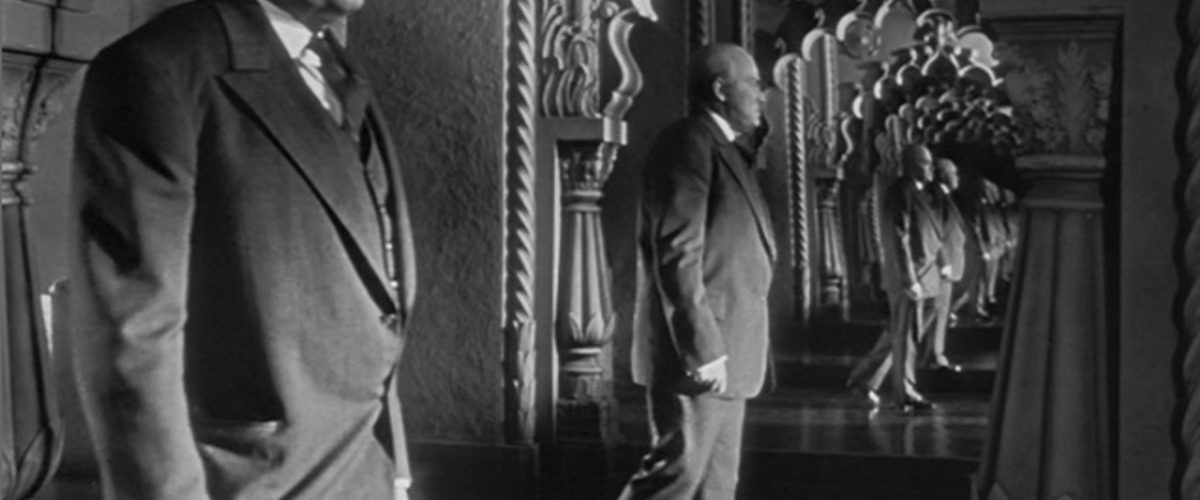
But, one-on-one interpretations are inadequate here. Bernstein said Thatcher did not understand Kane, in fact neither did he. Susan’s attempts to solve her jigsaw puzzles symbolize how difficult it is to totally understand who he was. The shot of Kane walking through the hall of mirrors where there is an infinite number of his reflected image points to the multifaceted components that make up such a complicated man. Thompson at the end dismisses the search to capsulize a man based on one word. Leland says Kane, “never gave anything away about himself. He just left a tip.” Perhaps all we really understand of another is just that part of the iceberg. And, with a movie like Citizen Kane, there is much that is going on below the surface.

Next week, a special post about movie cars and costumes.