Sunday, October 23, 2016

Little Big Man

SPOILER ALERT! The plot of the movie will be discussed.

This 1970 film directed by Arthur Penn is the first major revisionist Western movie that reverses the view of the Native American as a savage and the white man as civilized. It delivers its theme by having a 121-year-old protagonist who is the only living survivor of the Battle of Little Big Horn tell the story of how he moved back and forth between living with the whites and the Indians.

Jack Crabb (Dustin Hoffman), in person altering makeup and raspy voice, relates his adventures to a historian (William Hickey). Jack and his sister, Caroline (Carole Androsky), are the only survivors after Pawnee Indians attack their wagon train (later Jack has no use for the Pawnee because they pandered to the whites, allowing themselves to be used as scouts for the cavalry). A Cheyenne brave rescues them and takes the children back to his village. Jack’s sister’s attitude is the accepted notion of the time that the Red Man is a savage and will rape her. In fact, they do not even realize she is a girl, and offer her the peace pipe as the eldest male family member. She seems a bit insulted that she wasn’t assaulted. Jack says that the Indians treated him as a special guest. His sister escapes, and the 10-year-old Jack innocently believes that she was going for help. But, it is the white person who abandons him and the Indians who adopt Jack as their own. They teach him to hunt, to use red paint to protect his skin, and how to read a trail. He is considered a grandson by the Chief, Old Lodge Skins (Chief Dan George).

The Chief gives him the name of Little Big Man because even though he is small in stature, he has a big heart, and Old Lodge Skins tells him a mythic story about a small warrior whose courage was big. The positive moral here is that it is what is inside a person that matters. The whites don’t try to understand the Native Americans, but instead lump them all together and condemn them because they look and act differently. When Jack punches one of the older braves, the older boy is startled because the so-called barbaric tribe members don’t know how to beat another, as whites do. The bruised Indian, Younger Bear (Cal Bellini as the adult), is shamed because Jack says he is sorry for him, indicating pity. Jack later kills a Pawnee and saves Younger Bear’s life, forcing him to owe Little Big Man a life.

The accepting nature of the Cheyenne (which is translated as “human being,” ironically contrasting the nature of the Indians with that of the whites) is seen in how they accommodate Little Horse (Robert Little Star as the adult), who likes to be with the women, and grows up to be gay. In fact, Jack notes that the Cheyenne would not force any boy to fight if he was not so inclined, which shows how the tribe respected individuality.

The Cheyenne find that the white soldiers have slaughtered a Native American camp, including women and children. When Little Big Man asks Old Lodge Skins why whites would commit such cruel acts, the old man says, “Because they are strange. They do not seem to know where the center of the Earth is.” Here, the Chief indicts the whites for not having a moral center. He decides to wage war on the soldiers to teach them a lesson, but as Jack narrates, his grandfather’s idea of war and that of the soldiers were not the same. The Cheyenne just wanted to humiliate the enemy by “counting coup,” being the first to tap the opponent with a stick. The soldiers shoot to kill, and the Cheyenne believe Jack was killed. Instead he saves himself by showing that he is a white man. Here, and other times, Jack is not a noble person, willing to die for his tribe. He is pragmatic, doing what he can to survive.

The soldiers hand Jack over to the Reverend Silas Pendrake (Thayer David) to make sure he will now receive a Christian moral upbringing to counter the supposed barbaric life he has lived up to that point among the Native Americans. However, the first thing the “civilized” reverend says is that Jack is a liar, and endorses violence by saying “We shall have to beat the lying out of you.” Pendrake falsely condemns the Indians for not knowing anything of what is morally right, eating human flesh, and communing with the minions of the devil. Despite his warnings and beatings about the temptations of the flesh, the portly reverend is a glutton, always wanting to satisfy his hunger. His wife, Louise Pendrake (Faye Dunaway) is an extreme hypocrite, preaching the virtues of denying physical pleasure while indulging her lust by touching the grown-up Jack while washing the filth off of him, but revealing her dirty thoughts. She warns him of how the girls will be after him, likely vicariously thinking of her own wants, and trembles when she says “and that way lies madness,” showing how she already is in that state, made crazy by a religion that wants to repress her sexual drives. She tells Jack that “purity is its own reward,” and undermines the statement by kissing him on the lips. Jack actually believes in the religious teachings, and confesses to a true love for Mrs. Pendrake. But, while on a visit to the soda shop, he comes across her having sex with the proprietor (Jack, before spying on the couple, plays with a faucet in the shape of an elephant, the long trunk an obvious phallic symbol). Jack says, “She was calling him a devil and moaning for help, but I didn’t get no idea she wanted to be rescued.” Given the level of hypocrisy, Jack says after what he saw ended his religious stage.
He takes up with a swindler, whose outright dishonesty and lack of moral pretense is refreshing to him in contrast with that of Mrs. Pendrake. Mr. Merriweather (Martin Balsam) sells snake-oil, offering it up as a magical elixir. He says that Jack has this streak of honesty in him, instilled by Old Lodge Skins, that prevents him from exceling as a fraud. He says to his apprentice, “He gave you a vision of moral order in the universe and there isn’t any.” His nihilism and cynicism show in his words about how easy it is to get people to believe lies: “a two-legged creature will believe in anything and the more preposterous the better: whales speak French at the bottom of the sea. The horses of Arabia have silver wings. Pygmies mate with elephants in darkest Africa. I have sold all those propositions.” Could he be talking to us today about how politicians function? In any event, Merriweather keeps losing parts of his body, including his ear and a hand. He later loses an eye due to cheating at cards, and when Jack meets him further in the story, Merriweather proposes the rape of the land by killing dwindling buffalo herds for their hides. At that point he has lost a leg. His physical infirmities reflect his moral decay due to his exploitative capitalistic ways.

While working with Merriweather, the two are tarred and feathered by local town folk for the deadly potion the duo are selling. One of the locals is a woman who turns out to be Jack’s sister Caroline. She wants to teach him how to shoot. He doesn’t know anything about guns, to which his sister questions what kind of upbringing did he have with the Indians. To her, a “man ain’t complete without a gun.” Again, the so-called civilized world of the whites is satirized as violence is shown to be an intrinsic part of that society. It turns out that Jack is a natural at shooting. He enters the gunfighter stage of his life. Instead of looking intimidating, he dresses in an over-the-top way, in a fancy black outfit. His boots break through a plank of wood while walking on the street. He is known as the “soda-pop kid” and barely reaches the table as he props his boots up. He runs into Wild Bill Hickock, who rightly says to the young man, “you ain’t got the look of murder about you.” Jack’s life among the Cheyenne taught him to respect life, and that is why he is so awkward as a gunfighter. After seeing how nervous Wild Bill is, who is on the alert against being shot by men proving their white world worth by besting him in death, and witnessing Bill’s bloody killing of an opponent, he sells his guns. Disgusted with his not embracing violence, Caroline leaves Jack, abandoning her brother once again. So much for the white society’s loyalty to family.

After rejecting the religious path, the role of a swindler, and the gunfighter profession, Jack then tries another aspect of white society, that of a husband and businessman. Again, he fails. His partner robs him of all his money, emphasizing the dishonesty of the white world. It is interesting that he chooses a mail order Swedish woman, Olga (Kelly Jean Peters) as his spouse. Even though Jack is trying to exist in the American white environment, he marries a foreigner who doesn’t speak the language of that world. Perhaps his Indian roots subconsciously reject his trying to fit into the white American established order. Jack first encounters General George Armstrong Custer (Richard Mulligan) when he is being evicted from his home. Custer actually shows some sympathy for the deprived man and advises him to go west. Jack says his wife is scared of Indians, but Custer assures the couple he will protect them. Ironically the next scene is an attack by Indians on the stagecoach on which Jack and Olga are riding. A brave carries Olga off. Olga has the same attitude about the so-called uncivilized Indian that Jack’s sister has. However, we later find that she becomes the wife of Younger Bear, Jack’s Cheyenne enemy, and she seems right at home in the Native American world since she is much better suited to the non-standard American lifestyle, being a foreigner.
 Jack looks for Olga by venturing into Indian territory, and convinces Cheyenne braves that he is Little Big Man. He meets with Old Lodge Skins again, who has second sight. He says he had a dream of Jack at the soda fountain, playing with the elephant faucet. He also has a premonition about Jack having three or four wives, which is contrary to the Cheyenne tradition of monogamy. Since Olga is not yet with the tribe, Jack again goes back to the white world, hoping to find his wife by becoming a scout for Custer. The general reveals his self-righteousness when he says he can tell a man’s profession just by looking at him, and says that Jack is no scout, but instead is a mule skinner, a profession Jack knows nothing about. The bigotry of the soldiers becomes apparent when one tells Jack that it would be kinder to put a bullet in the brain of a woman who had been captured by Indians. When the soldiers raid an Indian village, they are merciless, killing women and children. Jack is horrified, and tries to stop them. An ironic scene follows when Jack, trying to escape, encounters the Cheyenne brave Shadow That Comes in Sight (Ruben Moreno), the man who originally brought him to the Cheyenne as a child. The brave does not recognize Jack, and tries to kill him. A soldier shoots Shadow before he can kill Jack. As Jack says, “An enemy had saved my life from the violent murder of one of my best friends. The world was too ridiculous to even bother to live in.”

Shadow was protecting his daughter, Sunshine (Aimee Eccles), who was giving birth during the battle. Her name offers the promise of hope, but it is a fleeting possibility given the times. Jack witnesses the child being born, finds out that Sunshine’s husband was killed, and he wants to trade her to find Olga. He again joins up with Old Lodge Skins, who is now blind from wounds sustained in battle. He recounts all of the Cheyenne who have been “rubbed out” by the white man. After his experiences, and now hearing his Indian grandfather’s account of suffering, Jack hates the white man. He settles down with the Native Americans on land the President and Congress have promised to be a safe haven for the Indians. Sunshine is now his mate, and they are expecting a baby. She says her sisters are now there and their husbands have been killed. Old Lodge Skins’ prophecy about him comes true, as his wife asks him to perform husbandly duties on her sisters in a humorous copulating scene under the tent. 

Old Lodge Skins has another dream, more ominous, in which the horses are crying, trying to tell him something. They discover that the message is that the soldiers, ordered by Custer, are coming to wipe them out, showing how the whites can’t be trusted to keep their promises. To the ironically contrasting upbeat marching music derived from an Irish jig, the soldiers systematically kill men, women, and children, including Sunshine and her newborn baby. In a bit of magical realism, Jack escapes with Old Lodge Skins, whom he convinces is invisible because he did not see soldiers in the dream, so they can’t see him. The Chief grins as he walks right through the soldiers to the river. Penn provides us with mirroring shots of Sunshine and Jack falling to the ground as he seems to die inside watching his woman and child expire. Jack poetically sums up the death of that promised hope by saying, “Sometimes the grass don’t grow, the wind don’t blow, and the sky is not blue.”


Jack wants to kill Custer, goes to his camp, and convinces him to hire Jack. He enters Custer’s tent with a knife, but the general intimidates him. Custer realizes that Jack came to kill him, but that he lost his nerve. He says since he is no Cheyenne brave, Jack isn’t worth hanging. Jack is so humiliated that he can’t return to the Cheyenne; so, he becomes a worthless drunk. He again encounters Wild Bill who is married and wants Jack to give money to a widow with whom he has been intimate. At that very moment, a youth kills Wild Bill for having shot his father, which emphasizes again the violence of the white society. Jack finds the widow, who turns out to be Mrs. Pendrake, who has indulged her lust by becoming a prostitute. With a bit of divine justice, she finds the profession boring since the sex occurs day and night. However, with the money Wild Bill has given her, she promises to leave for Washington. The film suggests that she will spread her corruption, like a venereal disease, into the body politic, as she promises to wed a senator, and will religiously continue her unfaithful ways, telling Jack to look her up if he ever visits the nation’s capital.

Jack is so alienated from the white world and unable to return to the Indian one, so he becomes a mad hermit, and one day is ready to kill himself. But, he hears that same jaunty marching music performed by the American troops. He vows to “look the devil in the eye and send him to hell.” He again goes to Custer’s camp. The general keeps him alive to use him as a “reverse barometer” since he believes Jack will only tell lies. Custer wants to provide him with the way he should deal with the Indians. He needs one more decisive victory before running for President of the United States. Just before the Battle of Little Big Horn, Custer asks Jack what he should do. Jack says, “I had him.” But, he wasn’t “armed with a knife, but with the truth.” He tells Custer that there are thousands of Indians in the valley who will wipe him out. So, he says to him he should go in there, “if you’ve got the nerve.” Custer wrongly thinks Jack is trying to outwit him, not wanting him to go against the Indians and getting a victory. Of course, he and his men were wiped out. Jack is rescued by Younger Bear, who finally has paid back the life he owed Little Big Man.
Jack meets with Old Lodge Skins, who says that they won a victory today, but he knows they will lose the war. In a statement condemning the whites for their lack of humanity, he says, “There is an endless supply of white men. There has always been a limited supply of human beings.” Without “human beings” the world has no center for him. So, he wishes to scale a mountain, die, and join the burial in the sky. However, he cannot will his own death, and after resting on the ground with his eyes closed, he reacts to rain falling on his face. When Jack reassures him that he is still in the world, his sad response, mirroring the doomed fate of the Native American situation, is “I was afraid of that.” The movie ends with the 121-year-old-Jack finishing his story, a man of longevity, but whose years were filled with unhappiness.
In one of his speeches, Old Lodge Skins sums up the moral divide between the Native American world view, which cherishes all of existence, and the spiritual emptiness of the whites’ selfishness: “The human beings, my son, they believe everything is alive. Not only man and animals. But also water, earth, stone … That is the way things are. But the white man, they believe everything is dead. Stone, earth, animals. And people! Even their own people! If things keep trying to live, white man will rub them out. That is the difference.”

The next film is Jules and Jim.


Sunday, October 16, 2016

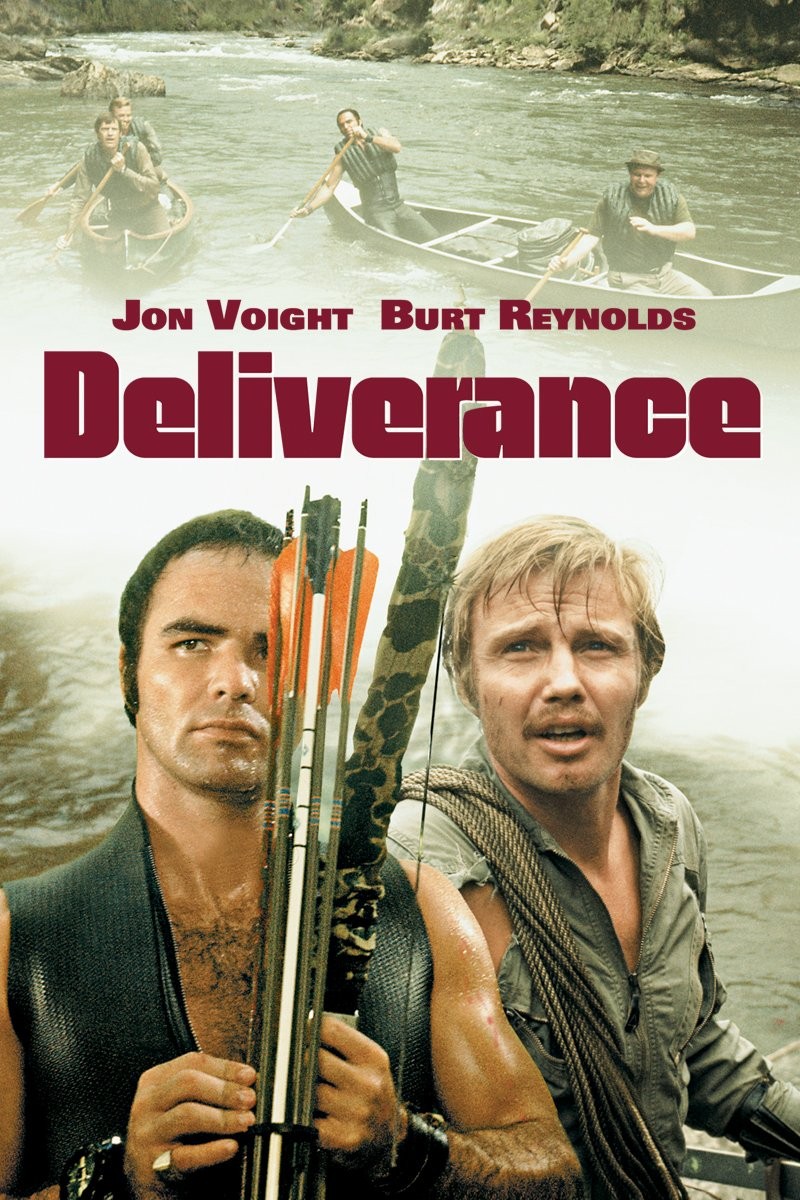
Deliverance

SPOILER ALERT! The plot of the movie will be discussed.

The theme of exploring the virtues and vices of the unspoiled frontier versus the industrialized urban landscape is a theme in American literature and films, as was noted in the discussion of Butch Cassidy and the Sundance Kid. This topic appears again in this 1972 movie, but the take on the discussion here is that although modernity may spoil nature, being in an uncivilized surrounding does not mean living in paradise.

The story centers on four men in Georgia who go on occasional escapes from their suburban world into the wilderness. The beginning of the narrative presents an anti-mechanization argument. For the leader, Lewis (Burt Reynolds), this particular trip holds a special meaning. The land and the river they will be traveling through is about to be converted into a lake with the whole area flooded to produce hydroelectric power. This event represents an extinction process for Lewis, as he complains about how they will be flooding the valley and “drownin’” the river. He sees the conversion as a “rape,” an omen of what is to come later. Their excursion is meant to experience the uncorrupted Cahulawassee River in the remote Georgia wilderness before it is lost forever. Lewis is a man who relishes the idea of hunting with his bow and arrows and riding his canoe through the river’s rapids. He believes that society’s machines will fail and the established order of civilization will collapse, but that his survivalist skills will allow him to go on. We hear the destructive sounds of dynamite blasting away at the valley ironically followed by the natural noise of thunder which sustains the river, the contrast seeming to emphasize the difference between human endeavors and the ways of nature. On the way to the river, Lewis gets a thrill just hearing the flow of the water. He initially gets lost on the way to the shoreline and says that “Sometimes you have to lose yourself before you can find anything.” He is espousing the need to shed themselves of soft city living to find their true natures which are consistent with the wilderness. When one of the group, Bobby (Ned Beatty) concedes that they have lost some of nature in the city, Lewis counters by saying they hadn’t “lost” it; they “sold it” for profit and creature comforts.
Lewis’ friend, Ed (Jon Voight) says he has done okay under the current system. Lewis counters by saying that, yes, he has a good job, and a nice wife and child. But, Ed says Lewis’ scornful attitude makes it sound like Ed’s life is “shitty.” Ed seems a bit embarrassed by admitting he has some insurance after Lewis dismisses Bobby’s work as an insurance salesman. Lewis says, “I don’t believe in insurance. There’s no risk.” And, risk makes life worth living for Lewis because it tests one so as to discover what a person is made of. Director John Boorman gives us a significant shot when he shows Ed sheepishly looking at his pipe, a symbol of his comfortable life, which he hides under his clothing. But, he also handles his knife, which is also part of his personality, but with which he currently is not comfortable, and he puts the weapon in a pocket, too. At the beginning of their journey, he starts to sense danger, and tells Louis maybe they should leave and just go play golf. He is being sensible, but at this point he seems cowardly. In an interview, Voight said he wanted Ed to pick the wooden canoe, because it looked homey, and fit Ed’s desire for feeling safe. Yet, Lewis asks him if he is so careful, why does he keep going on these excursions with him. Ed smiles and says he was wondering about that himself. There is obviously a part of Lewis’ wild nature that Ed admires.

Their first encounter with the area’s inhabitants starts to move the film away from Lewis’ positive viewpoint of this world by showing the unsavory and scary existence in this valley. The buildings are dilapidated. The people are unkempt. They are nothing like what these men see in their safe suburban communities. Bobby is condescending toward the locals, saying they “may be at the end of the line” of civilization. He also says they are examples of “genetic deficiencies” caused by inbreeding. That he comes from a removed world where money is the only thing that matters is seen when he says that they just have to give a “couple of bucks” to make things go smoothly. The natives warn them that they are out of their depth here. One tells Bobby that “you don’t know nothing,” and they are warned that they would be “crazy” to follow through with their canoe trip. The fourth member of their group, Drew (Ronny Cox), plays guitar with a banjo strumming youth who appears to have one of Bobby’s “genetic” deficits. The musical “dueling” with the locals dancing and singing along, although a sort of benevolent competition between the two cultures, does show how these people coming from different worlds can exist in the harmony of the artistic moment. But, after the music is over, the boy turns away, ignoring Drew’s offered handshake, emphasizing how they are too different to ever be friends.
After the men are on their way they see the boy above them on a makeshift bridge. He swings his banjo back and forth which makes it look like the pendulum of a clock. The image seems to be warning them that their time as civilized men is counting down. After they get through some rapids, Bobby says they “beat it.” Lewis admonishes him because his attitude is like those whose egos make them feel they can conquer nature. Lewis says, “You don’t beat this river.” But, even though he is an outdoors man, Drew offers a different perspective on Lewis. He says that he may know the woods, but he doesn’t “feel” them. Lewis may want to be one with nature, but he really “can’t hack it.” After all, he only visits the rural regions; he doesn’t live there. When Ed tries to wake Lewis in the early morning, his friend is in the fetal position, and gives out a little yelp, like a baby not wanting to be disturbed. This scene undermines Lewis’ macho persona. The warnings that they are out of place start to become evident. Lewis hears something at night that could be dangerous, but doesn’t know what it is. Ed sounds like he feels relief that the large problems in distant parts of the world, or even smaller ones in Atlanta, won’t touch them out where they are. But, it also means that they are cut off from any help from the outside world. When Ed tries to exercise his hunting ability, he gets the shakes pointing his arrow at a deer, and misses, showing his not being in sync with what is required to survive in the woods. We begin to hear the “Dueling Banjos” theme more and more, now telling us ironically that these suburban men are not in harmony with this alien environment. Lewis may see this world as the Garden of Eden, but as they row, Ed asks “are there any snakes around here?” and they later see a water snake. Perhaps this image suggests that the devil lives here and that it is no paradise.


Bobby and Ed shore up their canoe while Lewis and Drew are still on the river. They encounter two mountain men. One of them looks grotesque, with his upper front teeth missing (Herbert “Cowboy” Coward). In this context, Bobby and Ed’s weakness is that they try to deal with these people like civilized men, instead of immediately going into what we, today, would call a Walking Dead survivalist mode. Ed addresses these two savage types while holding that tobacco pouch he probably uses in his study at home. The mountain men say the other two are lost, and they are in this situation where there is nothing to prevent acts of depravity. These two get the jump on them with a rifle and a knife. Ed is bound to a tree with, ironically, his own store-bought belt. The other man (Bill McKinney) makes Bobby disrobe, stripping him of the remnants of civilization, and calls him a “sow,” reducing him to an animal, forcing him to squeal like a pig. (There was a foreboding of Bobby being used as a woman when he said the life jacket he was told to wear looked like a “corset). Boorman, said that Bobby’s rape was the malevolent nature of the wilderness exacting revenge for what Lewis earlier called the “rape” of the valley.

To show how God and religion have no place in the barbarity of the forest, the toothless mountain man, before forcing Ed to kneel so he can perform oral sex on him, blasphemously says, “You gonna’ do some prayin’ for me, boy. And you better pray good.” However, Lewis shoots and kills the one who raped Bobby, while the toothless man gets away. Given the context, Lewis’ act is legally justifiable. What follows is not. Drew, the moral center of the story, says they must report all that has happened to the authorities. Lewis argues that he will not get a fair trial in this part of the state because all of the people are related to each other, and he killed one of their kin. Also, the one that ran away can make up any story he likes and recruit other mountain men. Lewis wants to bury the body which will be covered by the lake. In response to Drew’s pleas to act within the law, Lewis, raising his arms and looking around them says, “Where’s the law, Drew?” They take a vote, creating their own little government. Bobby, ashamed about the violation he endured, doesn’t want information about the assault to get out. Even though Ed is emotionally conflicted, he goes along with Drew’s plan. By covering up the killing, they lower themselves to the same level as the mountain men, abdicating any accountability to society at large. As they dig the earth with their hands to make a grave for the dead man, Drew swings his arms like an ape, grunting, showing how he has devolved into an animal.
 While paddling their canoes to escape, Lewis looks up as if he notices something. Drew loses his wallet with pictures of his family in the river. It’s as if he has lost whatever grounded him in the outside world by going along with covering up the acts of violence. He doesn’t put on his life jacket, implying he no longer can live with what has happened. He shakes his head, and falls out of the canoe in the rapids. Lewis, the man of nature, is thrown out of his canoe and his leg is horribly mangled. This macho man whines in pain most of the rest of the film. He says that Drew was shot by the other mountain man. Ed, now having to take over Lewis’ position, climbs the mountain. He spies a man with a gun. Echoing the previous shaking while aiming his arrow, he kills his prey this time. However, he slips, piercing himself with another arrow. Could this imply that his act of violence is self-destructive? To compound the confusion, the man he killed has false teeth. Is he the one with the rapist? Why would he now put in his false teeth? Bobby later asks if he was just another guy out hunting. We don’t know, because no legal investigation is utilized to gather evidence. When Ed tries to lower the body of the man he killed, they both fall into the river, and the rope and the man seem to entangle Ed under the water, symbolically tying them together morally, and suggesting that violence equates to swimming in dangerous waters.

They put Lewis in the remaining canoe and on their way they find Drew’s body. His arm loops around his head in a distorted fashion showing how he was a broken man physically and spiritually after their cover-up. They can’t tell if he was shot. To avoid any questions, they weigh down his body, as they did with the man Ed killed. They eventually come to the place where they can get off the river. Their entry place back on land contains a rusted out wreck of a car, a symbol of the civilization they are returning to. They exit the water where there is a church. On their ride back to their cars they see the church being moved because of the future flooding. The solid, definite foundation of beliefs that a church should represent are undermined symbolically by the building having no set location. These men no longer have an ethical or spiritual foundation on which to rely, as their lives, too, are shifting following what has been done to them and what they have done.

Despite suspicions by one of the deputies, a brother-in-law of one of the missing mountain men, the Sheriff (played by the author of the story, James Dickey) says there is no evidence to hold the men. They may have tried to bury what happened, keep it submerged, but Ed has nightmares of the dead mountain man’s hand rising out of the water, in a way pointing an accusing finger.
This film provides no right way to live. The so-called “civilized” world is destroying nature. But, the men who occupy this wilderness act as primal beasts. Their living conditions are deplorable. As one inhabitant says, the best thing for the town in the valley is for it to be “covered by water.” It’s as if Dickey is saying that for humans to be one with nature is to be primitive. The idea of the “noble savage” is a contradiction in terms: there is nobility in being savage. It appears that in this tale, there is no “deliverance” from evil.

The next film is Little Big Man.


Saturday, October 8, 2016

Gilda

SPOILER ALERT! The plot of the movie will be discussed.


The plot isn’t really what’s important in this 1946 film noir tale. It’s really about the love triangle between the three main characters, or better yet, the love-hate relationships bonding them together.
We first see Johnny Farrell (Glen Ford), the occasional narrator, playing dice with sailors in Buenos Aires. (The foreign locale was required to allow the film to get some of its sexual promiscuity passed the censors, apparently it being permissible if set outside the U. S.). After he leaves the game he is threatened by a man with a gun. However, another man who turns out to be Ballin Mundson (George Macready) saves him with the use of a walking stick with a sharp blade at its end. Ballin knows that Johnny was cheating, but invites him to gamble at a casino. Johnny shows up there and continues his deceptive ways at card playing. We learn that it is Ballin’s casino. Johnny persuades Ballin to hire him since through personal experience he knows how to keep the place secure. The two earn each other’s trust, and Johnny becomes a loyal friend.
Even though the two agreed that gambling and women don’t mix, Ballin brings home a woman by the name of Gilda (Rita Hayworth) and says he married her. There is animosity between her and Johnny from the start, and we realize, as does Ballin, that the two were involved in the past, and what was love between them has turned to hate. But, hate is a strong emotion, as opposed to indifference, and it implies that for it to exist means that the people have not really moved on. This point is illustrated when Johnny says “I hated her so I couldn’t get her out of my mind for a minute.” Gilda, tries to reassure Ballin that he doesn’t have to worry about Johnny because, “I hate him.” Ballin says in response, “And he hates you. That’s very apparent. But hate can be a very exciting emotion … There’s heat in it … Hate is the only thing that has ever warmed me.” Here, Ballin seems to prefer the emotion of hate, the primal ferocity of it. Gilda echoes what Ballin has said when she says to Johnny, “Hate is a very exciting emotion … I hate you so much I think I’m going to die from it.” She then kissed Johnny passionately, showing that love and hate seem to be fueled by the same fire.
Gilda is a film noir femme fatale, but she doesn’t quite fit the role of unfettered manipulator of men. Yes, her flirtatious flings drive males crazy. She obviously hurt Johnny with her sexual ways. And, she cavorts with several men while married to Ballin. But, there are references in the movie about how she has been caged. She is called a canary (is she a bird in a gilded – with a play on ‘Gilda’ – cage?). She breaks the glass in a door at one point with a chair, as if trying to escape her prison. It’s as if she has painted herself into a corner with her sexual role-playing. The very dresses that accentuate her physical beauty confine her, and she asks for help so she can be bound, almost ironically allowing her captivity. She implies that this action is symbolic of her situation when she says, “I can never get a zipper to close. Maybe that stands for something, what do you think?” Ballin disappears after he fakes his own death following his killing a man because of his tungsten cartel business. Johnny marries Gilda, but treats her badly because he still is angry with her. She tries to escape, but he hires a man to romance her and hurt her by bringing her back to Johnny’s cage.


There is also a subtext in the movie involving sexual identity, which even actor Glen Ford admitted existed. Why is Ballin trolling the docks at the beginning? Is he really looking to hook up with sailors? He keeps referring to that blade-tipped phallic-shaped cane of his (the use of a knife as a substitute for the male penis was used in Peeping Tom and Psycho). He calls it “a most faithful and obedient friend: it is silent when I want it to be silent, but talks when I want to talk.” Johnny asks him if that is his idea of a friend, and Ballin says it is. Johnny says then, “You must lead a gay life.” Now, of course “gay” back then did not have the connotations it does now. Ballin is basically telling Johnny to be like his weapon/friend, to be quiet and to talk at his command. And Johnny is telling him his life isn’t very much fun if he wants to have that much control over his friends, the word “gay” used ironically. But, the sexual symbol of the sword seems to be the object that connects the two, since it saved Johnny once and now is meant to join the two in their relationship. The two become very close, with Ballin having Johnny take over the casino when he is gone and giving him access to the private papers in his safe. Johnny wants to stop Gilda initially from philandering because he wants to protect Ballin and later punishes Gilda for cheating on his boss after Ballin’s supposed death. Also, Gilda says at one point that Johnny is in his “nightgown” instead of saying his “pajamas.” This word usage paints Johnny in a feminine, not masculine way. Even Gilda’s femininity is called into question when Johnny says “congratulations” to her after finding out about the marriage to Ballin. He is corrected because the groom is the one that is congratulated, and the bride should receive a wish for good luck. The masquerade that occurs at Ballin’s house is a plot device to hide actions, but can also hint at the possibility that the main characters are hiding sexual aspects about themselves that exist beneath the façade.

Ballin returns at the end to murder Johnnie and Gilda, but he is killed with his own walking stick by Uncle Pio (Steven Geray), the only person in the story who is completely honest in his comments about the main characters. Johnnie tells her, “I want to go with you Gilda. Please take me. I know I did everything wrong.” She says, “Nobody has to apologize. We were both stinkers, weren’t we?” The leave together. But, remember that Johnnie once said, thinking of Gilda, that “Statistics show there are more women in the world than anything else. Except insects.” And, Gilda said, “If I’d been a ranch, they would’ve named me ‘The Bar Nothing.’” The hate part of their relationship seems to be the most sustainable one. Somehow I don’t think this is a “they lived happily forever after” ending.
The next film is Deliverance.

Sunday, October 2, 2016

Harold and Maude

SPOILER ALERT! The plot of the movie will be discussed.


This 1971 film has one of the odder relationships in movie history, which is one of the reasons it is a dark comedy “cult” classic. But this Hal Ashby directed movie’s early May, late December romance is at the thematic center of a movie that emphasizes the need to reconsider the whole perpetuating cycle of birth, life, and death.
The opening scene is a bit of a shocker as we hear the first of several Cat Stevens songs while Harold (Bud Cort) goes through preparations which culminate in his supposed hanging suicide. As he swings from the rope in one of the many dark, garishly opulent rooms in his family’s mansion, his mother enters, Mrs. Chasen (Vivian Pickles). She is unfazed and asks if Harold thinks he is being funny. As she talks on the phone about an appointment, Harold laughs slightly and then makes fake gagging sounds. This form of suicide could be indicative of the way his mother is emotionally “suffocating” him. She tells him that dinner will be at eight o’clock and that maybe he could be a little more “vivacious.” The black comic tone has been launched.
Harold performs several phony suicides during the course of the story, including a pretend self-inflicted gunshot wound, where he initially points the gun at his mother while she fills out all the questions meant for him in a dating questionnaire with her own opinions. In answer to his psychiatrist’s question if the suicides are for his mother’s benefit, he says no, not “benefit.” The movie obviously reflects the anti-establishment, anti-parental authority attitude among the youth in America at the time fueled by the hostility toward the Vietnam War. The house and Mrs. Chasen’s exaggerated clothes show a society preoccupied with material things (similarly satirized in Warren Beatty’s Heaven Can Wait). The movie directs its satiric thrust against the military in the form of Harold’s Uncle Victor (Charles Tyner), a high-ranking armed forces member whose name is ironic, since what he has won along with his glorious war stories is the loss of his right arm. The empty uniformed sleeve responds to the pulling of a cord by simulating a salute, an obvious jab at overzealous patriotism. It is darkly funny that right after Uncle Victor says he sees in Harold a little Nathan Hale, the man who said he regretted that he had only one life to lose for his country, that we have the shot of Harold floating like a dead person in the overly affluent family’s pool as his mother takes a swim, thus satirizing the loss of life for the object-worshiping country America has become.


Harold folds his hands over his chest as he lies on his back with his eyes closed, looking like a corpse at his psychiatric sessions. Harold’s psychiatrist (G. Wood) asks him what he does for enjoyment, the youth says he goes to funerals. He even buys a hearse for his car. He later modifies the sports car his mother provided as a replacement by welding on a hearse-like roof onto the Jaguar, a vehicular “screw-you” to his mother’s controlling nature and her preoccupation with materialism and appearances. Harold, although young, preoccupies himself morbidly with the end of life. Then he meets Maude (Ruth Gordon), a woman approaching the end of life, at a funeral. The first thing she does is offer him a piece of licorice. She brings something pleasurable, and a form of sustenance (although a dubious one) to the sad proceedings. She says “Who sends dead flowers to a funeral? It’s absurd.” She wants to celebrate that death is a part of life, and dead flowers just double down on one side of that process. She sizes up Harold’s inability to see the whole picture quickly. When he answers in the negative to her question about whether he sings or dances, she says, “No, I thought not.”

To emphasize the need to see that panoramic picture of worldly experience, Ashby gives us a joyous parade in the same shot as the funeral procession. Maude wears colorful clothes and carries a bight umbrella in contrast to the dark appearance of the mourners. Maude takes whatever car is available for transportation, including the priest’s at the funeral service. She even steals Harold’s original funeral conveyance, not knowing he owned it. He comments that her auto thefts upset people. She responds by saying, “I’m merely acting as a gentle reminder: here today, gone tomorrow, so don’t get attached to things.” But, she says that doesn’t mean she is averse to collecting stuff. Her “memorabilia” is not to show capitalistic gain, but instead reminds her of past experiences, and helps her appreciate the world. As she says, these things are, “incidental, not integral” to existence. It is significant that Maude lives in a train car. As opposed to Harold’s hearse, this mode of transportation symbolizes that living things are on a journey between two points, birth and death, and there are numerous stops along the way to experience what life offers.

Through her “stuff,” Maude opens Harold up to appreciate the body’s senses. She shows him paintings that stimulate the visual and provides him with smells to savor olfactory delights. He explores the tactile sense by touching a wood sculpture that suggests a vagina. He penetrates the opening with his hand, and even tries to fit his head through it (a substitute for the penis?). In this way, Maude is his midwife into bringing to life his youthful latent sexuality. She also introduces him to expressing himself artistically in dance and music, starting him on his interest in playing the banjo. While still pursuing his disturbingly comical theatrical self-destruction at home to ward off his mother’s picks for a potential mate (self-immolation, dismemberment, and disembowelment), he enjoys himself with Maude in the woods, saving a dying tree, where she celebrates “living things,” and going to a carnival (where they play with toy trains, reinforcing the journey of life initially implied by Maude’s train/home). She tries to convey to him the satisfaction derived from a passion to participate in life. She tells him that she is always looking for “variety” and “the new experience.” When she asks Harold why he would like to be a flower in a field, he says because they all are alike. It probably shows his desire to conform like most young people to the pressure around them to fit in. She says that they may look alike, but all living things are unique, and that specialness should be celebrated. She tells him “that much of the world’s sorrow” comes from people allowing themselves to think that they are not individually important.


She preaches that there are important issues worth fighting for: “Liberty. Rights, Justice … what sense in borders and nations and patriotism.” She sees these creations as mental prisons. She tells him that she used to “break into pet shops to liberate the canaries.” She comments that “the zoos are full, the prisons overflowing ... how the world still dearly loves a cage.” It seems she sees that people sometimes seek security in being told how to live so they can have the relief of giving up the responsibility of choices, and also incarcerating that which interferes with the status quo. He now realizes the incompleteness of his life so far when he says that “I haven’t lived. I died a few times.” Maude understands that many are afraid to risk failures by engaging in possible opportunities. She says, “A lot of people enjoy being dead. But they are not dead, really.  They’re just backing away from life.” Like the coach of a sports team, she exhorts Harold to “LIVE! Otherwise, you got nothing to talk about in the locker room.”

There are two scenes which provide a personal insight into why these two characters act the way they do, and deepen their presentation. Harold admits to Maude in a tearful moment that he was involved in a scientific experiment at school which resulted in an explosion and fire. When he saw how genuinely affected his mother was by the possibility that Harold was dead, he decided that he elicited more real emotion by dying instead of living. A single shot economically lets the audience peer into Maude’s psyche. While the two sit together, Harold sees the imprint of a Nazi concentration camp brand on her arm. We realize that her being a holocaust survivor amplified her commitment to “live life fully.”
The two declare their love for each other, and, yes, become physically intimate. The representatives of the established world order which are outraged at such a union are satirized because they are limited by their restricted ways of thinking. The psychiatrist, with Sigmund Freud’s picture on the wall, is baffled because Harold does not fit into the typical psychoanalytical belief in the Oedipal complex, because he doesn’t subconsciously want to sleep with his mother, but instead wants to have sex with his “grandmother.” The celibate priest, with the picture of the pope behind him, declares his revulsion at the union, while perversely overly imagining the physical appearance of Maude’s aging female form.
Maude already gave us hints early on where the story was headed. She told Harold that “it will all be over” on her approaching 80th birthday. She said that 75 was too young and 85 was just biding time. At a birthday celebration he prepared where he is ready to ask her to marry him, she says what a wonderful farewell he organized, as she has already taken the pills and would be gone soon. Unlike his false suicides, hers is real, but more appropriate because she realizes that she has lived a full life and is ending it on her terms. He tells her that he loves her again, and she encourages his tapping into this feeling by saying, “that’s wonderful. Go and love some more.” He is crushed by her death, and we see him driving his hybrid hearse up a hill. It plunges off a cliff. For a moment we think that he has killed himself for real this time. But, the demolition of the car symbolizes the destruction of his previous morbid outlook on life. The camera points upward to the top of the precipice, and Harold, now in life-affirming mode, plays his banjo, and dances away.

This motion picture challenges preconceived notions about material ownership, patriotism, and especially, love. But, isn’t that what art is supposed to do?

The next film is Gilda.