Sunday, January 21, 2018

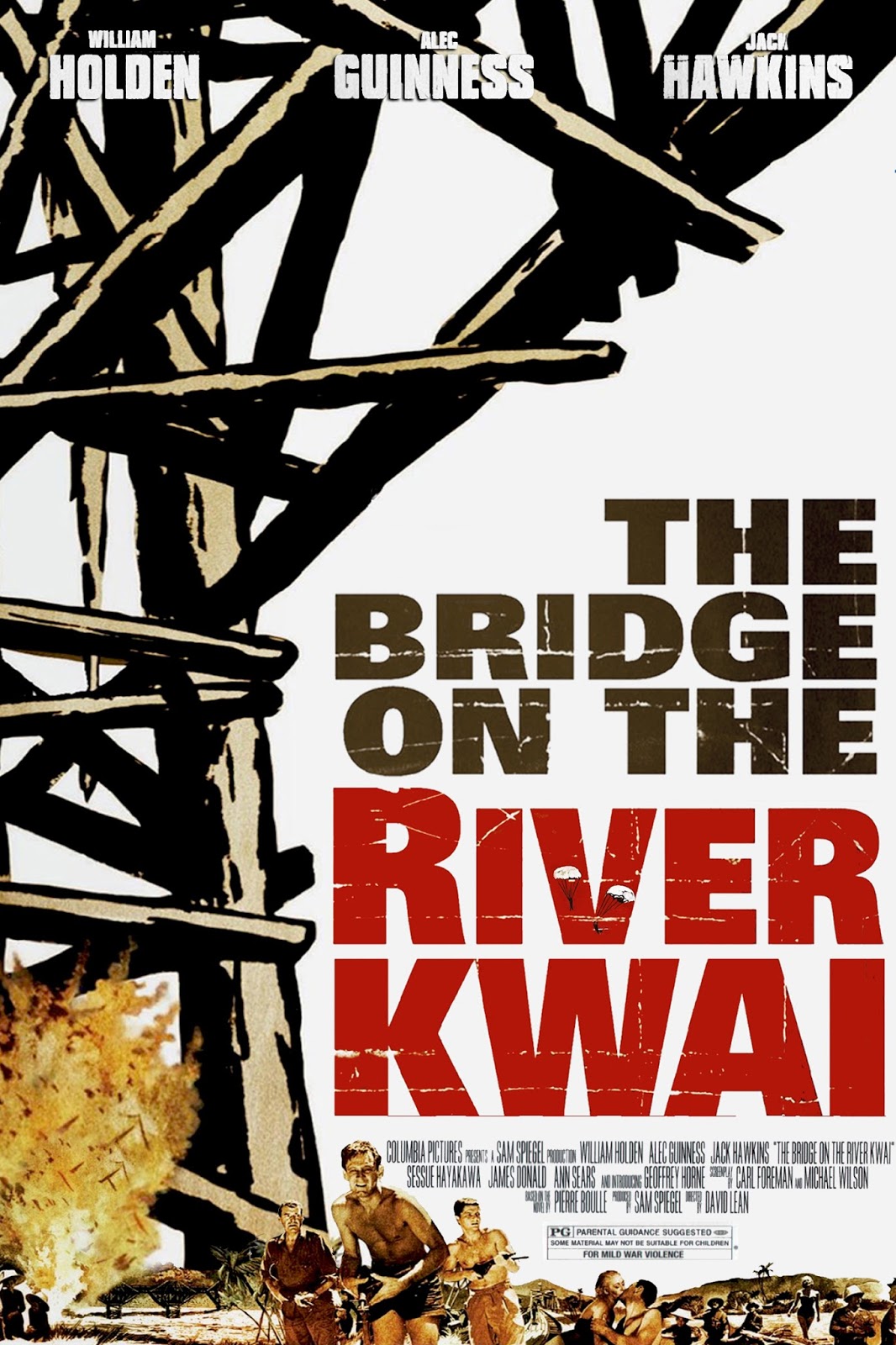
The Bridge On the River Kwai

SPOILER ALERT! The plot will be discussed.

Director David Lean was probably the most successful director of epic films that have at their center thoughtful themes about culture clashes. They include Lawrence of Arabia, A Passage to India, Doctor Zhivago (Czarist Russia versus the communist version), and this Best Picture Oscar winner released in 1957. Here we have individuals representing various attitudes of their countries concerning soldiering in the Asian theater of battle during WWII.
The first shot in this movie focuses on a bird flying high above a vast jungle. The freedom of the winged creature and the vastness of the land below contrasts with the confined world of a Japanese prison camp which seems out of place in the realm of nature. Shears (William Holden) has just buried another POW and there are numerous grave marker crosses at the improvised cemetery, which lets us know that there is danger here. Shears has a name which implies that he wants to cut through the bullshit surrounding the wartime agenda of those around him (which is a sort of human jungle). He represents, at least at the beginning, an American emphasis on the individual’s sometimes selfish concern of taking care of number one. He interrupts a cynical eulogy about the recently deceased by saying, “I’ve forgotten who we just buried.” After being reminded of the name of the British soldier, who died not in some glorious battle, but of a disease (beri beri) in a hostile jungle, Shears mockingly says the man’s death was “For the greater good … What did he die for? … May he rest in peace … He found little enough of it when alive.” He ends his tarnished tribute on a discordant note by slamming his shovel against the grave marker. After enduring the harshness of being a prisoner and witnessing so many deaths, Shears can’t see the fruitful forest for the diseased trees.
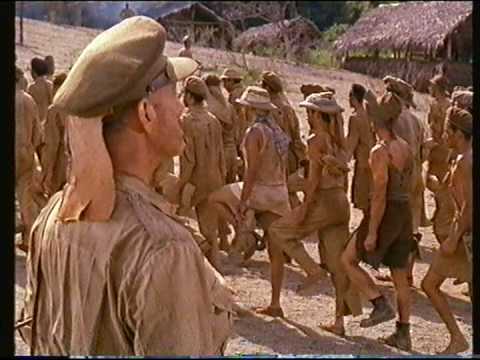
Like most pragmatic prisoners, he bargains to gain personal privileges. He robbed a corpse of a cigarette lighter and trades it with a guard who will put him on the sick list so he can avoid more hard labor while he plans an escape. The new POWs come marching in to the whistling tune made famous by this film. But, the sound fits in with the theme later expressed by the British and the Japanese that one should be happy at work. In Snow White, the seven dwarfs sing “Whistle While You Work,” which implies that in war, and in this threatening place, the whistling sounds like an escape from reality into a fantasy land. Of course to the British soldiers, led by Colonel Nicholson (Alec Guinness in a Best Actor Oscar winning performance), their group demonstration of precision music-making shows their unity of purpose and resolve to not be broken of their patriotic spirit (even as the camera zooms in on their falling apart boots as they march). Shears shows his contempt and for the gung-ho, straight-laced display, which he considers self-destructive in this environment, when he says to his fellow prisoner, “We’re going to be a busy pair of gravediggers.” The other POW says that Shears is neither an officer or a gentleman, the opposite of what we have been taught to admire in a soldier (and which turns out to be literally true concerning his rank). But, surface ideals are hard to come by and can seem fraudulent sales pitches amidst the realities of war (as was discussed recently in the post on Gallipoli).

The commander of the POW camp, Colonel Saito (Sessue Hayakawa), gives the same speech he delivers to all new POW’s, and which Shears mouths the words to. He says their task is to build a bridge over the Kwai River as part of a plan to provide a railroad link to transport troops and supplies between various parts of Burma. It is here that Saito says that they should be happy in their work. The bridge in this story takes on symbolic meaning since it also can pose the question as to whether there is a possibility to make connections among different cultures, even in the presence of hostilities between the various factions. Nicholson’s strict by-the-book position (he literally carries the articles of the Geneva Convention with him) at first indicates the answer is no. He declares to Saito that by the rules the enlisted men must perform labor, but the officers are exempt. But, Saito has his own military set of rules that expect a soldier to commit suicide if he brings dishonor to himself for not having completed his mission. He is just as rigid in his own way as is Nicholson, with harsh rules enforced against those serving under him. We see a man who constantly pulls a rope to fan Saito’s quarters, and a guard who must stay at a designated position in front of those quarters, even though it is where rain water pours off the roof onto the spot where he stands.

When Nicholson talks with Shears we see that the two could not be more different in their approach to soldiering. The colonel says there will be no escape attempts given the chances being slim of surviving the jungle. Besides, his orders were to surrender, and he must follow the rules. Nicholson thinks that he and his men can keep their British Army ways intact in the camp. Shears, of course, tries to open Nicholson’s eyes as to the realities of POW life there. He says that only he and one Aussie soldier have survived out of the group he arrived with. All the others died of disease, snake bites, or by way of Saito’s commands. Shears thinks the odds of survival are better in the jungle, and sticking to Nicholson’s impractical orders is pointless. He asks Nicholson if he intends to “uphold the letter of the law, no matter what it costs?” Nicholson tells Shears that without law, there is no “civilization.” Shears says, “That’s just my point; here, there is no civilization.” Nicholson’s response is, “Then we have the opportunity to introduce it.” Nicholson believes he can transcend the adversities there to maintain his world’s mindset, which, by his desire to impose his idea of civilization on foreign soil, can appear to be imperialistic. Nicholson says that the men must hold onto their self-respect by remembering they are soldiers, commanded by officers (which should not show debasement by being ordered to work); otherwise, they will see themselves as slaves. Shears, again insisting on the reality as he sees it, says that they are slaves here. Shears shows his focus on self-preservation by telling Nicholson’s British doctor, Major Clipton (James Donald, who will play a German POW in The Great Escape), not to fix him up so that he can stay on the sick list.
Saito smacks Nicholson and knocks the copy of the Geneva Convention rules out of Nicholson’s hand. He threatens to shoot the British officers, but Dr. Clipton stops the execution by telling Saito that it would be a scandal if he murdered the men. Saito instead forces Nicholson and his fellow officers to stand out in the hot sun. When they do not capitulate, he places the officers in a detention box, and Nicholson is beaten and put in “the oven,” a small cage. While this action takes place, the British soldiers slow the progress on the bridge by sabotaging the building so that sections fall apart. Saito is a realist. He says rules don’t apply in war, but unlike Shears, he has his orders, and has suspended only those rules that might prevent him from reaching his objective. Saito allows Clipton to try and convince Nichols to give in, since Saito has threatened to close the medical facility, and put the patients to work. Clipton urges Nicolson to relent so that he and the other officers can be released from their small prisons and get medical help. Nicholson says they must not give in. Saito tries to undermine Nicholson’s argument by saying that the officers are lazy and don’t want to take on their share of the labor. Clipton thinks both men are mad, a feeling he reiterates later. Saito starts to change his approach by offering the carrot instead of the stick. He gives the men some time off, and allows them to receive their Red Cross packages. Saito says it is not only the fault of the POWs for the lack of progress on the bridge, it is also due to his incompetent engineer, and so Saito takes over. But, there is still little progress. Saito tries to win Nicholson over by offering him whiskey, cigars, and food, but the British colonel refuses them. Saito is angry, and shows how hard it is to build a figurative bridge between the two men when he lists how different he perceives their respective cultures: “I hate the British! You are defeated but you have no shame. You are stubborn but you have no pride. You endure but you have no courage.”

Eventually, Saito must capitulate. So as not to dishonor himself, he releases Nicholson and says his officers do not have to work because it is the anniversary of Japan’s defeat of the Russians in 1905. So, he is granting amnesty in celebration of that historic event. Nicholson’s men cheer him, since his resistance to being subjugated by the enemy is a triumph. Saito, in private, is the defeated one, now, and he cries.

In the meantime, Shears and two others try to escape, with Shears surviving despite being shot and falling into a river. He makes it to a village just before he is ready to collapse. He recuperates there, and the inhabitants give him a small boat to get back to an Allied base. Again, he is lucky, as he is rescued as his water runs out. He awakes in a hospital in Ceylon. There, while those he left behind in the prison camp must do hard labor, he enjoys the lovely beaches and the affections of a nurse, as he awaits a medical discharge. As opposed to Nicholson, Shears says that he always was “a civilian at heart.” His indulging in selfish individual desires contrasts with those sacrificing their personal needs for bigger endeavors.
However, Nicholson’s larger plans are complicated, and seem contradictory. Saito’s confession that the Japanese engineer was not doing a good job provides Nicholson with what he sees as an opportunity to turn defeat into victory for the principles that make up proper British military behavior. Those ideals will not tolerate sloppy work or malingering with phony illnesses. Nicholson consults with those men who helped him build bridges in India, and they say the Japanese bridge is in the wrong place, and should be placed downstream where it can have a solid foundation. Nicholson tells Clipton that he must keep his troops active and working on the bridge will maintain order and discipline. He also wants the job to be done solely by the British soldiers so that they can show the Japanese how proficient the English are in completing a task. When one of his men says that the trees they will build the bridge with can last six hundred years, Nicholson sees that the building of the bridge will be a monument to future generations who will praise the accomplishment. On the one hand Nicholson’s vision is capable of seeing beyond the current fighting between the nations, but he also loses sight of the war at hand and is driven by patriotic and personal zeal for praiseworthy recognition.

When Nicholson’s team meets with Saito’s, it is Nicholson who is now in command, dictating the plan to build the bridge. As the operation proceeds, Saito becomes a ghost of his former self, looking stunned by the turn of events as he carries out Nicholson’s orders. The Japanese colonel really can’t do anything about this reversal because Nicholson is trying to accomplish what Saito has been ordered to do. Nicholson says he is “not responsible” for losing a month’s time of work because it was Saito who forced his will onto Nicholson and his officers. He uses Saito’s earlier words, because the camp commander said he was “not responsible” for the soldiers’ predicament, since they were ordered by their superiors to surrender. Nicholson does not allow that it was his resistance that also brought about the delay. Nicholson’s British imperialistic ways can be seen in even the smallest actions, as he orders tea while he discusses the building plans. At the camp, Nicholson really has succeeded in defeating his earlier adversary, but, ironically his victory is by actually helping his foe do his job for him. In order to speed up the construction, Nicholson does, ironically, what Saito wanted. He asks his officers to work with the other soldiers, but only if Japanese officers work on the railroad tracks. Under these strange circumstances, the two sides are in a bubble outside the external conflict, actually cooperating with each other. Nicholson also goes into the infirmary and recruits the injured, swaying them with British stiff-upper-lip talk so that they will volunteer to become part of the workforce. Dr. Clipton is upset by what is happening and says sarcastically to Nicholson, “I hope the Japanese appreciate what we are doing for them.”
Back in Ceylon, the British upset Shears’ plans for an early discharge. Major Warden (Jack Hawkins) asks Shears to volunteer to go with Warden as part of a commando group to destroy the bridge being built. It is interesting to note that when going to Warden’s quarters, Shears encounters commandos doing training simulations, and one soldier mistakes Shears for one the opposing participants, and manhandles him. The man says he confused Shears for “the enemy.” This scene echoes what is going on in the building of the bridge where Nicholson no longer seems to know who the enemy really is. In both cases, the narrow focus of wanting to be part of a job well done makes the individual lose sight of the bigger picture. Warden says that Shears will help given his knowledge of the area. Shears, not wanting any part of going back into the jungle and being part of a dangerous mission, says he is not the man for the job. He admits to being a regular enlisted man who happened to escape from a sinking ship with the Commander who later died (Shears up to this point seems to be lucky in escaping his dangerous military situations, and undercuts any praise Warden offers on his escape by emphasizing it was not due to heroic action, again contrasting him with the British outlook on soldiering). Shears assumed the man’s identity because, again looking out for number one, he knew that someone of high rank would get better treatment by the enemy if captured. He also continued the fraud after seeing how officer patients were treated better at the Ceylon hospital. Still trying to work a personal angle, Shears contemplates a psych discharge saying he will argue he assumes other identities because he has mental problems. However, Warden already knows that Shears is not really a Navy Commander. He tells Shears that he is an embarrassment for the Americans, because he should get a medal for his escape from the POW camp, but he is also a fraud. So, the Americans turned him over to the British. As Shears says, the Navy didn’t want to handle “a hot potato.” Shears now realizes he has no choice but to volunteer. Warden makes him a “simulated Major” for the operation, thus continuing Shears’ fraud to get the job done, which, again, takes precedence over other considerations.

Back at the camp, Nicholson can’t understand Clipton’s resistance to the British bridge building plan. Nicholson says that morale is high, discipline has been restored, the men are not abused, and they are eating better than before. Clipton says that it could still appear as collaboration and even treason. Nicholson says it isn’t collaboration because the British are building the bridge alone, which ignores the fact that Nicholson is still providing a means for the Japanese to fight the war. He also makes the argument that as a doctor, Clipton would operate on an enemy soldier to make him better, because that was his job. (Of course what Nicholson doesn’t say is that the doctor would not then arm the man and send him back into battle to shoot more of the doctor’s own soldiers). Nicholson comically says that Clipton may be a good doctor but he “has a lot to learn about the Army.” It doesn’t say much for the military if it operates in this nonsensical way.

Back in Ceylon, Warden, with Shears present, picks out his team. One of the men is Lt. Joyce (Geoffrey Horne). He is Canadian, which sets him apart from the American individualist, Shears, and the British getting-the-job-done-at-any-cost Warden. Joyce says his civilian job and his military one were boring. He wants some excitement, and his character shows the attraction of war as it provides that adrenalin rush. But, when asked by Warden if he could kill someone “in cold blood” with a knife, Joyce allows personal morality to enter into the equation, since he says he isn’t sure because he still feels “killing is a crime.” Warden recognizes that this dilemma has always been a problem in war, but they stick with Joyce, and Warden, employing British understated humor which goes back to Beowulf, tells Joyce he will join them on their “little hike in the jungle.” This way of downplaying danger is consistent with the British stoicism that doesn’t allow room for emotion to interfere with the task at hand. (Nicholson employs the same technique when he asks the camp’s patients if they wouldn’t mind doing a “little light work”). The fact that Shears never used a parachute is not a problem to Warden, since Shears can get in some practice. When there isn’t time for practice, Shears is told he still has a 50-50 chance of survival, so he might as well jump. And in case Shears gets captured, Warden gives him a suicide capsule, called an L-pill, so as not to compromise military operations. Shears does show some admiration for Warden when he learns that he has been captured before by the enemy and is willing to risk his life again.
Their journey is a trying one. Once of the men dies as his parachute goes down among trees. They are plagued by heat, leeches, rains storms, and thick vegetation that they must cut through. Shears, sarcastically, tells the team, which includes women carrying supplies and a local guide, to “be happy in their work,” echoing Saito, and thus showing how both sides try to rationalize away the harsh circumstances. The same point is made when they learn by radio that they must set off their explosives when a VIP Japanese train is crossing over the bridge. The message ends with “have fun,” which refers to the adrenalin rush that Joyce seeks, but also tries to dispel the danger involved. It is ironic that Nicholson has a deadline to meet to finish the bridge, while at the same time soldiers fighting on his side of the war now have a deadline to destroy Nicholson’s creation. Warden’s people encounter some Japanese soldiers, and, in order to not get caught in crossfire, they must use knives. Joyce hesitates in killing one of the enemy. Warden does the job, but chips a bone in his foot. He perseveres though, limping a great distance. However, when he sees himself as an impediment to the mission, he orders the others to leave him behind. He wants no sympathy from Joyce and tells him that he wouldn’t hesitate to leave Joyce behind if the situation was reversed. Shears is angry about the concern for the mission over the welfare of the individual, and tells Joyce that Warden would leave his own mother behind for the sake of the mission. Shears lets loose his contempt for Warden’s rules of war: “You make me sick with your heroics! There’s a stench of death about you. You carry it in your pack like a plague. Explosives and L-pills - they go together, don’t they? And with you it’s just one thing or the other: destroy a bridge or destroy yourself. This is just a game, this war! You and Colonel Nicholson, You’re two of a kind, crazy with courage. For what? To die like a gentleman, how to die by the rules - when the only important thing is to live like a human being.” Shears will not allow Warden to follow his rules and be left behind, and says they go on together.
Warden’s team arrives at the completed bridge in daylight and are able to get a good overview of how to set the explosives to destroy the bridge. Again, ironically, this happens as Nicholson places a plaque on the bridge announcing how it was constructed by British soldiers. The team can’t just set timers on the explosives on the bridge and make a clean getaway because they do not know when the train will be crossing, and must be there at the crucial time. Nicholson and Saito walk the bridge together, symbolizing their strange alliance despite being on opposing sides of the conflict. We then get from Nicholson why the bridge means something more to him than just a way to show the British ability to succeed. He says that he has served in the military for twenty-eight years and was hardly at home. It was a good life, but as he is now older, he wonders, “what the sum total of your life represents. What difference your being there at any time made to anything. Hardly made any difference at all, really, particularly in comparison with other men’s careers.” Nicholson is saying that he wanted to make a difference by contributing something concrete that will endure, which is what many people would want. But even if his motivation is pure, he has picked an odd way of achieving his goal. As he is saying these words, he drops his military crop into the water below, as if symbolically showing that, up until now, the Army has failed to make his dream come true. The lost crop seems to wake him up out of his reverie, and he again assumes the stoical look of a British officer.


Shears and Joyce plant the devices at night and hook them up with a wire to an explosive plunger as Nicholson’s men, in contrast, put on a show to celebrate the completion of the bridge. However, in the morning, as if nature itself is resisting man’s violent intrusion into the jungle, or because, as Warden liked to say “there is always something else” that seems to come up when trying to control an uncontrollable universe, the river has dropped, and the wires are exposed. Clifton, despite Nicholson’s speech of the night before about how this British accomplishment will be an inspiration to people in the future, wishes to view the train crossing from a distance, on a hill because he can’t be a part of what is happening. Nicholson, while doing a last inspection, sees the wires, and goes with Saito down to the water level to investigate. As Nicholson pulls up the wire, he yells out for help because he knows the bridge is in danger. Warden, realizing how Nicholson is about to betray the mission, yells out to Joyce to kill Nicholson. Joyce does stab Saito to death, but is shot to death by Japanese soldiers. Shears, now a true part of the team, runs out to try to complete the mission, but is also killed as he tries to reach the the detonator. Warden has fired mortar shells as backup, and Nicholson is hit ironically by “friendly fire.” In this moment where he has been attacked as an enemy of his own people, Nicholson is brought back to the realities of war and realizes his betrayal of his own military forces as he says, “What have I done?” He stumbles and dies, falling on the plunger, destroying the train as it passes over the bridge he was so proud of building.


We see the plaque that was supposed to last for six hundred years floating on the river. The bird that was in the first shot appears again, soaring freely above the men still imprisoned in their world of violence. The last words of the film are uttered by Clifton, which sums up how the existence of war destroys all the best laid plans, if not of mice, but certainly of men: “Madness - Madness.”

The next film is Goodfellas.
Sunday, January 14, 2018

Winter's Bone

SPOILER ALERT! The plot will be discussed.

This 2010 film mirrors what Truman Capote wanted to achieve with In Cold Blood, which was to show an underside of America that most citizens don’t know much about, and would rather not see. Director Debra Granik adapted the story for the screen from the novel by Daniel Woodrell, and she presents life in the Ozarks of Missouri as an impoverished, isolated place, whose adult residents become savagely tribal, and drug dependent, to survive.
Yet, the first scene in this movie shows children at play as they jump happily on a backyard trampoline while a lullaby is sung in the background. And as the story unfolds, having babies, despite the lack of financial resources, appears as a source of happiness in a life almost devoid of that attribute, and possibly the only hope for the future for these otherwise sad folks. Ree (Jennifer Lawrence, playing a seventeen year old when she was nineteen in her first Oscar-nominated role), visits a class where young pregnant girls learn how to take care of their future children. However, the harshness of the surroundings force the younger population to grow up fast in order to face the adversity around them. Ree must take care of her mentally ill mother and her very young brother, Sonny (Isaiah Stone), and sister, Ashlee (Ashlee Thompson). Their father, Jessup, who cooks meth, has been absent for a while. It is not an easy task for Ree given the lack of resources. The house is dilapidated, and the children sleep on a couch and a sofa. When Ashlee wants to feed the dog, Ree searches for something out of the refrigerator, smells it to make sure it’s still good, and announces what amounts to all that they can expect out of life when she says, “Better than nothing.”

Ree is a responsible surrogate parent as she teaches her siblings basic mathematics and spelling. She shows them even at an early age, because the surroundings demand learning these grown-up skills, how to use a rifle to hunt and protect themselves, but also how to be careful around the weapons. When Ree shows her brother and sister how to skin a squirrel, Sonny asks about the animal’s organs, “Do we eat these parts?” Ree’s answer is, “Not yet,” a minimalist answer that carries great meaning as to how precarious their world is. Ree must also chop wood so that they can stay warm. There is no reliance on the outside world here, so one must rely on others living there. Ree brings her horse to stay with her neighbor, Sonya (Shelley Waggener), who lives a little higher on the poverty spectrum, for food since the horse has not eaten in days. Sonya brings food over to Ree’s house, and lets Ree use her wood splitter. However, Ree tells Sonny, “Never ask for what oughta be offered.” Among these people, that rule maintains the recipient's pride, since they are not seen as beggars, and places responsibility on the residents to help others; if they have to be asked for what they should offer, they would incur embarrassment.


To make matters much worse, Sheriff Baskin (Garret Dillahunt) comes by saying Jessup put up the house and the land as collateral for his bail, and if he doesn’t show up for his court date coming up soon, they will have to give up their home. Despite the fact that the law has not found Jessup, we see Ree’s resolve when she convincingly says to the sheriff that she will find her father. When Sonya comes to her house and asks Ree if she’s sure she doesn’t know where her father is, Ree gives her a “how dare you ask that” look as if insulted to think she didn’t tell her the truth. Sonya says then Ree didn’t have anything to tell the sheriff. Ree says she wouldn’t tell the cop anything even if she did know. Sonya’s response is, “Honey, we know that.” This exchange shows the code of silence among the people living there that see the rest of the world as outsiders who only enter their lives to do harm.

At one point we hear the radio in the background which predicts more cold temperatures and freezing rain. The withering weather reflects the dire life the inhabitants must endure, and the hostility of the environment is palpable, so that the title of the film helps one understand how the coldness of the weather and of those living here penetrates to the bone. However, IMDb also says that the title refers to an Appalachian expression that compares a person who is searching for something and will not give up to a dog digging up a “winter’s bone.” Ree is like that dog as she is relentless in trying to find out what happened to her father in order to save her family’s home.
There seems to be more of a bond between the women living in this community than with the males, since the females share the child-rearing experience, and have to contend with the savagery of the men. But, that sisterly help doesn’t always come easily. Sonya delivers, but, as we saw, with a note of uncertainty. Ree goes to her friend and asks for the use of her husband’s truck. He refuses. Ree’s independence can be see in her admonishing her friend when she says, “It’s so sad to hear you say he won’t let you do somethin’ and then you don’t do it.” Ree reminds her that at one time her friend “never used to eat no shit.” Soon after she does secure the truck to help Ree with her search for Jessup.

Even though Ree fears her father’s brother, Teardrop (John Hawkes), she goes to his house to see if he knows what happened to her father. By the way, many of the names in the story are interesting. Ree’s last name is “Dolly,” which shows a nostalgic yearning for the innocence of youth, when a girl could escape into an imaginative world, playing with her doll. Ree has the nickname of “Sweet Pea,” and she is caring toward her family, but it is also ironic because Ree can be tough as hardwood. “Teardrop” sounds sentimental and sympathetic towards those that suffer. But, Ree’s uncle is one mean fellow. For instance, he tells his wife to shut up and when she keeps talking, he says,”I said shut up already, with my mouth,” implying the next time it will hurt. He also takes an axe to a man’s truck who gives him a hard time when Teardrop questions him about his brother. However, it can refer to how much family suffering he has had to endure, and currently points to what he feels about the loss of his brother.
Teardrop, with a gun in his hand, as if that is a normal thing to have even at a discussion at the kitchen table, warns Ree to not ask about her dad. He grabs her by the hair and the throat to emphasize his point, but then seems to soothe her with his hand as he lets go. In his rough way he is actually trying to protect her. He also voices the feeling that her choices are between the lesser of two evils when he says if she keeps asking questions she’ll become food for the hogs, “or wishin’ you was.” Again we see female support from Teardrop’s wife, Victoria (Cinnamon Schultz), who pleads Ree’s cause to Teardrop. He tells her to give Ree some money and send her on her way. Victoria gives Ree a marijuana cigarette to calm her on her walk, because she knows Ree won’t give up. Drugs are used to make money here but also as a means of self-medication to get through difficult times. It has become a lifestyle, but Ree refuses to take them. Later, Teardrop says to her that she hasn’t developed a taste for them yet, as he snorts some powder, which implies that living there creates the need for it.
Ree goes to the home of Little Arthur (Kevin Breznahan) who has another cutesy name which does not fit his character. He is Ree’s cousin (Ree keeps wanting to now why people who are her “kin” aren’t helping her) who used to cook meth with her father. Here, as everywhere else, the property is run down, with partially wrecked vehicles in the yard along with trash cans, old tires, and other refuse, showing us how the lives of these people are in shambles. In his house, a gun in the corner, always ready to be used, Little Arthur says he doesn’t know where Jessup is. Once again, a woman helps Ree. Little Arthur’s wife, Megan (Casey McClaren) tells Ree to ask Thump Milton (a more appropriately tough name) about her father. Ree confesses that he is one man she does not want to talk to. He is Megan’s grandfather, and she is afraid of him. Fear rules in this place.
Ree goes to to see Thump Milton (Ronnie Hall), but is told by one of the women living on his compound, Merab (Dale Dickey), that he will not see her, despite Ree’s argument that she isn’t looking for “trouble,” that is, she is not going after who might been involved in her dad’s disappearance, and that she and Thump’s people share some “blood.” But Merab says that she should leave because Thump doesn’t want any witnesses. Ree starts to realize that her father is dead, and those involved in his death don’t want any loose ends that could lead to who killed Jessup. While waiting for this information, Ree sees a small statue of a boy and a girl riding down a slide. The inclusion of this object makes one again think about the the loss of youthful innocence. Childhood has a short span in these circumstances, and all that’s left is an artistic resemblance of it.

Ree does go home, but Little Arthur shows up and takes her to a place where a meth lab blew up and where he says Jessup was killed. Ree says she is not stupid because she knew her father was careful and would not make a mistake that would result in an explosion. In addition, there are tall weeds at the site which would mean the explosion took place way before her dad went missing. Ree knows that Little Arthur was sent to give her an explanation for her father being missing which would end her investigation. Little Arthur says he knows how rough it will be for Ree if she loses her home and offers to raise her children. Ree defiantly refuses the offer, seeing it as an insult concerning her ability to take care of her siblings. She does not want to give up her search for Jessup. If she finds proof of his death, then there is no defiance of the order of the court to appear for trial, and her house and property will not be forfeited. Along the way of Ree’s quest we see people playing music and singing. The songs are mournful, with references about “flying away.” They express the sorrow of these people and how they wish for an escape.

Teardrop visits Ree and tells her that the law found Jessup’s car which was burned, but no body was found. Ree sees that evidence is being destroyed which would lead to her father’s killers. Teardrop advises Ree to sell the land and get some money for the timber before it is confiscated. But Ree instead again goes to see Thump Milton. Merab and the other women at the compound beat her as punishment for showing up again (their code does not permit the men to hit her). When Thump and his men arrive, Ree explains the situation to reassure Thump that she is not out for revenge or to expose anyone involved in her father’s death. Teardrop shows up, says his brother went against the ways of his people, and he assures Thump that he will take responsibility for Ree, promising she will not squeal on anyone. On the way home, Teardrop tells Ree that her father couldn’t handle another stretch in jail, and he made a deal with the law to provide information about the drug dealings of those men in his community. Teardrop believes that the sheriff then let it be known that Jessup had talked so he would get the Jessup’s information and not have to make good on the deal with Jessup, knowing Ree’s father would be killed by those he betrayed. Teardrop tells Ree that if she finds out who did kill Jessup that she shouldn’t tell him. Then he would feel compelled to go after the killer, which would probably lead to his death, or as he puts it, he will be “toes up.”
When Ree returns home, Sonya again is the female helper who gives Ree some pain killers to deal with the results of her beating. Ree accepts the drugs now after having experienced how punishing it is to defy the ways of her community. While she recuperates we see a show on the TV depicting the chopping down of trees as Squirrels scatter as their homes are destroyed. The inclusion of this footage points to how the outside world will decimate the home of Ree’s family. She becomes despondent, thinking that she may have to give up her brother and sister to other family members to take care of them. There was talk earlier of her desire to “fly away,” by joining the Army. She now goes to the recruiting office in order to get the $40,000 sign up bonus. But, she is too young to enlist without parental approval, and her mother is incompetent to give consent. The recruiter also tells her she can’t take her family along, so Ree would be abandoning them.
Teardrop comes by again because he feels the need to find his brother’s body. On their drive, the sheriff stops them, but Teardrop knows that there is no reason for being pulled over. He also has a great deal of animosity toward the sheriff because of how he probably assisted in the death of Jessup. Teardrop refuses to exit the vehicle and he makes sure that Sheriff Baskin can see in his truck’s side view mirror that Teardrop has a rifle in his hand. The sheriff backs off and lets them go. This scene stresses that although the ways of Teardrop and others in this place may be threatening, the law and others from outside their way of life can be just as destructive. Teardrop tells Ree that her father loved them very much, which ironically, in this uncivilized pace, made him weak, not wanting to go away from them to serve a long jail term, and this weakness made him susceptible to danger.
Some women from Thump’s place, including Merab, now join the list of other women who help Ree. They take her to where Jessup’s body is. They put a sack over Ree’s head so she can’t reveal where her father lies. That way, Ree can’t ever tell the police, which would lead to an investigation. They go on a boat to where Jessup rests in some shallow water. Merab says Ree must cut off her father’s hands to prove that he is dead (Merab says one hand might imply that Jessup is alive and tried to prove he was dead by cutting off one hand, which shows how violent is the logic in these parts). Ree breaks down and although she can lift up her dad’s hands, she can’t do the cutting. Merab uses a chainsaw, adding to the gruesomeness of the scene, to cut off the hands. Ree brings them to the sheriff, saying someone flung them on her porch. The sheriff doesn’t want Ree to spread it around that he backed down from Teardrop, saying he was just trying not to have a shootout that might harm Ree since she was there. Ree tells him that’s not the way she saw it, not giving him the satisfaction of his lie. She shows her contempt for the man who helped bring about her father’s death by telling him she wouldn’t say anything about him because she didn’t talk about the sheriff, “ever.”
Teardrop pays a visit to Ree’s home, and brings baby chicks for Sonny and Ashlee. This act may seem to show a gentle side of the man, but he probably is being practical, providing a source for future food, either by way of chicken dinners or eggs. He picks at Jessup’s banjo, and remembers fondly how much better his brother could play. Bree offers to give him the instrument, but he says that she should hold it for him. He then says that he knows who killed Jessup. So, his leaving the banjo may mean that he will seek revenge for his brother, which would probably get him killed. Ashlee picks up the banjo and starts strumming it. This action may seem like a sweet tribute to her father, but it also could imply that she is on the same road to disaster as her parent.
Sonny asks Ree if she is going into the Army and leaving them. Ree’s poetic response is, “I’d be lost without the weight of you two on my back.” The life here may be exacting, but the love of children makes bearing the burden of family responsibility worthwhile.

The next film is The Bride on the River Kwai.

Sunday, January 7, 2018

Gallipoli

SPOILER ALERT! The plot will be discussed.

An important historical note which helps to appreciate this 1981 film directed by Peter Weir is that Australia had just become a united country in 1901, just 14 years before the WWI events depicted in the movie. The Australian engagement in the war was the first national enterprise on the world stage for the country. So, there was a general feeling to prove itself in battle, sort of a trial by ordeal. An example of how there was this sense of proving the strength of its nationalism can be seen in the fact that the country had the only volunteer army fighting against Germany and its allies.
The titles of the film are in red, possibly pointing to the blood that will be spilled later at Gallipoli in Turkey. (The Turks were allies of the Germans). The story starts in May of 1915 with a youth practicing for a running competition. Archy Hamilton (Mark Lee) is a fast sprinter, and his uncle, Jack (Bill Kerr) is a loving, but demanding trainer. Archy’s youthful desire to compete successfully symbolizes the young nation of Australia wanting to prove itself. Some of the locals tease Archy about how men prove themselves by fighting, not running. It is possible that this needling is one of the reasons Archy feels he must fight for his country. A bully, Les McCann (Harold Hopkins) makes a wager with Archy, saying he can beat him if he runs and Les rides on horseback. Les says that Archy must be barefoot, to which Archy agrees, as long as Les rides bareback. Les falls off of his horse and loses, but Archy pays for the struggle with bleeding and injured feet. His wounds are a foreshadowing of what can happen in war.
We have a scene during Archy’s recuperation where his Uncle Jack reads from Kipling’s The Jungle Book. The section he reads is significant because it deals with leaving behind the sheltered protection of childhood and testing oneself in order to become an adult. Again, Archy’s journey mirrors Australia’s path to seasoned nationhood. Archy is later seen with local men who want to enlist, but there is one who sees the danger in this bravado, and tells the others that they are signing up to die. There is a large wooden horse at the town where the race takes place, and it reminds one of the Trojan horse, a symbol of how the urge for heroic conquest make one susceptible to deception. Archy competes against Mel Gibson’s Frank Dunne, who is a laborer that wants more out of his life. Archy beats him in the race, gives the prize money to his Uncle Jack, keeps his medal, and says he is enlisting. Jack is upset, not expecting his nephew to return from the war. However, Archy is underage, and is denied entry into the military.

Archy runs into Frank, who says if they go to Perth, nobody there will know Archy, and he can fake his age, and enlist. The travel to the city is a sort of journey to test Archy's survival skills because the two men hop a freight train are left off in the desert. (The desert is always a place of trial in the bible, and there is a shot downward from on high to show the immensity of the land versus their small size, which emphasizes the difficulty of their struggle). And the movement from a rural place to a city shows the transition from innocence to worldly experience. The two men quarrel along the way, and their differences reflect the growing pains of Australia itself. Archy feels that he must fight for his homeland, while Frank, being of Irish descent, sees the war as having nothing to do with him, it being a British conflict. On their way they encounter an old camel rider who gives them directions. The man seems to represent the isolationist attitude that Frank espouses, as he knows nothing of the world war, and says he “can’t see what it has to do with us.” Archy argues that if they don’t stop the Germans and their allies in Turkey, then they will eventually take over Australia (an argument that may have been sound in a world-wide struggle, but which was used later in the Communist domino theory used to justify America’s presence in Vietnam).
Archy and Frank arrive at a ranch, and Archy says he is going to join an elite fighting outfit called the Light Horse Brigade. The owner’s daughters say how much they love the uniforms the soldiers wear. The talk of patriotism and glory in battle, and the admiration of the young women, start to pressure Frank, who wants to improve his lot in life, into changing his decision to stay out of the conflict. However, Frank can’t ride a horse, which shows how idealism collides with reality. Archy tries to teach him how to handle a horse, and in return, Frank makes up a fake birth certificate for Archy. Another old man questions why Frank would want to fight for the British, who would just as soon hang Irishmen (these old guys are like Shakespearean soothsayers, warning of bad future events). When they go to enlist, Archy makes it into the Light Horse Brigade, but Frank can’t pass the riding test, and winds up in the infantry, the most dangerous fighting outfit. There is a big town send-of for the departing soldiers, making it seem like they are going off to participate in a sporting event. It’s as if they will bring back awards that will glorify their feats of accomplishment, instead of embarking on a voyage leading to brutality and death. Frank becomes separated from Archy, but he is glad to reunite with some old mates he used to work with.


The soldiers arrive in Cairo for training. They are still viewing the conflict like a sporting competition as Frank and his friends play ball near the pyramids. One man says that the Pharaohs buried their wives and their belongs with them in the ancient tombs, and says it was “man’s first attempt to beat death.” The point here is that even the great ancient kings, with all their power and wealth, could not escape their mortality. So, what chance do these foot soldiers have in defeating death? Instead of hearing about how slim their chances are of surviving combat, the officers dispense information about the dangers of drinking the local alcoholic beverages and contracting venereal diseases. There is a drill practice battle with the Light Horsemen, where Frank reunites with Archy. However, the mock encounter is  worthless as most of the men lie down and act dead so they can be carried off as opposed to doing the carrying of the supposed casualties.
There are scenes which show mistreatment of the Australians and the local people. Frank and his mates meet some British officers riding on horses, their elevated positions physically reflecting their superior attitudes toward the Australian men, who should be respected for risking their lives to help them.There is an encounter that illustrates how the local inhabitants suffer as they are caught between the warring factions. One of Frank’s friends says he was cheated by a local shopkeeper by selling him a fake relic at a high price. The soldiers harass a man and damage his goods, and he isn’t even the right merchant, as the victim keeps telling Frank and his mates.

Frank, to the disappointment of his fellow infantrymen, gets a transfer to the Light Brigade, which now will fight with the infantry without horses. He can now be with Archy. There is an elegant party which Frank crashes, and at which Archy delivers a note to their commander, Major Barton (Bill Hunter), that says they will be fighting at the strongly defended Gallipoli position. Barton shows his apprehension at the order. The brightness and merriment of the celebration contrasts with the darkness of the following scene where the men will be fighting, and where the only light comes from explosions. The soldiers must restrain from smoking and and making noise as to not give away their presence. There follows a scene in daylight where the soldiers swim naked and during their underwater dives they find ancient shipwrecks with rusted rifles. The images suggest the theme that wars are endless, dating back to antiquity and continuing to the present. Bullets zip through the water, and one man is wounded. The whole scene of youthful nakedness floating in water defiled by weaponry seems to symbolize a demonic baptism into the horrors of adult warfare.
Those men who have been there before Archy and Frank have already started to deal with their situation by engaging in dark humor. For instance, they shake the hand of the corpse of a dead soldier, and say, “G’day, Mate.” A seasoned infantryman shows them that just by poking a little above their trenches, bullets come flying in, ready to cut them down. There is a sign close to him which says, “Abandon hope past this point,” which sound like the words that appear before the gates to hell in Dante’s “Inferno.” They go about their business while there is constant shelling in the background. Frank receives a package from a women’s auxiliary at home which, although meant to be morale boosting, contains articles more fitting for a picnic, and which does not show an appreciation of what those at home have sent their men off to do. He also gets a bill from a man who fixed his bicycle, which is especially insulting giving Frank’s circumstances. Frank once again joins his old mates, and before they engage the enemy, they frequent some local prostitutes. One man tells another that it is okay to indulge, since God turns a ‘blind eye” before every battle. This can be taken two ways - one, that God cuts soldiers some slack before they face death, or it also can imply that the deity has forsaken them, as he “turns” away from them. One of Frank’s infantry friends is killed, another wounded, and yet another suffers from what we now call Post Traumatic Stress Disorder. There is a briefing among the officers that basically orders Barton’s men to be sacrificed at the Battle of the Nek as a diversion so that British troops can land elsewhere. Barton is promised that there will be heavy shelling of Turkish trenches to protect the advancement of his men.


Barton wants to use Archy, because of his running speed, to convey messages to command headquarters since communications will go down during the battle. Archy tells Barton to use Frank, who he says is just as quick a runner as himself, thus sparing Frank from becoming involved in the fighting. According to IMDb, before the fight, Barton plays some classical music by Bizet, which turns out to be a bad omen, as it is a duet between two men who swear to remain as friends, and who will be reunited in death. On the day of the battle, Barton is to send three waves of troops over the top of the trenches. Unfortunately, the Turks are able to regain their trenches after the British shelling and before Barton sends his men. The first two waves are almost immediately slaughtered by machine gun fire. Frank is sent to have the orders reconsidered, but is told they are to proceed by the colonel in command (who in reality was Australian, not British), and who is misinformed that there were British markers in the Turkish trenches, showing that they have persevered. Information comes down that the British troops have landed easily, are enjoying tea on the beach (as the Australians are being killed), and thus, there is no need for the continued losses. Frank Suggests to Barton that he go over the head of the local commander, and ask the general to reconsider. Frank dodges bullets and delivers the message. The general tells him that he will take some time to reconsider. But, Frank can’t get back in time before Barton must send the last wave over the top.

Death is now palpable for these young men. One looks at a letter and picture of his child for the last time. Archy embeds his running victory medal in the trench as a sort of memorial. Barton knows he is sending his soldiers to certain death, and sacrifices himself, too. The last image we see is that of Archy running, remembering the encouraging words of his uncle. It is not enough, and he is shot.

Weir leaves us with the frozen image of Archy’s body after being hit by bullets, a chilling reminder of how war, sold as an opportunity for glory and patriotic duty, many times strikes down the youth of a country, thus damaging the hope for the future.

The next film is Winter’s Bone.