Sunday, February 11, 2018

Throne of Blood

SPOILER ALERT! The plot will be discussed.

The Japanese title for this 1957 film from director Akira Kurosawa is “Spider’s Web Castle.” Although the “Throne of Blood” title rings true to the source material for the story, namely Shakespeare’s Macbeth, whose main character ascended the throne of Scotland through murder, the Japanese translation also fits the tale here. The castle is the home of the Great Lord who is the ruler of this realm. The forest surrounding the fortress contains interwoven paths through the woods that are meant to thwart attacks. However, in this story, the forest fits in with the saying, “Oh what a tangled web we weave/ when first we practice to deceive,” since the main character, Washizu (Toshiro Mifune, Kurosawa’s go-to actor), is caught up and undone in the tangled path of treachery he follows.
The movie begins with a desolate setting where wind (the winds of time?) have swept away what was once the Spider’s Web Castle. We hear an unseen chorus chanting (reminiscent of the ancient Greek theater device that comments on the moral issues in the drama). They say that the tale deals with destruction caused by all-consuming human desires which are delusions compared to life’s true nature. In the end, all but ruins are left as a result of treacherous ambition. Their words remind one of the Book of Ecclesiastes in the bible which speaks of the lack of progress in the natural world as all is caught up in the repeating cycle of death and birth. The book says pursuit to satisfy selfish desires is transient, since in the material world, “all is vanity, and a striving after wind.”
We then travel back in time to medieval Japan where two warriors, Washizu and his friend Miki (Akira Kubo) have won a military victory for the Great Lord against his enemy, Inui. On the way to receive thanks from their leader, the two men become lost in the very forest which is supposed to confuse the enemy, which hints at problems to come. (Forests in traditional literature are many times places of danger where one can stray from a safe journey because of a loss of direction. A couple of films, The Wizard of Oz, and The Princess Bride, are movie examples). As we see here, one can also become lost in such a place morally. They hear a screeching which they attribute to an evil spirit. They discover a shack which was not there before. There is what looks like an old person spinning yarn, and the turning wheel he uses also points to the theme of repetition of birth and death in the material world. He is singing words that mirror some of the chanting chorus. He sings about the meaninglessness of the nature of man, who will eventually “decay into the stink of flesh.” Man also burns himself up in the “flames of desire.” Mortal man is part of that eternal return of the same since from the foul stench of human decay comes the sweet perfume of the flowers. The man also says that men can’t see into their own “hearts,” which points to an inability to recognize a person’s inner nature, including its flaws. These words are warnings which go unheeded by the men, especially Washizu. When they interrupt the man, who is really a spirit, he reveals that he knows their names and commands, and predicts that Washizu will be made Commander of the North Garrison, and eventually will be the sovereign who will rule from the castle. Miki’s son will eventually become ruler, too. Then the spirit and his shack disappear, but what remains are mounds of dirt filled with human bones, meant to remind them of their mortality and the price that is paid for indulging one’s selfish ambitions.
The impenetrable mist and the blinding wind in the movie suggest that inability to see through to the truth of the “vanity” of human pursuits and to gain insight insight into a person’s true self. The two men laugh about the predictions as they rest outside the castle. Later, however, the Great Lord awards them the exact posts the spirit foretold they would receive. Washizu anguishes over his fate, since he is torn between his loyalty to the Great Lord and his own wish to replace him. Washizu spoke to Miki about how the meeting with the spirit was like a dream, and dreams expose our baser natures. In psychological terms, the unconscious mind harbors the selfish yearnings of the uncivilized id. Instead of the encounter in the forest dictating Wahsizu’s destiny, it instead allows his true immoral character to emerge.

We then see Washizu with his wife, Lady Asaji (Isuzu Yamada), (the Lady Macbeth of this film) who he has told about the prophecy. She wants him not to feel guilty because she wants her husband to act on his ambitions, which she says are natural desires given his military standing. She sows paranoia by warning him that if Miki tells the Great Lord of the prophecy then he will kill Washizu to protect himself. She urges him to kill the leader first, and escape retribution and fulfill his destiny. Her motto is kill or be killed, which derives from a sort of survival of the fittest jungle law. Washizu says that Miki would not put him in danger since he is a loyal friend. Asaji says that he can’t rely on that friendship because the times are degenerating, and instead of trying to fight that trend, she urges accepting it and acting accordingly. Obviously, she wants to satisfy her appetite for power through her husband. Asaji’s alternating deliberate and quick movements, which are stylized, like a sort of ballet, derive from the Japanese centuries old theatrical tradition of Noh. The word means “talent” or “skill,” and the art form employs stock movements to convey emotion and masks to represent character types. In any event, Asaji’s motion implies that there is something off about her. Her rehearsed motion suggests she is staging a performance to influence Washizu.
The Great Lord visits Washizu’s garrison to fortify the border and attack Inui when possible. He makes Washizu a vanguard commander and assigns Miki to guard the castle. Asaji twists the ruler’s intent around, basically providing her husband with medieval “fake news,” telling him that the Great Lord is exposing Washizu to an attack, hoping he will perish, while protecting Miki in the castle fortress. She eggs Washizu on by saying that Miki will laugh at him from his place in the castle. She wants to put the guards, who are under the command of Noriyasu (Takashi Shimura), to sleep by plying them with sake, kill the Great Lord, and then blame it on Noriyasu for using a guard to commit the murder. After the guards are asleep, Asaji brings Washizu his weapons in the room where a traitor was placed after capture and killed himself. The association of the room with Washizu designates him as a traitor, also. He seems torn, but goes to kill the Great Lord. He returns with a bloody sword, which Asaji takes from him and places it in a guard’s hand. She then washes the blood off her hands. She yells out that the ruler is in danger. Washizu kills the guard to make it appear he was exacting revenge for the Great Lord. Noriyasu flees with the Prince, who is the Great Lord’s son, while yelling that Washizu is the traitor. Washizu goes to the castle to find out what Miki will do. Miki says that the Great Lord’s wife killed herself, wanting to die rather than witness her husband’s enemy taking over the castle. The irony here is that Washizu, supposedly a loyal servant, is the enemy. Miki says that the prophecy is coming true, and Washizu is the best person to defend the kingdom from the enemy, Inui.

Later on, there is to be a ceremony to anoint Miki’s son as Washizu’s successor, as per the prophecy, since Miki has been loyal in supporting Washizu as the new ruler. Also, Washizu and Asaji have not been able to have children. Asaji argues against announcing Miki’s son as the next sovereign. Asaji drops a bomb when she tells her husband she is pregnant. Now it is no longer in Washizu’s best interest to make Miki’s child the next leader. We hear screeching birds, which Miki’s son says is a bad omen, and the young man is able to see that the forest spirit did not cause the prophecies to happen, but allowed the men to bring it about. At the banquet, Miki and his son are absent. Just as in Macbeth, the ruler sees the ghost of his friend. We now know that Miki has been killed. Washizu acts like a madman as he talks to the empty air and stabs at the ghost that nobody sees. After dismissing the guests, the assassin sent to kill Miki returns with the dead man’s head wrapped in cloth. Miki’s son, however, was able to escape.

We hear soldiers saying that the realm is starting to decline, with fewer noblemen showing up at the castle. Some were forced to take their own lives because the paranoid Washizu doubted their loyalty. Asaji has spread the false rumor that Inui’s spies killed Miki, but many of the soldiers do not believe it. There are rumors, which turn out to be true, that Miki’s son, Noriyasu, and the Great Lord’s son have joined with Unui to fight against Washizu. There are more omens, such as rats running away from the castle, which indicates to some that the rodents “flee a house before it burns.” Later, numerous screeching birds invade the castle, mimicking the sound of the evil spirit in the woods. Another bad omen is that Asaji gives birth to a stillborn baby. Washizu in private calls himself a fool after losing a leader, a friend, and now a child, but he continues on his self-destructive path.

Washizu returns to the forest to look for the spirit, who greets him invisibly at first with derisive laughter. When he appears, he says that as long as Washizu continues on this road of spilling blood, he will rise to a “pinnacle of evil,” which sounds contradictory, because good deeds are usually associated with “rising.” It is like Washizu is similar to Satan who is a king, but of the pit of hell because of atrocities committed. The spirit tells him that he will not, however, be defeated in battle as long as the trees of the forest do not attack the castle (a sneaky prophecy right out of Macbeth). Since this occurrence seems an impossibility, Washizu is emboldened, and having learned nothing about himself, says he has no qualms piling more dead bodies onto the the hills of bones the spirit has shown him.
Noriyasu, leading the armies against Washizu, says that the forest is a web of trails that ensnares people, and orders his men to follow a straight path through the trees. His command is a metaphor, urging his men not to be led astray, but instead to pursue a straightforward righteous path. Another bad omen presents itself, as Asaji, like Lady Macbeth, has gone mad, possibly due to guilt, and the loss of her child along with her now failed plans for ruling, and Washizu is horrified to find her continually washing her hands while saying the blood remains on them.

Washizu tries to rally his troops by sharing the prophecies, and telling them that of course it is impossible for the trees to march against the castle. As it turns out Noriyasu’s soldiers use the tree branches as camouflage to attack the castle, so it appears that the trees themselves are approaching. Washizu’s own men attack him, showering arrows upon him. He looks like he is ensnared in a web of violence he has created, and dies wrapped in the weaponry of death.

The film ends as it began, in a wasteland of dirt and wind, with the chorus chanting that only a monument remains where there once stood a castle of men’s delusions, a symbol of the misguided idea of worldly achievement through selfish ambition, which is transient. This is a story that says that personal, indulgent desire is consuming, and burns itself out, passing into ruin.

The next film is The Silence of the Lambs.

Sunday, February 4, 2018

Million Dollar Baby

SPOILER ALERT! The plot will be discussed.

I’m not much of a sports fan, but I do enjoy films about sports. It may be difficult for some to say they “enjoyed” this very sad Oscar winning movie for Best Picture of 2004, but there is much to admire about it, and it somehow is able to find humor despite the tragic nature of its tale. The story is one about people with punishing pasts and how they deal with the physical and psychological blows they have sustained.
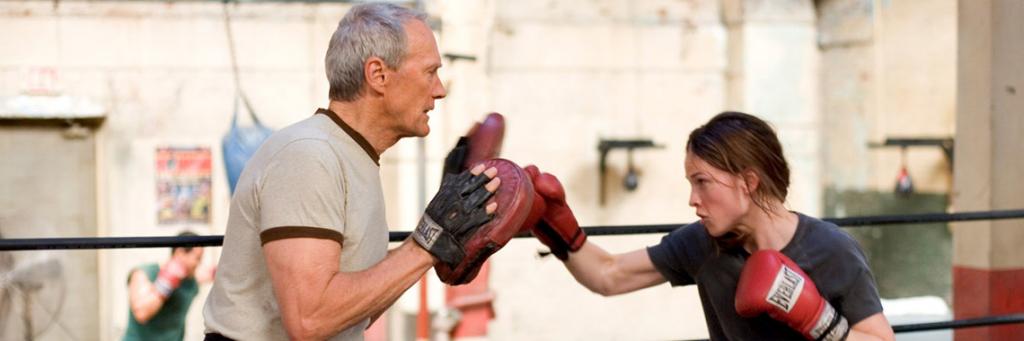
I talked about the successful use of a voice-over last week in Goodfellas, and director Clint Eastwood (Oscar winner for his direction here) uses it effectively by having the character Eddie “Scrap Iron” Dupris (Morgan Freeman, Oscar winner for Best Supporting Actor) provide it here (Eastwood must have decided that Freeman’s narration was such a positive part of The Shawshank Redemption that he would try it again). As in  Goodfellas, the narration does not replace the visual, but enhances it. Scrap’s words provide information about the fight game, but he also has a bigger picture wisdom that adds insight to the movie’s characters and events. Scrap (whose nickname can imply that all that has been left him are life’s “scraps,” or that he is “scrappy”) informs us that Frankie Dunn (Eastwood) is a great “cut” man, fixing up boxers in the corner between rounds. Scrap says there are times one can’t do anything about how the fight is going, the cut is too close to the bone, or there has been a severing of a vein, and that all our efforts can’t make a difference. Of course, Scrap’s words can apply to life in general. But Frankie would work every angle he could to turn a bad situation around in the ring. We see a fighter bleeding badly from a wound near his eye. Frankie’s seemingly contradictory advice to his fighter is to let the opposing boxer hit him. The punch pushes the coagulant Frankie administered go deeper into the wound so as to stop the bleeding.
Yet, even though, as Scrap says, boxing exists because those in the fight game know that people support the sport because of a love of violence, Frankie has retreated from confronting the savagery of the sport by playing it safe with the prize fighter he is managing. Big Willie Little (Mike Colter) wants his shot at the championship, but Frankie keeps telling him he is a couple of fights away from that goal. Scrap says that in boxing, sometimes you step backward to deliver a punch, “but step back too far and you ain’t fighting at all,” in boxing and in life. Frankie has been trying to play it safe in a sport that, by its nature, defies safety. Scrap knows Frankie understands the nature of boxing because Frankie has said that “boxing is an unnatural act, that everything in boxing is backwards.” Scrap illustrates this point by showing how a fighter must defy what his body knows is best for him: “The body knows what fighters don’t: how to protect itself.” When a guy is getting beaten up, the body says to him, “Hey, I’ll take it from here because you obviously don’t know what you are doing. Lie down, now, and rest, and we’ll talk about this when you regain your senses.” So, even though the fighter should stay down for his own good after getting knocked to the canvas, the true boxer will rise up to continue the battle. He will persevere, which Scrap says is the “magic” in boxing, because, battling, “beyond cracked ribs, ruptured kidneys, detached retinas,” there is a risking “of everything for a dream that nobody sees but you.” We have here a metaphor for how we must continue to fight as we focus on our dreams while enduring the batterings that life can deal us. Willie, although very grateful for what Frankie taught him, goes with another manager, and wins the championship. Scrap tells Frankie that the real reason that Willie left him was because Willie didn’t feel that Frankie believed enough in him. From a broader view, sometimes we need the support of others to help us triumph over the punches that life lands on us.


We see Frankie saying his prayers, so we know he is a believer. But, maybe because he is a fighter at heart, he battles the impatient priest, Father Horvak (Brian F. O’Byrne), over concepts in the Catholic religion such as the Immaculate Conception and the Holy Trinity. One scene which is funny occurs when Frankie sarcastically likens this latter concept to “Snack, Crackle, and Pop all rolled into one big box.” The weary and indignant priest responds by saying, “You’re standing outside my church, comparing God to Rice Krispies?” But despite the humor here, Frankie’s questioning springs from the conflict between believing in the ideals of his religion and reconciling those precepts with his real life negative experiences. He is estranged from his daughter, to whom he writes every week, only to have the mail returned unopened, like unanswered prayers. We later learn that in Scrap’s last fight, the manager was drunk and absent, and Frankie felt it was his responsibility, as the cut man, to stop the contest, even though he had no authority to do so. Scrap lost an eye due to the beating in the match. Despite their bickering with each other, Frankie has stayed close to Scrap, having him work in his gym (the “Hit Pit,” a name that doesn’t sound encouraging), and allowing him to live there. Father Horvak says that Frankie’s showing up every day for mass for twenty-three years indicates he “can’t forgive himself for something,” and Frankie’s guilt has made him fearful, which is counterproductive in a dangerous sport.


Maggie Fitzgerald (Hilary Swank, winning her second Best Actress Oscar here) shows up at the gym. Scrap’s voice-over tells us that she came from an impoverished, tiny town in the Ozarks of Missouri, “Somewhere between nowhere and goodbye.” Not exactly a place one wants to call home. Scrap says Maggie grew up knowing her whole life that “she was trash.” Given that perception it seems fitting that we watch her pick up other people’s garbage, leftovers from the meals she serves them, that she then wraps up for herself, telling the boss it’s for a dog she doesn’t have. But she gathers these food remnants because she has a plan to emerge from the trash. She is saving money by scrimping on buying food and collecting tips to pay her dues at the gym. She has relocated because she wants Frankie to manage her. Frankie’s first response is that he doesn’t want a girl in his gym, and tells Scrap to return her dues. But, she has paid six months in advance, and the gym is not doing well financially. Maggie’s drive to succeed is obvious as she stays after closing time to practice. Scrap, despite the setbacks in his life, wants to encourage the hopes of others. He allows “Danger” Barch (Jay Baruchel), a skinny, mentally challenged young man, who was abandoned by his mother’s boyfriend, to work out for free. His nickname is at odds with his appearance, but, like Maggie, he wants to rise above his disadvantages. Scrap allows Maggie to stay late at the gym and gives her some tips, as well as Frankie’s old speed bag for practice.

Frankie’s first response to Maggie is a sexist one. She tells Frankie she wants him to manage her. After she says she is tough, he says, “Girlie tough ain’t enough.” A sign on the gym wall says that winners are those who are willing to do what losers won’t. Maggie is that kind of winner. This film is about female empowerment, where women fight not only to beat opponents, but to gain respect as formidable individuals in an area which accepts male toughness as the basis to exert power. One male fighter, Shawrelle Berry (Anthony Mackie) is a bully, and he harasses both Danger and Maggie because they don’t fit the usual requirements for boxers. He makes fun of Maggie’s small breasts, but Maggie shows she can hold her own. She undermines his macho stance and reverses his put-down, pointing out his mammary obsession by telling him, “I saw your last fight, Shawrelle. Spent so much time face down I thought the canvas had titties.” Scrap tries to encourage Frankie to help out Maggie, saying she has something. Frankie’s funny reply is, “Yeah, she’s got my speed bag.” Frankie tells Maggie that she’s too old to try and become a prize fighter. She is thirty-one, and it takes five years to train properly, and then she will be going up against stronger and faster twenty-year-olds. Frankie discovers she has been working out after hours one night and she says that it’s her thirty-second birthday, and she is celebrating. She lets on about how she comes from a world of losers when she says, “I spent another year scraping dishes and waitressing which is what I have been doing since thirteen … my brother’s in prison, my sister cheats on welfare by pretending one of her babies is still alive, my daddy’s dead, and my momma weighs 312 lbs. If I was thinking straight, I’d go back home, find a used trailer, buy a deep fryer and some Oreos. Problem is, this is the only thing I felt good doing. If I’m too old for this, then I got nothing.” This speech presents how the hopelessness of Maggie’s world could lead to accepting the deaths of a young child and that of a parent as routine, and acknowledging that one is only worthy of getting a “used trailer,” and succumbing to an unhealthy lifestyle. Maggie is willing to fight against what seems like the inevitable. She tells Frankie that she doesn’t want pity, and is willing to work to earn her way. She says, “I want a trainer. I don’t want charity, and I don’t want favors.”
After losing Willie, and a chance at getting a title shot, Frankie decides to help Maggie, but only until she is ready to be managed by someone who handles female fighters. Maggie wants Frankie to believe in her, just as Willie did, but with Maggie and Frankie, it is more like a father-daughter relationship. Maggie lost her father at a young age and feels alienated from her family. Frankie no longer has any contact with his daughter. So these two are drawn together now in an attempt to fill the familial void. As Maggie improves in her training, she keeps asking Frankie if it’s time for her to have a fight. Frankie has already shown a fear of putting boxers in danger based on what happened to Scrap, and that anxiety is increased with his new boxer, Maggie. But he also fears getting too close to her and being hurt again, which is what happened with his real daughter. When he sees a manager at the gym who handles female fighters, Frankie abruptly dumps Maggie onto the other manager. He has continually told her to protect herself when in the ring, but he is now trying to protect himself emotionally, and, ironically, hurts Maggie by betraying her. She goes with the new guy who promises her a fight. Scrap and Frankie attend the match, but Frankie can see that the new manager has failed to prepare her for the fight. Scrap says he learned that Maggie was being set up to lose in order to build up the reputation of the other boxer. Frankie’s paternal instinct kicks in and he butts in, telling Maggie how to deal with her opponent. Maggie fires the new guy, saying it wasn’t a “good fit.” When the referee asks Frankie if Maggie is his fighter, he says yes, finally committing himself. Maggie knocks the other girl out. After the fight, Maggie repeats Frankie’s words about always protecting oneself, and asks if he was protecting her by dropping her. He said no, and when asked if he will leave her again, he says, “never.” Frankie is now all in.
Maggie is extremely successful, to her own detriment. No manager wants to embarrass his fighter by having her knocked out in the first round. So Frankie actually has to pay the men representing other fighters to set up matches with Maggie. In the voice-over, Scrap says that Frankie had to do want he feared - he moved Maggie up in class, exposing her to more dangerous fighters. In one fight her nose is broken, and she is bleeding profusely. This event echoes what happened to Scrap, and Frankie wants to throw in the towel. Maggie shows her determination, gets Frankie, the cut specialist, to stop the bleeding temporarily, but she must win quickly, or the blood will start to gush. She does, but they must go to the hospital afterwards. While waiting to be treated, Frankie is reading as he often does. He was previously seen reading Gaelic. Scrap asks him what he is reading now, and he says Yeats. Scrap’s funny line is, “Why don’t you talk a little Yeats to her. Show her what a treat that is.” But despite the humor, Scrap is concerned for Frankie after seeing Maggie hurt, and asks how he is doing. Frankie tries to avoid anything emotional by asking why is Scrap asking him, since Maggie is the one that is hurt. In the voice-over, Scrap’s statement about some wounds being too close to the bone fits metaphorically here. Frankie bleeds internally from the emotional wounds inflicted in his past.

Maggie has twelve straight knockouts and she is becoming well known and earning money. Frankie gets an offer to fight Billie “The Blue Bear” (Lucia Rijker), the welterweight champion, for the title. She is considered the dirtiest fighter in the ranks, and we see her grinding her glove in an opponent’s eye, and punching her when she is still on the mat. But she gets away with her infractions because the crowds love her. This fact points to how boxing cashes in by catering to the unevolved, brutal nature of humans, who support the beating of people to experience the vicarious adrenaline thrill of knocking someone else down to build themselves up. Scrap says at one point that boxing is about gaining respect for oneself by taking it away from another. It is a nasty way of gaining respect, but the boxers are putting their well-being on the line, while the spectators risk nothing. Again, in order to protect Maggie, he passes on the bout with Billie.

Scrap knows that holding back a boxer with Maggie’s drive is not what she wants. He takes her for her birthday to a diner, tells her about Frankie feeling guilty about Scrap losing his eye, and says that maybe Frankie isn’t the guy to get her to a title. He has the manager who took over Willie’s career show up at the restaurant. But Maggie is loyal to Frankie, and tells him politely that she will not leave him. Frankie does agree to have Maggie fight the British boxer, who Billie recently beat, in England. Frankie gives Maggie a robe with the Gaelic saying, “Mo chuilse” on the back. The crowd chants those words as a welcome and it becomes associated with Maggie, whose last name, as does Frankie’s, indicate they have Irish roots. There is an ethnic community feeling here from a people of battlers who have had to fight famine and poverty, and in the film it becomes universally symbolic of the struggles of all downtrodden people. As Scrap says, “Seems there are Irish people everywhere, or people who want to be.”

Maggie wins that fight and others all over Europe, and her reputation grows. But despite her victories, she cares about the health of a fighter who sustained a concussion in their fight. Frankie, knowing the nature of the game, says she can’t worry about that, and sarcastically says if she is so concerned why doesn’t she offer the other boxer the prize money. However, Maggie’s ability to show compassion despite the violence of her occupation shows what an admirable person she is. Frankie is starting to feel confident again about the chances of being part of a championship team, and his fear for Maggie fades as he negotiates a fifty-fifty split of the purse in a bout with Billie.
Frankie once told Maggie that when she had enough money she should buy her own house free and clear. Maggie, still wanting parental approval, unfortunately seeks it from her deadbeat family. She buys a house for her mother not far from where Maggie grew up so that her mom and sister’s family can live there. She makes this purchase a surprise. When she meets her family at the house, her relatives just complain. Instead of expressing gratitude, the sister says there aren’t appliances, which Maggie says are on their way. The mother says that if she has a house in her name she will lose her welfare check and Medicaid assistance. Disappointed at their reaction, Maggie still promises to send money to her mother to help with expenses. Her mother, Earline (Margo Martindale), says that people just laugh at the fact that Maggie is a boxer, a profession that is considered not fit for a woman from where she comes from, and tells her to get a man to support her. Maggie’s family of damaged people can’t find it within themselves to admit that someone like Maggie has found a way to escape their situation when they haven’t. They don’t allow themselves a chance to work their way up in the system, so they exist by scamming it. Earline won’t concede that there is a chance in the modern world for a woman to rise up on her own, because that would invalidate her own life, and so she still endorses the backward belief that a woman needs a man to get by. (This story about a woman with talent trying to rise above her low-life world is similar to the current film, I Tonya).
On the way back from the unhappy meeting with her family, Maggie sees a smiling girl with a dog at a gas station. She tells Frankie that they had a dog when she was young. The animal became sick and lost the function of its legs, dragging itself around. Her father, who was also sick (it seems all living things suffer in Maggie’s world) took the dog away one day and brought his shovel with him. When he returned, he came back alone (This story is a foreshadowing of what is to come). After the way her family just acted, Maggie says that now all she has is Frankie. He says, “Well, you’ve got me.” So the movie doesn’t get too sentimental, Frankie jokes by saying at least until they can find her a manager. Maggie has Frankie stop at a little restaurant where her father took her, and where she enjoyed some sanctuary amid the tough times of their everyday life. She remembers that Frankie wanted some good homemade lemon pie, and here he enjoys a slice that he can relish. He wonders if the place is for sale, and says he has some money now stashed away (another foreshadowing). Maggie loved her father, the one happy thing about her childhood, and that one gift was taken away from her at a young age. She here tries to recreate that feeling of happiness with her new surrogate dad.

They go to Las Vegas for the championship bout with Billie. The purse, which they will split fifty-fifty, is a million dollars, and because Maggie is the real draw, she is a million dollar baby. Even though Frankie invites Scrap to come along, he feels he has to maintain the gym. He has been reduced to janitorial work, fixing up a clogged toilet. But, the plumbing problem is a diversion so Shawrelle can get Danger in the ring and he badly beats the skinny youth. When Scrap goes to Danger’s aid, Shawrelle taunts Scrap about his age. Scrap takes one of Danger’s gloves and flattens the bully. In Scrap’s mind, he always felt he had one more fight in him, and he feels that his career is now complete. There is a feeling of satisfaction here that Scrap wins one for the underdog, which is what Maggie has done with her battles.

In the title fight, Billie again fights dirty, grinding her glove into the eye and hitting Maggie after she is practically thrown to the ground. Maggie battles back and knocks Billie to the mat for a count of nine. However, after the round is over, Maggie turns her back on Billie as she goes to her corner. Billie slams her with a blindside punch which sends Maggie falling to the mat. Unfortunately, the corner stool was placed on the mat at the end of the round. We have a slow motion sequence that has Maggie falling and Frankie reaching for the stool, trying helplessly to do what he wanted for his boxer, to protect her. Maggie’s head strikes the wood, breaking her neck and leaving her a quadriplegic. She can only breathe with the help of a respirator.

Frankie has many doctors do consultations, but Maggie’s condition is considered permanent. Maggie is not bitter nor does she break down emotionally. She is of such a generous nature that she worries more about how hard Frankie is taking things, and blames herself for turning her back on Billie. Frankie at first lashes out at Scrap for pushing him to manage Maggie, because, he says, then she wouldn’t have been placed in jeopardy. Frankie feels so guilty about another person he cares about getting hurt that he must blame someone else to lessen his feelings of responsibility. Maggie shows no anger, and can even joke with Frankie about how she said she wanted to fly to Vegas and return by car, and that’s what happened, only she came back in an ambulance. Scrap and Frankie visit often, with Frankie spending most of his time at the rehabilitation facility, saying he would just be reading somewhere else anyway, so Maggie won’t think she is taking up his time. He keeps up hope, getting a college catalog, saying she can go back and take courses. She says he should retire and get a cabin somewhere. He wants her to come, and she says sure, she will bake him pies and he can read. To hear them pretend to plan for a future that will never happen is extremely sorrowful.

Frankie tried to get in touch with Maggie’s family, leaving messages, but they show no concern as they fail to respond. They finally do show up at the hospital after spending an extended time at a nearby hotel, wearing clothes from their visit to Disneyland, paid for out of the money Maggie has been sending her mother. Instead of showing how much her mother cares about her daughter’s condition, the first words out of her mouth are a criticism, saying how Maggie’s hair looks so “greasy.” Earline has brought a business manager with her and wants Maggie to sign an agreement that would turn over the handling of her assets to the family so that her estate will, according to her mother, be preserved. Maggie asks her if she saw her last fight. Her mother says she doesn’t watch that sort of thing, and besides, she points out, Maggie lost. She doesn’t want her daughter to succeed, but feels better about herself if she labels her a loser, like herself. She can’t comprehend the possibility of her child trying to live a better life than her own. In a particularly cruel act, she puts the pen in Maggie’s mouth to sign the document. But Maggie, despite wanting her mother’s acceptance, is made of sterner stuff. She lets the pen drop out of her mouth. She tells her mother that because she was afraid of losing her welfare checks, she never signed the house’s ownership papers. Maggie tells them to get out and never come back or she’ll sell the house right out from under her mother’s “fat, lazy, hillbilly ass.”
As time goes on, Maggie’s skin develops ulcers because of the pressure building up due to lack of movement. One on her lower leg becomes badly infected, she develops gangrene, and her leg has to be amputated. As she declines in health, she asks Frankie if he remembers the story about her father and the sick dog. Frankie says he can’t help her die. She tells him that after having people chant for her, and seeing herself in magazines, she can’t live such a helpless life. She tells him that her weight when she was born was a little over two lbs, and she has had to fight her whole life to survive. She tells him, “I got what I needed. I got it all. Don’t let ‘em keep taking it away from me. Don’t let me lie here ‘till I can’t hear those people chanting no more.”

Because Frankie said no, Maggie tries to end her own life by biting her tongue, trying to bleed out. They stitch her up and she does it again. They stop her from doing it another time, but at this point it is almost like torturing a suffering person. Frankie struggles with Maggie’s request, knowing terminating her life is a sin in his faith, but letting her live is like killing her, too. He goes to Father Horvak, who of course says Frankie can’t commit this sin, but even if religion is taken out of the equation, the priest says Frankie will not be able to recover mentally from committing this act. Frankie tells Scrap that he knows the ex-boxer didn’t bring this suffering to Maggie. Frankie says he’s the one that killed her. Scrap says no, that Frankie gave her the chance to be what she wanted in her life. He says there are many people who die every day who never got a shot at what they wanted. Scrap is glad he had that chance. He says to Frankie, “Because of you, Maggie got her shot. If she dies today you know what her last thought would be? I think I did all right.”
Frankie sneaks into the clinic at night. He finally tells Maggie that mo chuilse means, “My darling, my blood.” He picked that robe to show how much he loves her, and really sees her as a daughter. With this admission, he then shows her what he feels is mercy by disconnecting her breathing tube, and giving her a shot to ease her into death. Frankie then disappears. Scrap says that Danger, after disappearing himself following his beating, resurfaces and comes back to train, showing how he can deal with his past and move on. Scrap and Maggie came to terms with their pasts, and carried on, no matter how horrible the struggle. But can Frankie?
We now see the source of the voice-over. Scrap is writing a long letter to Frankie’s daughter, trying to tell her what kind of man her father is, hoping that maybe she will open and read a letter from him, if not from her father. Scrap writes that he does not know what happened to Frankie. He offers that maybe there was “nothing left in his heart. I just hope he found someplace where he could find a little peace … somewhere between nowhere and goodbye.” The last shot we see is of that restaurant close to where Maggie grew up, where she shared some good moments with her father, and where Frankie ate the lemon pie. We see a figure that could be Frankie through the curtains in the window. Perhaps he could still feel connected to Maggie in the one place where she found peace by sharing her love with the fathers in her life.

The next film is Throne of Blood.

Sunday, January 28, 2018

Goodfellas

SPOILER ALERT! The plot will be discussed.

I grew up in an Italian neighborhood that had its share of gangsters, and there was a period of violence when some killings occurred. But, it was kindergarten compared to what happens in this 1990 film directed by Martin Scorsese. Here, we have a depiction of men who defy society’s rules by establishing their own subculture, with its own guidelines (which are also violated) so as to indulge their selfish urges. Even though on the surface this movie is anything but subtle, there are lines of dialogue and situations that carry meaning that can easily be missed amid the foul language and violence.
Scorsese decided to depart from the chronological order in Nicholas Pileggi’s book, on which the film is based, starting later in the story, backtracking, and then moving forward. This process grabs the interest of the audience by beginning with an action sequence and instilling the desire to know more of the tale that led up to the opening events. The credits at the start zip by, reflecting the racing car we are about to see, but also setting the stage for the lifestyles of these men, who live their life in the fast lane on their way to self-indulgence, not caring about the dangers of not obeying the rules, like a speed limit ignoring automobile.
The three men in the car in 1970 are Henry Hill (Ray Liotta), on whose life this motion picture is based, Jimmy Conway (Robert De Niro), and Tommy DeVito (Joe Pesci, Oscar winner for Best Supporting Actor). They hear thumping while driving and realize the sound comes from the trunk of the car. They pull over into the woods, open up the trunk, and inside is a bloody man, who the others thought was dead. Tommy precedes to repeatedly stab the guy, and Jimmy shoots him. It is significant that Henry is not participating in this lethal activity. We then here a voice-over provided by Henry, and he is our primary narrator for the rest of the movie. Filmmakers usually considered using a narrator to be a crutch to tell instead of to show the story, and in films, the primary emphasis is on imagery. But here, Scorsese uses this device well because it links episodic scenes, introduces the visual, and builds on it. Mainly, it puts the audience into the head of Henry. He is our gateway into this world of gangsters, and we see him seduced by it and grow into it. We are made to be complicit in this seduction, the way Alfred Hitchcock draws us into the story by making us voyeurs and identifying with transgressors, realizing we also have the potential to be lawbreakers. But out of this trio of mobsters, we eventually see that he is the only one who has some remnants of compassion for others.

The first words he says are, “As far back as I can remember I always wanted to be a gangster.” We hear these words right after the brutal violence in the opening sequence, when he actually shys away from gangster activity. What we eventually learn is that Henry loves the outlaw lifestyle, but not necessarily some of the horror that comes with it. As a teenager in 1955 he observed the gangsters from his family’s apartment window in a neighborhood filled with “nobodies.” Henry says that the gangsters could do whatever they wanted as they came and went at the cab stand across the street. While he is narrating, we hear song lyrics about going “from rags to riches,” which is how young Henry envisioned his life if he could become one of these wiseguys. He gets a job at the cab stand, and his father, a man of Irish descent, who was a legit working man, thought at first it was a good idea. But Henry, thrilled about being able to park Cadillacs at his age, took on more tasks, including helping out in the numbers racket (something that has disappeared since gambling lotteries have become legal). His association with the mobsters brought him recognition, which is especially attractive when one is young. He says the hoods treated him like a grown-up, and, like most kids, he wanted to escape the restrictions that parents and school imposed.

When his father received a letter in the mail that Henry hadn’t been in school for two months, he calls his son a “bum,” and beats Henry, who figures it was worth getting hit once in a while, because everyone has to go through beatings in life sometime, a cynical notion at that young age. Henry says that his dad was always angry because he made lousy wages to feed seven children (a result of the Catholic ban on birth control which facilitated the “propagation of the faith”), including one boy in a wheelchair. Henry sees being a gangster as the way to escape his father’s fate. When he tells his boss at the cab stand how he can’t work there full time anymore, the hoods rough up the mailman saying that any mail for Henry goes to them. For Henry, problem solved, the mobster way, breaking society’s rules by exerting force over others who are weaklings. Henry doesn’t care about getting a formal education, which he sees as just part of the road to a drawn out, loser life.
The gangster boss is Paulie Cicero (Paul Sorvino). Henry says that Paulie moved slowly, because “he didn’t have to move for anybody.” The action, that is the money and the power, flowed to him. But, to keep control, Paulie had to constantly watch his back, so all incoming and outgoing calls were made at a phone booth, and he only communicated one-on-one to limit what people heard he said or was told to him. We see later in the story how this paranoia can spread and escalate. Paulie’s influence infiltrated the unions and the law enforcement system. Henry says that other gangsters paid Paulie money, called a tribute (a Roman empire term) for protection in their illegal activities. As Henry puts it, Paulie was “the police department for wiseguys.” This short sentence, which combines legality and illegality, sums up how there is a corrupt world existing just below the surface of the appearance of a legitimate one.

We see young Henry becoming more and more a part of this illegitimate life as he blows up cars as a part of this gangster enforcement. However, for his actions, he no longer has to wait in lines at the bakery, nobody parks in his family’s driveway (even though they didn’t even have a car), he started to make more money than most of the adults in his area, and his mother was escorted home when she went outside to shop. He says that all these actions came out of earned “respect,” but they are really out of fear. To gangsters, that is the only way to ensure respect. Good deeds don’t pay off. For Henry, there is no reason why he should lead the straight life which brings economic frustration.

We now see some of that compassion mentioned before that lives deep in Henry. He relates the first time he saw someone who had been shot. He is outside the cab stand when a man, his arm bleeding, stumbles by, asking for help. He knows that Paulie would not want someone wounded going into the shop, drawing attention, and linking violence to one of his establishments. But, he still feels sorry for the guy, and grabs a bunch of aprons to wrap around the wound. His boss yells at him, saying that he wasted some good aprons. Caring about those outside of the gangster family and showing vulnerability are signs of weakness in a wiseguy. Henry is told that he needs to toughen up.
Henry meets Jimmy, who has a hardened reputation going back to age eleven, and who killed for the mob at age sixteen. He is now one of the most feared wiseguys. Again, a simple sentence reveals the upside-down world in which Henry has entered when he says that Jimmy would root “for the bad guys in movies.” Jimmy had no feelings about killing people, and saw it only as part of doing “business” (we heard this before in The Godfather). But, what excites Jimmy is stealing. The act of taking from others, depriving others for his own gratification, is what excites this man. Henry said Jimmy would hijack anything. He would spread money around everywhere, not to be generous, but to stimulate the greed gland as a means to upend the social contract of abiding by the laws. He would bribe truckers, policemen (supposed enforcers of legality), even crossing guards (guardians of children), subverting the social order in order to acquire his stolen goods.
The final line of this criminal triangle is drawn when Jimmy introduces Henry to Tommy, who, also as a youth, helps Henry sell stolen cigarettes. The police catch and arrest Henry for this illegal act. Henry thinks that Jimmy will be angry at him for getting pinched, but Jimmy says everybody gets arrested in their community. He is proud of Henry for not betraying him. Because their secret society operates within an outside world that at least espouses legality, Jimmy announces the two rules the gangsters must live by: “never rat on your friends, and always keep your mouth shut.” Of course these two rules are the same, which makes it sound funny. But it shows the emphasis crooks place on secrecy, and is a foreshadowing of what lies ahead for Henry. Instead of a Catholic confirmation, or a Jewish Bar Mitzvah, the gangsters see getting arrested for the first time as a rite of passage, and celebrate Henry’s initiation with a party. Here again is another example of this alternate criminal reality existing side-by-side with the legitimate one.
It is 1963, and Henry is an adult now and an established member of the gangster world. He says that their version of the legal Citibank, which ordinary people use to withdraw hard-earned money, is stealing goods and cash from the airport. They would either bribe their way into getting information or cooperation, or Paulie, who controlled unions, would threaten businesses with strikes if they didn’t play along. In one scene, Scorsese makes the audience a member of the crime family by having the camera wind through a club full of gangsters like an individual, as the various wiseguys address their greeting to the lens. Henry again heaps scorn on the civilians who were “suckers,” who rode the subways every day to their “shitty jobs” for “lousy paychecks,” worrying about paying their bills. Henry says these people “were dead,” like zombies, whereas the gangsters felt alive in their hedonism. What separates the “suckers” from the wiseguys, according to Henry? He says having the “balls” to risk breaking society’s burdensome and unfair restrictions. Perhaps that is why Americans, who always value Wild West individuality, have always had a romantic desire to vicariously live the life of the outlaw in the movies.
Tommy, now also an adult, reflects old western lawlessness. He likes to call people “varmints,” and says at one point, wielding his gun, that he is the Oklahoma Kid, the title of a movie western that has James Cagney and Humphrey Bogart in it, two actors, known for playing gangsters, portraying cowboys in that movie. Even Paulie calls Tommy a “cowboy.” There is the famous scene in which he tells a funny story at the restaurant, and then flips on Henry, going from congenial to seemingly menacing by questioning if Henry sees him as only a buffoon. It is only a pretend intimidation, and Henry finally catches on. Tommy, realizing he scared Henry for a while, jokingly says, “I wonder about you sometimes, Henry. You may fold under questioning.” This statement is another bit of foreshadowing. Tommy is always being funny, but his surface humor reveals his dangerous personality. His funny stories are full of violence, as the one he tells here, where he talks about getting beaten up during an interrogation (which also connects him to the violence he shares with cops, and which is part of the same culture). His violent, anti-social nature erupts when he bashes the eatery’s owner over the head with a bottle for having the audacity to ask Tommy to pay up on his escalating tab. He smashes other objects, and frightens the waiter, who was afraid to bring the bill, and calls the man a “moron.” Tommy erupts with anger and foul language often, insulting those who get in his sociopathic way. The others at his table just laugh, showing their scorn for those they can scare, and their disrespect for a rule which says they must pay for what they have ordered.

The owner of the restaurant wants Paulie to become a partner so as to curtail Tommy’s behavior. Henry uses this plea as a way for Paulie to make money. The boss makes no investment, and the owner must pay him a regular fee for his “protection.” Paulie controls Tommy and deals with the unions. But, Paulie demands his money no matter the number of paying customers at any given time. Paulie’s men just take the inventory which the owner pays for and then they resell it. It doesn’t matter at what price, it is all profit for Paulie. He and his friends can run up huge tabs for free. When the restaurant must go out of business, Henry and Tommy set it on fire so Paulie can collect the insurance. We have here a good example of how the criminals drain the economic life out of a hard-working, legitimate businessman.
While waiting for the restaurant to burn, Tommy pushes Henry into going on a double date because his girl’s Jewish parents won’t let her go out alone with an Italian. Tommy points out the prejudice in the situation (although he has no room to talk since he spouts bigoted statements often, as he does here about Jewish people always having money), and complains what “is the world coming to?” This statement is comical because anarchistic Tommy has no right to complain about the decayed state of society to which he has contributed. The Jewish girl on the double date is Karen (Lorraine Bracco, later Tony Soprano’s psychiatrist). Scorsese shifts the narration to Karen, and although Henry remains the predominant storyteller, his perspective now alternates with Karen. She is an outsider to the gangster world, and we now get an alternative to the male’s seduction into the outlaw world. Karen is an innocent woman of this time, and her reaction to the first encounter with Henry’s rude, gangster-selfish attitude is one of being hurt by his ignoring her for his criminal activities. When he fails to show for the second date, she makes Tommy drive her to confront Henry. Her anger, which she is not afraid to show in public, is attractive to Henry, because the gangster mentality respects someone with guts.
Another noteworthy scene follows when Henry takes Karen to a nightclub. He says they don’t have to wait in line to get in. They enter by way of a back door, and we follow the couple as they walk through the basement where the help works and the kitchen where employees prepare the meals. All along the way, Henry greases palms with cash, which opens the doors for him, which he learned from Jimmy. When they enter the nightclub, the staff treats Henry like a VIP, with a waiter immediately carrying a table and leading the two to a front row seat to enjoy the entertainment. Others seated close by greet Henry, and one man buys the couple drinks. Not only does this impress Karen, it is a symbolic journey showing how Henry has been able to bypass hard labor and rise from a humble beginning to a successful position rapidly.
This obtainment of illegal power and wealth, and the sexual conquests that accompany them, requires the use of violence. One of the colorful characters in the story is Morrie (Chuck Low), who has borrowed money from Jimmy to produce his hysterical wig commercial (he says his hairpieces are hurricane-proof). He hasn’t paid Jimmy the money plus interest, and Jimmy and Henry are there to collect. Henry always tries to negotiate, and is a regular go-between separating Jimmy and Tommy from their hothead natures and others. When Henry’s talking doesn’t work, Jimmy angrily grabs a telephone cord and wraps it around Morrie’s throat, choking him. The phone rings, and Morrie still manages to answer it while being assaulted, and hands it to Henry since the call is for him. Now this of course is funny, and Henry laughs, as we do. But, this scene implicates us as viewers, joining us with people like Tommy, who derive humor from violence. The phone call is from a traumatized Karen who was sexually attacked by her young neighbor. Henry drives Karen home, takes out his gun, and pistol whips the guy viciously. This beating is the first act of violence against another person that we witness Henry committing. If we are honest, we will admit to a bit of satisfaction at wanting Henry to beat up this privileged, elitist, sexual aggressor. But the savagery of the scene then revolts the civilized part of us. Henry’s face is a scary vision of revenge. He gives the bloody gun to Karen to hide. Her narration tells us that she should have nothing to do with Henry after this incident, but she says she couldn’t help being “turned on.” She has been seduced by the power and protection that Henry represents to her. Accepting the pistol and keeping it a secret shows us that she has taken a blood oath, and joined Henry in his life defying the laws of society.
Henry marries Karen, and through her voice, accompanied by sequences of get-togethers with the wives of the other gangsters, trips, and family celebrations, we are told how everything is done together. This extended criminal family tries to insulate itself from the world at large to ensure that no outsider can acquire information that will compromise their way of life. The symbolically incestuous nature of the situation is shown when Paulie introduces Karen to her new Italian family of hoods. It seems that all the men are either called Peter or Paul (ironically named after Catholic saints), and the women are named Marie (Mother Mary?), as are their daughters. This bunch, although declaring independence from society’s regulations, has its own rigid rules to bind all of its members together, making them identify themselves as part of their shared cult of illegality. Once immersed here, Karen says it all seems normal, with their husbands working hard, even taking risks, to make a living and acquiring extras to make life enjoyable. There is an almost throwaway line when Tommy’s girlfriend says that he will kill any man if she even looks at him. Her female friend says something like,”isn’t that great,” as if this violent jealousy (which goes along with selfishness) is perversely admired as the standard for affection.
Henry says if you got out of line, you would get whacked, and that, everybody knew the rules. But the contradiction inherent in trying to regulate men who relish selfish individuality causes problems. The story returns to the to the opening scene, and provides some backstory. Henry, Jimmy, and Tommy are at a bar, and the “made” gangster, Billy Batts (Frank Vincent, another hood on The Sopranos), tries to humiliate Tommy, bringing up his childhood shoeshining days. Tommy leaves, but returns when everyone but Billy and Tommy’s two friends remain. Tommy and Jimmy brutally beat Billy, believing him to be dead, and of course, they finish him off later. “Made” men can do whatever they want, and, at that high level nobody can mess with them, so they are almost exempt from any regulation. To get permission to kill one, the wiseguy has to have done something extreme, and then there has to be a “sit down” conference, and the bosses must grant permission. So what Jimmy and Tommy did was definitely against this special gangster rule. These guys pretend Billy just went missing, but Paulie is pressured later about what happened to Billy. Again Henry is not involved in the attacks, and he later is atypically quiet at Tommy’s mother’s house, where they stop for a shovel to bury Billy. Whereas Jimmy is the typical selfish, cold hood, complaining that the man he has beaten almost to death got blood all over his shoes. A similar extreme version of self-centered thinking is shown when Tommy shoots and kills the bartender Spider (Michael Imperioli, another future Soprano gangster), and all Jimmy and Tommy concern themselves with is the inconvenience of disposing of the body. (Tommy shot Spider once before in the foot over a misunderstanding, and, of course, makes jokes about it, while Henry, like he did when he was young, gets towels to stop the bleeding, again showing his somewhat less aggressive nature).
Also, despite the emphasis on allegiance to family, the men have girlfriends, and specific alternate days are designated to entertain wives and mistresses. When Karen becomes boisterous in her anger when learning about her husband’s infidelities, Paulie, not wanting to draw attention by way of her disturbing the peace, tells Henry he must keep up “appearances,” and go back to his wife. That is a significant word, since it says that what counts is how things look on the surface, a kind of pulling the wool over the eyes of the population at large. It implies that insincerity can be packaged and sold to the public. Paulie also, ironically, says that Henry has to return home, because, as he says translated from the Italian, they are not “animals.” No, animals are not as excessively cruel and selfish as these men.

The crooks pull off a big paying robbery at the airport. Morrie brought the job to Jimmy, along with Henry. But some of the guys involved are showy by spending money, and one of them is sloppy leaving behind a getaway van with fingerprints. Jimmy gets paranoid, which is one of the side effects of this stressful life of always worrying about getting caught. He gets Tommy to kill almost everybody involved, even though Henry tries unsuccessfully to prevent Morrie’s death, again showing his less lethal nature. Henry does get sent up for a stretch in prison when he leans on a guy whose sister happens to work for the FBI, and who testifies against him. In prison, Henry becomes involved secretly, and against Paulie’s permission (again breaking rules) in the illegal drug business. Meanwhile, while acting like they are going to turn Tommy into a “made” man, the gangster bosses actually set him up to be killed for having murdered the “made” Billy Batts. Here is an instance that even the rule-breakers have to enforce some rules.
Henry is also doing coke, and in a tense, frantic day, which mirrors what one feels like under the influence of that drug, Tommy makes up a “to do” list, like all normal people. But on a gangster’s version of this list, along with everyday things like picking up your brother, and preparing a meal, there are items such as selling guns, getting drugs ready for transport, and having the babysitter set up as a mule to carry the shipment. Henry keeps seeing helicopters as he drives, and his paranoia now matches Jimmy’s before, and he feels that he is being followed. He is right. The narcotics squad has been onto him for a while and make an arrest. He is released on bail, but Paulie disowns him, and he and Jimmy think that Henry may strike a deal. When he meets with Jimmy, who wants him to do a job, he knows he won’t come back from it alive. He is told about the job while a tricky camera shot allows the background to zoom in, visually telling us that things are not right here, that the world is out of whack. Henry says that “murderers come with smiles, they come as your friends … and they always seem to come when you’re at your weakest and most in need of their help.” Gangsters are deadly fair-weather friends.
Henry makes a deal to expose his fellow gangsters in exchange for going into the Witness Protection Program. At this point we have Henry break the “fourth wall” and he speaks directly to the camera, and thus to us. He misses the old life, where all his selfish needs were met. His life has become what he wanted to escape. Now “there’s no action .. I have to wait around like everyone else … I’m an average nobody … get to live the rest of my life like a schnook.”

At one point he says that the wise guys were were called “good fellas.” Despite the allure of obtaining immediate gratification of their wants and living a rebellious lifestyle, the harm that they inflicted on others in their immoral, reckless drive to satisfy their self-centered appetites would make it hard to say these “fellas” could be considered “good.”

The next film is Million Dollar Baby.