Sunday, August 19, 2018

Thelma and Louise

SPOILER ALERT! The plot will be discussed.
Since this 1991 film directed by Ridley Scott deals with the sexual abuse of women, I thought I would issue a reminder about my new novel, The Bigger Picture. It is a mystery for movie lovers, and it contains a #MeToo theme. All of my earnings are being donated to the Bryn Mawr Film Institute. The link to Amazon is: https://www.amazon.com/Bigger-Picture-Augustus-Cileone/dp/0997096284/ref=sr_1_1?s=books&ie=UTF8&qid=1527711220&sr=1-1&keywords=cileonea

Men do not come off well in this Oscar winning script by Callie Khouri. However, the movie serves up its indictment of the male predatory inclination toward women with a side order of humor which helps to make the message entertaining. The first shot is of a road in the open, unpopulated part of the American landscape. It sets the stage for the road picture that follows, only this story’s travelers are two women instead of the usual couple of male buddies. But, it is also the vastness of the land on either side of the paved passageway, which can represent the accepted path to follow, that gives a sense of freedom from the restraints that society dictates. This film is about outlaws in the broadest sense, those who find themselves rebelling against repressive confinements (a theme similar to last week’s Kiss of the Spider Woman).
Susan Sarandon’s Louise Sawyer (the last name reminding us of Mark Twain’s Tom Sawyer, making a connection between Louise and an adventurer and rule-breaker) works as a waitress in a diner type restaurant. She is obviously making meager earnings in a marginal job usually assigned to women. She tells some female adolescent customers who are smoking that they are too young to engage in that vice. She makes it relevant to them by saying it will ruin their sex drives. This scene establishes Louise as a wannabe maternal figure who has never achieved motherhood. The next shot undermines her advice as we see her smoking. So, she doesn’t practice what she preaches. This duality in her nature appears several times in the story.

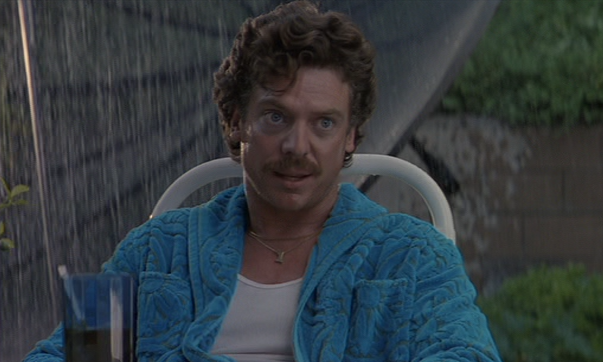
Louise is excited about breaking away from her dreary job by going on a short getaway with her friend, Thelma (Geena Davis). But in a phone call, Louise learns that Thelma hasn’t “asked” husband Darryl (Christopher McDonald) if she can go. Thelma shows how up to this point she is intimidated and subservient to her spouse. Darryl curses at her and is impatient with Thelma when she asks if he wants something special for dinner. He says he doesn’t “give a shit” what’s on the menu, exhibiting his uncaring attitude toward his marriage. He says his job workload on Fridays might prevent him from coming home for dinner. She questions why is it so busy on a Friday evening all of the time. There is an implication that Thelma suspects he’s having an affair, but she is too timid to confront him with an accusation. He is condescending as he says it’s a good thing she isn’t in his trade, the carpet business, which he makes sound like it’s equivalent to working for NASA. The two women have plans to go to the mountains where they can stay at a cabin owned by Louise’s friend. Louise says they can learn to fish since it must be easy if Darryl can do it. Louise can be comically insulting about Darryl’s intelligence since she knows Thelma must regrettably agree with her.
We initially find that Louise is the more rebellious one, but her protege, Thelma, surpasses her as the story goes on. Louise tries calling Jimmy (Michael Madsen), her boyfriend, but he is not answering, and his absence, playing gigs in his spare time as a musician, is a sore point for Louise, pointing to her belief that men are not there when she needs them. In her kitchen sink area, instead of the usual handle, there is a figure of a man straddled over the faucet that makes the spout look like a large penis. This image shows how Louise is sexually uninhibited, but it also conveys that she wants to be the one in control of how that spout is used. She drives a flashy Ford Thunderbird convertible. The Thunderbird is a muscle car,  and the bird it is named after, in Native American stories, causes lightning and thunder. Thus, the automobile is symbolic of Thelma’s desire for female empowerment.

Thelma starts the journey in a state of trepidation, and upsets Louise by bringing along a revolver for protection against psycho killers, bears, and snakes. Thelma tells Louise to hold the gun, thinking she knows more about how to handle it. This act sets the stage for what happens shortly, and is ironic, since Thelma will eventually show her ease with handling a firearm. She tells Louise that she wants to take along a lantern in case a psycho is after them up in the mountains and cuts off their electricity. Louise says jokingly that the lantern will come in handy, as if it will be a great deterrent against a maniac killer. Louise kids Thelma’s fearful logic by saying maybe she should take her car, too, in case the psycho steals their spark plugs, and then they will have spares.

Thelma says she didn’t tell Darryl about going on the trip. Louise is shocked but impressed that she defied her husband’s wishes, which, according to Thelma, is that she just stay home and never have any fun. Thelma just left a note and food to microwave. Thelma starts to hold a cigarette. When Louise asks what she’s doing, Thelma says, “Smokin.’ Hey, I’m Louise.” She is beginning to mimic her renegade pal, becoming her student. She is like a catholic schoolgirl escaping the priest’s iron rule. But, when Thelma hikes her legs up on the car seat, which can reveal too much as the wind blows up her skirt, Louise wants her to be a bit more modest. Her protective, motherly side appears again, which derives from what we later  learn was a traumatic event that she experienced while living in Texas before moving to Arkansas.
Thelma wants to go to a truck stop, but again Louise, showing her worry about being around strange men, wants to keep going. She eventually gives in when Thelma reminds her that Louise was the one who wanted her friend to “let down her hair,” and have some fun. They stop at the Silver Bullet (a sign that women may need a weapon like the one that kills werewolves, equating some men with the bestial monster). There are lots of people in this joint, playing pool, and listening to country music. Louise says she has not seen a place like this since she left Texas (which means she wanted to leave behind the life that this bar signifies). Thelma orders a Wild Turkey, with emphasis on the “wild” part, which shows how Thelma appears to want to cut herself loose from her constricted life (but which also points to the “be careful what you wish for” warning). Louise is worried about Thelma opening herself up to exploitation by reacting too quickly and extremely to her newfound freedom. Thelma, resembling a rebellious teenager, says it’s her vacation, and Louise is as bad as Darryl, trying to control her. Louise responds by saying she is just surprised because Thelma is usually so sedate. Thelma says she’s had it with being sedate. Louise plays along and also orders some alcohol, but Louise wants them to have girl fun, without men.
A handsome guy named Harlan (Timothy Carhart) hits on them right away. The waitress, (Carol Mansell) knows his philandering ways, and asks if he is bothering the women. Thelma says to the questioning Harlan that she and Louise were out looking for some fun. Thelma is an innocent who trusts and reveals too much around what the experienced Louise sees as a potentially dangerous threat. Louise tries to put the guy off, telling him to mind his own business, and blows smoke in his face. Thelma promises to dance with Harlan later, and after he walks away, blames Louise (who has those two sides to her) for sending out mixed messages about having a good time and then acting like a chaperone. Thelma says she knows that Louise is upset with Jimmy, and Louise’s plan is that once Jimmy sees she’s not around he’ll be begging her to come back. In the meantime, Thelma says she wants to enjoy herself. Harlan treats them to drinks. Thelma says to Louise that they should dance, but Louise thinks Thelma means the two of them, as can be seen by her bewildered look when Thelma goes off with Harlan. Again, Louise wants to keep the vacation restricted to themselves. Louise dances with a guy, too, and then they all do line dancing. But, Louise goes back to the table leaving her dance partner with a  regretful look on his face (Scott is good at getting the actors to convey their feelings without using words).
Thelma has drunk too much and, along with the dancing, feels dizzy. Louise says she is going to the restroom and then wants to leave. Harlan says Thelma needs to get some fresh air, and they go outside to the parking lot. Louise is in the Ladies’ Room which is filled with women doing their makeup and griping at each other about getting space in front of the mirror. The quick scene shows how women are put in the position of worrying about their looks so they can attract men. They are made to turn on each other in this competition with other females. Outside, Harlan starts to make advances, but Thelma says she has to keep walking, and wants to go back inside. Harlan just wants what he wants, and tries to hike up her skirt. He says he wants to kiss her, while saying he won’t hurt her. This reassurance is actually a reminder that the threat of harm is present. She says she’s married, and he says so is he. She says it to stop any sexual intimacy, but he acts like it’s okay as long as they will be consenting cheaters. His promise not to hurt her is a lie, and he hits her when she resists. When she fights back, he hits her hard twice, and says that she dare not hit him, as the thought of a woman using force to turn away an attacker won’t be tolerated. Harlan is ready to rape Thelma when Louise shows up pointing, appropriately, Thelma’s gun at his head. He backs off. After the two women start to walk away, Harlan says he should have raped Thelma, and uses vulgar language toward Louise. She then shoots him. Here, and in the rest of the movie, men who feel they have the upper hand are deprived, legally and illegally, of their power by Thelma and Louise.

Louise wants to flee immediately, and Thelma drives them away. Thelma is hysterical and wants to go to the police and say Harlan was trying to rape her. But, Louise, as we learn based on her own experience, knows the reality behind the situation they are in. Since Thelma was dancing and laughing with Harlan, society will not take her word that Harlan went too far. The implication is that the sexist legal system is prejudicial in blaming the female victim for encouraging the male sexual behavior, arguing that the male can’t be responsible for his actions once aroused. They pull over, and Louise, temporarily derailed by the situation, vomits, but then is able to take over the driving, and the situation. At a coffee stop, Louise says they must not panic. She tells Thelma that nobody saw them at the shooting. In response to Thelma’s objections, Louise says if Thelma wasn’t so into having fun they wouldn’t be in this situation. Louise here is practically taking the position that women who arouse men are at fault for the abusive actions that follow. Thelma rightly and shockingly asks, “you mean this is my fault?” Louise, after what happened to her in Texas, knows Thelma didn’t do anything wrong. Louise knows that you don’t blame the victim when it is the perpetrator who inflicted the suffering. Thelma calls home in the middle of the night, reaching out to her husband in her desperate situation. But, there is no answer, as we see the untouched note she left next to the uncooked TV dinner in the microwave. Darryl was out, probably cheating on his wife, so he is no help to Thelma in her time of need.
Harlan is dead, and Detective Hal Slocumb (Harvey Keitel) questions the truck stop waitress who says that the two women, whom she says she can identify, who were associating with Harlan, weren’t the type to kill him. She says Harlan’s ways caught up with him, and she hopes it was his wife who did him in, but it was probably an old girlfriend, or her husband that committed the crime. She seems to be trying to protect Thelma and Louise in an act of sisterhood (similar to the women in Big Little Lies).
While stopping at a motel, Louise says they need more money, and the two squabble about what to do next. Louise cries, and says she can’t go back to jail (does she know how rape victims are treated because she was incarcerated for what she did to her rapist?) While alone, Louise is very upset, vigorously wiping Harlan’s blood off of her, like a guilt-ridden Lady Macbeth. She calls Jimmy to get him to wire her money. She reaches out to her man, like Thelma did. When she asks Jimmy if he loves her, he gives a halfhearted “Yeah.” So she, like Thelma, feels that she can’t rely totally on a man. But, Jimmy is more decent than Darryl, and says he’ll get her the cash, which Louise says should be sent to Oklahoma City, where they will be headed.

While Hal’s boss, Max (Stephen Tobolowsky), says to put out an APB on the women based on the descriptions they have, Louise tells Thelma that after they acquire the money, she wants to head to Mexico. She wants to know if Thelma is willing to go with her. Louise doesn’t want to involve their men in what’s happened, so she tells Thelma to call Darryl and say they’re having a good time and she will be back home soon. But Louise also doesn’t want to involve Darryl and Jimmy more than necessary since she just doesn’t trust men after her violent encounters with them. Both Louise and Thelma feel increasing anger toward males. At a stop, Louise is hostile to a guy gawking at her, as she feels she can’t escape the leers of men. While on the phone with Darryl, Thelma can’t even get her husband to care about what she is saying. He just yells at her for taking off, and is annoyed because she has interrupted the football game he’s watching. He demands that she come home that night. She gets angry, says he’s her husband not her daddy, so he can’t demand anything of her. She is finally asserting herself with him, and tells him to go “f---” himself.”

On her way out of the phone booth, Thelma bumps into J. D. (Brad Pitt, in the role that put him on the road to stardom). She seems flustered, and the first thing he says is “crazy women.” Notice his use of the plural; he’s not just talking about one individual, but instead makes an unfounded generalization about “women” as a whole group. But, he is a great looking guy, and because it is difficult for women to break away from how they have been brought up, Thelma puts on some makeup in the car to enhance her attractiveness. J. D. is very mannerly and tells Thelma he needs a ride because he is trying to get back to school, which is an obvious line to anyone who has a lick of sense. She again, despite her being attacked by Harlan, is too believing and open, revealing to him that they are going to Oklahoma City. Louise blows J. D off. Thelma says he was so polite and wants to give him a lift, but Louise just looks at Thelma and says her name, as if to imply “why don’t you wise up,” especially given that they are on the run. Thelma goes into a store and buys little bottles of booze, even though the shopkeeper says it’s cheaper to purchase a big bottle. Thelma is mentally caught between two worlds: her “sedate,” in-her-place safety with Darryl; and the wild, fugitive mind-set to which she is trying to acclimate herself. Buying the liquor shows on the one hand that she wants to cut loose, but purchasing the tiny bottles lets her think she is still hanging onto her protected, married world by indulging herself responsibly.

Louise guns the car in reverse to get to the gas pump, which shows how even though she is trying to hold onto control, there is turmoil underneath wanting to break out. Thelma asks how long will it take to get to Mexico, which shows she is onboard with the plan, and Louise just smiles to show she is glad her friend is hanging in there with her. Thelma observes J. D. walking away from them, and says what a nice butt he has. Her sexual passion is breaking free, and she is acting more like the pursuer instead of the pursued. Louise, wary of men, diverts her by asking Thelma to find roads on the map to Mexico from Oklahoma City which do not go through Texas. Thelma points out how impractical it is to avoid Texas, but Louise won’t tell Thelma what happened there that makes her want to avoid the state.

We are not given a step-by-step exposition of the detective work here, since that is not the focus of the film. So, how Hal learns out about the identity of the women is not well explained, except someone at the truck stop described Louise’s car. As Hal shows up at Thelma’s place, and basically breaks in to gather information, we see the women singing in the car, feeling free despite the circumstances. They run into J. D. again, and Thelma acts like a dog begging for a bone, sexual innuendo intended, and Louise reluctantly gives J. D. a lift. Meanwhile Hal visits Darryl, tells him about the shooting at the Silver Bullet, and says his wife is involved.

While Louise drives, J. D. asks why Thelma has no children. She says her husband is too much of a kid himself and prides himself on being infantile. Louise gets off a zinger saying, “He’s got a lot to be proud of.” Thelma says she started dating Darryl at age 14 and married him at 18.  She candidly, and probably too quickly , admits to not having been intimate with anybody else. Her statement shows how limited her life has been. J. D. notes that the way Louise drove off the road (the symbol of the legal path) in a hurry to avoid a police car makes him suspect they are in trouble. He jokingly plays down his suspicions by saying maybe she has too many parking tickets. Louise, again not trusting men, wants to separate themselves from J. D., wisely not wanting him to know more about them in case he is later questioned by the police.

Hal reports to Max that Thelma and Louise never reached the cabin they were going to. He somehow finds out Thelma took a gun with her, but Darryl said she never touched it. The fingerprints on the car where Harlan was shot match those of Thelma, which Hal probably got from her house, but gain we are not given this information. Meanwhile, Jimmy surprises Louise by showing up at the motel where she is supposed to pick up the money. Jimmy gets two rooms for the women. While alone, Thelma says she thinks that Louise really likes Jimmy, but Louise says he just likes the “chase” part of going after a girl. Louise shows her cynical attitude about men and romance here. Thelma, following up on the “chase” line and the fact that they are on the run, jokes by saying Jimmy “sure got his work cut out for him now, don’t he,” Louise, not in a joking mood, then tells Thelma to guard the money. Why she gives the cash to Thelma doesn’t make much sense, except as a contrivance to present a problem later in the plot.
In the room they are sharing, Jimmy wants Louise to tell him what’s going on. He displays his temper when she doesn’t respond, knocking over a table. Louise, who will not tolerate such aggressive male behavior, starts to leave. He calms down, and then offers her an engagement ring. He says he was afraid he was going to lose her, but she says that’s not a good reason to get married. She says she thought it’s what she once dreamed of, but given what’s happened, she no longer sees a romantic relationship with a man as being possible in her life. He says that she’s not the only one who didn’t have their dreams come true. She says to him what she said once said to Thelma - “we both got what we settled for.” She seems to be saying that they are all responsible for having low aspirations, capitulating to the burdens the world places on them.
We have the two women paired off, as J. D. shows up at Thelma’s room. While playing a slap-hand game, J. D. says Thelma has to take off her hand jewelry, including her wedding ring, which symbolically makes her free to be with him. She knows he’s no student, and he admits to robbing liquor and convenience stores, and a gas station. He’s also on the run, having violated his parole. Since Thelma is on the off-road to breaking rules, she is intrigued by him. She picks his brain about his robberies. He says he checks out a place, and his rendition of what he says when he robs an establishment is very civilized and humorous. He says, comically, that armed robbery doesn’t have to be such a negative experience. It can be something to tell your grandchildren about, sort of an upside-down version of a benign anecdote. Thelma and Louise don’t seem to be cut out for lasting relationships. Their intimacies here with men are brief. Louise has sort of a goodbye tryst as she is nostalgic about how she and Jimmy first met. In contrast, Thelma’s lovemaking with J. D. contains the heat of her first true passionate encounter.

Before he leaves, Jimmy promises he won’t say anything about seeing Louise. At breakfast, Thelma has mussed hair, and love marks on her neck. She says now she knows why there is so much fuss about sex, having broken the rules by indulging in an extramarital fling to achieve her physical self-fulfillment. Louise, in a kind of odd motherly tone treating the grown Thelma as her child, says she is so happy “you finally got laid properly. That’s so sweet.” She almost sounds as if she is praising her daughter for getting a part in the school play. But, Thelma’s gain comes with a cost when Louise realizes Thelma left J. D. alone with their money, which he ran off with. So, even though Thelma had a life-altering experience, in the end, the man still exploited the woman. Louise breaks down, feeling powerless. Thelma, learning from her mentor, takes charge and says it will be okay. Thelma tells Louise not to worry, and she is the one who tells her they must get going. Louise was previously the one to urge moving on. Thelma now takes command.
The cops show up and tell Darryl that they tapped his phones and want to try to figure out where his wife is. They tell him don’t let on that he knows anything about what happened. Max tells Darryl to be gentle on the phone and say how much he loves Thelma. Darryl looks like this advice sounds crazy to him, as if expressing affection is alien for a man. Max says, “women love that shit.” He is just as guilty of not being able to understand women, implying men aren’t really sweet and caring by nature, but they just have to pretend to be once in a while to get what they want from women.
While Thelma goes into a market, Louise gazes at some old women in a building. The expression on her face implies that she is thinking about how she will appear when she ages. Her fear of losing her attractiveness is evident as she starts to put on some makeup (mirroring Thelma earlier), because she, too, as a woman, has been programmed to be constantly concerned about how she looks. Louise’s lapse into traditional female role playing is placed in counterpoint to Thelma’s unladylike running out of the store after robbing it. We see on the surveillance tape reviewed by the cops that Thelma used J. D.’s amusing style to rob the place. She said, “Who will win a prize for keeping their cool.” She said the people in the store had a choice. They will either have an interesting tale to tell their friends or will get to wear toe tags. She says, “If nobody loses their heads, nobody will lose their heads.” The policemen and Darryl watch the tape and are practically rendered speechless by Thelma’s audacity, showing how she derailed their expectations that she, as a woman, would act meekly. Louise says maybe Thelma found her calling, and Thelma says it’s “the call of the wild.” They are now outlaws because playing their prescribed parts in the male world was like being in jail already, and now they whoop it up because they feel liberated from their gender prison. Yet, ironically, they still follow some of society’s rules, trying to find an anchor that will stop them from being totally socially adrift. That is why Louise, despite their other serious infractions, tells Thelma, in comical contrast, not to litter.

At a rest stop, Louise takes off her jewelry, just as Thelma removed her rings when she was with J. D., and exchanges the objects for an old man’s hat. It’s as if she doesn’t want to devalue herself anymore by being adorned in order to be pleasing to a man’s eye. The women discuss their legal stance by admitting that there is no evidence showing that Harlan tried to rape Thelma. Louise humorously says they can’t argue Thelma’s stealing from the store was allowable since there is no such thing as “justifiable armed robbery.” So, the legal system comes up short for them since it won’t give enough weight to their word about what happened.

Even though Jimmy said he wouldn't say anything about meeting Louise, once the police confront him, we find out that he told the cops that he delivered the money to Louise. This is another example of a woman being betrayed by a man. Darryl is at the police station when J. D. shows up, whom the cops bring in for questioning because he has on him the same amount of money that Jimmy delivered. Jimmy told them he saw J. D. with the women at the motel and then identified J. D. from mugshots. Alone, Hal, who seems to be the only one with sympathy for Thelma and Louise, blames J. D. for having stolen their money that caused them to commit the robbery. Otherwise they would have had a chance to prove why there was violence at the Silver Bullet. Darryl’s ego gets knocked down another peg when he is humiliated as J. D. lets him know he had sex with his wife.

Louise wants to know if the police are onto them so she wants Thelma to call Darryl (Don’t they realize that the store Thelma robbed would have a surveillance camera?). If Thelma suspects by the way Darryl reacts that there’s something not right, she is supposed to hang up so as not to be traced. Since he is never nice to Thelma, all Darryl has to say is “Hello” in an upbeat way to make Thelma hang up and say he knows about their situation. Louise calls back to talk to the cops. Hal says they have not charged them with murder yet, and they just want them for questioning. He says he doesn’t think they will make it to Mexico. Louise hangs up, and is angry, as Thelma admits that she told J. D. about going to Mexico. Louise says what they had “going for them” was the police didn’t know where they were or where they were going, and now “that’s gone.” Louise tells Thelma she has to stop being so open with people. They are fugitives now, and have to start acting like it. Here, Louise pulls away from her inertia and starts to deal with the situation again.

Driving at night through the southwestern part of America, Thelma comments on the beauty of this natural (that is, uninhabited, unrestricted) landscape. She says she always wanted to travel but never had the opportunity to do so. Louise says now she has. Through crime, ironically, Thelma gains freedom to do what she couldn’t while enslaved in her gender bondage. Louise stops and gets out to look at the territory, losing herself in its vastness. Maybe she is already thinking this place is where it will end for them. Perhaps society is not a place for women who defy men’s power. On the road again, Thelma starts laughing hysterically as a release from the horror of killing a man. While giggling, she says, of Harlan, “Guess he didn’t expect that.” Louise says it’s not funny. Thelma guesses that’s what happened to Louise, that she was raped in Texas. Louise stops the car and says emphatically that she is not going to talk about that. So, even though we don’t have the details, we understand, while not approving, of why Louise shot Harlan. It was a sort of retribution against all male sexual aggression.

A trooper pulls them over for speeding. He swaggers over to their car, oozing macho intimidation, gets Louise into his car, and is ready to use the police radio. Thelma comes up with her gun and puts it to his head. His bloated manliness is immediately deflated. The women are very polite and apologetic, still ironically adhering to certain social conventions, with Thelma saying if he gets on the radio he will find out they are wanted in two states, and that will ruin their plans. She tells Louise to take the officer’s gun and shoot the radio. Flabbergasted by Thelma’s calm strength, Louise comically shoots the car radio, and Thelma has to tell her to shoot the police radio. Thelma tells the trooper that one would never have thought they were capable of this behavior just a few days ago, but if he had met her husband then he would understand. Thelma shoots holes in the trunk so the officer can breathe. Before getting into the trunk, the cop, completely stripped of his inflated male authority, starts to break down in tears and says he has a wife and kids. Thelma says he’s lucky. She tells him to be good to his wife. Her husband wasn’t nice to her, and “look how I turned out.” So humor upends the seriousness of the scene, but turns it into a cautionary warning to all men (see Dietland, The Handmaid’s Tale) that if they don’t cease their abuse, they will pay for it.

Both women are practical now, getting used to their fugitive situation. They pick up extra ammunition from the trooper’s car. Thelma says it’s crazy, but she seems to have a knack for being an outlaw, her rebelliousness having been dormant, waiting for a chance to surface. Louise now shows some regret saying that they could both get killed, and maybe they should have gone to the cops, as Thelma had suggested early on. In a complete reversal, Thelma is a convert to realism, no longer believing that they would get justice within the system. She says that nobody would have believed them because of the way she was dancing with Harlan. She says people would have said she was “asking for it.” She says Harlan had hurt her and would have hurt her worse if Louise hadn’t shown up. Her life would have been ruined anyway. At least this way Thelma says she’s having some fun. She only regrets she wasn’t the one who shot him.

Max says Thelma and Louise are either smart or lucky they have not been caught yet. Hal, in a dire forecast about those who buck the system, says brains will “only get you so far and luck always runs out.” Louise calls Hal, and in response to his question about where she is, she says they are not in the middle of nowhere but can see it. Both women have developed a sort of gallows humor. She says it was just an accident how all this happened, and Hal says he believes that was the case, But it has snowballed, so now Louise says she thinks of the words “incarceration,” “cavity search,” and “death by electrocution.” She’s starting to feel that coming out alive doesn’t sound so appealing, which is a foreshadowing of the end of the film. Hal says he knows what happened to her in Texas, so he understands her motivations. She hangs up, but the police traced the call. Hal wants to be at the apprehension to keep things cool, because in these situations, he says, “the volume gets turned up,’ and Hal thinks the girls will get shot.

Louise wanted Thelma to commit to going to Mexico, but now it is Thelma who wants Louise to assure her that she isn’t giving up. Thelma says something inside of her has “crossed over,” and she can’t go back. She is beyond the point of return in her mind, the place where one has broken the rules and no longer can abide by them. Louise promises that she won’t make any deals with the police which would compromise their freedom. Louise says that Hal said they will be charged with murder, and their only choice is between coming in dead or alive. Thelma, again using gallows humor, asks, “Didn’t he say anything positive?”


Thelma, while riding along, says she is wide awake, more awake than ever before, seeing things in a different light, like a woman no longer having the wool pulled over her eyes about the role she was told to play. She is like Neo being given the truth about the falseness of his world in The Matrix. Thelma says she is looking forward to Mexico, and Louise says they will be sipping Margaritas. They ride along enjoying loud music. They keep running into a vulgar trucker who makes overtly sexual propositions. They finally engage him and when he asks if they are ready to get serious, Louise says “I think so.” But, she means to get serious in a very different way from what the trucker thinks. They pull over, and, he, like the trooper, swaggers over to them, ready to party. They tell him his behavior is lewd and disgusting. They ask how would he like it if men treated his mother, sister, or wife the way he treated them? Louise demands an apology for his unacceptable behavior. He just curses them. Louise then shoots out the tires on his rig. He just curses them more. They then shoot at his tanker and it blows up in flames. He, along with Harlan, Darryl, and the trooper, have been, literally or figuratively, shot down off their perches of abusive power.
After the phone trace, the police are now in pursuit of the women, and a car chase ensues. Louise’s fancy driving creates some Keystone Cop entertainment as the police cars get demolished, either getting involved in collisions, getting caught under a low bridge, or flipping over. The comic scene still illustrates the theme of the women undermining the male show of force. Thelma says no matter what, she’s glad she went along with Louise. With more gallows humor, Louise asks how does Thelma like the vacation so far? Thelma says she went a little crazy, and Louise says she always had it in her, just now she took the opportunity to express her outrageous side.


They are going so fast that they swerve at the end of the road and realize that they are looking at The Grand Canyon. Thelma says it looks beautiful, and perhaps so does death, now, given the alternatives. The openness of the wilderness that made them feel free is now invaded by the males hunting them. The attractive view of the Grand Canyon is undermined as the police helicopter swoops up in front of the scenery. The women have run out of alternative routes, and of freedom in this life. The men are there with their guns, their show of force, telling them again what to do. They are told to raise their hands. Otherwise, it will be considered an act of aggression against the police if the women are not subservient. Hal says to his boss, Max, “how many times can these women be f----- over?” Thelma says let’s not get caught, but instead, keep going. Louise kisses Thelma, who may really be the love of her life, and they grab hands as Louise bravely floors the car. We see various scenes that represent their lives flashing before our eyes. These two can only be free by driving into the canyon itself, merging their outlaw souls with its natural sovereignty.

The next film is Blow-Up.

Sunday, August 12, 2018

Kiss of the Spider Woman

SPOILER ALERT! The plot will be discussed.
The title of this 1985 film continually scrolls across the screen in large letters as the titles are displayed. In the context of this story, this technique implies that the imaginary story told in this movie within a movie can block out reality and divert the audience from the harshness of the world.
And what a harsh world the story presents. The first shot is of the shadows cast by the bars of a prison cell on the wall. Mixed in with the drab clothes hung around the enclosed space, however, are drawings and movie star photos displayed on the walls, contributing to the theme of imaginary escape. Luis Molina (William Hurt, who won the Best Actor Oscar for this role) melodramatically tells the story of a favorite film of his. He wears women’s make-up and he has a scarf wrapped around his head which covers his moderately long hair. He wears a colorful robe, engages in slow, fluid movements, and speaks in a sensuous manner. The result is the presentation of one of the first sympathetic transgender characters on screen. In contrast, Molina’s cellmate is Valentin Arregui (Raul Julia), who has a macho scruffy look, complete with unkempt hair and beard, and wears a bland shirt and pair of jeans.

We are not given a specific time or location, but it appears they are in a Latin American country in the present day that is controlled by a brutal dictatorship. Molina’s exaggerated descriptions of the woman in his story grate on Valentin, who wants to edit the story, making the woman have black eyes (possibly reflecting the darkness of his personality). Valentin says the woman in the tale has not met that special man she seeks, not because of the frustration of not finding a perfect love as Molina suggests, but because she probably has bad breath. Molina is the romantic and Valentin is the realist (not unlike the two characters in When Harry Met Sally …, which was discussed last week, only here the story is very serious).

Molina’s story is set in Paris during the Nazi occupation. The setting epitomizes a brutal world that still contains the hope of true love (which is what this film is about). He tells of men dealing in contraband, and describes specialty foods. Valentin demands that the story not contain food or naked women. They just remind him of what he can’t have in the prison. Molina seems concerned about Valentin’s health. Valentin admits that his back hurts. He says he is sweating because his fever is breaking, so the health issues here are daily, tangible problems. The disparity between Molina’s romantic story and the brutal nature of incarcerated life suggests the need for imaginative escape when there is physical bondage (another example of this theme exists in the satire, Brazil, which is the country where Molina and Valentin may be confined). Indeed, Valentin, reflecting his take on life, critiques Molina’s movie because he says there is no reality in it. Valentin was a journalist, but the stories he told were of real events. In Molina’s story, he describes thugs, who are stealthily observing the Nazis, wearing hats that he thinks makes them Turks. But, Valentin says they were yamakas and he angrily says Molina’s movie is a Nazi propaganda, anti-Semitic film. Molina seems clueless about politics. He is only interested in the story of the lovers, not in the historical backdrop of the story, again stressing the difference in the two characters’ perspectives.
Molina continues the story, which he admits contains his “embellishments,” (his creative collaboration with a fictional work) and introduces the German head of intelligence, Werner (Herson Capri), who is at a club. Also there is a cigarette girl, Michelle (Denise Dumont). The club’s singer, Leni (Sonia Braga) performs her act. Michelle gets a call from the French Resistance telling her to get a Nazi map showing the location of German weapons. The diverting story is interrupted, and thus, escapism is undermined, when a new person arrives at the prison who is bleeding profusely. Valentin concludes he is probably a political prisoner, since the authorities don’t hurt those in custody to such an extent if they only “stole bananas.” The fascist regime sees the real threat to its existence as being those who challenge their rule, like Valentin himself, as opposed to actual criminals. Molina says he wishes he could be with a blonde, handsome cellmate, since Valentin is so moody. Valentin tells Molina that he is boring, but Molina says that Valentin doesn’t know that much about him, except that he is gay and was arrested for seducing a minor. Molina says that he doesn’t care about politics, only how handsome the men are, showing his desire to evade a world that would judge his sexuality. Valentin criticizes Molina for liking blonde, Germanic types, Werner being one of them, and implying that Molina’s focus on sex and romance alone allows political repression to take hold. Valentin wonders why his interrogation stopped a week ago, which is a hint at some subterfuge that will be revealed later.

The story that Molina tells begins to mirror what is going on between Molina and Valentin (whose name sounds like Valentine, which is ironic for someone who seems, at least through much of the movie, to be anti-romantic). Michelle confesses to Leni that she is pregnant by a German officer, and feels as if she is a traitor to her country. Leni questions how she can fall in love with the enemy, but Michelle says love knows no national boundaries. However, what makes it worse is that Michelle works for the French Resistance. (Molina says he identifies with the female singer, because his inner self always wants to be the heroine in his stories, wanting to feel the depths of emotional love, as opposed to adopting the traditional male stoical persona). This conflict between love and allegiance to a cause is distasteful to Valentin, and he criticizes Molina, as a gay man, for romanticizing any relationship with Nazis who would exterminate someone with a homosexual orientation. Valentin tells Molina that he isn’t facing the facts with his movie fixation. He tells Molina that there is no escape for him. But, Molina says he will escape in his own way, through his immersing himself in his fictional story. Valentin’s reaction is to say that Molina’s life is as trivial as his movies, which shows Valentin trying to invalidate the power of imagination.

Molina offers Valentin some delicious avocado, but Valentin says he doesn’t want to get used to something satisfying because it will make him weaker. He sees the food as a sort of forbidden fruit being offered by a tempter to divert him from his righteous path. He is so invested in his social fight that he can’t indulge in personal delight. The two-line exchange that follows between the two sums up the film. Molina says it is okay to enjoy the pleasures that life offers him. But, Valentin counters by saying what life offers him is “the struggle.” Molina advocates being a hedonist, taking advantage of whatever joys life offers. Valentin is more like Sisyphus, destined to continue to push up against the woes that the world rolls down upon him, like a huge rock. Molina asks if Valentin has a girlfriend, and if so, does she also deny herself pleasure. Valentin says the most important thing in life is to support a cause that is noble, and his woman knows that is what is important. Valentin angrily says that Molina’s talk is like that of a woman. Molina, sounding very contemporary to our time, says what’s wrong with that? He asks why should women only be sensitive? Why can’t a man also be emotional? He argues, effectively, that then there wouldn’t be so much violence in the world, implying that empathy for suffering would inhibit the hurting of others.

The warden wanted to see Molina, who tells Valentin it was because his lawyer called and it appears that Molina’s parole is out of the question. When Valentin asks how did the warden treat him, Molina says “Like a faggot.” Molina looks defeated and disgusted by his life in a harshly judgmental society. Molina feels guilty because his mother has high blood pressure, which Molina feels has been aggravated by her son being imprisoned. Valentin, generously thinking here that escapism may be what’s best for Molina, says he can continue with his movie. In Molina’s movie, Werner’s limo is at the stage door, and Leni joins Werner, which seems hypocritical since she criticized Michelle about falling for a German. Meanwhile, Michelle is followed by men from the Resistance, who know she hasn’t delivered the map, and is meeting her German soldier lover. The men see her as a traitor, and run her over with their car. In a reversal of approaches to the story, Valentin is actually moved by her death, and Molina plays it down, saying it’s only a movie. They now seem to be capable of looking at things from the other’s standpoint. Valentin admits that the story was relevant to his actual situation because it made him worry for his girlfriend. Molina says Valentin should write to her urging her not to be reckless. Valentin counters by saying nothing will be accomplished if one doesn’t take chances. Molina now attacks Valentin’s commitment to what Molina sees as a doomed cause, and says it is Valentin who is living in a fantasy if he thinks his political solution can be achieved. But,Valentin shows his scars from being tortured, and says he does not indulge in fantasy. Molina is disturbed by seeing the wounds and apologizes. Valentin says there will be a victory, so he is now looking for hope amid the negativity around him.
But, Valentin has trouble dealing with his predicament. He paces the cell like a wild animal in a cage. He is starving, yet wants Molina to take the plate with the bigger portion that was delivered to their cell. He says their jailers deliberately offered the disproportionate amounts to cause fighting between them so that they would be more easily controlled if they are divided against each other. Molina urges Valentin to tell his girlfriend how much he loves her if he writes her a letter. But, Valentin says that will expose her, and what is keeping him alive is if he retains some information as leverage. Valentin admits to worrying that his girl is also being intimidated to divulge secrets. He seems to be straddling between being concerned about the cause and the welfare of individuals.

Molina shows how he also sees the story from the movie connecting to his real life, and he demonstrates his deep, feminine emotions. He cries about the lovers in the film, because he identifies with how difficult it is to find the right man. He confesses to having been hurt romantically many times. He replaces the story of the film with a true one that feels like a film to him. He fell for a waiter who had a “sad smile” and Molina worked hard just to get him to take a walk with him. After a year they became friends, but the guy was straight and married. Valentin, taking the typical male pose, says he should stop crying about it and should “take it like a man.” But Molina, true to what he feels he really is, says, “I take it like a woman.” Valentin asks what does he feel is a “real man.” Molina says a real man for him is handsome, tall, and doesn’t flaunt his strength. Valentin correctly points out that those are just surface poses. He says a real man does not take anything from others, but especially does not humiliate anybody, and does not allow people around him to feel degraded. Typically, Molina’s outlook is more physically tangible, and Valentin’s is more philosophical.
Molina becomes sick to his stomach after eating the unequally portioned meal, and says it could be his ulcer. As a distraction, he tries to resume his story. He say the resistance men lie to Leni, saying the Germans killed Michelle, and tell her she must find the map to the German arsenal from Werner. She manages to escape from them. But the tale is again interrupted as Valentin calls for help because Molina is very ill. It’s as if the reality of sickness undermines his desire to immerse himself in his fantasy. In the infirmary, the doctor tells Molina to only drink clean water if he can find it, emphasizing the harshness of the reality of Molina’s non-movie life.

Back in the cell, and because the film story shows both Michele and Leni falling for men that are their country’s enemies, Molina wonders if Valentin has ever fallen for someone he shouldn’t love (this is an ironic foreshadowing of what happens later). Another prisoner is killed, and Valentin, in his outrage, stirs up the other prisoners, calling their captors fascist murderers. Valentin is angry with Molina, again saying he is telling a pro-Nazi story. He reminds Molina that Nazis killed Jews, Catholics, and gays. Molina cries because of Valentin’s outburst. Valentin says he may sob like a woman, but he is denying the truth all of the time, because Molina has a penis and is still a man in prison, and that is reality. Molina says it’s a mistake, and he would cut it off if he had the courage. There is a flashback to Molina being sentenced to eight years in prison. But, in a very real way, Molina has been a woman confined in a male body, so he has been in prison his whole life.
Valentin now becomes sick after eating, but doesn’t want to go the infirmary because he feels the authorities will try to get him to inform by using his illness as leverage. Molina resumes the story to take Valentin’s mind off of his agony. He talks about Werner and Leni dancing and listening to music so he can soothe Valentin. As he says what happens in the movie, Molina covers Valentin with a blanket, and strokes his head. Later, he says how Leni hears her lover, Werner, ordering executions and is horrified that she must, out of national duty, betray Werner. In a break from the storytelling, Molina makes Valentin laugh as he pretends to have breasts, using avocado skins. But, again, escapist fun is interrupted by punishing reality as Valentin can’t even use the bucket because he has to defecate so quickly. As Molina tries to comfort Valentin, there is a drawing on the wall next to Molina of a skull and crossbones, an ominous symbol, usually associated with poisoning, and Valentin believes that he has been poisoned. He is embarrassed for soiling himself. But Molina uses Valentin’s own words and tells him to take it like a man. Molina, appearing generous, shares his clean clothes saying they are “ours,” and is willing to clean Valentin. Here, Molina is willing to deal with the unsavory reality in front of him, despite Valentin saying he, the so-called realist, maybe couldn’t tolerate something so disgusting. Possibly Molina can confront unsavory business when he has to, because he knows what it is to have others feel disgust for him. Valentin admits that Molina is very kind, (which turns out to be a somewhat ironic statement), but Valentin still does not trust easily, and he seems concerned that he may have divulged secret information while asleep.
Molina assures Valentin that all he said was a woman’s name, Marta (also Sonia Braga). Valentin admits, in a moment of trust, that she is not his girlfriend in the resistance. Marta is from a well-to-do family, so Valentin confesses that he is a hypocrite for loving the enemy of his cause (just as Leni cares for Werner). But, she was useful to him, because, before he was imprisoned, he was able hide from the authorities at Marta’s place. He revealed his resistance activity to Marta, who, out of concern for Valentin’s safety, asked him to leave the movement. He said he couldn’t, because, again, he placed his happiness below fighting for his cause. Because her first priority was love, Marta told Valentin not to come back if their relationship was not what he valued most.

Valentin attempted to help Dr. Americo (Fernando Torres), one of the original resistance leaders, by giving the man his passport so he could leave the country, and spread the word of their struggle to the outside world. Valentin, showing his dark pessimistic side, says during all the time Americo was a leader, he had accomplished hardly anything. Valentin, although believing in his fight against oppression, admits to not being so unselfish as to be a martyr for the cause. He pleads with Molina to not let him die. Molina promises to help him.

But then the film reveals a secret to the audience. This time, we witness Molina meeting with the warden, and we see that he has made a deal for an early parole. He agreed to be an undercover spy and report any information Valentin might disclose about the resistance. Molina assures the warden that Valentin doesn’t suspect him (which we can believe, because most of us didn’t realize he was involved in something covert). There was poison in the food, as Valentin suspected. Molina became sick first because Valentin had insisted Molina eat the bigger food plate which had been tainted. Molina couldn’t refuse that dish or Valentin would have become suspicious. The next time, Molina did give Valentin the plate with the poison. The warden, wanting Molina to stick with their deal, tells him that his mother was doing better knowing that her son would soon be released. There is a policeman with the warden who wants Molina to get the code name of a recent prisoner once Valentin recognizes him.
Molina gets the warden to provide a bag of supplies and food that he said his mother would bring. Otherwise, Molina argued, Valentin would be suspicious if it didn’t arrive. But, Molina actually wants to get these goods for Valentin. Molina shares food, cigarettes, and clean sheets with Valentin. Valentin now says he wants to hear how Molina’s movie story ends, but he may just want to indulge Molina as a thank you for the supplies. Molina says that in the film, Leni is angry at Werner for butchering her country. In response, he shows her footage of poor people in places where the elite have hurt lower classes. He paints himself as a liberator of the underprivileged.  Leni then makes a commitment to Werner to betray the resistance men. She arranges a meeting with the resistance leader to give him the map. (The movie within the film has to do with betrayal, as does Molina’s supposedly working for the warden). The resistance leader tries to ravish Leni (this may be, as Valentin suggested, a Nazi propaganda movie, but it also points to the fact that not all people in a good cause are necessarily good people). She is able to stab her attacker and retrieve the map. Werner appears and shoots one of the leader’s associates, who gets off a shot that kills Leni. Werner says her sacrifice was not in vain. Ironically, what Werner says resembles what Valentin had said about the cause being what was most important. People may be genuinely committed to a movement, even if that crusade is not a just one.
Valentin hears a man suffering, and eventually reveals that the man is Americo, the one to whom he gave his passport. Molina does not divulge any information to the authorities, despite his acting as if he is trying to ingratiate himself to find out information from Valentin. Americo is killed, and Valentin goes into a rage. Molina manipulates the warden by saying that if he can tell Valentin that Molina will be released soon, then, Valentin will be willing to bring Molina into his confidence. Back in the cell, Molina shares candy, but Valentin says he doesn’t want to be indebted to Molina, because Valentin does not feel he can be as generous. Molina tells Valentin that even if he is paroled, he is still imprisoned by the society at large for his sexual orientation.
Molina starts to tell another story about a woman (Sonia Braga in a third role) on a faraway island who was caught in a spider web which came out of her own body. A man washes up on the beach, and she nourished him back to life. When he awakes he looks at the spider woman and she has a perfect teardrop on her face. In a way, Molina is comparing himself to the spider woman, caught in his own web because he can’t conform to the ways of the world around him, and Valentin represents the man she nurses back to health. Molina says he is suffering because he has fallen in love with Valentin. As a form of gratitude, Valentin allows Molina to touch Valentin’s facial scar, a sort of symbolic healing act. Molina rests in Valentin’s arms, and submits to Molina’s love as they then have sex.
The next day, Molina says he is so happy to the point that he feels like he won’t be unhappy again. Molina is back in the warden’s office, but says Valentin revealed nothing about the resistance. The policeman is angry and rightfully accuses Molina of having fallen in love with Valentin. The warden still grants Molina his parole. Valentin wants Molina to deliver a message for him to the rebels, but Molina says he can’t because he is afraid that the police might find out. Molina says he wishes he could be with Valentin. Valentin says he will miss Molina, too. He wants Molina to promise him not to let others exploit him or humiliate him, which is exactly what the authorities have been trying to do. Molina changes his mind and agrees to deliver the message. They kiss goodbye.
But, the authorities expected Molina to collude with Valentin, and that is why he is released from the prison. The police follow him to see if he will lead them to the the enemies of the government. Molina appears to be accepting that he will meet his end. He returns home to his mother and goes to a gay bar to see friends. He seems sad because he is actually saying his goodbyes. A policeman says Molina has not returned to work and mostly stays at home, which is further evidence that Molina is accepting that his helping Valentin will lead to his death. Molina tells the waiter, whom he cared for, that he won’t be seeing him for a while, and is going away. The movie star pictures on the walls of his room at his mother’s house help to stress the contrast between the escape into the fantasy of films with the dangerous action Molina is about to take. He calls the resistance number that Valentin gave him, whom he must meet in person. As further proof that he knows how things will end for him, he withdraws his savings and gives them to a friend to hold for his mother. As his mother sleeps, Molina says that he must now take care of his own life. On his way to the meeting, Molina sees the cops tailing him, but he feels that he must get to the meeting. A car pulls up and Molina says he has a message, but the police burst onto the scene, shooting. Molina runs after the car, but Molina is shot, ironically, not by the police, but by the resistance fighter who assumes Molina has betrayed them. Molina won’t divulge the phone number Valentin gave him to the police, and he dies remaining loyal to Valentin. The cops just drop his body in a dump. The official report says that he was more involved with resistance forces than they thought and was willing to die rather than be compromised. The truth is that he was involved with one person, and unlike those who care primarily for causes, was dedicated to an individual more than a political movement.

Valentin has been badly tortured. He dreams about Marta, the rich girl he loved. In the dream, she takes him away to a beach, and they row away on the water. It is filmed in black and white, which makes it seem unreal, but then the scene changes to color, making it more believable, and the dream substitutes for reality. Valentin now, as did Molina, escapes into an illusion, which is what a movie is, because sometimes we only find refuge in our imagination.
The next film is Thelma and Louise.

Sunday, August 5, 2018

Dial M for Murder

SPOILER ALERT! The plot will be discussed.
This post, as have others, comes out of a film class at the Bryn Mawr Film Institute. Since Alfred Hitchcock directed this 1954 film, I couldn’t help but want to write about it. The instructor was Dr. Andrew Owen of Cabrini College, and he focused on how the movie presents the discrepancy between the appearance of civility and compliance with accepted moral behavior, and the social transgressions by characters who try to hide their darker natures.

The story takes place in England, and the opening shot is of a “Bobby” being watchful over the street below the flat belonging to our main characters. It is a bit of an ironic image, since what will take place out of the sight of the policeman are unethical and illegal acts. (However, the police come off better here than in other Hitchcock films, where the authorities are usually incompetently seeking an innocent man, such as in The 39 Steps and North by Northwest).

The home of Tony Wendice (Ray Milland), and his wife, Margot (Grace Kelly), is well appointed and pleasing to look at. The first appearance of the two has Tony giving Margot a good morning kiss, a little bit of token affection, because it is required, with no passion, as Margot doesn’t even remove her hands from her morning newspaper. It appears staged, which is in reality what it is, being a movie based on a play. Tony looks well dressed as does his wife. There is no communication between them, no feeling of true intimacy, and they just exchange smiles that seem pasted on their faces. She is wearing conservative clothing in the brief shot. We then switch to the next scene where Margot has on a sexy red dress (which, as our instructor observed, is equivalent to her wearing “The Scarlet Letter”), as she is now in the arms of her secret lover, Mark Halliday (Robert Cummings). (Something similar occurs in Psycho, where Marion Crane’s underclothes change from white to black after she steals the money). So, the first shot of a seemingly content married couple was a fraud.
Margot tells Mark, an American who writes mysteries for television, that her husband has changed. He decided to end his professional tennis career so that he could stay home to be with her. She says she burned all of Mark’s love letters to her except one, which was stolen when her purse went missing at a train station, along with some money. The audience never learns the contents of the letter, except for a hint that it may have been very romantic. It is really just a tool to further the plot. Margot says she received a blackmail note from whoever stole the purse and the letter, and she paid out £50, but the money was not taken and she didn’t get the letter back. Margot originally wanted to tell Tony about her affair with Mark, and leave her husband for her lover, but she now seems ready to call that plan off.

We soon get a sniff that Tony has his own dirty secret plans. After Mark is introduced as a visiting acquaintance of Margot’s, Tony convinces the two to go out without him. He says he needs to work, which turns out not to be true. Tony, who always speaks politely even while he tells a lie, instead uses this private time to phone a person to buy a car. He says he wants the man to come to his flat because he sprained his ankle, which also is not the truth. The man, Charles Swann (Anthony Dawson), who has adopted aliases, turns out to be an ex-classmate of Tony’s from Cambridge, and he appears in a class picture that hangs on the wall in Tony’s flat. The luring of Swann to buy his car is a ruse, and Tony now abandons the cane he used to fake his injury. Swann then knows there is something unexpected going on. Tony has done his homework and knows Swann has a criminal background, and has followed him, discovering his activities, and implies that Swann murdered a woman for financial gain. He tells Swann that he knew about his wife’s affair, and at first thought of killing Mark. He then says he thought better of it, and realized that it was more logical to do away with his wife, since he can inherit her substantial estate. Tony’s easygoing manner, his appearance of normality, is undercut by the abnormal content of what he is actually saying. Tony reveals that he has been planning his crime for quite a while, so his decent behavior toward Margo has also been a sham. He pretended to want to be near his wife, so he retired from tennis. He was the one who stole the letter and sent the blackmail note to confirm that his wife wanted to hide her affair. He pretends (more deception) to drop the love letter so that Swann picks it up, thus getting Swann’s fingerprints on the envelope. Along with the evidence he has concerning Swann’s illegal activities, he now can blackmail him because he can say that Swann stole the purse and was trying to extort money from the Wendice’s. Tony knows that along with the “stick” to get Swann to do his bidding, he also must offer a “carrot.” Over time, Tony has withdrawn small sums of money to build up a cash reserve. He exchanged the withdrawals for other bills along the way to make it difficult to link him to the money he now offers Swann to kill Margot.
Tony has swiped Margot’s key to their place. The plan is to place it under the rug on one of the steps of the staircase outside of the inside door to the flat. Tony points out that the outside door is always open (in its own way a deception, since it would appear to most to be locked). Swann will use the key to get inside the flat, and return the key to its hiding place. Tony will have an alibi by attending a stag party with Mark, pretending to enjoy his company, and probably giving Tony inner satisfaction that he is enrolling the unknowing Mark in the plan to murder his lover. Tony will pretend to call his boss, but actually phone the flat first, causing Margot to get out of bed. When she answers the phone on the desk in front of the French doors, Swann will come out from hiding behind the curtains and strangle Margot with a scarf. He will have a bag meant to steal objects from the flat, but he will leave it there, making it look like the phone call and Margot surprised the burglar. It will appear that the thief had an altercation with Margot, resulting in her death. The symbolic thrust here is that what is hidden can be dangerous since an ignorant victim doesn’t have the information to ward off an attack. Thus, lies, too, being false information, are dangers to others. Swann asks how will it look like he entered the place, and Tony will say that Margot took walks in the garden in the back and left the patio door open.

Mark is also deceitful, being very charming and polite, wanting to drink and go out and dine with Tony, while he is really guilty of being romantically involved with his host’s wife. Since Mark is a mystery writer, Tony asks him can there be a perfect murder (the remake of this movie, A Perfect Murder, with Michael Douglas and Gwyneth Paltrow, is suspenseful, but doesn’t have this film’s levels of meaning or fun). Mark says there can be one on paper, but not in reality, which is where the plan plays out, and things can go awry (a bit of foreshadowing here). Tony probably asks Mark the question as a little personal joke since he egotistically feels he has already planned “the perfect murder,” and is fooling (more deceit) Mark into thinking that Mark is the expert on the subject.

There are escalating kinks in Tony’s plot. Margot says she will go out to a movie while the men are at the party. Tony tells her that he doesn’t want her out and about alone and persuades her to complete the task of cutting out newspaper stories of his tennis matches and placing the clippings in an album. She gets her scissors out of her box, and the men leave. At the party, another unexpected occurrence is that Tony’s watch stops and he loses track of the time he is supposed to call the flat. Swann has entered the place, and is almost ready to leave, in the absence of the call. It is here where Hitchcock, as he does so well in movies such as Psycho and Rear Window, makes the audience complicit in the criminal’s action. Since we are invested in the plan, we actually feel ourselves rooting for that man in the phone booth to get out of there so that Tony can make his call, thus putting his wife in jeopardy. Hitchcock wants us to realize we, too, have antisocial tendencies, and shouldn’t feel morally superior to the culprits in the story.

Tony does make the call, Margot goes to answer the phone, but here is where “the best laid” plan goes astray. Swann does surprise Margot and almost strangles her, but she left the scissors on the desk, grabs them, and stabs Swann in his back. Swann’s jerky, backward movement reminds one of the vampire who dies when exposed to the daylight in F. W. Murnau’s Nosferatu. It’s not the first time Hitchcock uses the reference of a vampire to characterize a killer. He also has Joseph Cotton getting out of bed like one of the undead rising from his coffin in Shadow of a Doubt. Swann falls backward onto the scissors, which plunge into him deeper, thus assuring his death.

Tony hears the struggle on the phone, and it is one of the few times he actually looks emotionally involved, such as when he says goodbye to Margot for what he thinks is the last time. When he hears Margot’s voice saying how she had to kill an intruder, Tony must rework the plan. He now tries to make it look like Swann was the blackmailer and was let in by Margot, who then killed her blackmailer. After he returns home, Tony plants the love letter with Swann’s prints on it on Swann’s body to implicate him. He burns Swann’s scarf in the fireplace, substitutes the scarf with one of Margot’s stockings, then hides the other stocking under the desk blotter to make it appear (again appearances being deceiving) that Margot made it look like Swann attempted to strangle her with a stocking that he brought with him. When the stocking is found under the blotter, the supposed murder weapon will look as if it was planted. The marks on Margot’s neck could have been self-inflicted, which points to how all surface appearance can be false. For the new story to hold up, he searches Swann’s body for Margot’s flat key and puts the one he finds in Margot’s purse.


Chief Inspector Hubbard (John Williams) arrives, and inspects the flat. He sees that the intruder could not have entered through the kitchen because there are bars on the windows. (One class member said the shadow that the bars cast on the wall are a foreshadowing of the incarceration to come). He asks if either Tony or Margot recognizes the dead man. Tony says the mustache threw him off, but admits that Swann was a classmate, and he has the picture on the wall to prove it. He also now recalls he saw Swann at the train station the day the purse was stolen. Hubbard confirms that Swann entered through the doorway, not the French windows, since the dead man’s shoes had no dirt on them. Tony’s revised plotting works, and we have a collapsed time sequence where Margot is arrested, tried, and sentenced to death for murder (it was suggested that the dress that Matrgot wore earlier had a design that appeared to loop around the neck, like a hangman’s noose). Tony now appears to be able to inherit his cheating wife’s wealth and punish her in the process. He gets a visit from Mark, who is desperate to clear Margot. Using his mystery writer skills, he tells Tony to sacrifice himself by presenting a story to the police that shows how Tony hired Swann and framed Margot. Mark has figured out what really happened, but ironically there has been so much deceit, even on his own part, that he thinks he is telling a lie and doesn’t recognize it as the truth.

Okay, the ending gets complicated. It came to Hubbard’s attention that Tony had been spending large enough amounts of money that it aroused the inspector’s suspicions. It turns out Tony was trying to ditch the cash that was supposed to go to Swann. Hubbard visits Tony at the flat, and since their raincoats are the same, switches them. We see that Hubbard seems to know the truth and he has the police bring Margot to the flat while he and Mark wait quietly inside. Margot can’t get in with her key. Hubbard knew that a flat key was not found on Swann’s body. Hubbard wanted to use the key in Margot’s purse to get into the flat earlier to check on Tony’s bank records. The key didn’t work. Hubbard searched and found the hidden key under the carpet. Tony made the mistake of assuming that Swann would replace the key under the carpet upon leaving, but instead he returned it right after opening the door. The key Tony put in Margot’s purse was Swann’s flat key. The fact that Margot didn’t know this fact shows she did not know anything about the key. Tony left the flat to do some business, but, as part of Hubbard’s plan, was told to collect Margot’s possessions at the police station. When he returns and sees that the key in his possession does not work, he realizes that Hubbard took the wrong coat, and Tony was left with Hubbard’s flat key. Tony goes to the police station to get what he thinks is Margot’s key out of the purse to open the door. When it doesn’t work, he walks away. But, Hubbard can see through the window that Tony is reasoning it out and he comes back in, gets the key under the carpet, and opens the door. Thus, he reveals that he was the plotter all along. Tony’s high opinion of his own intelligence actually works against him, as his resolving the puzzle about the key brings about his own downfall.

More evidence of the influence of German cinema on Hitchcock can be seen in his use of expressionism in the movie. The flat appears initially neat and clean and eventually becomes cluttered and drab. Margot’s hair looks less stylized, and at the end she wears no makeup, and almost appears catatonic, unable to put up a false front of pleasantness. The change in the proper exterior appearance mirrors the interior decay as society becomes undermined by corruption. But, in the last scene, after he has been found out, Tony is his smiling self again, and he, Mark and Margot are ready to share in a drink, as if to restore the semblance of proper behavior. But, there is a rather stern look on Hubbard’s face, as he brushes his mustache (which one class member said was a reference to Agatha Christie’s sleuth Hercule Poirot), implying that the show of civility, in his line of work, can just be an illusion, and thus the presence of the police is required in a potentially dangerous world.

The next film is Kiss of the Spider Woman.