SPOILER ALERT! The plot
will be discussed.

The title of the movie, Adaptation,
takes on many meanings in this 2002 film written by Charlie Kaufman and
directed by Spike Jonz. It refers to adapting another person’s writing into a
screenplay. So, the movie is about writing a movie, but it also is a satire on
traditional Hollywood storytelling. It also deals with changing oneself in
order to survive, and in that way, it points to the evolution of species that
must change to continue.
The film begins with no
visuals and a voice-over by Nicholas Cage as Charlie Kaufman, which is the name
of the actual screenwriter of the movie, playing a version of the real person,
the way Larry David acts like a fictionalized character based on himself in Curb
Your Enthusiasm. Charlie’s speech is full of insecurities about his
appearance and he lists a number of desired self-improvements, including
learning a foreign language, playing an instrument, etc. His focus on himself
is so intense that he is a hypochondriac agonizing over bodily aches and pains
and functions, like sweating. All of the above add up to someone unsure and
unhappy with who he is and his place in existence.
The first visual is what
appears to be real footage on the set of the movie, Being John Malkovich,
as it is made, except for Nicholas Cage portraying a balding, overweight
Charlie. It is a real film that Kaufman wrote that references a real actor,
Malkovich. Adaptation reflects on the creative process, as reality and
imagination are intertwined. Charlie questions everything, including, “Why am I
here? How did I get here?” He is in self-conscious overdrive. There is a
comical visual response to his angst-filled musings that shows the early
melting lava of earth’s inception four billion and forty years earlier, because
Charlie is forty years old. He is so self-absorbed he must include himself in
the planet’s creation and subsequent evolution to include his life up to his
present age. He is interested in the big picture, but movies usually need a
dramatic center to hang onto.

While having lunch with
Valerie Thomas (Tilda Swinton), a studio executive, he continues to worry about
his physical appearance despite her admiration for writing a great script for Being
John Malkovich. They are there to discuss making a film out of a book
entitled The Orchid Thief, written by Susan Orlean (Meryl Streep) who is
a writer for the New Yorker magazine, which is about John Laroche (Chris
Cooper who won the Best Supporting Oscar for this role), who knows a great deal
about flowers. (These characters and the book exist, and writer Kaufman found
it difficult to adapt the book to the screen so instead he wrote Adaptation to
tell the story of his problem). Charlie’s concern, which is one that
independent filmmakers always struggle with, is that he doesn’t want the story
commercialized. He asks that the movie be true to the book’s story about Native
Americans, the Florida landscape, and the fact that Laroche poached orchids. He
does not want the project to be turned into a Hollywood film that sacrifices
character studies and setting for a plot-driven narrative about drug runners.
He also stresses, in neurotically sweaty speech, that he also does not wish the
movie to be one that follows the usual formula of a love story or a narrative
where characters find a path from despair to “learning profound life lessons”
and “overcoming obstacles to succeed in the end,” because “life isn’t like
that.” He wants to do a film about flowers, which is exactly what we are
watching. His words mirror his own bitterness about his life and his
pessimistic vision of existence. The story suggests that to produce meaningful
art the artist may lead a miserable life due to delving into insights about the
unhappy aspects of the human condition.

Don’t ever expect a
straightforward script from the real Kaufman. The film now switches point of
view and narrators as there is a jump back in time to Susan saying she went to
Florida to find out about Laroche and Seminole Native Americans who were
arrested for stealing orchids from a state reserve. She mentions that Laroche
has his front teeth missing (has life kicked him in the teeth literally and
figuratively and does it add to his outsider persona?). There is a further
shift backward to Laroche using the Native Americans to acquire the lovely
flowers. A state trooper says that he can’t allow them to remove the
vegetation. But, Laroche in a folksy way, recites legal precedents that allow
Seminoles to acquire local wildlife and plants for their tribal purposes. So, the
lawman becomes flustered, but Laroche is arrested anyway.
Meanwhile, back in the
present, Charlie goes home where his twin brother, Donald (an invented
character also played by Cage) lives with him. Donald is better looking, and
seems to take advantage of his brother, even eating food designated for
Charlie. Donald needs a job, and says he will be a screenwriter, too. He
figures he can be successful after taking a three-day seminar conducted by
Robert McKee (Brian Cox) on how to write movies. (McKee is also a real person
who teaches screenwriting). Donald is, at least at first, the superficially
acceptable hack version of the artistic, though tormented, Charlie. He tells
Donald that these classes that promise to have “the answer” just “attract
desperate people.” Donald counters by saying McKee offers “principles” which
have always worked “through all remembered time.” Charlie says art isn’t about
recreation based on something old, it is doing something new and different, “a
journey into the unknown,” like his project based on The Orchid Thief.
(Kaufman is always innovative, as anyone who has seen Malkovich, or Eternal
Sunshine of the Spotless Mind knows. But we’re not talking the huge
commercial success of Marvel movies here).
The socially inept
Charlie is with Amelia (Cara Seymour) at a party, and it is interesting that
the man who can write words so well can’t seem to say the right thing to
ingratiate himself with women. He wants to say something funny to impress her,
but he just comes off complaining. The film implies that maybe true artists
can’t express themselves like average people because they have such complex
ideas and feelings which can’t be readily spoken. Amelia does think it is good
that Charlie will be working on a new assignment so he will not just ruminate
on his own feelings of awkwardness that come from being in “his own head.” In
other words, obsession with one’s own thoughts can create a self-consciousness
that blocks any connection with others. There is a moment where Charlie looks as
if he will kiss Amelia, but his self-doubts rule.
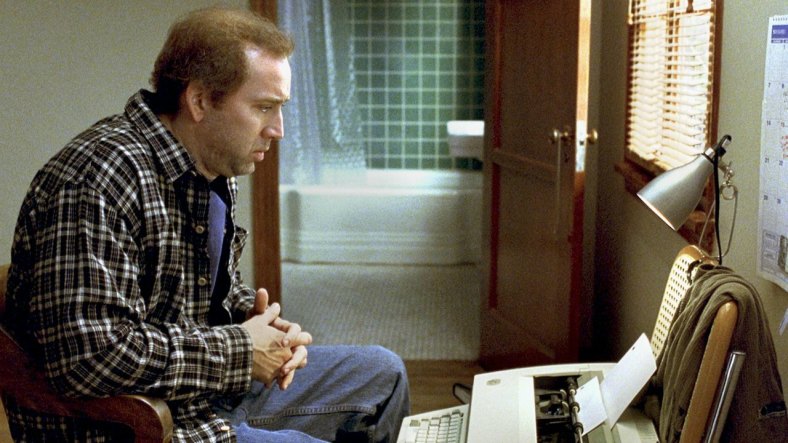
Charlie faces the
daunting appearance of the blank page, as many writers do. Writing is always
one step removed from real life. Many times the screenwriter is two steps away,
since the writing is based on another person’s rendering of reality. Maybe
Charlie is so wrapped up in himself because of these degrees of separation.
Charlie keeps trying to keep himself on track while fighting the temptations
(like feeling that he must have a muffin) that tempt one to evade the creative
process (I know all about that).
While Charlie struggles,
there is a jump back to the flowing prose of Susan who recounts the historical
dangers of orchid hunting. Susan says that she came to feel that it wasn’t just
the orchids, but the threat of “fatality” in acquiring them that was attractive
to Laroche. In that sense, it is not the destination but the adrenaline jolt of
the perilous journey that is appealing. Some who write may find a different,
but similar enjoyment during the creation of the project, and a letdown when it
is completed. She meets Laroche after he testifies in court concerning his
arrest. Despite the prejudice associated with a backwoods appearance and
dialect, Laroche upends that view as he is a highly intelligent and informed
individual. He is impressed with Susan’s willingness to print whatever he has
to say without censorship. So, a bond starts early on between these two.

There is a shift back to
Charlie who doesn’t know how to adapt the book into a screenplay. Writing, a
solitary activity, is where he usually functions well, so he is not at home
anywhere at this point. His inability to be social is evident after going to a
concert with Amelia. He is complimentary about her musical ability, and she is
obviously interested in Charlie romantically. But, his insecurity sinks his
chances with Amelia who gives him an opportunity to join her at her place after
the concert. He makes excuses about having to get home and rest so he can
grapple with the script the next day and doesn’t take advantage of her desire
to have a goodnight kiss. Amelia is giving up on him as she refuses his
invitation to go to an orchid festival. His voice-over bemoans his gutless
behavior and he tells himself that he will march up to Amelia’s door and kiss
her. Of course, he doesn’t, his neurotic state of mind rendering him an inert
person.

The cut to Laroche
giving Susan a ride contrasts with Charlie’s static temperament. Laroche drives
recklessly, while complaining about the other drivers, announcing how those
that follow rules make the world “insane.” His desire to deviate from norms
does connect him to Charlie. Laroche is looking to make a profit by obtaining
the ghost orchid, which is endangered in the wild, and is difficult to
cultivate. But Laroche declares that he is the only one who can make the flower
thrive, and as long as only the Seminole Indians acquire the orchids, it is
legal to remove them from the Florida state park. Susan writes in her notes
that Laroche’s boasting indicates “delusions of grandeur.” In this way he is
the polar opposite of Charlie who has zero self-esteem.
Charlie, back in the
present, reads Susan’s book. Her voice-over declares that “orchids are the
sexiest flowers on earth.” She says the word “orchid” derives from the Latin
word “orchis, which means testicle.” The story’s association of the flower with
Laroche suggests that he is the male with the balls and Charlie is the eunuch.
(However, if one is familiar with the paintings of Georgia O'Keeffe, orchids can
possibly be considered as symbols of female sexuality. In either case, the
flower is associated with sexuality). Brother Donald interrupts and says that
he “pitched” his story to their mother who said it was like Silence of the
Lambs meets Psycho. Charlie is anti-movie establishment, and he is
annoyed by the industry jargon word “pitch.” The film here makes fun of how
Hollywood loves to use past films to act as if they are creating something new
while really regurgitating something old that made money. The combination that
Donald uses here is nonsense because he combines one serial killer story with
another, thus showing a lack of imagination.
Flashing back, Susan
goes to see Laroche but instead meets a Seminole Native American, Matthew
Osceola (Jay Tavare), who accompanies Laroche on his orchid hunting. Matthew
seems to be looking at Susan from a cosmic perspective, touching and commenting
about her hair and seeing her “beautiful” sadness. She remains in the mundane
realm, talking about having washed her hair and the conditioner she used. He
says he can’t speak to her for very long because it is “the Indian way.” For
him life is experienced, not watered down by secondhand words.

That scene contrasts
with the next one between Laroche and Susan, where Laroche talks on and on
about flowers and Charles Darwin (adaptation referring to evolution here). His
ego is in full bloom as he is condescending by needlessly explaining his
scholastic references to Susan. Laroche notes that every flower at the horticultural
show they are attending has a “specific relationship with the insect that
pollinates it.” Some flowers have evolved to fit the shape of the insect they
need to attract. His statement suggests that for life to continue, there must
be an “adaptation” between organisms in the environment to create intimate
connections. And, by example, Laroche’s comments can refer to the relationships
between people. He says that the insects and flowers don’t realize it but their
apparently localized “lovemaking” behavior has vast repercussions. He makes the
jump to people by analogy as he says, “when you spot your flower, you can’t let
anything get in your way.” His statement would be good advice for Charlie, but
the look on Susan’s face shows it also applies to her.
There is another fine
transition to a dinner party that has Susan starting to stand apart from her
snobbish urban intellectual friends who make disparaging remarks about
Laroche’s missing teeth, his personal hygiene, and general oddness. Her
internal voice declares that she wants something more primal out of her life.
But she says it is not in her character to seek that goal. In that sense she is
like Charlie. She says she wants to know what “it feels like to care about
something passionately.” She admits to not being interested in orchids
themselves, but wants to understand the force that draws people to the ghost
orchid (the phantom part of the name taking on supernatural or spiritual
meaning).

Susan questions how
Laroche moves from one passion to another so easily. He went from loving
various forms of turtles, to ornate mirrors, and then to tropical fish. After
the immersion into his fascinations with different things, he subsequently lost
interest in them, like an abandoning lover who leaves after having reached his
satisfying climax. She narrates her wonder at this process by asking, “if one
really loved something, wouldn’t a little bit of it linger?” Laroche’s quest
for self-gratification shows he is centered on himself, but in a different way
than is Charlie. Laroche appears to care about ecological elements, but has no
fidelity to them. Susan wishes she could emulate his ability to just keep
moving on with nothing in the past to emotionally weigh her down.

We transition nicely to
Charlie reading from Susan’s book, which Susan has been narrating. Does it
become a sort of manual for Charlie? A waitress named Alice (Judy Greer) sees
him reading the book, and notes how she loves orchids. Charlie, the written
wordsmith, again can’t connect orally. It appears as if she goes with him to
the orchid festival, and says that the flowers are very sexual, as she touches
Charlie’s hand. She takes him into the woods, kisses him, and begins to
disrobe. But, it is just an erotic dream, stressing Charlie’s only refuge is his
imagination. (Later he misinterprets Alice’s friendliness for romantic
interest, and she goes off embarrassed as he starts to invite her to the orchid
festival. He can’t turn his imagination into reality). Donald interrupts his
brother’s sleep to pitch his serial killer thriller story that mixes in
dissociative personality disorder. A weary Charlie points out how derivative
the story is in addition to its obvious plot gaps. He realizes it’s pointless
to explain the shortcomings of Donald’s story, and placates him with the
Hollywood convention of combining old stories by calling Donald’s idea, “Sybil
meets Dressed to Kill.”
At the flower show he
hears Susan’s words in his head describing how the orchids resemble other
things and he inserts his own narrative for hers, substituting the women
attending into items in an exhibit, saying different females look like either a
schoolteacher, a gymnast, or an intellectual. By saying one object in nature
looks like another doesn’t alter its essence. But what about labeling women as
certain stereotypes? Doesn’t that attempt to define their more complicated
nature just by the way they appear? But, Charlie goes beyond superficial looks
and becomes poetic as he describes one woman having eyes that dance. Then he
returns to what he read about how Matthew said that Susan has eyes that contain
“the sadness of the world.” Charlie is a writer and he is creating characters
out of what he observes in life.
Susan is riding with
Laroche, and he says that he loves plants because they are so “mutable,” and
then he brings up the movie’s title by saying, “adaptation’s a profound
process.” He points to how metamorphosis, adapting to the environment, ensures
survival. As Brad Pitt’s character in Moneyball says, “Adapt or die.”
But Susan counters with the difference between plants and people. Flowers have
no memory, and when people don’t respect the history that came before, it’s
like “running away,” She is upset that this man whom she admires could easily
discard her if she commits to him.

Back on the set of Being
John Malkovich, actor Cage is portraying Charlie, who is a fictionalized
version of the screenwriter who wrote the movie, as he observes the actual
actors in Malkovich, such as Catherine Keener and John Cusack, who are
playing themselves in Adaptation, which is a film that is a reproduction
of their earlier roles. We thus have a story (Malkovich) within a story
(Charlie’s world) that is pretending to reflect reality. Donald is also there
attempting to connect with Caroline (Maggie Gyllenhaal), the makeup artist. He
asks Charlie about how to kill someone in his script. Charlie is disgusted by
that type of story and, using a sarcastic pun, tells him to make the killer a literature
professor who cuts off parts of his victims which makes him “The
Deconstructionist” murderer. But Donald wants to use the idea. Back at their
home, Donald is impressing Caroline with his script that tries to appeal to a
mass audience which contrasts with Charlie, in another room, staring at a blank
page, frustrated by having difficulty producing great art from a story about a
flower.


Charlie’s writing and
life continue to spiral downward. Donald now introduces Caroline as his
girlfriend and they kiss at a party where Amelia visits with her new guy, David
(Bob Stephenson), a man who is not what one would consider typically handsome.
That fact indicates Charlie’s worrying about his looks was not a barrier to
having a relationship with Amelia. Donald is crude in describing the sex he
intends to engage in with Caroline that evening, and Charlie just wants to
escape. When asked by Amelia how he is doing, Charlie describes himself as a
“mess.”
Charlie starts to sound
like Laroche equating evolution with adaptation. He delves into Charles
Darwin’s words (the man is “dramatized” by actor Bob Yarkes, which shows what
the screenwriter must do to visualize a story). Charlie says he needs to know
the orchid’s “arc,” equating the flower with a character’s progression in a
script. Since the flower is the story of the earth itself, Charlie feels he
must go back eons, since, as Darwin states in the film, we travel on “a journey
that unites each and every one of us.” Darwin says that we all developed from
one cell, yet we are all separate. Charlie believes his job is to “tie all of
history together.” Quite an undertaking, and not a tale easily placed in the
two-hour format of a Hollywood movie. He dictates the opening of his movie that
tries to sum up the tale of the planet which is just the introduction to Susan
and Laroche’s tale. Charlie listens to what he dictated and looks like he is in
pain at the unwieldy nature of the project. Donald bursts in interrupting him,
proclaiming his screenwriting teacher, McKee (the “key” to success?) a
“genius,” which is what he previously called his brother, but Donald has a
substitute now. Donald says McKee thinks the only way one can be original is to
stay within genres. The look on Charlie’s face suggests that what he thinks McKee
urges is like putting oneself in a jail cell and then making up new ways to
pace inside of it.
Back to the past, Susan
calls Laroche to find out what happened to the nursery he and his wife owned.
He says it was going very well, but then “darkness” descended. Instead of just
him telling the story we have some visualization (which is what a movie script
must do) showing what happened nine years earlier. Also, there is some action
that complies with what a more mainstream movie might contain. Laroche's car,
with his wife, mother, and uncle inside, is hit by another vehicle when Laroche
carelessly backs into traffic (a foreshadowing). (He still drives recklessly as
we have seen, so he either hasn’t learned his lesson, or he is somewhat
suicidal because of guilt. Possibly he moves on so quickly from one interest to
another because he doesn’t want to again experience the pain of losing someone
he cares about). Only Laroche survived the accident mostly intact, except for
his front teeth, but his wife went into a coma for three weeks. But she
divorced him when she woke up. Then Hurricane Andrew destroyed everything he
had, making him a sort of Job type of character. He subsequently joined up with
the Seminole Native Americans.

There is a shift forward
to when Susan met with Valarie about making a film based on her future book
which would develop out of her New Yorker article. Valerie repeats
Laroche’s words about wanting to give the Native Americans something
“amazing,'' (the word will change meaning later) which would be the ghost
orchid. Susan is surprised by the desire to option her work to be made into a
film and says she never wrote a screenplay. Valerie assures her that they have
screenwriters. Then there is a cut to the dejected Charlie as he listens to a phone
call telling him that Valerie wants the overdue first draft. Charlie has
another erotic dream about giving Valerie the finished story and making love to
him. She calls him “a genius,” as the word starts to sound tarnished by overuse
under inappropriate circumstances.
Charlie meets with his
crude and unempathetic agent, Marty Bowen (Ron Livingston), saying how he can’t
adapt the book which has no story structure. Marty says Charlie is good at
making crazy stuff up. But Charlie says he wants to respect Susan’s work and
wants to do something simple (which is not what Kaufman does, not even in this
film). He wanted to show how “amazing” flowers are, the way Laroche described
them, as Charlie wants to channel Laroche so he can gain Susan’s admiration. But
Marty asks if flowers really are “amazing,” which stresses how the inexplicable
beauty of nature is just skimmed over by some. Even the defeated Charlie admits
that he isn’t sure if he understands their amazement. Charlie wants Marty to
get him out of the deal, but pulling out of the project at this late date would
do great harm to Charlie’s career.
Following up on this
theme, Charlie returns home looking downtrodden while Donald is typing and
saying his script is working so well that it’s “amazing,” at least in how much
it is using overused movie story conventions. Charlie comically says it’s like
Donald has joined a “cult,” the one run by his screenplay teacher, McKee.
Donald has put McKee’s ten writing commandments on the wall. These rules (which
by the way are helpful guidelines for writers to follow, such as creating
complex characters and avoiding the use of a “deus ex machina” to solve plot
conflicts) take on a mock religious aspect here. Kaufman is an iconoclast and
for him rigidity can stifle creativity.
Charlie hasn’t been able
to sleep which is exacerbating his inability to transform the nondramatic book
into something that must be dramatized. He picks up Susan’s writing and her
voice states, “There are too many ideas and things and people. Too many
directions to go,” which sums up Charlie’s dilemma with writing a script from
this book. She says when one cares passionately about something, “it whittles
the world down to a more manageable size.” Her explanation may suggest why
Laroche must delve deeply into one thing at a time and then move on, which is
his way of serially trying to experience the totality of life. Susan’s insight
resonates with Charlie as he declares her observation as “so true.” He now
sexually fantasizes about Susan, as he keeps hoping for an intimate link with
someone who understands his unorthodox personality. However, his only
satisfaction is through masturbation since his negative, awkward, insecure
personality resulting from his alienation prevents an emotional connection with
another person. He hallucinates hearing Susan’s voice telling him that, for his
purposes, he must focus on the one thing in the book he feels “passionately
about.” He starts to dictate ideas that zero in on how the story will deal with
Susan’s search for passionate enthusiasm.
Charlie happens to
encounter Valerie at a restaurant, and since he has been derelict in supplying
a script, he tries to avoid her, but fails. Valerie is having lunch with Susan
who is not at the table at the moment. Charlie’s insecurities get the better of
him and he makes up an excuse about not wanting to meet the person he is
writing about so as to maintain objectivity. His self-doubts soar as he
realizes he is too inadequate to write about Susan since he can never meet and
know her. He says he only knows about himself, and starts dictating a
self-pitying story with himself at the center instead of Susan (we are
obviously getting some of this part of the story in what we are watching).
Donald, who is not introspective, interrupts him and says his script is
completed and wants his brother to submit it to his agent. Donald’s main
character makes his victims eat parts of themselves, which actually helps
Charlie realize he is feeding off his own life and making the story only about
himself.

Susan is shown with
Laroche who says that if they make a film out of Susan’s story he should play
himself. We have an actor playing a fictionalized version of a real person who
wants to be in a film (the one we are watching) expressing the desire to play
himself. Kaufman is playing with the writing process here, and the blurring of
reality and illusion. The two are looking for the ghost orchid, which seems
like a sort of mythical quest. Susan narrates that it is intoxicating being
around someone so alive in his passion. But Laroche gets lost in the swamp
(representative of life?), and projects his anger resulting from his bruised
ego onto Susan. He calls her a “leech” who has no interest of her own and
instead is feeding off of his interests. Susan then narrates that it’s attractive
to imagine that something is magical, such as the ghost orchid (and Laroche) to
“fall in love with,” but which is really “out of reach,” not real. And that is
how the book ends, not with a bang, but a whimper, to quote T. S. Eliot.

Charlie feels that for
him to move forward on his script and on his life he must meet Susan, so he
travels to The New Yorker office building. Susan actually comes into the
elevator Charlie occupies, but his crippling emotional self-loathing prevents
him from talking to her. During a phone call with his agent, Marty says that
Donald’s screenplay is “amazing,” that word again, which keeps getting knocked
down in importance. Marty thinks it’s “a smart, edgy thriller,” and “the best
script” he read that year. It’s like driving a nail into Charlie’s creative and
emotional coffin. Even worse, Marty suggests Charlie collaborate with his
brother on the orchid book, because Donald is good at “structure,” which
contradicts Charlie’s desire to write a story without that anchoring aspect.


In desperation, Charlie
attends a workshop that McKee conducts. While the man speaks, Charlie has a
voice-over rant, calling himself a loser who has sold out his standards because
he lacks “conviction,” or possibly that word we have heard, “passion.” As he
tells himself that he should leave, he hears McKee saying that a writing sin is
the use of voice-over, which is “flaccid, sloppy writing.” But that is exactly
what Kaufman has been using in this movie about his alter-ego, Charlie, and his
subject, Susan. What McKee says was considered gospel for many years in most
Hollywood projects, except maybe in film noir projects. It was considered a
crutch that substituted for dramatization. (However, along came Goodfellas,
Fight Club, The Shawshank Redemption, and others, which showed
when done well, it augments the visuals). Charlie gets the guts to ask a
question about writing a script that doesn’t have epiphanies and which shows
people “frustrated” and where “nothing is resolved,” like the “real world.” McKee
says that it is a waste of the audience’s time to present them with a boring
story. He yells that real life is filled with violence, betrayal, corruption
and other conflicts, so if one doesn’t see that, that person doesn’t understand
life.

After the seminar,
Charlie summons the will to ask McKee not just for help in his writing, but
with how he sees life. They go for a drink, he quotes from Susan’s book, and
Charlie says he doesn’t want to sensationalize the story, saying the ending is
“about disappointment.” McKee says what Charlie wants to do “is not a movie,”
and he’s right by most Hollywood standards of filmmaking. He tells Charlie he
has to have characters that experience arcs where they change. And, he notes
successful movies have a last act that wows the audience. Of course Kaufman’s
movie up to this point is doing exactly what McKee says a screenwriter
shouldn’t do.

McKee says the great
script for Casablanca was written by twin brothers. So, that gives
Charlie the idea to invite Donald to hang out with him in New York and work on
Charlie’s script. Donald is receiving more than a million dollars for his
story, called The Three. (In a way the main characters in Adaptation are
three parts of Kaufman’s personality: The neurotic, insecure Charlie; the
upbeat, superficial and oblivious Donald; the poetic supposed soulmate Susan;
there may be a fourth, the carpe diem advocate Laroche). Donald says that his
brother needs to know more about Susan because he feels that who she really is
does not appear in the book, which he now has read. Actually Charlie had the
same idea and that is why he went to New York. Given Charlie’s inability to
meet with her, Donald pretends to be Charlie, and sees Susan. Donald says he
felt there was an attraction on Susan’s part toward Laroche, but she says that
any psychological intimacy between journalist and her subject ends at the end
of the book. His questions seem to make Susan uneasy. Donald tells Charlie that
Susan’s answers were too perfect, not revealing her truth, and therefore he
concludes that she is lying.

McKee’s version, through
Donald, for how a script should be written now takes over the movie as Kaufman
satirizes the formulaic ending of a movie. Donald uses binoculars to spy on
Susan as she makes reservations to travel to Florida. In the book, Laroche
shows an interest in exploring the internet and came across porn sites. Donald
finds that Laroche created one, and there is a topless picture of Susan. So,
Donald is correct about Susan denying a relationship with Laroche. There is a
reversal now, as Charlie is reading McKee’s book, and Donald is reading Susan’s
which suggests the unstructured, undramatic story is being transformed into a
commercial product.

Susan’s story changes to
fit accepted movie business standards. Susan says they found the ghost orchid
but she is underwhelmed by the find. Laroche tells her the Seminoles only
wanted him to help them find the ghost orchid so they could produce a drug from
it to get high (the drug story that Charlie initially said he didn’t want to
write). He says that it seems the intoxicant helps one “be fascinated” by what
they observe. She refuses to be a part of the drug aspect and leaves, but he
sends her the drug which she subsequently inhales. She becomes absorbed by everything
around her, even the sound of the dial tone of a phone, which becomes a
mechanical “Om” sound. Even the trivial becomes “amazing.” Instead of having a passion for one thing, she spreads herself thin by being interested in everything. She returns to
Laroche and they become lovers. She seems stoned all of the time now, saying
she wished she were an ant because they are “so shiny.” Her eloquent, poetic
voice has turned into inane ramblings. This revised version of the story defies
McKee’s prescription because the drug acts like a deus ex machina that
artificially alters the plot.

The brothers go to Florida
and trail Susan meeting up with Laroche. Charlie sees how much of the ghost
orchid drug Laroche is cultivating and watches Susan and Laroche inhaling the
drug and making love. Laroche sees Charlie spying on them and grabs Charlie.
Melodrama ensues as Susan recognizes Charlie and says he knows too much about
the drug business and she says she must kill him. She holds a gun on Charlie as
they drive away in Laroche’s old van to the swamp. Donald is hiding in the car
and creates a diversion so that the two brothers run off into the night. While
Susan and Laroche track them. the brothers have a conversion while hiding.
Charlie says he envies Donald’s lack of caring what others think of him, and
Charlie wasted his life ruminating about how others may be devaluing him.
Donald says he was aware that a girl in high school made fun of him, but he
loved her, and she couldn’t take away what he felt. He tells Charlie, “You are
what you love, not what loves you” which brings a tear to Charlie’s eye. It is
a rather generous statement coming from what appeared to be a selfish,
superficial character. But is the movie just having fun with us here, providing
a sentimental line and showing the absurdity of Donald actually showing
maturity when none should exist?


After spending the night
in the swamp, the brothers encounter Susan and Laroche, who accidentally shoots
Donald. The brothers race off, but a pickup truck hits their vehicle, and
Donald dies in the crash. Laroche and Susan follow the fleeing Charlie into the
swamp. Then, to pile on the action aspects of the exaggerated ending, an
alligator attacks Laroche. That shot is followed by the overly sentimental
scene of Charlie having to tell his mother about Donald’s death.

Charlie now is finishing
his screenplay that mostly conforms to the McKee prescription, He meets with
Amelia. He finds the courage to kiss her and tells her he loves her. She is
involved with someone else, but she admits her love for Charlie, giving him
hope. He wants to end the script with that feeling of hope, but he
self-consciously comments how he is doing a voice-over, which McKee would
disapprove of, even though he doesn’t care at this point. However, he has made
the story about himself, and wonders, as did Laroche, who will play him. We
again have this meshing of reality and imagination within the framework of a
creative work. Charlie drives away to the song “Happy Together” by The Turtles.
We see flowers in bloom, symbolizing a positive ending. That shot is undercut
by the film speeding up, showing cars moving quickly, days ending and starting
again, as if all we are seeing is repetition, which is what happens in all of
the derivative stories that come out of the show business film industry.
The next film is The African Queen.


