Saturday, May 7, 2022

Manchester by the Sea

 SPOILER ALERT! The plot will be discussed.

Manchester by the Sea (2016), written and directed by Kenneth Lonergan, deals with the impact of the traumatic loss of a family’s children and how that tragedy disrupts any connection to others.

The film begins in the coastal community of Manchester-by-the Sea in the past with Lee Chandler (Casey Affleck, who received the Best Actor Oscar for this role) on a boat with his then eight-year-old nephew Patrick (Ivy O’Brien). The two are playful together, as Lee jokingly says he knows more about life than Patrick’s dad and, thus, would be the one to choose if stranded on an island. The idea of isolation is introduced early here. As it turns out, Patrick starts out with a natural father and a father-figure, but he loses both. The sea suggests freedom but the isolation of being on the water can point to what happens later in the story.

There is a jump to the present in Boston where Lee is working as a handyman at an apartment building. It is winter and it is snowing, presenting a feeling of an unwelcoming environment. Lee’s constant acts of shoveling and filling up a dumpster with trash seem fruitless, like Sisyphus continually rolling his rock uphill. Lee can keep trying to dig himself out of his predicament, but the task is overwhelming to him. There is no feeling of community in this place as the residents seem to not have any social skills, which reflects Lee’s current state of mind. The tenants argue or are sexually inappropriate showing how they do not know how to interact with others, and Lee responds angrily when provoked by them.

This disconnect continues when Lee goes to a bar. A woman spills a drink on him as an awkward attempt at staring a conversation with Lee. Her action demonstrates an inability to connect in a meaningful way. He tries to avoid looking at the woman, indicating his unwillingness to interact with anyone. Two businessmen there appear to be talking about Lee and he accosts them, punching them both. Lee carries with him anger and shame because of his past, and he misdirects that wrath toward others. The Ray Charles song in the background is ironic because he is singing “Oh, what a beautiful morning.”


Lee lives in a basement apartment, alone of course, and its subterranean location shows how he has buried himself physically and emotionally in his withdrawal from life. There is even a sign on the back fence that says, “Keep Out,” which could mirror Lee’s mental state toward others. He has exiled himself from his hometown. But circumstances thrust him out of his personal purgatory in Boston back to Manchester-by-the-Sea. He learns that his brother, Joe (Kyle Chandler) is in the hospital but by the time Lee arrives he finds out from a friend, George (C. J. Wilson) that Joe is dead. Lee has become so numb from his prior trauma that he shows little outward emotion, maintaining his flat affect, common to those with post-traumatic stress disorder. Except for one angry f-bomb, irritability being another characteristic of PTSD, he maintains his distanced appearance. George’s sobbing contrasts with Lee’s stilted reaction. Director/writer Lonergan said that Lee is trying to keep the “walls from caving in,” so he exerts extreme effort not to collapse under the onslaught of his tortured emotions. However, when Lee goes to the morgue to see his dead brother, he does show emotion, hugging Joe’s body and whispering to him. It’s as if Lee is more equipped to connect with the dead than the living. Later, Lee has trouble even talking on the phone to the funeral home to set up arrangements for his brother.

There is a flashback to Joe’s previous hospitalization for congestive heart failure which his wife, Elise (Gretchen Moll), does not take calmly when Dr. Bethany (Ruibo Qian) tells the family that Joe has only five or ten years to live. When the doctor says, “it’s not a good disease,” Joe’s no-nonsense response is “What is a good disease?” The doctor says, “Poison Ivy,” and Lee adds, “Athlete’s foot.” They deal with bad news with humor to lessen the blow, but Elise can’t cope with the situation and leaves, feeling that Joe is not taking the threat seriously.

Another flashback of young Patrick and Lee with Joe shows how Lee would tease his nephew about how there are sharks ready to get at the boy even if he throws a bloody band aid in the water. These scenes show how familiar and at ease Lee and young Patrick were and how their prior relationship contrasts with the tension that exists in the present.

As Lee drives through the frigid Manchester-by-the-Sea he remembers coming back from his happy day on the boat to the warm domestic world of his wife, Randi (Michelle Williams), and his three young children. Randi has a flu-like illness, but Lee wants to be romantic despite that fact, and the two tease each other. The comfort and love are symbolized by the lit fireplace that will, ironically, be the thing that turns Lee’s life into a living hell.


Lee drives to pick up the teenage Patrick (Lucas Hedges) at his school to break the news about his father. He talks to Paul (Paul Meredith), the Assistant Principal, who tells Lee that Patrick is at hockey practice. The conversation between the men is broken up on the cell phone, and when Paul asks about Joe, Lee acts as if his brother is still alive. We have here a scene which stresses the lack of Lee’s ability to deal with another.

That lack of communication shows up again in the scene at the hockey rink. As soon as Patrick sees his usually absent uncle, he knows that there is something wrong with his father. Patrick is like his uncle, and instead of telling his coach (Tate Donovan) what he assumes, he yells at him instead. The camera shows Patrick and Lee talking at a distance, thus stressing Lee’s inability to express himself by the omission of any audible conversation. Even though that distanced conversation continues with his teammates, one of them hugs Patrick. This show of affection toward another living person contrasts with the embrace of a dead person that Lee showed earlier. Both Paul and the coach reveal that Lee is known for his tragic past, and how he may be to blame for what happened.

The inability to connect with another continues into the next scene where Lee and Patrick are in Lee’s car. Patrick can’t say whether he wants to see his father or not as Lee tries to explain how the boy’s father appears. When they get to the hospital, Lee asks Patrick if he wants to go home or see his father. Patrick says, “Let’s just go.” Lee starts to pull the car away and Patrick is angry, because he thought he said, “Let’s just go inside.”

Patrick asks Lee if he could have some friends over, including Patrick’s girlfriend, Silvie (Kara Hayward), to which Lee consents. Lee stays in the kitchen and goes upstairs, maintaining his distance from others. There is an awkward scene when Patrick asks Lee if Sylvie can stay over, and Lee says why is Patrick asking his permission. Lee asks if he should tell his nephew to use a condom. Patrick also asks if they should contact his mother, but Lee says they don’t even know where she is, which tells us how estrangement has widened as time progressed. (A flashback shows Lee and Joe coming back from an outing with young Patrick, and Alise is passed out, half-naked on the couch, with a bottle of booze next to her. Perhaps Joe spent more time with his brother and son, and not enough with his wife). There are silences between talking, as if both are trying to figure out what to say. Patrick hugs Lee, who seems stiff, as the hugging motif continues, showing Lee’s inability to show affection for the living. Patrick appears to be used to having an adult parent and Lee is at a loss as to how to fill that role. He later has difficulty typing an email to his mother, another moment of a failure to connect.

On the way to the lawyer’s office to hear Joe’s will, Patrick tries to reach out to his uncle by starting up a conversation with Lee about rock music. But Lee shuts it down by saying all the bands sound alike to him. Patrick does a quick shake of his head and lets out a short sigh as if in frustration with Lee’s inability to engage with him. At the lawyer’s office, the attorney surprises Lee by telling him that Joe chose his brother to be Patrick’s guardian. Joe set aside funds to take care of his son and for Lee’s moving back to Manchester-by-the-Sea. Lee is adamant about how he can’t carry out what the will says, but realizes that Joe didn’t discuss the matter with him because Joe knew Lee would have not agreed to its terms. It’s as if in death, Joe was trying to bring Lee home to reconnect with Patrick, and thus give him back some of the family he lost. Lee comes to the hard realization that he has no choice but to take care of Patrick.


While in the lawyer’s office we discover through a flashback the event that devastated Lee and Randi’s life. He was having a gang of his friends over one night and they were drinking. Randi slept downstairs and the kids were upstairs. The guys were loud and she told them to leave. Lee joked with his friends as they departed, but this fun time turned to tragedy. Lee, drunk and high on drugs, walked to the grocery store for more beer since he knew he couldn’t drive. He later told the police that he started a fire in the fireplace because it was cold upstairs, and his wife’s sinuses wouldn’t tolerate the forced hot air of the heater. He was trying to be conscientious, but forgot to put the fireplace screen in place. He says that a log must have rolled out and set the house ablaze. Randi was able to get out, but the children died in the fire. The police said it was a mistake, but the odds of what happened were so unlikely that Lee was not considered to be criminally negligent. At the police station Lee’s guilt is depicted as being overwhelming and, because he wasn’t charged with a crime, he wanted to put himself out of his misery. So, he grabbed a cop’s gun and tried to shoot himself, but the policemen restrained him. The bleak cold and snowing that the camera reveals mirrors Lee’s emotional landscape.

Lee is furious at having been placed in a parenting situation with Patrick when he is sure that is the last thing he is qualified to do. His anger at himself is misdirected at others. He is harsh toward Patrick when the boy jokes about the next stop might be the orphanage. He nastily berates Patrick about his desire to take care of the family boat, telling him he can’t maintain it, and is loudly hostile when a passerby comments sarcastically that Lee is showing “great parenting.”

Lee and Patrick meet with George about the boat. Lee does not want to return to Manchester-by-the Sea, the scene of where he considers his crime took place, so he blurts out that Patrick will be moving to Boston. Because he feels that he is unreliable, Lee wants to relinquish as much responsibility as possible, asking if George knows someone who will buy the boat. He goes so far as to put George on the spot by asking if he would like to be Patrick’s guardian, even though George already has kids to take care of. During this scene the conversations overlap, creating a cacophony of sound that furthers the theme of miscommunication. After leaving George, Patrick reveals that he has been emailing his mother after she contacted him, and discovered she lives in Connecticut. Lee is caught between what he wants, which is to withdraw from family concerns, and what he should do, which is not to have Patrick’s mother have custody of the young man.


After going to the funeral home, Patrick is initiated into the depressing realities of the funeral process. He learns that his father is being kept in a freezer until the ground thaws for the burial, and he says that “freaks him out.” He has no idea of the undertaking process and wants to get a small steam shovel to bury his dad quickly. Lee has no patience or empathy and becomes irritated instead of consoling his nephew about the youth’s concerns.

Lee brings Patrick to his other girlfriend’s house for practice with a rock band. Her name is Sandy (Anna Baryshnikov), and her mother is Jill (Heather Burns). Because of his alienated state of mind, Lee would rather stay outside in the cold car than go inside the house to pick up Patrick. Jill invites him in for dinner but of course Lee refuses.

Back at Joe’s house, Lee gets a call from his now ex-wife, Randi, who asks if she can come to Joe’s funeral. She offers condolences, but then drops a bomb on Lee, saying she is ready to have a child with her new husband. Randi has been able to move on and now is starting a new family, while the only companion that Lee has is his guilt. The church scene is shot in slow motion, which makes Lee’s suffering seem unrelenting as he sees Randi with her husband there.

At the reception at George’s house afterwards, the crowded, noisy room interferes with George calling to his wife about the food. They can’t hear each other, another example of the verbal disconnect between people. Back at Joe’s house, Patrick talks about all his connections in Manchester-by-the-Sea and doesn’t understand why Lee can’t be a janitor there since he has no ties in Boston. Because Lee is unable to talk about his feelings, he is unable explain that he can’t live in a place that holds nothing but misery for him.

Patrick opens the refrigerator and wrapped frozen meat falls out. He begins to become extremely agitated and slams the freezer as packages fall to the floor. We know that he is thinking about his father, but Lee is so detached he feels helpless trying to understand Patrick’s behavior. Patrick finally unleashes his feelings and cries. There is finally communication between them when Patrick connects his actions to hating the thought of his dad being kept in a freezer. Lee stays with the boy until he falls asleep, which is what a parent would do for an upset child.

A flashback shows the devastated Lee moving into a spare basement apartment after, we assume, he has broken up with Randi. Joe says they must get him furniture, but Lee yells at Joe to leave him alone. Probably, Lee doesn’t feel as if he deserves to have a comfortable home. But Joe quietly gets his brother to have some furniture in his new surroundings.

In the present, Lee concedes that Patrick can stay in the town until the end of the school year, and he can work with George on the boat in the summer. Patrick is not placated and there is again overlapping dialogue as they argue over how long it takes to get from Manchester-by-the-Sea to where Lee lives. They can’t even agree on the distance between two places.

Lee compromises, gathers his things in Boston, and moves back to Manchester-by-the-Sea through the summer. He goes around town looking for work, but people turn him down because they too feel he is responsible for the deaths of his children. It appears that it is impossible for him to live in this place because of his past. He looks out of the window in Joe’s room and suddenly punches his fist through the window. He hurts himself because of his anger for having to be back in the town, but he may be punishing himself for what he feels he deserves for his past actions. When Patrick asks what happened to his hand, Lee says, “I cut it.” Not much of an explanation. Patrick stresses this lack of communication by sarcastically saying, “for a minute there I didn’t know what happened.” Further breakdown in connecting to another occurs when Patrick’s mother, Elise, calls, and Lee can’t get himself to say anything before hanging up. He is most likely unable to deal with anything connected to the loss of his brother.

Lee continues his lack of talking by not telling Patrick his mother called. Patrick says she emailed him and she is sober and wants Patrick to meet her and her fiancĂ©. Patrick says he can live with Eloise. Typically, Lee says he doesn’t want to talk about it. But, he is willing to call her back and if she sounds okay, he will let Patrick meet his mother. He is stuck chauffeuring Patrick around and suggests a driver’s education course, but Patrick says his father didn’t want him driving until he is seventeen. Lee is still torn between what’s best for himself and his nephew.

Patrick says he wants Lee to spend some time with Sandy’s mother, Jill, who he says is attracted to Lee. Patrick wants some time so he can have sex with his girlfriend while Lee is with her mom. Lee, reluctant as ever to be social, agrees, since Patrick pleads with him so he feels he should help him out. But he is so lacking in any social skills at this point that Jill finds the time with Lee unbearable. Patrick criticizes Lee on the drive home for not being able to even participate in small talk, that is how dysfunctional Lee has become. (It is humorous that Patrick is upstairs half-naked with Sandy, but trips over her doll house, which points to how these young people are caught in that awkward stage between childhood and adulthood).

On the way to Elise’s house Lee and Patrick continue their inability to connect even down to the smallest detail. They can’t even confirm the address. Elise looks clean and sober as she introduces her fiancĂ©, Jeffrey (Matthew Broderick). Lee leaves and they have dinner. There is a religious painting over the fireplace. They say grace before the meal, and Elise says she didn’t hear Patrick say “Amen.” Elise seems nervous, as Patrick reports to Lee on the ride home. He also comments that Jeffrey is “very Christian,” suggesting that she depended on religious strictness to keep her addiction in line. Lee acts positive, saying Elise is sober and not in a mental institution. Patrick, who wanted to break ties with Lee, does a reversal because of how uptight his mothers’ home is. He accuses Lee of trying to get rid of him. Jeffrey sends an email to Patrick saying that they can’t rush Elise into her son joining the household and that all future communications must go through him. His message shows how fragile Elise’s sobriety is, and Patrick slams his laptop closed, which shows how his hope that his mother was fit for him to live with can’t be realized.

Patrick is sad because of what happened with his mom, so Lee makes an attempt at empathy by asking what Patrick’s friends are doing or if he wants to invite Sandy over. It’s not enough to raise Patrick’s spirits, but the boy admits that at least Lee is now trying. Earlier Lee refused to get a loan for a new engine for Joe’s boat. Now, he eyes Joe’s rifle collection and says they could be worth enough to pay for a new boat motor. Patrick smiles, admitting that is a good idea. Lee is finally successful in reaching out to his nephew and bonding with him through this act. He also gives some free time for Sandy and Patrick to be together, knowing how important it is to his nephew. When they put in the new motor and the boat is sailing Lee smiles, maybe for the first time in the present. The shot mirrors the opening when he felt at home and at ease on the waters of his town.

Lee encounters his ex-wife, Randi, on a walk. This scene shows the writing, acting, and directing at its best as the two struggle to have a conversation as the trauma due to the loss of their children still devastates them. Randi has her new baby with her, which adds to Lee’s emptiness. As they talk, they appear to be on either side of a divide, Randi is on the left side of a wall’s edge and Lee stands on the other. The image stresses the emotional barrier that separates them. Randi seems to want to bridge that separation by asking if they might have lunch together. Randi begins to cry as she says she is sorry for horrible things she said to Lee at the time of their loss and admits that she still loves him. She admits that her heart is still broken, but she represents the type of person who deals with that damage by trying to continue living some version of a meaningful life. Lee remains in anguish, saying “there is nothing there” for him to hold onto that could allow him to connect to Randi. It’s as if her offer confronts him with how much he has lost, and he must leave to avoid that feeling.

That sense of profound loss fuels Lee’s anger at himself and he again vents it by attacking others as he gets into a barroom brawl. George rescues him after Lee is hurt and takes him to George’s house. There he cries, releasing emotion that he has suppressed for so long. Once he experiences feelings again, Lee is able to give his nephew some affectionate pats on the shoulder.

Lee starts cooking something on the stove and then takes a nap. He dreams of his two very young daughters who ask him why he can’t see that they are burning. He wakes up to the sound of the fire alarm which was triggered by the burning food on the range. It’s as if Lee is unable to escape the fire that burned up his life years ago.

Lee talks things over with George. Two of his children will be leaving home so Lee sets it up for George and his wife to adopt Patrick. He will stay with them until he’s eighteen. Patrick will then have his father’s house and do with it what he wants. This way he will be able to stay in his hometown. Lee secured a handyman job elsewhere. Patrick wants his uncle to stay in Manchester-by-the-Sea, but Lee tells him, “I can’t beat it.” Lee finally communicates with Patrick about his pain and then hugs the boy, showing affection that he has not shared for so long. He has made plans that he knows will be the best for his nephew, and knows that he can’t live in the place that haunts him.

When the ground is warm enough they can bury Joe. Lee is looking for an apartment that has an extra room for Patrick if he wants to visit, Patrick doesn’t say anything except he will not be looking to go to college in the city. He probably is still not thrilled about his uncle leaving. Lee is bouncing a ball he found outside an ice cream shop and the two sort of have a catch, like a father and a son.

The last scene mirrors the first one, as Lee and Patrick fish on the boat. This time it is quiet, with no teasing, but even though they are not audibly communicating, it is still comforting for the two of them to be together.

The next film is The Breakfast Club.

Sunday, April 3, 2022

Wall Street

 SPOILER ALERT! The plot will be discussed.

Wall Street (1987), directed by Oliver Stone, whose father worked on that avenue of affluent dreams and financial nightmares, starts off with Frank Sinatra singing, “In Other Words.” It contains the lyrics, “Fly me to the moon/And let me play among the stars/Let me see what Spring is like/On Jupiter and Mars.” In the context of this film, it suggests there are those people who want to be so powerful that they don’t even see the sky as the limit. And that power comes from accumulating money, no matter what the cost is to others who the wealthy use as their stairway to the affluent heavens. The opening montage shows all levels of society in New York City, from laborers to those going to financial institutions as they crowd onto sidewalks and into elevators, trying to make a living.

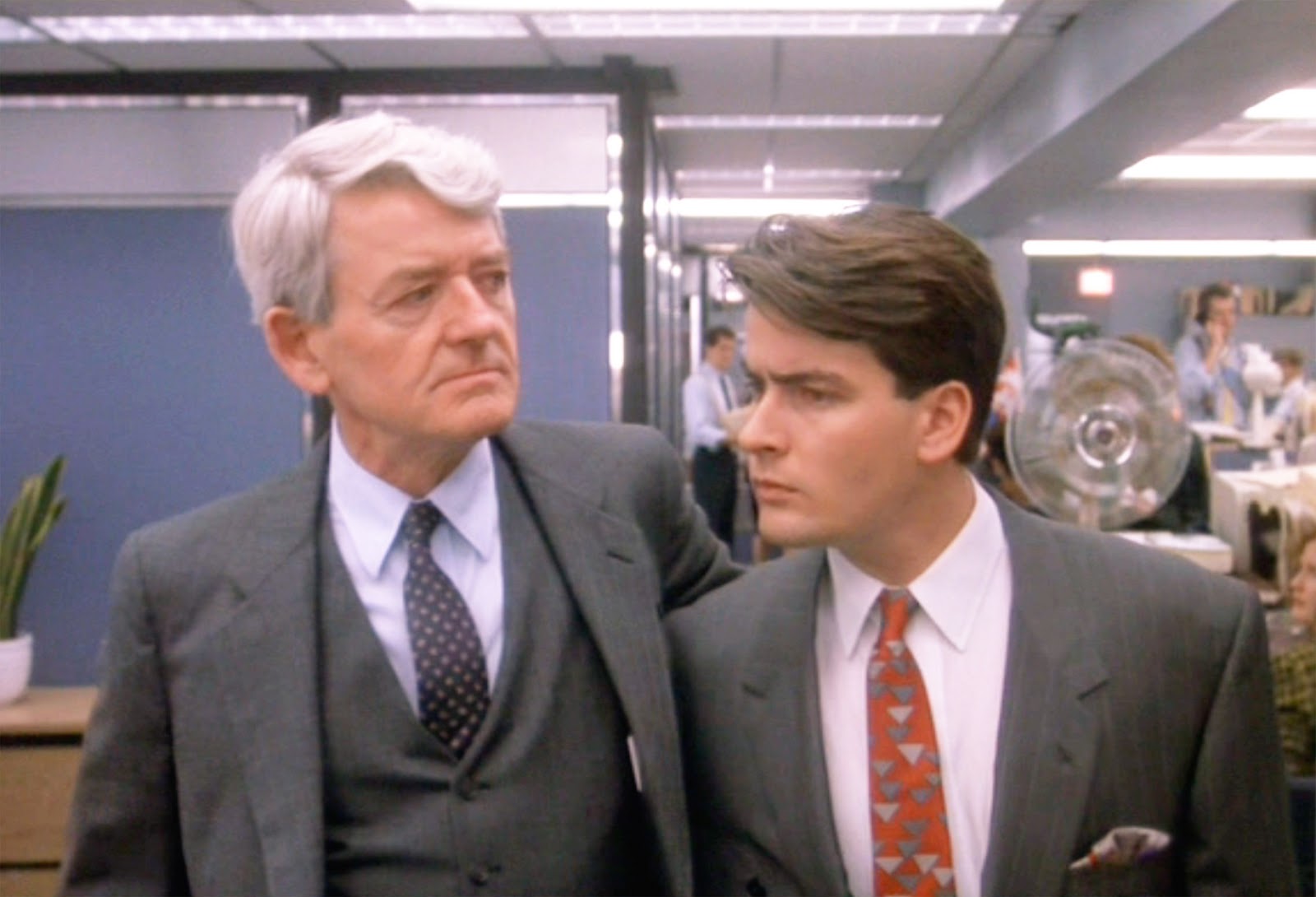
The story takes place in 1985. Bud Fox (Charlie Sheen) works at a Wall Street brokerage firm, trying to get ahead in the cutthroat business of selling stocks through cold calls. (Bud’s last name is Fox, but is he as sly as one? At the beginning of the movie it is an ironic name, but he lives up to it by the end). When someone cancels a deal, Bud must make up the loss the firm sustains. His pal, Marvin (John C. McGinley), says it could have been worse if it was “my money.” He is joking, and offers Bud some spending money, but his selfishness epitomizes the central work ethic of his profession.

Bud is desperate to rocket out of his current job, unlike coworker Lou Manheimm (Hal Holbrook), who believes in patience and sticking with the stock of a company that creates good products, no matter if it takes five years to fulfill its potential. He says, “Good things sometimes take time.” Marvin, in contrast, says on the phone he needs information immediately, because in a very short time, if he doesn’t get it, he’ll be a “dinosaur.” His point is that in the stock market world, sure and steady doesn’t win the race; if that is the practice, one becomes a financial evolutionary failure.

Director Stone said that he wanted to make a “movie about sharks, about feeding frenzies.” So, the camera keeps moving, in circular fashion many times, like a “predator.” There’s no letup until we get to Bud’s father “where the stationary camera gives you a sense of fixed immutable values.” In this way Stone uses motion to contrast the loose ethical ways of the Wall Street types with the steady, honest, hard-working members of society.

Bud continually calls Gordon Gekko (Michael Douglas, who won the Best Actor Oscar for this role), an unscrupulous giant in the stock and real estate investment area, to work with him. However, Bud is a nobody who never gets through to Gekko. (Gekko suggests a gecko. As IMDb notes there is a Golden Gecko, which sounds like Gordon Gekko, and which may point to Gekko’s lust for riches. We may think of the creature as a friendly lizard from insurance ads and forget that it is a carnivorous animal). Even the mercenary Marvin sees how Gekko is beyond the edge of acceptable moral behavior when he says that the man had “an ethical bypass at birth.”

Bud goes to a tavern to see his father, Carl (Charlie’s real dad, Martin Sheen). When Carl uses the word “spaghetti,” Bud says his dad should use the word “pasta,” since spaghetti is out of date. Carl says so is he. The film implies that Carl’s morality is becoming extinct. Carl notes he is taking blood pressure medication, and Bud wants him to stop smoking. These facts are a foreshadowing of what is to come. Bud needs to borrow more cash. The lifestyle which he maintains to be a player in his job cuts right through his earnings. He can’t even pay off his college loan. So far, he has been staying inside the ethical playing field, but his profession makes it difficult to stay there. Living a working man’s life is not good enough for Bud. He says, “There’s no nobility in poverty anymore.” So, when his father mentions that the airline he works for, Bluestar, has been cleared of any wrongdoing in an accident (which Carl knows was due to lax standards on the part of the manufacturer, pointing to more unethical behavior due to stress on the bottom line), Bud has access to information that has not been made public yet. If used to purchase stock, it is insider trading, which is illegal.

Bud finally gets a meeting with Gekko when he shows up in person on Gekko’s birthday with Gekko’s favorite Cuban cigars. This contrasts with his dad’s pedestrian cigarettes, but both men are subject to the same threats to mortality. However, Gekko has the money for technology that monitors his heart in the office. He doesn’t even stop for a smoking break if a buck is to be had. As Bud says, for people on Wall Street, Fortune Magazine is the “bible,” which is substituted for religious values. Around him, Gekko has cutthroat businessmen who will do anything for a monetary killing. Gekko actually uses lines like “lock and load,” and being in the “kill zone,” which metaphorically illustrates the brutality of the big business mentality. On the phone, Gekko says, “Lunch is for wimps.” For him, taking time out to enjoy a midday meal shows weakness. Gekko does admire Bud’s persistence, but the only thing that gets some attention from Gekko is the information about Bluestar achieving a clean record form the FAA.

Bud thinks he struck out with Gekko, but the bigshot calls him and tells him to buy Bluestar stock for him. Bud is now ready to fly to the moon, as the song says, since he will make money off the purchase. The newspapers then announce that the airline was exonerated in the crash, and the stock price soars, just like a jet plane. Gekko meets Bud at a high-class restaurant, but Gekko doesn’t have the meal with him, following his own rule. He does give Bud a million dollars to invest and says he doesn’t like losses, so if Bud continues to do well, there will be lots of “perks” to reward him. He orders steak tartare for Bud, which is raw meat topped with an uncooked egg, which fits in with the predator theme of the film.

After taking a loss on an investment for Gekko, Bud meets with Gekko at a sports club where Gekko handily beats Bud at squash. The competition jives with how Gekko sees the world divided up between winners and losers. He sees himself as a self-made man. Those with “Ivy League” diplomas who he sees were given advantages that he had to earn now kiss up to Gekko. He says, “Give me guys that are poor, smart, and hungry, and no feelings.” For him, caring about others just gets in the way of accumulating wealth. Unlike most people, he says he doesn’t “throw darts at a board.” He only bets on “sure things.” To have that surety, he goes outside the law. For Gekko, all is fair in love (which he thinks is an emotional scam) and war, and he sees monetary acquisition as warfare. That is why he tells Bud he should read Sun-Tzu’s The Art of War. He says that “every battle is won before it is fought.” He doesn’t gamble, but wants the game rigged in his favor.  

Gekko is a complicated person. He makes valid comments about how little invested in their own companies the executive officers are. Even though he is a self-made man he has disdain for those that just labor their whole lives without success, including his own father, who died of a heart attack at an early age. This fact is another foreshadowing, and the story suggests that he is linked to Bud through their fathers. Gekko sees things in binary ways. When he observes a beggar standing next to a well-dressed businessman, he says nobody can convince him that only luck was the factor between success and failure. He seems to think that being rich and being poor are the only choices. He doesn’t concede that those who work hard should be deserving of more than being poor. He tells Bud that the choices are either being rich enough to own an airplane, “or nothing.” Yet, he is also able to appreciate that the beauty of a sunrise is not something that can be measured in dollars and cents.

He wants Bud to follow a rival, Sir Larry Wildman (Terence Stamp. The character’s name suggests staid nobility and a rulebreaker at the same time). Sir Larry had a “mole” in Gekko’s organization and burned Gekko on a deal. Gekko wants “payback.” He has seduced Bud and will dump him if he doesn’t spy on Sir Larry in the U. S. and provide Gekko with insider information. After tailing Sir Larry, Bud and Gekko realize the Englishman is investing in Anacott Steel. Bud and Gekko start buying stock in the company which drives the price up and makes it expensive for Gekko’s nemesis, Sir Larry, to purchase the company. When Bud tells Lou about it, the latter dismisses the idea of a sure thing, and says a steady investor gets through the “bear” as well as the “bull” markets. Lou reminds Bud to keep his eye on the larger picture that goes beyond individual gain, stressing how the money invested wisely “creates science and research jobs.” In response to Bud saying a person must make it big before he or she can do good, Lou says, “You can’t get a little bit pregnant.” The point is once you cross the line that leads to corruption it means you’re all in.

Bud brings documents for Gekko to sign at his house where he is having a party. It is there that he meets Darien Taylor (Daryl Hannah), an interior decorator, who is quite snobby in her attitude toward design. Gekko notices that Bud admires her beauty, and Gekko and Darien stroke each other’s hands, so we know that there was a sexual connection between the two. Darien says she’s a spender of other people’s money, so Bud uses that information to make a direct play for her, saying he will be moving up in the world after a couple of deals with Gekko. Acquiring people is the next step after obtaining things in this world of high finance.

Sir Larry arrives to confront Gekko about how he has driven up the cost of obtaining Anacott Steel. Sir Larry recognizes Bud, and probably realizes that he was following him. The references to war continue to make the connection to how big business is carried out. Gekko has a wall of firearm collectibles, including a German Luger, joining him metaphorically to Nazi war tactics. This time, Sir Larry wants to turn the company he is buying around. He’s in it for the “long haul,” harkening back to the beneficial principles that Lou espouses. Gekko gets him to buy his shares of the company at a high price, but his motives are revenge as well as profit. Bud now quotes Sun-Tzu, which impresses Gekko, since battle tactics to win the immediate confrontation are what he is teaching Bud, not long-term prosperity.

Gekko wants to be continually “surprised,” by new information that will get those sure things he can invest in. So, Bud visits a college buddy, Roger Barnes (James Spader), a lawyer at an upscale legal firm. He tries to bait the hook by offering lots of cash if Roger will provide information on a certain deal. Roger is wary about getting disbarred, but still seems interested. He notes that the records in his uncle’s office at the firm contain loads of great information about company transactions. So, Bud gets involved in the janitorial service that cleans the office building where Roger works so he can delve into the uncle’s files. It is interesting that he does his dirty business by pretending to be working in a business that involves dirt.

Bud’s fortunes are rising, so he now can afford to date Darien. He even adopts Gekko’s phrase, “I’ll talk at you,” showing Gekko’s influence. The words suggest giving dictation, as opposed to listening to the needs of others. He plays rich games, like riding dune buggies with Gekko and Darien on the beach. Their vehicles are filmed in front of fisherman with their nets who have no time for play as their survival exists from day to day. Bud is decent about paying his father back for all the money he borrowed from him. But the workers at the airport kid him about joining them in doing a “honest day’s work,” as opposed to the slick Wall Street manipulations he’s involved in. His father compares his recent big monetary gains to winnings at the racetrack, which is a gamble, and which one can lose soon after.

Gekko always protects himself first so his lawyer gives Bud a limited power of attorney that allows Bud to make trades and assume any possible liability, since Gekko can claim plausible deniability. They use offshore accounts such as in the Cayman Islands to hide money. As Bud gets richer, another worker who has been with the firm for a long time is fired, showing how loyalty in the investment business does not last based on past accomplishments. As Marvin says, they are only one stock trade away from “humility,” which shows how precarious their profession is.

Time passes and Bud moves to an expensive penthouse apartment with Darien, who is also his decorator. They enjoy the high life together way above the worker bees below them. But Bud hasn’t forgotten his roots. At one point, staring out at the view high up in the clouds where he now resides, he asks himself. “Who am I.” It is more like what has he become.

Gekko wants to take over Teldar Paper and goes to a stockholder meeting to give his famous “greed is good” speech. He says, “greed works. Greed clarifies, cuts through, and captures the essence of the evolutionary spirit. Greed, in all of its forms: greed for life, for money, for love, knowledge has marked the upward surge of mankind.” He makes a valid point about how the drive of the individual to excel brings about changes moving forward. However, he leaves out that not all change is good, especially when it comes to technology. And, his sermon sounds like he is preaching Social Darwinism, where only the strongest can survive as they vanquish all others. He says according to him, “You either get it right, or you get eliminated.” Again, we have his extreme binary way of looking at things. But “getting it right” for Gekko only means making huge profits no matter the cost to others. He often breaks up companies he buys and sells them for their components that pay more than what the company were worth when combined, regardless of who loses their jobs and benefits. We again hear the lyrics, “Fly me to the moon,” which fits in with these men who have the hubris to think of themselves at gods on high, ruling the earth below.

The film nicely segues to Bud telling Darien that he is “shooting for the stars,” and, appropriately, he wants to run an airline. He tries to convince Gekko to help build Bluestar Airlines into a bigger and better company after he hears from his dad that layoffs are coming. Bud says he knows the people working at Bluestar, and they will trust him that they can turn the company around if there is a cut in wages. Trust is the branch that Bud is hanging onto here, and betrayal will be what breaks that trust.

Bud (whose hair is greased back now like Gekko's, reflecting their slick maneuvers) and Gekko meet with the airline union leaders, including Carl. What Gekko and Bud propose seems like a good plan to turn Bluestar around, but Carl knows Gekko’s love of greed and doesn’t believe he will follow through once he owns the airline. Bud may have some good general plans, but Carl points out that his son only worked at the airline for a short time and isn’t ready to be president of the company. Gekko calls Bluestar’s management “scum” who have ruined the company. Carl points out that the management of Bluestar built the company over thirty years from scratch when they started with one plane. Carl’s argument is that management is in it for the long haul, and he knows that Gekko is a short-term speculator who gets his money and then dumps what he buys.

Bud is of course embarrassed by his father’s lack of support, and they have an emotional confrontation after Carl walks out of the meeting. Carl says Gekko is using Bud, but Bud says, “What I see is a jealous old machinist who can’t stand the fact that his son has become more successful than he has!” It is an incredibly hurtful statement, and Carl feels that he has failed in raising his boy if that is what he believes. Carl marks an individual’s success by the morality of an individual, not by the “size of his wallet.” But, Carl does agree to let the union members vote on the proposal.

Bud’s lawyer friend Roger calls Bud into his office because he’s worried about the SEC looking into offshore purchasing of Teldar Paper that Roger is complicit in. Bud learns from Roger that Gekko is using the law firm to instigate plans for Bluestar. In a meeting, Bud finds out that his father was right, that Gekko is planning on breaking up Bluestar and selling its components, including the property for housing development and the planes, and plundering the overfunded pension for a substantial profit.

Bud confronts Gekko, who says he was reading his son the story of Winnie the Pooh, and how the bear became stuck in the honeypot, supposedly relating the tale to the Bluestar situation. Bud wittily says maybe Gekko should have read the story of “Pinocchio,” which talks about someone who lies, obviously referring to Gekko. Gekko gives a speech which some may feel is shockingly true to this day. He says how the richest one percent of the United States own most of the country’s wealth. He says that “I create nothing. I own.” The stock and real estate speculators just manipulate the capitalist system to profit from it, but not by creating anything or helping others. The amount of gain is not important to Gekko. He just sees things in that binary way, where there are only winners and losers. He says that we don’t live in a “democracy.” It’s the powerful wealthy who “make the rules.” As he says this speech, the camera includes a shot of a man washing the windows of Gekko’s high-rise office. The movie is saying with another visual example that the manipulative wealthy live in extreme comfort as others must labor for meager earnings.

Bud is feeling guilty about being played by Gekko. Darien is frightened by Gekko’s wrath if Bud fights him on the Bluestar deal, and says she will not stick around because she will lose all her clients through Gekko’s influence. She tells Bud that he should look in the mirror and should not act self-righteous concerning Darien’s plans to bail. After he throws her out, she looks at herself in the mirror in the hallway, and Darien, like Bud, is not happy with what she sees.

The foreshadowings are realized as Carl has a heart attack and he and Bud have a tearful bedside meeting where Bud says he will make things right and use Carl’s “words,” which come from an “honest” man, when he speaks to the union leaders. Bud wants the unions to confront Gekko when the stock begins to rise once he implements his plan. He also knows that Sir Larry wants to hurt Gekko over the Anacott Steel deal. Bud and the union leaders give the same deal to Sir Larry that they gave to Gekko so long as he agrees to make a contract not to break up Bluestar. Sir Larry is agreeable, since he seems to be willing to help companies, not exploit them at this point.

Bud then tells his fellow workers at the investment firm where he works to start buying Bluestar to drive up the price. Ironically, Bud uses Gekko’s connections against Gekko to create enthusiasm for Bluestar stock. The union people tell Gekko they know his plan and will disrupt the airline’s activities, causing the company to be worthless before he can break it up. Bud then gets everyone to sell stock and take gains, thus lowering the price so that Gekko takes big losses on the shares he bought as the price went up. Sir Larry buys the stock at a cheap price and he is the only person willing to buy Gekko’s shares, which amounts to a total defeat for Gekko.

However, Gekko lets the Federal authorities know that Bud was involved in insider trading violations, and they arrest Bud. Bud meets Gekko in Central Park. He smacks Bud around for how he caused Gekko to lose millions. However, Bud is wearing a wire and makes a deal with the authorities to get Gekko on illegal activity.

Bud will be going to jail, but he saved Bluestar, and Sir Larry has offered him a job at Bluestar once he gets out. As his parents drive him to the courthouse, Carl states the theme of the movie, telling Bud “Stop going for the easy buck and start producing something with your life. Create, instead of living off the buying and selling of others.” The camera pulls away, a bookend which compliments the opening shot, to take in the whole skyline of New York City, as if to suggest people should look beyond their own interests to the bigger picture that includes the welfare of others.

The next film is Manchester by the Sea.

Tuesday, March 22, 2022

Oscars - 2022

 Here are my picks and preferences for the 2022 Academy Awards:

Best Picture:


I do not think that either Licorice Pizza or Don’t Look Up deserve to be in this category. Licorice Pizza had a meandering plot that didn’t amount to much and the characters are unsympathetic. The dialogue was mediocre. Don’t Look Up had moments of satiric observation, but its tone was inconsistent between biting and just plain silly. It needed more focus. I thought the best film was Belfast. It successfully personalized the conflicts that occurred in Ireland between the Protestants and Catholics by focusing on a family caught up in the turmoil. Unbelievable that it was not nominated for editing or cinematography since it is an evocative and seamless creation. However, the contest seems to be between CODA and The Power of the Dog. The former deals with a hearing-impaired family in a way that is moving without being patronizing. It received the ensemble acting award from the Screen Actors Guild and the Producers Guild Award for best film. The Power of the Dog is an impactful depiction of homophobia in the American West. It won the Golden Globe award for best drama and Jane Campion received the Directors Guild Award for her direction. I think the theme and the character portrayals in CODA will win over the Academy.

Prediction: CODA

Preference: Belfast


Best Actress:

Good performances all around here. Nicole Kidman received the Golden Globe for her performance as the shrewd Lucille Ball behind the scenes in Being the Ricardos, while Jessica Chastain won the SAG award for her portrayal of Tammy Fae Baker in The Eyes of Tammy Faye. I’m giving the edge to Chastain, who shows a flawed character who also truly believed in her faith and was not afraid to stand up for gay people against the self-serving male TV evangelists.

Prediction: Jessica Chastain

Preference: Jessica Chastain


 Best Actor:

Will Smith has a lock on this category. He has been nominated before and is a box office favorite. He does a good job of showing a man who was passionate to the point of obsessional about having his daughters excel and be role models for African American women. The story is a little creepy on how much he controlled his daughters’ lives to fit his plan that he developed before they were even born. My pick is Benedict Cumberbatch for his scary self-loathing homosexual cowboy in The Power of the Dog. It is an uncompromising portrait of how bigotry can poison a person, in the case of this story, both figuratively and literally

Prediction: Will Smith

Preference: Benedict Cumberbatch


Best Supporting Actress:

I believe Oscar lightening is going to strike twice for the character of Anita in West Side Story. Rita Moreno won the award in the original and indications are that Ariana DeBose will do it again for her interpretation of the role. She is very good at singing, dancing, and acting in Steven Spielberg’s remake. I have a slight reference for Kirsten Dunst’s heart-breaking depiction of the tortured mother in The Power of the Dog.

Prediction: Ariana DeBose

Preference: Kirsten Dunst


Best Supporting Actor:

Another good group of performances. However, I think that Troy Kotsur’s emotional and strong father in CODA will win over the Academy members.

Prediction: Troy Kotsur

Preference: Troy Kotsur


Best Original Screenplay:

I hope that the Academy will honor Kenneth Branagh for his memoir of what it was like for him growing up in Belfast during the confrontations he experienced as a child. The script depicts the characters realistically and allows the audience to truly care about their fates.

Prediction: Belfast

Preference: Belfast


Best Adapted Screenplay:

I think CODA will be the choice for its honest depiction of the hearing-impaired family who has a daughter who can hear and, ironically, sing beautifully. She is caught between the worlds of sound and quiet.

Prediction: CODA

Preference: CODA


Best Director:

Jane Campion most likely will win this award for her masterful work on The Power of the Dog. As was stated she won the Directors Guild Award. She also is the only woman who has been nominated twice in this category, having previously been acknowledged for her direction of The Piano. Since I was awed by the work done on Belfast, I would prefer that Branagh be the pick.

Prediction: Jane Campion

Preference: Kenneth Branagh

Sunday, March 6, 2022

Closely Watched Trains

 SPOILER ALERT! The plot will be discussed.

I occasionally write a post about a film my movie class watched and discussed at the Bryn Mawr Film Institute. We recently saw Closely Watched Trains, a Czechoslovakian film which is a tragicomedy that received the Best Foreign Language Oscar of 1966. The story takes place in that country during the Nazi occupation. There is a sarcastic saying that fascist countries can make the trains run on time. The line may imply that the machinery of the state dehumanizes people. It follows that the compensation for the loss of freedom is not worth the sacrifice paid by the dominated citizens. The trains in this context also may be a reference to the shipping of Jews to concentration camps. The placement of the story in the past allowed the filmmakers to make hidden references to the oppression Czechoslovakia suffered under Russian rule.

The film centers on Milos Hrma (Vaclav Neckar), who comes from a family of lazy losers. His great grandfather was a soldier, but students hit him with a stone, and he retired early. Milos says, “he didn’t do anything after that except buying a bottle of rum and a pack of tobacco every day.” His train-driver father retired early and just sits around all day. Milos is an apprentice train dispatcher at a small station. He enjoys wearing his new uniform and when his cap is placed on his head, the image suggests a mock coronation, implying the grandness of the ceremony is only in Milos’s head.

The train dispatcher, Hubicka (Josef Somr), is a ladies’ man, apparently having had many sexual conquests. He exhorts Milos, a virgin, to pursue the conductor, Masa (Jitka Scoffin), who shows an interest in Milos. At her urging, they attempt to have sex, but the inexperienced and anxious Milos has a premature ejaculation and is unable to consummate the act. Milos is in such despair that he attempts suicide, but is rescued. As he is carried to a physician, Milos is naked except for a wrinkled sheet covering his lower body. The image resembles Michelangelo’s Pieta. Could this be a foreshadowing of the need to have an individual sacrifice for the good of the many?

The doctor tries to calm Milos down, telling him what he underwent was common, and to think about other topics so as not to climax so quickly. The class disagreed as to whether the tone of the film was inconsistent, taking a light-hearted view of sex and then combining it with the topic of Nazism and suicide. The film does not depict the brutality of the Nazis, which is consistent with its lighter approach, but it also downplays the repression that the Czechs were undergoing.

Hubicka charms the telegraphist, Zdenicka (Jitka Zelenohorska), into letting him use the station’s rubber stamps to place print marks on her thighs and buttocks. I wondered if this playful activity on the surface suggested its demonic opposite which was the tattooing of numbers on those interned in the concentration camps. At the least, it makes fun of the overemphasis on bureaucracy.

Zdenicka’s mother observes the print on her daughter’s body while the young woman is asleep, and is in an outrage. She ironically lifts the girl’s skirt to show just about anyone what an outrageous act was done, at the same time being even more outrageous by exposing her daughter’s behind. She takes Zdenicka to the pompous Zednicek (Vlastimil Brodski), the Councilor, who is a Nazi collaborator, who previously espoused Nazi propaganda. He is emotionless in listening to the mother’s complaints. The whole episode suggests an abandonment of valuing human feelings for efficient regimentation.

There were comments by members of the class that the movie seemed to be preoccupied with sex, and that women were portrayed as sex objects willing to satisfy the urges of the men. It could be that given the state of the country, sex was a diversion from the Nazi oppression. A resistance agent, Viktoria (Nada Urbankova), brings explosives to the train station to get the workers to blow up a German train carrying ammunitions. She is older than Milos and is successful in making him sexually efficient. Her character, as well as the other uninhibited women, show females awakening the latent masculinity of the males and empowering them to act.


After feeling that he is no longer a “flop” but is now “a real man,” Milos says, “I cut myself off from the past entirely.” He detaches himself from the failed men in his family and his own prior ineptitude. Milos takes the bomb with a timer and climbs a tower which spans the train tracks. When the Nazi train carrying ammunition passes under him, Milos drops the explosive onto it. But, he pays the price for his heroic action as a German soldier on the train shoots him. Milos falls onto the train. In Elizabethan times, death and sex were equated, since the sexual climax in poetry was depicted as a sort of bodily release.

After the train travels away, there are several detonations, and the train is destroyed. The explosions could be seen as an orgasmic eruption against repression. The blast blows Milos’s cap near Masa’s feet. Because he has redeemed his family, fellow workers, and himself, the head covering can now truly be seen as a crown of distinction.

The next film is Wall Street.