Friday, November 4, 2022

Bridge of Spies

 SPOILER ALERT! The plot will be discussed!

In Bridge of Spies (2015), director Steven Spielberg, with the help of the Coen brothers who worked on the script, presents a story based on true events that explores how the fervor of patriotism and fear can sometimes overshadow objectivity regarding individual actions and the pursuit of justice. This movie, as others by Spielberg (E. T. – The Extra-Terrestrial, Jaws, Close Encounters of the Third Kind, to name a few) focuses on ordinary people in extraordinary situations.

The story begins in 1957 and revolves around the capture of a Russian spy and the United States U2 spy airplane piloted by Francis Gary Powers (Austin Stowell) that was shot down during the Cold War. The first shot is that of Rudolph Abel (Mark Rylance, Oscar winner for Best Supporting Actor for this performance). He is painting a self-portrait as he looks at himself in a mirror. As has been noted previously in this blog, mirrors symbolize the “other,” or alter ego of people. The painting shows a different version of Abel, looking less polished both in his face and clothes, the person under the disguise. Abel is pretending to be a law-abiding resident in Brooklyn while spying for the Soviet Union.

The opening sequence shows Abel is already under surveillance by American authorities. He paints in the park and finds an America coin that was planted under a bench. He pries the phony object open when he returns to his apartment. There is a message inside. It is a wonderful ironic symbol since it uses the currency of a capitalist nation on the surface to hide the Communist efforts to undermine that monetary system inside.

FBI agents burst into the apartment while Abel is in his underwear in the bathroom. Despite the fact that authorities caught him in a vulnerable situation, he is incredibly calm as he says, “Visitors.” He professes not knowing why they call him “Colonel,” and he asks simply for his false teeth (“false” being the operative word here for Abel’s fake presentation). He asks meekly to be allowed to clean his painter’s palette. He deceptively grasps the message from the coin as he wipes the paint and while the agents search his place.

The focus shifts to James Donovan (Tom Hanks) who is an insurance lawyer. He argues with the attorney of five individuals who were hit by a car covered by the insurance company. The suing lawyer, Bates (Joshua Harto), argues that since there were five injuries there are five claims because five events occurred. Donovan says it’s only one accident and the liability is limited to “one” event. He says that if a tornado rips apart a house it is the whole house that the insurance company covers, not each separate piece of wood. Otherwise, there is “never any limit to … liability.” That would put an end to the insurance business and then “nobody is safe.” The scene shows Donovan’s insistence on precise language and definitions. The stress on “one” transaction here ties in with later events.

At the law office, Donovan’s partner, Thomas Watters, Jr. (Alan Alda) has Donovan meet an acquaintance from the Bar Association, Lynn Goodnough (John Rue) in private. Goodnough wants Donovan to defend Abel. Donovan helped prosecute war criminals years earlier at Nuremberg, Germany. IMDb also notes that Donovan worked as general counsel for the U. S. military intelligence, so he had experience with spies and war crimes. Goodnough says that it’s important that Abel get a fair trial since the American legal system will show itself to be legitimate. Goodnough agrees that the American people hate Abel for being a Soviet spy and that Donovan most likely will be “reviled” for representing him. In addition, the evidence is “overwhelming” that Abel is a foreign agent. With dark humor, Donovan acknowledges the no-win situation when he says, “Everyone will hate me but at least I’ll lose.” Watters tells Donovan it’s his “patriotic duty” to “defend the son-of-a-bitch.” His conflicting statement reflects what is the right thing to do despite one’s personal feelings.

At home, Donovan’s wife, Mary (Amy Ryan), is against her husband representing Abel because she sees him as a threat to the country which is on high alert at the height of the Cold War. She calls Abel a “traitor.” Again, words are important to Donovan. He points out that the Rosenbergs were traitors because they were Americans and gave secrets to the enemy. Abel is not an American so the classification wouldn’t fit as he was working loyally for his own country, even though Russia was the enemy of the United States.

Donovan meets with Abel and makes clear that he does not work for the CIA or any part of the U. S. Government. He works for Abel. Abel says that he was offered to work as a double agent, but he refused to be a spy against his country for the United States. As Donovan says most Americans would like to see him go to the electric chair, but Donovan is there to ensure that there is a proper handling of the law. Donovan says one of the charges is that Abel didn’t register as an agent of a foreign government. Abel’s humor remains intact when he asks do many foreign agents register. It is of course a ridiculous requirement to have a spy from another country announce his purpose. Given the extreme nature of Abel’s potential punishment, Donovan notes that Abel does not “seem alarmed.” Abel’s response is, “Would it help?” I have often repeated that line when I find myself worrying about something. It may be difficult to react as Abel does, but he is right that being alarmed does not help the situation in any way. This first conversation has Abel asking for some drawing materials and cigarettes. Donovan says at first it’s not possible. Abel then says that America has spies doing the same for the U. S. and if they were caught Abel is sure Donovan would want them treated well.

There is a perfect cut to the situation Abel refers to. We see Powers along with others receiving top secret orders to spy on Soviet nuclear capabilities. So, the film says that it depends on your perspective as to who is the hero and who is the villain. In a way, Abel does surveillance on the ground of his enemy’s land while Powers does it from the sky. From a distance it is easy to place individuals into stereotyped categories. Once a person gets to know another, that set of criteria may change. As Spielberg said, “everyone you think should be wearing a black hat isn’t necessarily wearing that hat … how could we possibly come out caring about this person in the least? But in this case, we do.”

The bias that Judge Byers (Dakin Matthews) has against Abel is evident in the first pre-trial meeting Donovan attends. Byers basically says there will be a pretense to due process under the law, but that Abel should be convicted. Byers considers Donovan’s plea for a continuance that would delay the inevitable guilty verdict a ridiculous request.

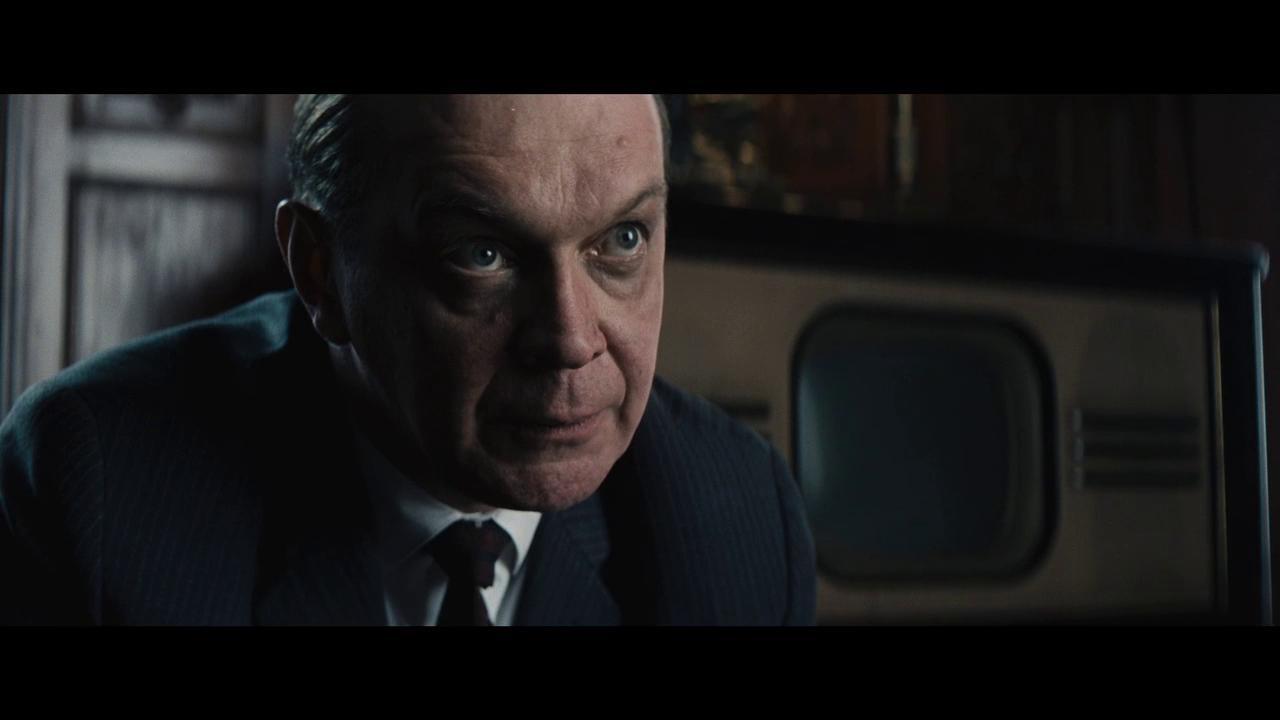
After the meeting, Donovan can’t get a cab. It is night and raining, which adds a sinister quality to the scene. A man follows Donovan. He turns out to be CIA Agent Hoffman (Scott Shepherd), who, after they go into a bar, attempts to acquire from Donovan what Abel tells the attorney. Hoffman scoffs at attorney-client privilege and says there is “no rule book here” given the circumstances. Donovan says he is Irish and Hoffman admits he is of German heritage, but the “one” (that number again) thing that makes them Americans is the adherence to the “rule book,” the Constitution. Donovan is angry at this point with the ease with which Byers and Hoffman dispense with legal safeguards. There is an intimidating force behind Hoffman’s question to Donovan when the CIA agent says, “Do we have to worry about you?” The irony here is that Donovan feels threatened by his own government for doing his job according to the law that is supposed to protect democratic principles.

Donovan looks at the evidence acquired from Abel’s belongings, but there was no search warrant for the items the FBI acquired. He points out to the judge that even though Abel is not a U. S citizen, due process still applies, and the evidence should not be used. The judge doesn’t seem to care about the letter of the law and says that given the Cold War he denies Donovan’s motion. The film shows that the judge’s decision isn’t an interpretation of the law but simply a dismissal of it, which is a dangerous act.  He justifies his actions later by saying there are “bigger issues” at stake. Donovan says to Abel that he is not a U. S. citizen, but his “boss” says he’s not a Soviet citizen either, since Russia is not going to acknowledge that it had a spy in America. Abel again uses his humor despite his dire situation. He says, “Well, the boss isn’t always right. But he’s always the boss.” His remarks apply to the judge, too, which means both countries can be wrong but those in power can ignore the truth.

There is a nice cut to students making the “Pledge of Allegiance,” which states there should be “liberty and justice for all.” This story shows that provision doesn’t always apply. Then there are school children in tears as they watch a film showing the devastation that a nuclear blast can inflict, which can sway people away from that “justice for all” belief. The government gave out false hope that people could withstand the blast by following the “duck and cover,” action, and filling bathtubs and basins with water if the utilities are not functioning. Donovan’s son, Roger (Noah Schnapp), is in his bathroom preparing for the water shortage and tells his father about how their house will be in the blast zone. Donovan tries to calm his boy by saying that no attack is imminent. Apprehension causes even his own son to question why he is defending a spy who could help make the Soviet attack possible. Donovan saying he is doing his job is not sufficient for Roger, as he, like the judge, is willing to dismiss the rules when fear is present. That negative attitude carries over into the population at large as people recognize Donovan from his picture in the newspapers showing he is representing Abel.

Donovan gives Abel a drawing he left in the courtroom and discovers from Abel that his wife plays the harp in a Russian orchestra. Abel also tells a story about how his parents were beaten. Abel’s humor, unwillingness to give into fear, and the facts about his family make him a human being, not a stereotype for Donovan. Abel says that there was a friend of his father who suffered repeated beatings but still stood up. Those inflicting the pain gave up and called him, “standing man.” Abel sees in Donovan that same type of resilience.

The movie does not depict the trial since that is not the focus of the story. The jury finds Abel guilty, despite the illegally acquired evidence. He is, in fact, guilty of espionage. Donovan tells Abel that the death sentence isn’t a lock. Donovan goes to the judge’s house who is preparing for a March of Dimes event to combat polio. The judge is not without his humanitarian interests. Donovan makes a practical argument by stressing his insurance background and says that Abel should be kept alive in case an American is captured doing the same act, spying for his country. Then a trade could be made, which is what the rest of the film depicts.

Donovan’s insurance argument works as the judge sentences Abel to thirty years imprisonment. There is an outcry in the courtroom as people yell for Abel’s death. There is a massive number of reporters taking Donovan’s picture as he exits the courthouse. His wife is frightened by the outcry and Donovan’s partner, Watters, says that Donovan has done his job showing that Abel received a decent defense. If Donovan pursues an appeal, although legally sound, it is not, as Mary says, worth the “cost” to his family and the firm. Again, the environment of fear surrounding the Cold War threatens the letter of the law. Even Abel warns Donovan that he should be “careful” about what can happen to him in an atmosphere of hate as he tries to follow the lawful path.

Abel and the warnings of his wife and partner come to fruition as shots are fired into the Donovan house. The neighbors shout intimidating remarks and even a police officer is confrontational telling Donovan that he shouldn’t be defending Abel. Donovan, the “standing man,” is not one to back down, and stands his ground (Tom Petty reference intentional) as he says that he did his patriotic duty by serving in the military and the policeman should now do his job (which is what Donovan has been stating he is doing).

There is a switch to instructions that the U2 pilots receive. They are told that their mission is secret, and they must not let the plane fall into enemy hands. There is a self-destruct mechanism on the aircraft, and they must go down with the plane. If they think they will be captured, they will have a dollar coin with a lethal poison on a pin inserted in the currency which they are to use. Agent Williams (Michael Gaston) says, “spend the dollar.” It is interesting that we have a second reference to American money, and by extension its capitalist system, that has hidden action attached to it: with Abel, it is to discover the military secrets of the United States; with the U2 pilots, it is to protect those secrets.

We have a series of cuts between the pilots preparing for their spy flights and Donovan getting ready to make his case by citing the Constitution in front of the Supreme Court. In essence we are seeing two versions of fighting for American democracy. Before the Supreme Court, Donovan argues that Abel should be given “the full benefits of the rights that define our system of government.” He makes the case that by showing “who we are,” is “the greatest weapon we have in the Cold War.” He is basically saying that not following the laws that make America an exemplary form of government shows the world that we are no better than the enemies of democracy that we fight against. But he loses his logical argument in the face of an irrational situation, and the Court upholds the conviction.

In a dazzling piece of cinematography, the film shows Powers’s plane hit by enemy fire. He attempts to throw the self-destruct switch, but the cockpit canopy blows apart as the plane falls to the ground. Powers temporarily remains tethered and again attempts to flip the self-destruct switch. But his connecting line to the craft breaks and he opens his parachute. The Russians capture him and he, like Abel, receives a conviction for spying. the filmmakers have stressed the analogy between the two men.

Donovan receives a back-channel letter from East Germany that purports to come from Abel’s wife. Abel says the writing style shows it to be a fake but says that Donovan may as well answer it since it’s difficult to know what “move” to make when one doesn’t know “the game.” There is the implication that the letter may be an attempt to get Abel back to Soviet territory. Donovan meets with Allen Dulles (Peter McRobbie), Director of the CIA. He acknowledges that Donovan was right about the possibility of a prisoner swap and believes that the Soviet Union is using East Germany so it will not have to acknowledge Abel as a Russian spy. The CIA wants Powers back before he cracks and gives up secrets, and Russia wants Abel returned for the same reason, although Donovan knows Abel would never cooperate. Dulles wants Donovan to appear to act (more deceiving appearances) as an independent citizen so that the U. S. Government does not appear to be involved. He will receive no help if “things go south.” As Dulles and Donovan state, there is a fiction being presented on both sides of the Cold War. So, Donovan must pretend that he is corresponding with Abel’s “wife,” and must be a spy himself now as he must go undercover, keeping his mission secret from everybody, including his wife. To complicate matters Russia wants to stop the negative appearance of refugees escaping from East Berlin to West Berlin and is ready to construct what becomes the infamous Berlin Wall. Dulles is funny when asked by Donovan what he should tell Abel. Dulles says, “tell him to stay alive.” It is ironic that the country that wanted Anel dead now needs him to be that “standing man.”

Another element is added to the exchange plan. As the Communists build the Berlin Wall amid chaos among the citizens of the city, American doctoral student Frederic Pryor (Will Rogers) rides his bicycle to get his girlfriend, Katje (Nadja Bobyleva) out of the city. Even though he has identification documents and is carrying his dissertation on Communist economics, the East Germans authorities arrest him.

Donovan travels to Berlin and he hears about the arrest of Pryor who the East Germans are saying is also a spy. Donovan, again trying to do whatever he can to make things right, wants to try and get Pryor out, but the U. S. stance is to worry about the student later. The lawyer, Wolfgang Vogel (Sebastian Koch), representing the fake Mrs. Abel is also Pryor’s attorney. It appears that the East German and Soviet interests may not align, since the East Germans don’t want the Russians to treat them as pawns.

It is very dangerous for Donovan as he travels to East Germany without U. S. support. Food is scarce in East Berlin so there is crime and little police enforcement at this point to keep criminals in check. If Donovan gets too close to the wall he could be shot. He must also not draw attention to himself since he is a foreigner and could appear to be a spy. He has papers added to his passport which justify his entrance to East Berlin. He demonstrates his boldness by confronting the guards at the entrance to speed him ahead of the long line. It is very cold and youths accost him and he must give up his coat and walk in the freezing weather to his meeting. Donovan is also not feeling well since he caught a cold. The story shows the courage and persistence of the man in his pursuit in what he believes is just.

At the Russian Embassy where Donovan is to meet Vogel he encounters three people who say they are relatives of Abel. As Abel had said, the woman is pretending to be his wife and she has a fake daughter and cousin with her. They put on a show of grief that they hope will soften Donovan’s negotiation terms, but Vogel can see past their drama. Ivan Schischkin (Michael Gor), who says he’s a secretary at the embassy, but is really a KGB chief, appears instead of Vogel since the lawyer is a German and would make the negotiation between the U. S. and Russia more indirect. The two play a clever diplomatic game. The Russian wants to get Abel first so as to save face and then they will release Powers. Donovan rejects that move knowing they may never get Powers back. Schischkin suggests the quickness desired by Donovan means Abel has already given up what he knows and wants to stop Powers from doing the same. Donovan concludes that Powers must not have divulged anything, or the Soviets would agree to a fast trade. He suggests that Abel may still have secrets and will be willing to divulge them for some American favors and suggests that future Soviet prisoners might do the same if Russia will not seek their return expeditiously. Donovan says that that the two of them must work together so that their countries do not escalate their problems to the point that war is possible. Donovan makes a bold request to make Pryor part of the deal, but it is the East Germans who apprehended him, complicating the deal.

Donovan finally meets Vogel at the lawyer’s address. Vogel says that the United States must recognize East Germany as a sovereign state in exchange for Pryor. But Donovan can refuse that demand because he is not officially representing America and can’t grant that request. Vogel says that he also is not a representative of East Germany, so basically he is Donovan’s counterpart as their respective governments want to keep their distance from the activities. Vogel agrees to provide Pryor as part of the exchange. The implication is that if East Germany handles getting Abel back for the Russians it will acquire respect on the world stage for doing the Soviets a favor. The Feds just want Powers, but Donovan insists on Pryor being part of the deal. Powers was captured and didn’t commit suicide, so Donovan cuts through any humanitarian hype about getting him back. He knows that there is no love for the pilot and that the U. S. Government just doesn’t want him to leak information.

The Soviets apply tactics seen in The Ipcress File on Powers. They keep waking him up to wear him down, hoping to squeeze information about the spy flights out of him before the trade. There is a fitting symmetrical cut to the Feds arousing Abel in his cell to go to East Berlin. Schischkin says Russia has consented to exchanging Powers for Abel. Donovan thinks he also has a deal to get back Pryor, who everyone knows is not a spy, from the East Germans. But when he meets Vogel again the lawyer is angry that Donovan has made a deal for getting two-for-one. East Germany wants all the credit for getting Abel. Donovan again uses his insurance argument that this transaction is all part of one deal. Donovan rides in Vogel’s car because he is going to West Berlin. Vogel points out the devastation in East Berlin and reflects his country’s anger at Russia for deciding not to rebuild the city. He deliberately speeds the car and the police stop them. Vogel knows that without the proper credentials the authorities will detain Donovan.

The film then provides shots of what is now four incarcerated individuals in this story: Powers, Abel, Pryor and now Donovan. The police release Donovan and, as he rides the train to West Berlin, he witnesses the shooting of people trying to scale the Berlin Wall. That scene adds visceral shock to the horrors taking place in the world.

The U. S. Government has been keeping Donovan under wraps and placed him in an obscure, dingy, cold dwelling. He decides to be defiant considering what he has endured and shows up at the Hilton and orders a proper breakfast at the place where CIA agent Hoffman is staying. He points out to Hoffman that his night in jail wasn’t much worse than where the CIA set him up to stay. Donovan learns that the East German Attorney General, Herald Ott (Burghart Klaubner), called to meet Donovan, but Hoffman sees that as nothing important since they will be getting Powers.

Donovan never wavers from his moral imperative of trying to get Pryor returned. Donovan takes the meeting with Ott who is congenial about exchanging Pryor for Abel but is outraged when Donovan mentions Powers. Ott says the release of an innocent man is understandable, but why care about what in essence he sees as spilled milk when it comes to Powers. Ott gets a call and Donovan waits outside Ott’s office and a worker there tells Donovan the Attorney General had to leave. Here is where Donovan takes advantage of his unofficial negotiating status by making the demands he sees as morally fit, unencumbered by the political posturings of the countries involved. He gives the employee a message stating that there will be no exchange for either the Soviets or East Germany if the deal isn’t for both Pryor and Powers. He adds weight to his demand with the scenario that if Abel realizes he will not return to Russia he may change his mind about cooperating with U. S. intelligence. Ott must call by the end of the day since there will be no point in going to the Glienickie Bridge in the morning if the deal is off.

As IMDb points out, as Donovan passes a movie theater on his way to calling his wife the marquee shows the film playing is Spartacus. Dalton Trumbo wrote the screenplay when he was on the Hollywood blacklist and this movie was the first to show his real name during that time. The inclusion points to how destructive the anti-communist fear was in America. In another scene Spielberg also includes a reference to the film One, Two, Three, a satire about the Cold War, again stressing the preoccupation with this time in history. Donovan’s family thinks he is in London and his children are too “busy” to say hello to him on the phone. Given what he’s been going through it’s funny when he asks Mary if the kids even noticed he hadn’t been “around.”

Donovan receives a call saying the exchange is on, but Pryor will be released at Checkpoint Charlie only after Abel and Powers are traded. The tenseness of the scene at the Glienickie Bridge is heightened since there are snipers from both sides in position to open fire if needed. Abel is happy to see Donovan there, knowing that this person who works for his enemy is an honorable man. Donovan’s actions show what he said earlier that demonstrating the best of American ideals is the strongest weapon against the enemies of the United States.

These two keep their sense of humor in this dangerous situation. Fellow U.S. pilot Officer Murphy (the recently Oscar-nominated Jesse Plemons) is there to identify Powers. Abel wonders who will ID him and Donovan says that he hopes it isn’t his fabricated East German family who couldn’t identify each other. When Donovan asks Abel what will happen when he gets back home Abel says he’ll “have a vodka.”  He then soberly says he will be considered to have acted honorably if he’s embraced. But, if the Soviets show him “the back seat” of a car, he might be punished. To help Donovan, Abel refuses to cross the bridge until Pryor is released. When the word comes that the student has arrived, the two prisoners cross the bridge. Donovan looks in dismay as there is no embrace for Abel, only the open door to the back seat.

Nobody will acknowledge Powers on the airplane back home. The CIA and military see him as a failed soldier no matter what he says about not divulging anything.  For them, he should have sacrificed his life as a patriot instead of allowing Russia to display him as a spy. He tells Donovan he told the Russians nothing. Donovan tells him it doesn’t matter what others believe, only Powers knows what he did. He could be talking about himself, since Donovan was hated for his defense of Abel. But he knows he did what was right legally with Abel, and secretly fashioned the release of two American prisoners without seeking thanks. He only wishes to go home.

However, when Donovan arrives home he receives acknowledgement of his efforts on TV to his family’s astonishment. A passenger on the train to work now sees the bigger picture that Donovan was a part of and smiles at him. Donovan may have come home, but when he sees boys jumping over a backyard fence, his face looks troubled as we know he is thinking of those shot at the Berlin Wall. The horror of the time has come home with him.

A title card at the end of the film says that President John F. Kennedy recruited Donovan to negotiate the release of 1,113 prisoners from the Bay of Pigs invasion. He arranged for 9,703 to be let go. He was an extraordinary man.

The next post will offer comments on recent streaming shows: The Good Nurse; The Watcher; Bad Sisters: The Patient.

Tuesday, September 27, 2022

Bound for Glory

 SPOILER ALERT! The plot will be discussed!

Bound for Glory (1976), directed by Hal Ashby (Harold and Maud, Coming Home), is an episodic story that reminds one of The Grapes of Wrath. It starts out with a line from Woody Guthrie that urges others to not get “plumb” down. We have here an optimist even though he sang songs about the Great Depression, the toughest economic time in American history.

The story begins in Pampa, Texas in July, 1936. Woody (David Carradine, who plays guitar and sings in the role) strums his guitar while other men talk about wanting to go to California or the Gulf of Mexico. Old Man Jenkins (Delos V. Smith, Jr.) says, “In California, you just plop a seed into the ground, you find a sprout the very next day.” They want to escape to anywhere that might suggest the promise of a better life, even if those dreams are as insubstantial as the smoke coming out of a pipe. Woody says these men are “depressing,” probably because of their pathetic ramblings. But they have lost their jobs and there is nothing promising where they are.

A man named Collister (Beeson Carroll) arrives to get gas for his car and says he’d pay a fortune teller who can inform him of something interesting. Woody says he knows the man must work for the oil company because nobody else could afford a fortune teller and a “soda pop.” He adds that the man is serious about his work because his eyebrows are knit together. He goes on to say that Collister is looking for a better idea and wants a big company to buy him out. Collister asks when he should make the transaction. Woody laughs and says he isn’t a mind reader, which is funny since he has made such an accurate assessment of the stranger. Collister gives him a dollar and compliments Woody, saying he’s the only man not claiming to know everything. The exchange shows Woody’s insight, humility, and honesty.

Since he made some money from talking, Woody paints a sign advertising his communication skills. His wife, Mary (Melinda Dillon), tells her husband to be practical about making money from his artistic sign-making ability. Woody ask her not to harp on that point, which shows him to be an impractical man interested in artistic and extraordinary practices. That same idea comes up around the family dinner table later when Woody’s father, Charlie Guthrie (Robert Sorrells), says there are jobs in Amarillo Texas at a department store. Woody says he isn’t going to be “no shoe salesman.” Mary is sarcastic about how maybe Woody can tell his daughter’s fortune when the child is “begging for milk.” The artistic and the practical just don’t mix well in Woody.

Because he now has a reputation as a fortune teller, people expect him to have other extraordinary powers like helping those that are sick from inhaling the dust from the storms prevalent in the middle of the country. These actual storms seem to mirror Mother Nature’s symbolic comment on the waste land that has taken over the United States. Woody gives a mind over body speech to encourage an ill woman to keep fighting for survival. He tells her that God gave her a mind which is “the boss of the whole body.” So, her mind can tell her body to drink water and thrive so she will not leave her husband and children behind. When the woman starts to drink water her relative offers Woody some money, but he refuses it. He probably feels doing a good deed is compensation enough, and he is proud that his words could do what they did. This ability to influence others through words eventually leads to his being a singer/songwriter.

Woody’s individualism comes across when instead of painting a shipowner’s sign with white letters against a black background, he instead uses red as the backdrop. He tells the owner that red stands out better which demonstrates his artistic sensibility and defies traditional standards. That defiance gets him fired from the job, showing that the nonconformist finds resistance from those that subscribe to rigid standards. That rebelliousness can lead to selfish behavior since we see a scene where a woman makes sexual advances after he sings. His infidelity is not an admirable aspect of rule breaking as Woody ignores the commitment to his wife.

A large man named Heavy Chandler (Lee McLaughlin) introduces himself to Woody as an “insane” man. He says that he was in an asylum and that ever since he was young he saw “newsreels” in his head. He says that those images showed that “the boom is over,” and “the dust storms are getting darker and there’s people fighting and killing, and there’s kids sick.” As a fellow fortune teller Woody most likely feels a kinship with Heavy’s premonitions, and he says, “Ain’t nothing wrong with your head.” The artist traditionally had the label of being “mad” as he felt the influence of outside forces flow through him, the literal meaning of “influence.” Those with insight into the dangerous paths that society follows often experience ridicule from the short-sighted. Heavy goes on to say that he also sees “shapes and designs and I see how to build roads better.” In his special way of transcending present limitations he can see how things can be better. Woody recognizes a kindred soul and gives paint and brushes to Heavy so he can present his vision artistically for the rest of the world to appreciate. Woody realizes that his role is the same one he advocates for Heavy.

Woody plays fiddle with some local musicians at a local square dance. Everyone is having a good time despite the tough circumstances. But it’s as if Mother Nature will not allow them to experience enjoyment since a huge dust storm interrupts the party. Woody fights the unbreathable air as he rushes home to try and protect his family which must cover all openings to their shack. As they listen to Woody’s music they must cover their noses and mouths with damp cloths. The suffocating environment is symbolic of how life is trying to choke the life out of the impoverished. He sees the depressed barber who has no customers in his dust-laden shop, and the resident who can’t get his motorcycle started because of the dirt. After learning that there will be no more square dances even the positive Woody admits to his wife that things are getting desperate.

Woody’s free spirit can’t tolerate staying in the bogged down existence of Pampa, so he leaves a note to Mary that says he is going to California. He hesitates for only a moment, but when he sees he can get a ride out of town he takes off. It’s not easy for the audience to accept his decision to leave his wife and young children. He travels with nothing more than the clothes on his back, his paint brushes, and a harmonica. He becomes an illegal passenger in a cramped train boxcar with other poor travelers chasing what’s left of the American Dream out west to California.

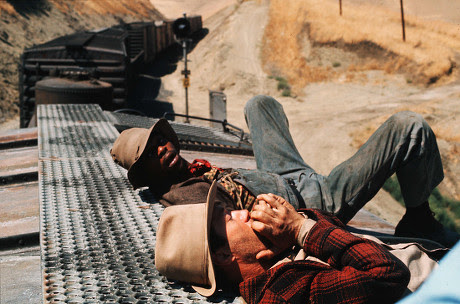
He becomes friends with another hobo, an African American named Slim Snedeger (Ji-Tu Cumbuka). On the train he also meets Po Steve and Crippled Whitey (James Jeter). Their names reflect their sad fates. Whitey calls himself a “fight spotter,” because he can “spot a fist-fight on the street three blocks” before he reaches it. He fits in with the motif of the fortune tellers, poor folks with prophetic visions who can see things that others can’t. Slim says that people can get short-tempered riding boxcars, but Woody’s optimism surfaces when he says that it still “beats walking.” But Whitey’s prediction of a fight in ten minutes is right as a brawl breaks out among the stowaways. Slim and Woody jump out when the train slows, and they climb on top of one of the train cars. Slim echoes the earlier pie-in-the-sky idea that one can find “whatever a man needs” in California. Woody keeps music as his companion as he plays the harmonica. As the train rolls on we get a taste of Woody’s most famous song, “This Land is Your Land,” that remind Americans that the country should belong to everyone, not just a privileged few.

The travelers receive a mean unwelcoming by men with clubs and guns as the train pulls into a station. One of the armed thugs threatens to kill one of the hobos. Some must give up what little money they have to continue to travel. Those like Woody who don’t hear coins “jangling” or money “folding” in their pockets are considered vagrants and must walk, threatened with thirty days imprisonment if caught riding a train for free again. Slim is able to get a ride on the train, so Woody loses his new friend in a hurry and continues traveling alone.

Woody can’t even get kindness from a clergyman, who is supposed to be in the Christian compassion business. Woody asks for work to earn a meal. The pastor says that there isn’t any work so it would be charity, and that would cause “harm” in the long run. The film suggests that it is cruel to not help people to live when there is no other alternative for them to survive.

Woody’s musical abilities are many since he can sing, play the guitar, fiddle, harmonica, and now a piano in a bar for tips. The song he sings stresses Jesus’s compassion for the poor, which makes it relevant to the Depression era. He writes songs along the way, winning over a woman’s submission by saying he wrote a particular song just for her. Despite his leaving and infidelity, he still writes letters home to his wife. One may find this act either touching or hypocritical.

Woody is thrilled when he gets a ride that crosses the Arizona border into California. However, that exhilaration lasts a New York second as many transporting their belongings must pull over. The police from Los Angeles require that every man must have fifty dollars to get into California. These are not deadbeats that are trying to enter the state, but down-on-their luck fellow citizens. So much for America being the land of the free. Woody shows his generosity by giving money to the fellow that drove him even though he is dirt poor himself.

He receives help from others that are destitute. A man shares a blanket and campfire with Woody. Another fellow helps Woody get on a guarded train as it starts to quickly depart. For his attempt to travel onboard with Woody, the guards shoot him atop one of the cars. We have citizens shooting other citizens who are just looking for a reprieve from their poverty.

Woody must jump off the train at a station since he can hardly stand up after holding on between cars so no one will notice him. But he has made it to California. However, the hopes for a better place to live there are not in the cards. He cleans up the kitchen area of the restaurant of a Chinese cook and receives chili to eat as payment. But again, there are no jobs. When he helps a couple with a bent wheel on their truck, the man, Luther Johnson (Randy Quaid), says everything in California is “bent.” The promised land is not delivering on its reputation.

Woody rides with Luther and his wife, Liz (Elizabeth Macey), and their infant child. Luther is a migrant farm worker. They go to a place where there are only about three hundred jobs and there are a thousand more than that number hoping for work. Most of the people live camped outside, crowded together, hoping against all odds to get employment. Wages are so bad that they can’t buy essentials. Woody says that there ought to be something done to help the workers. Luther mentions the possibility of a union, but a strike would bring hardship to those already suffering.

He goes into town to pawn Luther’s guitar for him and stops at a soup kitchen. Woody is not used to getting handouts and expects to work for the soup. He eventually accepts the free meal from Pauline (Gail Strickland) but promises to paint a sign for the kitchen the next day. She agrees to red and white, and it appears Woody sees a connection between them. After painting the sign, he says he hopes she will make dinner for him. She realizes the romantic implication here and says she can’t grant his request. Woody rubs his scruffy beard and says, “of course you can’t.” She insists that it is not Woody’s downtrodden appearance that is the reason for the rejection. But, he shows no hurt because he says it is a good reason.

Woody then goes to a bar just to play a relaxing song, but a fight breaks out between two men. It seems there is no place of peace in this tension-packed world. Back at the migrant camp, tempers are also running high as only thirty people get jobs. Luther says that all the employers are alike no matter where a worker goes. The depression was truly great.

Ozark Bule (Ronnie Cox), a singer, arrives at the campsite and those present are excited by the possibility of entertainment. He brings fruit to eat and says he will only play his guitar if they all shout “Union!” He sings a song that criticizes the employers for saying workers will get their reward in heaven. Ozark’s ability to generate the desire to change the horrible conditions of the poor through his music gets Woody’s attention. There is a hoe-down into the evening and Woody joins with others in singing and playing music. Woody sings his songs, including “Bound for Glory,” about a righteous train traveling. The people there applaud Woody’s performance. The boss’s enforcers try to run Ozark off and fighting breaks out. Woody rides off with Ozark, who tells Woody he should start “trying” to use his talent to make a difference.


Ozark gets Woody an audition at the radio station and Woody gets a weekly job playing his music. He joins with Ozark and other musicians performing at the studio. He sings about not having a home, with the police hassling him as he wanders about, with the bosses cashing in on his hard work. He goes around to the fields with Ozark talking about joining a union and the employer’s goons come by and attack them as they barely escape with their lives. The movie is presenting the abuse of unrestrained capitalism.

Woody now looks cleaned up and goes to the soup kitchen where Pauline still says she doesn’t want to have him over for dinner because she doesn’t know him. He is persistent and funny when he says he would like gravy with his chicken. When he goes to her neighborhood he finds it to be quite upscale. He is funny when he says to Pauline that he thought the mayor would be answering the door since the building looked like city hall. At dinner he asks her if she ever feels “embarrassed” about having so much when others have nothing. He says he met many people on the road who were dead broke who didn’t want charity, just work. Woody says despite being deprived they could still give him something of themselves. When he met rich people they wouldn’t even look at him. In other words, they became dehumanized because they were always afraid of someone taking what they had. He is suggesting what Brad Pitt’s character in Fight Club says how the things you own begin to own you. Pauline is adamant that she has feelings and cares just like others. He says that isn’t good enough, but he thought she had “possibilities” because she was the first rich person “that looked back” instead of ignoring him for being poor.

At a union meeting there is much discord among those present. Woody literally writes a song on the spot and he and Ozark sing about “Stickin’ with the union.” His music and words transcend the animosity and get the crowd on their feet in unison. The goons are there, too, however, and start to use blackjacks on the men. Woody and Ozark join those in the fight to defend their bodies and their rights.

Back at Pauline’s house, Woody nurses his poor, bruised body in her luxurious tub as she sits in her bed. So, they have obviously become intimate. She admits that she is happy knowing him. Despite her being wealthy, he has added an intangible richness to her life. The next morning he confesses that he is married and has children. He can’t lie to her because he knows that they care for one another. Unlike the way he was with other women, when it comes to Pauline, he can’t be selfishly deceptive with her.

Woody now feels that he has enough money to have his family join him. He calls Mary and tells her he loves her. Woody is ready to be a family man again, and buys a house so he, Mary, and the children can live like they hoped they would. They are ecstatic in this new life, but that elation will contrast with the sadness that they will encounter later.

Woody receives fan mail, and the station manager, Locke (John Lehne), offers him a nightly gig with increased pay. However, Woody will have sponsors who want him to steer clear of “controversial” topics. The companies want to cash in on his talent but they want to own his soul so he will not attack them. Ozark gives him a knowing nod to agree to the deal, which suggests he expects to have Woody still preaching the union gospel, but not on the radio. Woody has a difficult time separating the job one uses to make money and one’s moral responsibility. He rebels on the air as he sings a song about the dashed dream of leaving the “dust bowl” for the “sugar bowl” of California, only to discover that visitors are not welcome unless they pay their way in. Locke wants a list of the songs he is going to sing, but Woody would rather have Locke fire him if he must compromise his artistic freedom.

After a show at the station, a man named Baker (Bernie Koppel) meets Woody and eventually becomes his agent. Woody travels and sings, but finding workers earning only “pennies” for their labor depresses Woody. He says to Mary that somehow it made more sense dealing with what Mother Nature served up than people’s “greed.” It seems that he is saying that Mother Nature did not knowingly try to hurt others, unlike humans. Mary worries about him losing his job and doesn’t want to return to an impoverished, unhealthy existence. It is a precarious life at this time when the state of the society can quickly lead to a ruined life.

Woody runs into his old traveling friend Johnson, who incurred a face wound from strike-breakers. Johnson says he learned from his baby that you must make noise to get what you want and tells Woody to keep being the voice of the poor workers. After he gives Locke the list he wanted, Woody is angry and starts to wreck the studio out of guilt for capitulating to the demand. He hits the road again to visit the workers and uses his songs to urge them to become union members. At one spot the company thugs beat him up and destroy his guitar. There is a cost for fighting inequity. Woody left the job and the family, again, and when he returns, Mary is crying when she says, “You don’t think nothing about running off whenever you get the urge.” They have a heated fight. His wife and children become collateral damage in this war Woody wages against the rigged economic system, and the film stresses how difficult it is to fight against those in power.

Woody returns to the radio studio but refuses to stop singing his songs dedicated to the field workers. Locke fires him, but Ozark is jubilant because the agent Baker lined up a CBS performance that will allow Woody to sing to the entire nation. He and Ozark go out celebrating and Woody returns home with gifts for the family. But Mary has had enough of the mostly absent and unreliable Woody going off on his crusades. She has left with the children.

When Woody auditions at the exclusive Coconut Grove venue the booking staff wants to package him as a hillbilly act and do not care about the message he is bringing. He tells Ozark that he doesn’t want to perform in front of rich folks who, according to Woody, are cut off from the rest of the population and, thus, do not bother themselves with the plight of the destitute. Baker has already told him the that he has to avoid “controversial” topics on the CBS show. It’s the same situation that he found at the radio station, where those with money, sponsors, dictate what the artist should say so their own affluent lives can remain impervious to criticism.

He walks out and Ozark finally says goodbye to Woody who says he just wants to be somewhere else. He echoes what he said earlier that he always feels he should be somewhere else. He is not content to settle in and be comfortable and complacent. He’s like a soldier who keeps looking for the battle.

There is a voice-over narrative in which a recording of the real Woody Guthrie says that he hates songs that run people down by saying they are bound to lose. As Woody rides yet another train he sings “This land is Your Land,” which stresses that we should be bound for glory. Woody would die of a terrible ailment, Huntington’s disease, but his music and hope to eliminate oppression lives on.

The next film is Bridge of Spies.

Tuesday, August 23, 2022

Angel Heart

SPOILER ALERT! The plot will be discussed!

Angel Heart (1987) depicts a world bereft of goodness and morality, where evil reigns. The movie is most notable for Allan Parker’s directing that creates visceral responses through surrealistic and religious imagery and symbolism.

The initial setting is an inhospitable wintery New York in 1955. The opening shows a dirty, dark alley with smoke rising from vents which, in the context of this film, suggests the fires of hell. A dog and cat prowl the spot, making animal sounds possibly pointing to the bestial nature that exists even in a metropolitan city. There is a dead body with a blood-smeared face in the alleyway. No one is singing “New York, New York” here.

Harry Angel (Mickey Rourke), which turns out to be an ironic name (the title of the novel on which the movie is based is called Fallen Angel), is a lowly private eye with a messy office. He receives a phone call from attorney Herman Winesap (Dann Florek) to meet Louis Cyphre (Robert De Niro). The last name sounds like “cipher,” which means something cryptic that needs decoding. Well, if you put the first and last names together you get what sounds like “Lucifer.” So, meeting this guy can’t be good.

Angel must go to a church in Harlem which turns out to have a funeral procession outside, an ominous scene. The place is not what one usually associates with a place of worship. Pastor John (Gerald Orange) is overtly greedy as he tells his flock to open their “wallets” and “purses” because he should not be riding in a Cadillac, because if his parishioners “love” him he should have a “Rolls Royce.” Angel meets Winesap who has a partner named Mackintosh. As IMDb points out they have names of apples, and in the Bible the apple represents temptation which brings sin into the world. (Not the only time lawyers are associated with evil. There is The Devil’s Advocate with Al Pacino as Satan. The senior partners in the TV show Angel, another deceptive title, are demons). Angel sees a woman wearing a black hood (spooky) cleaning blood off a wall. Winesap says a man committed suicide by shooting himself. What a church. Do they sing “Oh, Happy Day” here?

Angel meets Cyphre who sits on a small platform almost like he is on a throne. He wears black clothes (nothing subtle about that). He fiddles with a cane (a scepter?) His fingernails are long, a possible reference to his being a demon, and he has a pentagram ring on his finger. Be afraid, be very afraid. Winesap greets Cyphre by holding his hand, like in The Godfather or, in a different context, the way one kisses the Pope’s ring. The image is one of paying tribute to a powerful leader. There are electric fans in the room which become a motif in the movie. Cyphre wants Angel to find out if a “client,” a singer named Johnny Favorite, who was injured in the war and supposedly suffered from amnesia, was alive or dead. He received treatment at an institution. Winesap, using legal language, says that there was a contract between Cyphre and Johnny, and there was to be payment for what Cyphre supplied. If he is the devil, then one would suspect that Johnny sold his soul to achieve some fame. Cyphre suggests that he and Angel met before, which is also ominous.

Angel drives to the place that treated Johnny. He has a bunch of fake ID cards, which shows his use of deception in his work, and pulls one out for the “National institute of Health.” IMDb also mentions that Angel has several keys that would be “skeleton” keys (a deadly name). In the novel they are pass keys that can, supposedly, magically open all doors, which adds to the supernatural element in the story and fits how a private detective tries to discover secrets. He discovers that a Dr. Albert Fowler (Michael Higgins) transferred Johnny Favorite (whose real name is Liebling) out of the institution. (“Fowler” is pronounced like “Foul-er,” suggestive of one who commits foul deeds. But, as we find, chickens disturb Angel, so “fowl” works here, too).

Angel tracks the doctor down through the phone directory and breaks into the dilapidated residence. Next to a bible in a drawer is a revolver, offering up opposite images of destruction and salvation. Angel finds morphine in the refrigerator, an illegal substance to privately possess. So, when the sweaty Fowler, looking for a drug fix, comes home, Angel threatens to snitch on the doctor if he calls the cops. Angel found out that the deceptive Fowler faked a transfer to a VA hospital and took a bribe of $25,000 to release Johnny to a man named Edward Kelly and a girl while maintaining that Johnny was still hospitalized. Angel locks Fowler in his room so he can’t get at his morphine to make him desperate enough that he may remember who took Johnny. In the room is another slow-moving fan that alternately shifts its blade direction. These fans seem to announce the presence of evil or of corrupted souls.

The surreal quality of the film increases as Angel hears his name whispered as he walks down a street and he sees two nuns through a swinging church door silently praying, while what looks like blood drips into a basin near them. There is an old-fashioned elevator door opening and closing inside, too. Could these images suggest the opposites of going to heaven or hell, gaining salvation or being damned?

The camera focuses on Angel holding the key to Fowler’s bedroom, another reference to trying to discover what is happening by finding out what is hidden. When he unlocks the bedroom, it appears that the doctor killed himself with his gun, the one that Angel found in the drawer outside the bedroom. How did Fowler get it if the door was locked? Angel lights a cigarette by striking a match on the dead man’s shoe, an emotionally cold thing to do. As it turns out the bible Angel discovered was hollowed out and contained bullets. Talk about danger hidden below a benevolent surface! Angel wipes down everything to erase his fingerprints (more deception).

Angel meets Cyphre in a nice restaurant which is strangely empty. Angel tells Cyphre what he has learned about Johnny, informing him that Johnny left with his face bandaged because of an injury. Cyphre is undeterred, equating Johnny with a slug who always leaves a trail of “slime” when they leave. It is a damning metaphor, and Cyphre says it as he loudly cracks the shell of a hard-boiled egg. He convinces Angel to continue his investigation by upping his fee despite Angel worrying that he could now be a suspect in Fowler’s death. Cyphre says that in some religions “the egg is the symbol of the soul.” He asks if Angel wants an egg, but Angel declines and throws salt over his shoulder. IMDb says that superstition says that one is throwing salt into the eyes of the devil, blinding the demon. Cyphre then devours the egg staring menacingly at Angel. If this guy acts like he is eating souls then he is either the devil or thinks he is.

Apparently, the church where Angel met Cyphre harbors an evil cult because when Angel returns there he finds a dead monkey that was killed as a sacrifice and other items, such as an inverted cross. Men (probably members of Pastor John’s cult) attack Angel as he is about to confront a hooded person (the person who cleaned up the blood earlier?). He escapes to a bar and meets a woman named Connie (Elizabeth Whitcraft) who works for the New York Times. She provides Angel with information as they undress (not very romantic as there is no room for love in this world). He now has a picture of Johnny Favorite who had a fiancé named Margaret Kruzemark (Charlotte Rampling). She, along with Johnny, and other companions, practiced magic. Angel then has a series of images: soldiers celebrating in Times Square; a trellis elevator, which is what he saw at the church; a person going up a staircase; a woman’s feet; and a fan in a window (lots of fans here).

Angel tracks down Johnny’s associates and starts with Spider Simpson (Charles Gordone) who is a patient in a hospital. He tells Angel that there was a musician named Toots Sweet (Brownie McGhee) who went to New Orleans. Angel suspects that Johnny and Margaret also went there. Johnny also was intimately involved with an African American woman named Evangeline Proudfoot. She had a “spooky store” in Harlem. There was also a palm reader named Madame Zora who had a booth at Coney Island. Angel goes there and it looks desolate which fits the time of year and the tone of the film. There is a geek named Izzy (George Buck) there who says he bites the heads off rats. We are definitely in the realm of the bizarre here. He wears a nose guard but there is hardly any sun. He gives one to Angel, who puts it on. He looks scary, like he is wearing a mask, possibly showing his true nature. There is a possible reference to Chinatown where Jack Nicholson’s private detective wears a bandage over his nose after getting cut, which suggests he is following the wrong scent. Angel learns from Izzy’s wife (Judith Drake) that Zora was actually Margaret who eventually went home to Louisiana.


Angel goes to New Orleans which is the opposite of New York because it is sweltering. Angel is traveling south, possibly symbolically to hell. He notices an advertisement for M. Kruzemark, a fortune teller. He makes an appointment with her. He sees a woman who turns out to be Margaret, which is kind of magical in itself, and follows her to her place. She asks his date of birth, which is on Feb. 14, 1918. She says that she knew another born on that date and she admits that he hurt her. It’s Johnny’s birth date and he eventually tells her he is trying to get information about the singer. She abruptly ends the session, saying Johnny is dead. She quickly reads his palm on the way out telling him he wouldn’t like to know what she sees, which is a bit of foreshadowing. He notices she wears a necklace that has pentagram similar to the one Cyphre wore, which indicates her ties to the satanic realm.

Angel discovers that Johnny’s secret love, Evangeline, is dead. He goes to her grave (another Gothic element added to the story) and hides as a young woman approaches the gravesite. She has a baby and changes offerings that are on the plot, which contrasts with the Catholic cemetery setting. The girl says to her child that it is her grandmother there. Angel follows her and finds that Evangeline’s daughter’s name is Epiphany (Lisa Bonet) (an “epiphany” is usually a sudden insight into something and usually has spiritual overtones). Angel accidentally scares the child with his nose shield glasses, which adds an ominous tone to his presence. She denies knowing anything about Johnny or Toots Sweet. Angel compliments her on her beauty and she smiles, showing she might find him attractive, too. (The chickens around the yard upset Johnny and he mentioned his problem with them before. Does it have something to do with Cyphre saying eggs were symbols of the souls of people, and he has lost his?).

Angel goes to a bar where the guitar-playing Toots Sweet performs. Angel asks about Johnny, but Toots is evasive. Angel follows him into the men’s room, and Toots is now upset with Angel. He is shaken when he sees a black cloth tied around a chicken foot on the sink, an obvious witchcraft. voodoo object. A bouncer sticks the foot in Angel’s face, and he again says he has a thing about chickens before the big bouncer tosses him out of the club. Angel follows Toots to a voodoo gathering in the woods where Epiphany, while dancing, performs a blood ritual by cutting the throat of the chicken and spilling it on her. The recurrence of associating blood with ritual adds a dark supernatural feel to the story.

There is another slow-moving fan in a stairwell as Angel climbs steps, which somewhat mirrors the previous image he saw as a kind of premonition. He is following Toots. He attacks Toots who has a razor like the one Epiphany used in the previous scene, which links the two characters together. Toots cuts Angel on the face, which echoes the sacrifice scene. During the fight that follows a religious statute falls from its perch and cracks on the ground, suggestive of the fall in the Bible from religious grace. Angel takes the razor and overpowers Toots. Angel then threatens to reveal Toots presence at the ritual. Toots also has the symbol of the pentagram decorating a tooth, which links him to Epiphany and Cyphre. Toots tells Angel that Epiphany is a priestess in the cult and the chicken foot was a warning for Toots that he talks too much. The association of chickens with occult groups may be another reason why Angel basically says the only good chicken is a dead one. As he leaves Angel drops Toots’s razor and a fan stops turning as he goes. Could it mean that Angel is the source of the evil symbolized by the turning fan blades?

Angel has a nightmare where he enters a dark room. The elevator appears again. His shirt is soaked in blood. He sees a razor and picks it up and blood gushes from his hand. The same person with the dark hood sits there. As he is about to reach for the anonymous person, he wakes up. Could Angel be the one causing the bloodletting, and, thus, guilty of crimes? The scene seems to link him to the blood sacrifices. Cops wake him up because someone killed Toots. His assailant cut off his penis and stuffed it in his mouth, causing him to asphyxiate. Talk about being full of yourself. The police found Angel’s note leaving contact information with Toots. He tells the cops that he was just asking Toots for some information and tells them the lawyer he is working for. Angel touched the implement of death twice now – the gun that killed the doctor and now the razor that a killer used on Toots.

In another bar, Angel prepares to call Margaret as he looks at his reflection. Mirrors in gothic tales usually represent the other, darker side of a person. Angel gets images of himself in that elevator again and soldiers celebrating. The fan makes another appearance. These images seem to connect Angel with something sinister. And something sinister occurs in the next scene. Angel goes to Margaret’s place and finds her dead, The same ornate knife he found interesting on his first visit is the murder weapon. Someone carved out Margaret’s heart and left it on the coffee table. Those associated with Johnny Favorite are turning up dead. Again, Angel handles the implement of death. He is upset and nauseous, but still searches the premises, finding a mummified hand in a box, which resembles the chicken foot that appeared earlier, another connection to dark ritualistic practices. Angel removes his name from Margaret’s appointment list so as not to be a suspect.


The unnerved Angel passes by a church (religion is on the sideline here) and drinks in another bar that has another ominous fan. Incongruously, there is a religious statue in the window, maybe showing the desecration of the spiritual. He drives past a baptism in a nearby lake, but that religious scene contrasts with a suspicious truck following Angel’s car. Angel stops at a dock and the men from the truck unleash their dog that attacks him. One of the men says Margaret’s father, Ethan (Stocker Fontelieu), is a rich man who wants Angel to go away.

Angel meets up with Epiphany and tells her she set up Toots since she was the only one who knew Angel was looking for him; thus, she sent the chicken foot warning that Toots talks too much. Epiphany is adamant that her religious group does not kill people. She now admits that Johnny Favorite is her father, but she does not know where he is.

Angel receives a message from Cyphre who is now in New Orleans and requests that Angel meet him at a church. These two again being in a place of traditional worship adds to the theme of evil undermining Christian ideals. It is funny when of all people, Cyphre chastises Angel for using vulgar language in a church. Angel tells Cyphre about the murders and notes the strange element of religious practices present. Cyphre comments on the twisted nature of the world when he says, “There’s enough religion in the world to make men hate each other, but not enough to make them love.” Angel thinks Johnny is killing those who disliked him, and he was setting up Angel to take the blame. Cyphre says he is only interested in collecting what Johnny owes him. It is ironic that he says he has traditional beliefs, such as “an eye for an eye.” We have the devil quoting the Old Testament Bible, which darkly associates the deity with his adversary.

What follows is a dark surrealistic mixture of sex and violence referring to previous images in the film. Rain is pouring as Angel finds Epiphany near his room, which is leaking from the ceiling. Inside she says her mother thought that Johnny “was as close to true evil as she wanted to come,” but he also was a wonderful lover. Evil, which can destroy also seems to fuel the fulfillment of one’s sexual appetite here. As the two make feverish love the rainwater turns to blood. There are cuts to the hooded figure cleaning the suicide’s gore, the sacrifice of the lawyer Winesap, the elevator, and the fan. Epiphany reaches a screaming climax that sounds more violent than pleasurable. Angel gets out of the bed and punches the mirror, possibly reflecting anger at his darker, other self.

The police visit Angel, and one cop spews racial slurs after seeing Epiphany in the room. They ask questions about Margaret. The police are feeling the pressure from the dead woman’s powerful father. So, they try to squeeze Angel for answers, but he blows them off. The guys in the truck with the dog wait for Angel outside. He goes after them and chases one into a barn. The other man follows and again sets the dog after Angel, who runs off through a yard full of dreaded chickens, the objects of voodoo sacrifices.

Angel attends a sordid gathering of people skinning animals and conducting cock fights, another example of the depraved environment. He meets Margaret’s father, Ethan, who Angel now believes is the Edward Kelly who, with Margaret, took Johnny Favorite out of the medical institution. Ethan takes Johnny to where gumbo is cooking. The bubbling cauldron looks like it is boiling blood, another disturbing image. Ethan says he and his daughter left Johnny, with amnesia and a bandaged face, in Time Square on New Year’s Eve in the crowd in 1943. Ethan says he did it for Margaret’s sake because she and Johnny were delving into dark magic. Ethan says the mummified hand Angel found represents the Hand of Glory that can open all doors. This idea refers back to all the skeleton keys (another deadly reference) that Angel possesses. While Ethan talks, Angel becomes increasingly agitated, chopping at mounds of ice in Ethan’s office (The fires of hell attacking its opposite?) and he knows Ethan is more complicit than he lets on, and threatens the man. Ethan says that he introduced Margaret to Johnny, who conjured up Satan, to whom he sold his soul to become famous. Johnny then tried to cheat the devil by performing a demonic ritual which included taking the soul of his victim, the soldier, and his identity, by eating the man’s heart. Afterwards, Johnny was drafted and came back injured. Margaret hoped he would restore his memory by being in a New Year’s Eve crowd again, but instead Johnny disappeared. Ethan says that Margaret kept the unfortunate soldier’s dog tags in a vase.

After hearing this tale, Angel vomits in the bathroom, most likely because he is learning the truth about himself. He looks in the mirror, reflecting the other side of his being again, and visualizes the recurring images of the hooded person wiping blood off the wall, the fan, and the soldier in a crowd. When he exits the bathroom, Angel finds Ethan dead, his head plunged into the boiling gumbo, as fire wins over ice.

Angel bursts out of the building and runs to Margaret’s apartment. He rummages through the place and finds the dog tags that show his name, Harold Angel, on them. He is the soldier that Johnny Favorite possessed. If Epiphany (who lives up to her name in being part of Angel’s revelation) is Johnny’s daughter, then Angel in a way has committed incest. Also, Angel’s subconscious self (Johnny) killed all those associated with Johnny who helped him along the way to deny the devil his due.


On cue, Cyphre is there. He has used Angel to do his work for him. However, Angel is still in denial, saying the name Louis Cyphre is just a cheap joke reference to Lucifer. He says Cyphre killed all of the people and is using Angel as the fall guy. Angel keeps saying he knows who he is, but the opposite is true. Cyphre says Angel/Johnny was living on borrowed time, and now Angel’s soul belongs to him. As he says those words, his eyes glow. Cyphre puts on a record of “Girl of My Dreams,” the song that has been playing throughout the film and which was associated with Johnny, showing how Johnny was in Angel’s subconscious mind. Angel has flashbacks of his killing the victims.

Angel runs to where he is staying and finds the cops there next to Epiphany’s dead body, which has his dog tags around her neck, courtesy of Cyphre. Angel admits that it is his place and says that Epiphany is his daughter. Epiphany’s child is there and his eyes glow like Cyphre’s, which suggests that the devil is the father. The policeman says Angel will burn for her murder, and Angel says he knows, because his soul will suffer in the fiery pit of hell. We see that elevator going downward, suggesting his soul is descending to Lucifer’s realm.

The next film is Bound for Glory.