Sunday, July 26, 2015

Hud

SPOILER ALERT! The plot will be discussed.

Well ladies, Paul Newman is attractive and ugly in this 1963 Martin Ritt (Norma Rae) directed film. He is sexually appealing, but he is pure id, - selfish with a capital S.  The locale is Texas. We immediately understand the kind of man Hud (Newman) is in the opening scene. His nephew (Brandon de Wilde) is tracking him down in town because Hud's father (Melvyn Douglas, in an Oscar best supporting actor role) wants him back on the cattle ranch to discuss dealing with the sick animals. The trail Hud has left leads de Wilde to a bar which his rowdy uncle busted up the night before, and then to Hud's pink Cadillac convertible (obviously a car that does not fit in with the surroundings, much like Hud himself). The car is parked outside a married woman's house, where Hud has spent the night.  Apparently married women are his sexual objects of prey, since there is no chance of commitment with them. When the husband arrives, Hud blames his nephew and says he will take care of things. He drives his car fast and recklessly. These scenes show us Newman's character's egocentric personality in short order. 


Hud's rebelliousness against rules involving sex, drinking, and the treatment of others is attractive to his nephew. Douglas scorns his son, especially after Hud wants to sell off the herd before it becomes known that they are suffering from hoof and mouth disease.  Douglas has two long-horned steer that he raised, and which are becoming extinct, much like Douglas' code of ethical behavior. When we see Hud's bedroom, he has steer horns over his bed, emphasizing that his type of person is responsible for the death of an old morality. We see Hud give his car keys to his nephew to drive to town after Douglas gives him a nasty stare. We later learn that de Wilde's dad died in a car accident when Hud was drinking and driving.  Douglas does not want to shelter his nephew.  He tells him he deserves to go out with women and sow his oats.  But, Hud is still dispersing those wild seeds into his thirties, and doesn't care where he plants them.


Patricia Neal (another Oscar winner for this film) plays the housekeeper, who has had a negative past with a man. But, she too, is attracted to Hud's sexuality, flirting with him, but backing off when he is too forward, fearing a repeat of past experiences. The way Neal and de Wilde devour food symbolically shows the effect Hud has on their appetites.  On the other hand, the housekeeper's nurturing ways make an impression on the nephew, who sees her as a good person, and leads him to respect women in a way his uncle does not. When in a drunken rage Hud tries to rape Neal, it is de Wilde who comes to the rescue. Although it is Newman who withdraws from beating his nephew, pulling back on his own drives.   


Ritt depicts Hud on the outside of circles of people, emphasizing his anti-social ways. He is the winner in the pig catching contest (it takes one to know one), stealing one animal off of a fellow contestant. He wants to shoot the buzzards that are close to the cattle that are to be examined for disease. Douglas tells him that the birds are necessary in the life cycle, but Hud has only contempt for that circle of life.  Hud wants to forget about raising animals, which along with the ranch, represent the life process. Instead, he wants to make money drilling holes for oil, grave robbing the earth for profit. Hud’s plan is a blasphemy to his father. When they have to kill the herd, including the father’s beloved two steer, and bury them, it is Douglas' way of life that also has died.  He tells Hud he always despised him because he just didn't give a damn about anything and had no control over his selfish appetites. When the father is thrown from a horse and physically dies, it is after he was killed spiritually.


Neal leaves after the assault. The nephew, after seeing how Hud tried to declare his father incompetent before his death, and witnessing the assault on Neal, also leaves. When all you care about is yourself, you are left alone.


Next week’s film is To Kill a Mockingbird.

Sunday, July 19, 2015

Klute

SPOILER ALERT! The plot of the movie will be discussed.


Guess what? Here we have another movie where things are not what they seem. Director Alan J. Pakula’s film takes its title from the name of Donald Sutherland’s character, John Klute. But, this story is really about the sex worker/actress Bree Daniel (Jane Fonda, in an Oscar-winning performance). On the surface the narrative is a mystery/thriller, but, it is really about the roles played by men and women in society.


In the very first scene, we have people enjoying food, drink, and each other’s company at a dinner table. Everything appears safe and civilized. Klute is there, as well as Tom Gruneman (Robert Milli), his wife, Holly (Betty Murray), and Tom’s boss, Peter Cable (Charles Cioffi), a distinguished looking man with gray hair. There is a pocket-sized tape recorder sitting on the table, recording the event. We don’t know who owns the recorder. However, we later hear Bree’s voice played back on the device in an encounter with a weird “John.” So, we learn whoever owns the recorder is scary, and thus there is danger under this scene of supposed normalcy.

We discover that Tom is missing, and the FBI is at a dead end in its investigation. Tom’s wife, Holly, with Cable at her side, hires Klute, Tom’s best friend, a policeman-turned-private investigator, to find out what happened to her husband. A typed obscene letter from Tom to Bree was found at Tom’s office. Bree testified that she received a number of letters from Tom, but could not identify him by his photograph, since it all took place two years prior. She has a sense that she is being watched before Klute arrives. She says that she received phone calls from an unidentified person, and that someone was messing with her trash and mail. The movie builds this sense of paranoia with a feeling of being observed accompanied by a very eerie soundtrack. 


Klute goes to New York, but initially encounters hostility when approaching Bree. Klute is sort of a surrogate for the audience, as he takes us into this seedy world where Bree exists. Why did Klute stop being a cop? Possibly his decent morality made it difficult for him to continue to deal with criminals day in and day out. He rents a small basement apartment in the building where Bree lives. He is sort of a voyeur, watching and listening to Bree, and taping her. The possibility that he is the owner of the tape recorder is raised here. However, we then see the back of a man observing the two, and Klute chases but does not catch someone who is on the roof of Bree’s building. Klute could be the antagonist’s symbolic double, chasing his darker self, implying that we all have those unsavory tendencies that could push us through a scary doorway to our darker selves.The camera gives us shots from a distance, as if we, too, are hiding behind objects, being voyeuristic, and in this way, director Pakula, along with cinematographer Gordon Willis, add an Alfred Hitchcock feel to the film. The remote and obscured shots also add a feeling of unease, like something if off and unsettling here.

When we see Bree at an audition she is sitting in a row with many other attractive women. A male casting agent goes up and down the line of women, rejecting them for just the way they appear, like a person going through a menu dismissing dishes to eat. We later are at therapy sessions, where Bree says that she has no power over being chosen for acting roles. But, when she “plays” the part of the sex worker, she calls the shots. She is allowed to act as the seductress, manipulating her clients. She does not get pleasure from the sex, but achieves enjoyment in the performance, which is more like a simulation of a powerful event. She appears to get real satisfaction in this escape from the “real” world. (Apparently Fonda did the therapy session scenes at the end of the filming so she could be deep into the character’s journey, and she improvised her lines with a real female psychiatrist). But, she admits to her therapist that she wants out of the call girl business, because it has become an addiction, and she realizes that she plays the sex roles that men have defined for her.


Bree has contempt for the “straight world,” because to her it is a hypocrisy, where men pretend to be upright and moral. She has seen the ugly underside of these pretenders in her profession. When she taunts Klute about what strange sexual practices he may really like, he tells her that she is acting “pathetic.” At first, she feels angry at him, probably because his decency shames her. He makes her bed, soothes her, and brings her cool compresses. One night, she goes to his basement apartment because she says she is afraid. She climbs into his bed, and they have sex. She later acts as if she has compromised him. She tells him not to feel bad, because she never climaxes with a “John.” She demeans him by putting him into the category of her clients. She says not to worry about “losing your virtue” with her, because in her pessimistic world, “everyone does.” She wants to bring him down to her level, so she can feel more at ease with her work in the depraved world where she earns her living. When Klute attacks her pimp, Frank Ligourin (Roy Scheider) after he says demeaning things about Bree, she tries to protect her pimp, going after Klute with scissors. This act shows what a threat the upstanding Klute is to her lifestyle. She says to her therapist that she normally does not like being truly intimate with a man because she can be vulnerable by caring about another. There is comfort in numbness for her. But, she likes being physical with Klute. He accepts her even though he knows her job and has been caring when she has revealed her fear. 


Bree tells Klute about a man who beat her. She was given this client by another prostitute, Jane McKenna. Klute and Bree go to her pimp to find out more information. McKenna was jealous of Bree’s success and approval from Ligourin. So, she passed on the beater to Bree as a punishment. McKenna was later found dead, apparently by suicide. Klute and Bree then seek out another sex worker friend, Arlyn Page (Dorothy Tristen). She and her boyfriend are pathetic junkies. Bree starts to see her world through Klute’s eyes, and realizes her life could deteriorate as she observes Page (Klute sounds like "clue" and not only does that fit with his profession, he may be the clue to her finding her way to a new life). Page looks at the photo of the missing man, Tom Gruneman, and says he is not the beater, who was older.


The audience by now knows the villain – the outwardly upstanding businessman Peter Cable. Again, things are not what they seem. The antagonist on the surface seems like a friend of the family, helping them solve the mystery of the missing man. But, he actually uses information from Klute to further his own twisted agenda. The small tape recorder is his, and we see him listen to Bree’s voice who he recorded on the night he beat her. On the recording, Bree says that “nothing is wrong.” She says she has wicked ideas. She means sexual ones, which is what her clients want to hear. But ideas can be hurtful when words and actions spring from them. Klute finds out that the second hooker, Arlyn Page is dead. Bree’s apartment is trashed and semen is found on her clothes. The semen does not match Tom’s, so Klute knows that the missing man is not the perpetrator. He now suspects that the killer murdered the two prostitutes and Gruneman to cover his tracks. Page died after Klute confided about her to Cable. Klute also runs a test and the letters to Bree were produced by Cable’s typewriter. The businessman pretended to be Gruneman with the sex workers, and killed him when he found out about the fraud. Cable finds Bree at the factory of one of her clients where she went for sanctuary. She hides there after closing hours. Cable plays his tape of her, and tries to kill her. But, Klute arrives, and Cable kills himself by jumping out of a window. He would not be able to endure the exposing of his black deeds to the light of the waking world.


Most of the film is shot in darkened rooms. Perhaps that is because we all go to Bree’s world in our hidden thoughts. Most of us do not act on those feelings. Maybe that is why we vicariously participate in the nightmare realm by watching movies.

Next week’s movie is Hud.

Sunday, July 12, 2015

House of Games

SPOILER ALERT! The plot will be discussed.


David Mamet explores the area between what is legal and illegal, civilized and uncivilized.  He does it in the scripts for The Verdict, The Edge, The Spanish Prisoner, The Untouchables, and he does it in the first film he wrote and directed, House of Games.


Here we have Dr. Margaret (Maggie) Ford (Lindsay Crouse, Mamet's wife at the time), who is a psychiatrist and a recent best-selling author. Her book is entitled Driven, and we later see what drives this woman, who previously was just a passive observer of life, listening to the confessions of criminals. Early on we see her with a female murderer who asks her if the doctor is "exempt" from life, emphasizing Maggie's detachment. 

Maggie has lunch with her mentor, Maria, who has a cigarette lighter that is made of gold, heavy, and precious. She says that she does not have anything precious in her life.  Maria, seeing that her friend has been totally consumed by her work, says she should do something for herself. Ironically it is the advice of the similarly named mentor, her civilized double, who is suggesting something innocent, that helps push Maggie over "the edge," the line that leads into a darker world.

Maggie starts her journey to that world when she meets with a new patient, Billy, who is a compulsive gambler. He says he lost money gambling and now owes $25,000 to a man named Mike. He tells Maggie that her therapy is worthless to him. It is a "con" game, promising some vague help. Because she cannot help her female murderer, she later echoes that she feels like a con artist, which of course lets us see how she can easily enter the world of con men. What Billy says he needs is something concrete, the money, or he will be killed. Maggie gets the address where Mike hangs out, a joint called "House of Games." Maggie enters the place, which along with the Budweiser sign hanging on the wall, displays another advertisement which says, "Say Bull." It may be a Mamet hint that what is about to transpire is "bullshit," something untrue. 


Maggie now adopts a tough gal persona, which the audience did not know she has in her, to see Mike (Joseph Mantegna). This scene shows us that she may not be what she appeared to be, just as are the other characters. For example, we first "see" Mike in shadows, suggesting he may not be what he seems. Mike flatters her by saying how quickly she sized him up as a guy who would not physically hurt someone (which turns out to be true). He shows Billy's marker, which is only for $800. This action makes Maggie trust Mike, since he could have said Billy owed more. Mike says he will tear up the marker if Maggie will help him in the card game being played in a back room. He asks her to tell him if she sees a player in the game show his "tell," which is twisting the ring on his finger, meaning he is bluffing. Maggie goes along, but when things go south, and Mike owes six grand, she offers to pay the money. But, she sees that the gun that the other gambler threatened them with is a water pistol. It was all a scam to get $6,000 from her. Again, Mike seems impressed by Maggie's observational smarts. And Maggie is drawn in by the psychological aspects of people's "tells," which Mike says convey the inner person. She also had a chance to witness a magic show that entertained her, one not seen in legitimate society, and she has fun participating in that world.


When she goes back home, she has in her possession Billy's gun, which she convinced him to give her, and an empty book of matches (no expensive lighter), again reminding her of the emptiness in her life. She goes back looking for Mike, saying she wants research to write a book, but we know it is the excitement of the illegal activity that has brought her back to him. He shows her a "short con" saying that the con artist gives his confidence to the mark, showing that he trusts him. This action makes the mark want to do something for the con artist. Mike says in these transactions, each party gets something:  the crook gets money, and the mark feels good about himself, helping another. Maggie sees that Mike has great psychiatric abilities, as he tells her that she wants to be with someone who will take her to new experiences. It is ironic that he tells her “don’t trust nobody." They go to a hotel, steal a key and use the room to make love.  Mike lets Maggie use the key to open the door, symbolically making her a willing participant as she enters the realm of the criminal.  Mike tells Maggie that she should always take something, a memento, to assert herself. She secretly takes a penknife off of the dresser.


As they leave the hotel, Mike says he is late for a new scam, and tells her to leave. She wants to stay, and becomes part of an elaborate scheme to take money form a mark. In the course of the con, she realizes the mark is an undercover cop, and when she warns Mike and his partner, the cop is accidently shot. They sneak out to the garage and Mike says she has to steal this red Cadillac so they can escape. They get away, but they forgot the $80,000 that was needed for the sting, and which they owe the mob. She promises to get the money to him, which she does. Billy shows up at her office, but she sends him away. As she goes out to dump any incriminating evidence she may have, she sees Billy drive away in the "stolen" red car. She now realizes she has been swindled to get her money, which is confirmed when she goes to the club and eavesdrops on the participants in the scam. Billy was sent to make sure she wasn't caving and calling the cops. She hears Mike say how she stole his "lucky" penknife. She shows up at the airport where Mike is taking a flight, and pretends to act afraid and wanting to leave with him with all of her money. She happens to mention "his" pen that she took and feels so guilty about everything. Of course, her mentioning that it was "his" pen makes Mike realize that she is trying to con him. He thinks he knows her, but he doesn't. He has created a monster in the transformed Maggie, who is livid about being "raped" by him, and having her money stolen. She takes out Billy's gun, saying it isn't hers, so she was never there, and shoots Mike to death.


Earlier on, Maria told a distraught Maggie that she should "forgive" herself concerning any act that she felt guilty about. After all, it wasn't like she killed anyone. At that time she hadn't. In the last scene, she seems refreshed and happy as she meets Maria, and tells her that she has forgiven herself, but she doesn't mention it is the crime of murder for which she has absolved herself.  Maria leaves their lunch table to answer a phone call.  Maggie sees a woman with a gold lighter. She distracts the woman, and steals it, lights a cigarette, and smiles. She feels she has literally and figuratively acquired something  precious, which she felt was lacking earlier, and has followed Mike’s advice about taking something to assert herself. The psychiatrist, who is supposed to promote proper behavior, has crossed over the line and has become a sociopath.


If life is a house of games, one may never know the true nature of an opponent, which, sometimes, can make the game deadly.

Next week’s movie is Klute.

Sunday, July 5, 2015

3 Days of the Condor

SPOILER ALERT! The plot will be discussed.


The book from which this movie was based is called 6 Days of the Condor by James Brady. The reduction in the number of days does not diminish the impact of this 1975 film directed by Sidney Pollack. It is packed with enough thought-provoking ideas for hours of discussions.


Joseph Turner (Robert Redford) works at the American Literary Historical Society in New York City. The place is a cover for a CIA section that reads, according to CIA supervisor Higgins (Cliff Robertson), “everything.” Redford’s name is “Turner” as in “page turner.” The workers at the Society feed stories into the computer and look for espionage plots hidden in the narratives. They also get new ideas from the stories. We see that Turner does not like to play by the rules. He is often late for work. He uses an unauthorized exit to buy lunch for his co-workers. He covers his face with his hat at the door to mock the surveillance by the security camera.

There is a poster of Albert Einstein in Turner’s office. This image lets us know that he admires the very intelligent. He too is a smart guy who has absorbed much of what he has read. He can predict when it will start and stop raining. He advises his supervisor to protect his plant from blight, and can fix the computer printer. He talks to his co-worker and girlfriend, Janice (Tina Chen) about a mystery that didn’t sell, but was translated into Spanish, Turkish, and Dutch. He filed a report about a theory of his that this novel may indicate the possibility of a spy network that is unknown to the CIA. His boss gives him a letter that says the higher-ups saw no basis for his theory.


When Turner goes out of the building to purchase lunch, we witness the execution of the whole Society by men led by person we later learn is named Joubert (Max Von Sydow). His code name is “Lucifer.” Interesting, because Von Sydow once played Jesus in The Greatest Story Ever Told. When Turner returns and sees that everyone is dead, he takes the receptionist’s gun and calls into the office in a panic. Earlier, his boss questioned Turner’s compatibility with his job. Turner says he doesn’t like that he can’t tell anyone what he does because he actually trusts some people. And that is the focus of the film. Trust. It’s hard to come by in the spy profession. Turner’s code name is “Condor,” a nearly extinct bird. Turner is a man who believes in trust, because his moral code distinguishes between right and wrong. In the world of this movie, he is seen as part of an endangered species. His “Days” of the title may be numbered.

The attack at the Society flips Turner’s world upside-down. Trust now is very hard to imagine. He is now suspicious of everyone. A woman with a baby carriage walking toward him is seen as a threat. Later he says, “I don’t remember yesterday. Today, it rained.” He must leave behind all that gave him comfort and must face the present storm. He will not be brought into the “Company” after the hit because he tells Higgins he doesn’t know him or his Section Chief, a man named Wicks (Michael Kane), who says he will meet Condor. Wicks brings Turner’s friend, Sam Barber (Walter McGinn), a man Turner trusts, to meet them at an alley. Wicks shoots at Turner when he arrives, and the latter wounds Wicks, who then kills Sam so he won’t be able to tell anyone that Wicks is part of the conspiracy. Wicks turned Turner’s trustworthiness concerning his friend into a vulnerability. It now appears to Higgins and his boss, Wabash (John Houseman) that Turner is the one who killed Sam and wounded Wicks. However, the shot that killed Sam was too precise for the non-marksman Turner.


Turner is now forced to subvert his moral code in order to survive. He needs a place to hide and rest. In a clothes store he overhears a woman, Kathy Hale, (played by Faye Dunaway) talking about meeting someone in Vermont for a skiing vacation. Outside, he forces her to take him to her place. The relationship that develops between these two is a peculiar one. It’s almost impossible to talk about it. It has to be experienced by watching the film. Turner’s two sides are alternately shown. He wants her to understand that he is a victim, so he tells her the truth about what his job was and that he is being hunted. But, she has a hard time believing him. So, he must tie her up when he goes out, or they lie on the bed and he holds her so he’ll know if she stirs. There is a sort of bondage-sexual subtext to these scenes. She says he has roughed her up. He asks “Have I raped you?” She counters with, “The night is young.” He tells her that he is afraid. She asks why is he afraid; he has the gun. “Yes,” he says. “And it’s not enough,” indicating how terrible the world has become. She says at one point, “This is … unfair.” He says, “I know,” which shows how the concept of right and wrong has become compromised. So, he is torn, feeling compelled to be rough with her at one moment out of expediency, and then complimenting her work as a photographer, admiring the photos on the wall.

About those photographs. They show benches in parks and playgrounds. They are black and white shots.Turner says they are beautiful, but there are no people in them. She says it’s winter. He says no, not fall or winter. They are in between. They are like “November.” He listens in on a phone conversation between Kathy and her boyfriend who is upset about her not showing up, again. She tells Turner that she doesn’t want to know him because he may not be around too long. He counters by saying she wants to be with someone who is on his way. The lack of people in her photos shows that fact. She says she takes pictures of some subjects that are not like her. But, she takes the photos so they are like her. In essence she is saying that underneath she is like Turner. They are both solitary figures. She asks what he wants. He says he just wants it to stop for one night. They make love and during the lovemaking, the camera cuts to the photos on the wall, emphasizing the “November” relationship, a world that is not permanent, but is “in between” something definite and stable. It is ironic that Turner finds someone to trust in a person he chose “at random.”


Turner visits Sam’s place and realizes his friend’s wife doesn’t even know that her husband is dead. He fears for her and gets her out of the apartment. He encounters Joubert, and realizes he is there to kill him since he exits and enters an elevator, following Turner. But, he is able to escape among a crowd of youths. He tells Kathy that he believes he and his office were targeted because of his report. That the hidden spy agency he discovered was another CIA within the CIA. Turner has Kathy pretend she is applying for a job at the New York CIA office. She fakes looking for someone else, but wanders into Higgins’ office. Thus, she can recognize him, and follows him to lunch. She tells  him that Condor wants to see him. They abduct Higgins. Turner finds out that Higgins does not know what is going on. He describes Joubert to Higgins, and says his accent indicates he is from Alsace. Alsace is a land which kept going back and forth between the French and the Germans. Thus his heritage fits a person who has no permanent allegiance to loyalty. Higgins does some research. He is able to link Joubert to Wicks and Atwood (Addison Powell), the CIA head of operations.


However, Joubert was able to see the license plate of Kathy’s car at Sam’s place. Joubert meets with Atwood who we realize is the leader of the conspiracy. While Joubert goes off to eliminate Wicks so he can’t be questioned about the alley incident, Joubert sends an assassin, dressed as a mailman, to Kathy’s apartment to kill Turner. Life is dangerous indeed when those who appear to be trusted government workers are in fact dangerous predators. Turner is able to kill the killer, and takes a key and phone number off of the body. The phone number turns out to link the assassin to Wicks in Washington. Turner traces the key to a Holiday Inn where Joubert is staying. Turner was in the signal corps and worked for AT&T. He taps the phone line and calls Joubert, mentioning the “condor.” He knows Joubert will call someone involved in the murders, and Turner then discovers it is Atwood, who lives in Chevy Chase, Maryland. 

Turner takes Kathy to the train station to go to Vermont. He says she could take him to Maryland, but she says, “No I can’t.” Their “in between” time is over. She says that Turner has eyes that “don’t lie, don’t look away much. And they don’t miss a thing.” She could use eyes like that in her job. He then warns her not to talk to anyone, and sees the hurt in her eyes as he realizes he is again not trusting. He apologizes and he goes off to confront Atwood.

At Atwood’s house Turner understands by talking to the conspirator that the language translations of the obscure book meant that the whole business was “about oil.” So this 1975 film has a topic that is very timely in our present day. As Turner questions Atwood, Joubert shows up. He kills Atwood. The Company has hired him back, since it realizes that Atwood would have become an embarrassment. The assassin makes it look like a suicide. Joubert assured Turner that he has no contract to kill him now that Atwood is gone. He knew Turner would be at Atkinson’s house - but the CIA did not. He says that if Turner goes back to New York, he has not much of a future there, since he also can be an “embarrassment.” Turner asks Joubert how does he do what he does. He would find it tiring. Joubert says it is quite relaxing. There is no need to worry about sides or politics. Only who, where, and always how much. The joy comes from one’s precision. Joubert says in New York a car will come by, and someone, maybe a person he knows, maybe “trusts”, will have a becoming smile, and offer him a ride. He hands him his gun and say to Turner, “For that day.” So, the Lucifer of modern times is one who has no sense of right and wrong, and is comfortable in that environment. In a scene at CIA headquarters, Wabash, in answer to subordinate Cliff Robertson’s question, says he does not miss the military action of his youth. He misses “the clarity” about right and wrong.


In New York, Turner meets Higgins on the street. A car comes up, but Turner refuses to get in. He asks Higgins if this whole thing was about a plan to invade the Middle East to seize oil. Higgins says the plan would have worked, and the people won’t care about right and wrong when the oil runs out. They will just want them to go get it. Turner takes Higgins in front of the New York Times. He says he has told the newspaper everything that has happened. Higgins tells him he is about to be a very lonely man (he already is). We are not even sure his story will see the light of day, as Roberson asks, “But will they print it?” At the end, Turner, the Condor, is walking alone to Christmas music that ironically contains the words “comfort and joy.”

Redford teamed up with director Pollack on a number of films, including Out of Africa, The Way We Were, and The Electric Horseman. Do you have a favorite?

Next week’s movie is House of Games.

Sunday, June 28, 2015

Body Heat

SPOILER ALERT! The plot of the movie will be discussed.


I’ve been to Florida in the summer, and I sweated as much as the characters in Lawrence Kasdan’s Body Heat. But I was at Walt Disney World, so my activities were very different from the ones depicted in this movie. The steamy Florida locale adds to the atmosphere of this erotic film noir. The title of this film implies contradictions. A dead “body” is cold. It represents the absence of heat. And, murder is a calculating cold-blooded act, an unfeeling one. But, a crime of passion is considered to be irrational, based on hot-blooded impulses. Also, bodies involved in sexual activity create a heated encounter. A mind immersed in sultry passion many times cannot see straight. The dark titles seen through flitting garments at the beginning of the film emphasize the lack of clarity that can result when a person is in heat, both physically and mentally.


The film opens, appropriately, with a fire. Attorney Ned Racine (William Hurt), looks out of a bedroom window at a burning restaurant in the distance. He shares sweat (and presumably other bodily fluids) with a woman who occupies the room with him. It is suggested that the restaurant was destroyed by an act of arson, which is a foreboding event of what is to come. At the local diner, the air conditioner strains unsuccessfully to cool the patrons. The deep fryers boil. The waitress says she’s not thinking straight because of the heat. Characters say that “when it gets hot, people start to kill people,” another foreshadowing. Someone says the heat causes things to be “a little askew,” and the usual rules don’t apply. The exchange between Ned and his friend, prosecutor Lowenstein (Ted Danson), presents Ned as a man preoccupied with sex, and who has a weakness for women. He is also defending a man in a case involving fraudulent payments revolving around toilets, which may imply that Ned’s life resides in the porcelain throne.


These initial scenes are a setup to Ned meeting Matty Tyler Walker (Kathleen Turner). He sees her at a beach concert as people fan themselves. Matty seems to be playing hard-to-get, quickly saying that she is married. However, when he starts to wipe a spill off of her jacket, she says to him, “Don’t you want to lick it?” She also says to him, “You are not too smart. I like that in a man.” Another definite foreshadowing of events to come. He says he’s not looking for trouble, but, of course he is. After throwing him off balance by alternately pushing him at a distance and then drawing him closer, Matty mysteriously leaves, but not before telling him she lives in nearby Pine Haven. He finds her there at the only night spot in town. They engage in what Kasdan said is the highly stylized dialogue of film noir. She says that she is always warm because her “temperature runs high,” which again refers to her sexual steaminess. When she complains about the local men who are always hitting on her, he says she shouldn’t wear the clothes she dons. When she says she is only wearing a blouse and skirt, Ned says, “You shouldn’t wear that body,” which implies that no matter what she does, or he does, she will be irresistible to him. She manipulates him by saying how he has made it farther with her than the other men at the bar, thus pandering to his macho competitiveness. 


 She invites him to her place, as long as nobody sees them leave together (which will protect her later against a conspiracy to commit murder charge), and only to hear her wind chimes (what’s that saying about “it’s an ill wind that blows no good?”). She slaps him before they leave to make it look like he is a rejected suitor. He drives his corvette (a fast car, indicating that lustful haste makes waste) to her place. Her husband, Edmund (Richard Crenna) is away often doing business. The maid is also not there, making putting a move on Matty almost irresistible. She kisses Ned, and swoons, saying she is weak (as we see, far from it), and locks him out of the house. In an act symbolic of rape, Ned smashes the French doors, and takes her in his arms. They have a torrid affair for about a month. There is an interesting scene where Ned approaches a woman from behind who he thinks is Matty. It turns out to be Matty’s old friend, Mary Ann Simpson (Kim Zimmer).


Matty starts to plant seeds (a reversal of what the male usually does) that will lead Ned to suggest killing Edmund. She calls her husband a small. mean, weak man (which we discover he is not). She will only get a small amount of money for a year if she divorces him, based on the pre-nuptial agreement he had her sign. However, she will split his fortune with his young niece if he dies. She says “I wish he were dead,” but, she plays the part of the innocent female concerning legal matters involving Edmund’s estate, saying “I’m too dumb a woman you know … we can talk about pantyhose.” When Ned meets Matty and her husband accidently at a restaurant, Edmund says that he won Matty because she was with a man who didn’t do what it takes to get the job done. In a way, this statement ironically is like throwing down the gauntlet, and eggs Ned on to take extreme measures.

When Matty shows up at Ned’s office, seemingly unable to stay away from him despite their agreement not to be seen together, he sees this act as her commitment to him. He says that they have to kill Edmund. Edmund owns an abandoned property on the beach, and Ned plans to make it look like he was killed in a fire at that location. He gets a shady character, Teddy Lewis (Mickey Rourke) to make him an incendiary device with a timer. But Teddy warns him that a genius can’t prevent himself from getting caught in a crime, and he reminds Ned that he admitted to Teddy that he was no genius. Matty says they can get all the money if Ned writes up a new will leaving everything to her and make it look like her husband initiated it. Ned says if they get greedy, they’ll “get burned” – an interesting choice of words considering the theme of heat associated with sexual passion and arson.


When her husband is home one night, Ned sneaks into the Walker house and clubs Edmund to death. They put the body in a rented car and Ned dumps it at the beach property. He activates the device to start the fire. He had checked into a hotel in Miami to have an alibi. But, there were no eyeglasses on the body, which indicates that Edmund was killed elsewhere. Also, Matty had the will changed and made it look like Ned did the revised document. Since Ned had made a mistake in a previous will, she made it appear plausible that he could do it again. The current error invalidates the will. Edmund thus dies intestate, and Matty, as the widow, inherits it all. There were phone calls to Ned’s room in Miami, which he did not answer. He is now a suspect in the murder. We find out later that Matty made the calls to frame Ned. In this film about acting in the heat of the moment, she is actually one cool conniver. We find out that she worked in a lawyer’s office and that is how she knew about writing up the will. Also, her father died in a fire – was Matty a budding arsonist? Is she a woman who can figuratively and literally ignite the world around her?

Ned runs into a lawyer and finds out that Matty was asking about him a while ago, and found out about his error on the previous will. Now Ned sees that he was targeted and is being set up. Teddy says that a woman came to him asking about Ned and requesting another explosive device with a timer. Matty says that the maid took the eyeglasses and was blackmailing them for money. The eyeglasses, according to Matty, were placed by the maid in the Walker boathouse. When Ned walks to the boathouse he can see it is rigged to start a fire. He goes back and accuses Matty of double-crossing him. To prove her innocence, she goes to the boathouse. It explodes. The police show up at that moment. Ned thinks she is dead. The dental records prove that Matty Tyler Walker’s body was in the boathouse. Ned is imprisoned. The money she inherited has vanished. He wakes up in jail realizing that she is alive. Matty was really Mary Ann Simpson, and she switched identities with her schoolmate, Matty Tyler. Matty knew about Mary Ann’s sordid past with drugs, and settled for a piece of the inheritance to keep quiet. Mary Ann had planned on killing Ned and Matty in the boathouse, but settled for getting rid of Matty and having Ned jailed. But, Ned acquires the two women’s yearbook, and sees the pictures with their correct names. Mary Ann was called “The Vamp,” which is a female who sucks the life from you. The last scene we see is Mary Ann on a beach presumably in another country, enjoying her wealth, with another man (the next victim?). He says, “It is hot.” She says “Yes.” She is in her element. Demons call the inferno home.


There are many fine moments in this film. There is a scene where Matty (Mary Ann) looks out of the window and sees a spider web. Obviously, she is the spider weaving this story’s deceitful plan. Just before Edmund is clubbed by Ned, Matty seduces him into an exhaustive lovemaking act to prevent him from going downstairs too quickly. He says, “You’re trying to kill me.” If he only knew. Ned sees a clown driving a car. Take a good look, pal, because you are the clown in this story, and the joke is on you. When Ned drives the car with the body in it, he is riding in a literal fog, almost getting into accidents and whacking into a tree branch. But, he has been in a figurative fog, as the femme fatale in this script has completely clouded his judgment.

Next week’s movie is 3 Days of the Condor.


Friday, June 19, 2015

Fail-Safe

SPOILER ALERT! The plot of the movie will be discussed.


This Sidney Lumet cold war movie suffered from incredibly bad timing. It was released in the same year as its comic counterpoint, Stanley Kubrick’s satiric masterpiece, Dr. Strangelove. The latter received all the praise and Oscar nominations, and Lumet’s film was virtually ignored. It shouldn’t be. Despite the fact that the two motion pictures share the same basic plot, Fail-Safe focuses on a different target.


Kubrick, no fan of overreaching technology himself, centers his picture on the connection between war and the male preoccupation with sexual conquest. His General Ripper, a person, starts World War III. In Lumet’s movie, it is the over-dependence on advanced machinery that is the cause of nuclear devastation. The film opens with General Black (Dan O'Herlihy) in the middle of a recurring nightmare. He is in a stadium watching a bullfight. The bull is being stabbed by the matador. He cannot see who is the matador. When he wakes up he tells his wife that if he retires from the Air Force, he believes the nightmares will end.

General Black goes to a Pentagon briefing where a consultant, Dr. Groeteschele (Walter Matthau) is giving a briefing. His character believes that losses are acceptable in a nuclear war if it is the American culture that survives instead of that of Russia, which is “our mortal enemy.” Black feels that there are no winners in a nuclear confrontation. He cautions against putting our defenses in the hands of lightning-fast machines that can make deadly errors which humans are powerless to correct in time. While this discussion is going on, General Bogan (Frank Overton) goes to pick up his second-in-command, Colonel Cascio (Fritz Weaver) on the way to The Strategic Air Command headquarters. Bogan finds Cascio at the basement apartment of the Colonel’s parents in a seedy location. The father is an alcoholic and Cascio is mortified that Bogan now knows of this humiliating secret.


Jack Grady (Edward Binns), is a Colonel in the Air Force, who leads a squadron of Vindicator nuclear bombers near Anchorage, Alaska. Grady and his wingman are seen playing pool before performing their flight rotation. They discuss the younger pilots, who Grady thinks are more like machines than the pilots that were in the Second World War. This is a revealing scene, since it suggests that people are becoming dehumanized in an age where technology dominates civilization. Is the story here a foreboding of our present?

Back at SAC, there is an impromptu civilian tour headed by a congressman. While he is being briefed, a UFO is sighted, and the defenses are placed on alert in the event of a Russian attack. It turns out that the UFO is a commercial aircraft off course. There is a statement by a civilian observer indicating that the more complex the machinery, the more it is prone to problems. What follows proves this point. A computer component malfunctions at the same time (as is later found out) the Russians initiated a new communications jamming device. While replacing the part, a signal is accidentally sent activating the fail-safe box in Grady’s plane. The crew can’t verify through verbal communication that the command is legitimate because of the Russian jamming. They must proceed as if a state of war exists, and they head toward their target, which is Moscow.


The President (Henry Fonda) now becomes involved. He is accompanied by his Russian translator, Buck (Larry Hagman), and they descend to an underground bunker far below the White House. The President asks for suggestions. Groeteschele’s suggestion is to do nothing. He says that Russia will not retaliate because to do so would put an end to its plan of Communist World denomination. Bogan says that belief is nonsense, and that the Russians will counterattack with everything they have. Black and Groeteschele debate the idea of the first strike, and the latter says that the Nazis and Japanese were right to attack first to destroy their mortal enemies. He says he has learned from them. Black says “you learned so well, that there is no difference between you and what you want to kill.” Again, a timeless question is raised: Is it necessary to become as ruthless as the enemy, who you condemn for that ruthlessness, in order to stop that opponent?


The decision is made to shoot down America’s own bombers to prevent a nuclear attack and subsequent armed exchange between the two countries. This action appears ironic, since the whole point of the military is to exact losses on an opponent. When the President gives the order, he says he expects the SAC personnel “to act as patriots.” At first this statement seems inappropriate. But, the President wants them to look at the big picture and understand that they must sacrifice their fellow servicemen to protect their country from the devastation of a nuclear holocaust. The American fighter pilots fall to their deaths in the ocean when they run out of fuel in the failed attempt to catch the bombers. It is then that the President contacts the Russian Premier. He offers American help to shoot down the bombers. It is at this point that trust becomes an issue.

Cascio is unable to tell the Russians how to detonate the Vindicator air-to-air missiles inside the planes to stop the bombers. He attacks Bogan and says he is under the orders of the President to take command. The Colonel is taken away, saying how he was better than Bogan, who looked down on him when he saw him with “those people” – his parents. Cascio’s inferiority issues turn into paranoia. He thinks the Russians are really flying under the radar, ready to launch a surprise attack. The person who doesn’t want to admit to his own shortcomings wants to blame and attack others before he is scrutinized and found lacking in ability.


The Russian military men are also suspicious. They attack decoys even though they have been told it is a waste of precious time. They are also prideful, and reject help to shoot down the bombers at first. People tend to fall back on old ways of thinking and behaving because they feel reassured with what is familiar, even when these ways are blind to the perils that exist outside their worlds. An example of this way of acting is when Groeteschele, during this crisis, analyzes Russian military hardware, and says the U.S can “compensate” to gain superiority in the future, ignoring the real possibility of no future. It appears that he, and those like him, do not learn from their mistakes.  But, the President believes that they should learn from this horrible error. He tells the Russian Premier “If we do not trust each other, there may not be another time” to fix the dangers in the nuclear age. He says to the Russian, “What we put between us, we can remove.” Humanity over machines is emphasized by camera close-ups of eyes, mouths and faces. During a break in communications, the President and Buck, the translator, hold onto their humanity by talking about the weather. Bogan and his Russian counterpoint share warm memories of the times they spent in London, finishing their conversation by saying, “Goodbye, my friend.”


In the end, Moscow is destroyed. The President realizes that a great sacrifice has to be made to avoid nuclear war. He orders his friend, General Black (his name indicates that he must take on this dark deed), to drop hydrogen bombs on New York City. The First Lady is there, and so is Black’s family. In the beginning of the film, Black tells his wife how much he needs his family, and now he must kill them. He tells the bomber’s crew that he alone will fly the plane and drop the bombs. He knows that he would not be able to endure living after doing this deed. He pulls out a poisoned needle and sticks himself, as we reenter his dream of the bullfight. He now realizes he is the matador, the killer, the military man, who must now take the place of the bull and be permanently “retired” to end the nightmare of death.

The term “fail-safe” indicates an automatic device that, in the event of a system failure, prevents harm from that failure. The argument of this film is that in the age of weapons of mass destruction, there is no automatic “safety” from such “failure.”

Next week’s movie is Body Heat.

Sunday, June 14, 2015

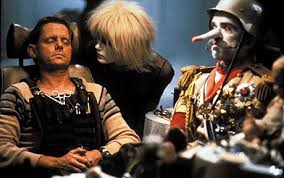
Blade Runner

SPOILER ALERT! The plot of the movie will be discussed.


Ridley Scott’s 1982 movie (with subsequent “Director’s Cut” and “Final Cut” editions), explores the question of what it is to be human. This theme, visited often by author Philip K. Dick in his writings, including in his story, Do Androids Dream of Electric Sheep, on which Blade Runner is based, has been addressed recently in the films Her and Ex Machina, and in the television series, The Walking Dead.  


Here, the eyes have it! There are numerous references to vision in the film. The android detecting test at the beginning of the film is administered by a man named Holden (Morgan Paull), a “blade runner,” who is a person who hunts down the illegal presence of replicants (synthetic life forms) on earth. The device used tests pupil dilation to see if an emotional response is elicited by the subject. (The phrase “the eyes are the windows to the soul” comes to mind). The idea behind the test is that only humans can show emotion, and in particular empathy. The fact that there needs to be an involved, one hundred question test administered by an expert in emotional detection shows how difficult it has become to distinguish real humans from artificial ones. The replicant in this scene is Leon (Brion James) who does have an emotional response, becoming agitated by the questions asked, followed by him shooting Holden. Leon is one of a group of advanced androids known as Nexus-6 replicants. Leon was trying to infiltrate the Tyrell headquarters (the company that engineered the replicants) following a rebellion on another planet.


The Los Angeles of 2019 presents a world mostly inhabited by people from other countries, mostly Asians. The movie implies that the original inhabitants are racists, alienated by these aliens. The racism is emphasized by the existence of slaves in the form of the replicants. It could be that the Americans are offered an escape to “off-world” colonies because the “world” in LA feels “off” to them. Alienation and racism detach us from our humanity, which relates to the overriding theme of the movie. It is interesting that the replicants want the freedom to return to earth. In that sense they are more human, looking to seek comfort in the home of their origin.

Roy Batty (Rutger Hauer) is the leader of the Nexus-6 group. He and Leon visit the manufacturer of replicant eyes at a place called “Eye World,” looking for ways to extend the four-year lifespan of the replicants. The engineer there can only understand the androids by producing one part, the eye, so he doesn’t understand them as complete entities. He looks more like a machine himself than do the replicants in his outfit, with multiple hoses attached to him. The man gives them a lead, telling them to seek out J. F. Sebastian (William Sanderson), a genetic designer who works for the Tyrell company.


Deckard (Harrison Ford), a retired blade runner, is pressed back into service by his old boss, Bryant (M. Emmet Walsh). He finds photographs at Leon’s apartment. Deckard tries to hunt down the replicants by using a computerized picture viewer, a “visual” device, to analyze Leon’s photos. The replicant wants to keep his “family” pictures, because he cares about his fellow synthetics, thus actually showing empathy. Pictures are visual, but they are not reality, only two-dimensional representations, once-removed from actual people and things. Yet, we invest our belief in their accuracy as a substitute for the real thing. In this world, people have been replaced by floating billboards with pictures of people talking to the residents. There is more interaction with synthetic life than “real” people. Is humanity becoming extinct here? What about in our lives right now, with streaming video and video games?


There is the indication that there may have been some type of environmental crisis, since there is an absence of real animals. The owl, a creature with large eyes, at the Tyrell Corporation appears genuine, until we see that one of its eyes does not appear lifelike in a certain light. There are similar glowing moments in the eyes of the replicants. When Deckard meets Tyrell (Joe Turkell), the latter asks him to test his assistant Rachael (Sean Young) to show the results of the test on a human. Just like the owl, we can’t trust what we “see” because Rachael is also a Nexus-6 replicant. But, she cares (emotion) for Deckard, and shoots Leon when the latter tries to kill him, by jabbing his fingers into, what else, Deckard’s eyes. This may imply that Deckard is not able to “see” the whole story involving the plight of the replicants. Deckard also finds an animal scale in Leon’s bathtub. He tracks down its origin and finds it is from an artificial snake used in a striptease act by another replicant, Zhora (Joanna Cassidy). Zhora says she can’t afford a real snake. True life is becoming scarce. Again, we can’t trust our eyes, because the animal appears to be an actual snake. When Deckard shoots Zhora in the back as she flees, he is being cold-blooded, demonstrating a lack of empathy. Is he becoming what is usually considered more machine-like?


There is an ongoing debate as to whether Deckard may be a replicant since his eyes glow with a red reflection in one of the versions, and he sounds and looks similar to Holden. Is he just another android version? He has a dream about a unicorn. There is a shot of a unicorn in Sebastian's apartment, and he is an engineer for Tyrell. At the end of the film, Gaff (Edward James Olmos), who works for Bryant, makes an origami unicorn. How would he know about Deckard’s dream of it unless it was an implanted memory, which he read about in a file. Gaff also states later that Deckard acted like "a man," which could mean he performed in a masculine way, or it could imply that as a replicant, Deckard was just acting lime a human. Deckard earlier asks Tyrell how Rachel “could not know what it is?” But, he may not know he is one, too. If he is a replicant, then why does he not have the strength to match Leon and later Roy?


Pris (Darryl Hannah), a replicant, surprises Sebastian, and pretends (again, looks are deceiving) to be a homeless person. He offers her shelter in his home. He has an accelerated aging condition, just like the replicants, which also suggests how the two are alike. He also “makes friends,” literally, because he is an engineer, and has mechanical “friends” even before meeting the replicants, who also try to become his new synthetic pals. One of Sebastian’s “dolls” walks into a wall, showing that they are as fallible as humans. A rat walks across a table in his dining room, and we can’t tell, by “looking,” if it is real or mechanical. Sebastion recognizes Roy and Pris as replicants and he says to Roy, "There's some of me in you." In his book, Future Noir - the Making of Blade Runner, Paul M. Sammon notes a theory that Tyrell used some of Sebastion's rapid aging DNA to build in early obsolescence in the replicants.

Roy uses Sebastian to meet Tyrell at the corporate headquarters, housed in a pyramid-shaped building. It suggests that Tyrell is at the top of the technological evolutionary ladder, and Roy climbs up the ladder to meet his maker (shades of 2001: A Space Odyssey?). But his “god” falls short of expectations, being unable to give his creation the answers he seeks. The owl, a symbol of wisdom, is associated with Tyrell at his office, but it is a fake. Tyrell himself has weird, large, thick spectacles, and his human eyes appear distorted. The implication is that his brilliance is also impaired. Has he lost his humanity by playing God, creating sentient beings and then limiting the length of their lives, and enslaving them? His eyes are gouged out by Roy for the failure of Tyrell’s vision in not completely understanding the needs of the synthetic humans he has designed.


Pris sprays paint around her eyes to pretend to look like one of Sebastian’s dolls. So, she is a mechanical creature, who is so lifelike, she must pretend to be mechanical. She is pretending this time to ambush an investigating Deckard. She attacks him, but he shoots her. Roy arrives and shows true loss at Pris’s death. He stalks Deckard throughout the building that contains Sebastian’s apartment. The flight is again upward in this building, but Roy’s ascent this time is spiritual. He is seen as a Christ figure, pushing a spike through his hand, supposedly to slow down his built-in destruct mechanism. Roy breaks fingers on Deckard's hand in the pursuit, which can show how the reference to both characters' hands implies that they are not really enemies, but are connected, each having human and inhuman drives. If Roy is a Christ figure, maybe he is what Deckard has the potential to become. Roy saves Deckard from falling off of the building, thus forgiving the blade runner, illustrating the higher attribute of mercy. He releases a dove (the Holy Ghost?, his spirit?) he is holding in his hands as he dies. He says "it is finished," repeating Christ's words in the Gospel  according to John. Deckard and Rachael are fugitive lovers at the end of the film. Gaff lets them escape saying he didn’t know how long they had together, but “who does?”


Are we the sum of our memories, the images that we see in our mind’s eye? Or are we who we are because of our basic personalities, and memories are just layered onto that foundation? Rachael’s memories are implants, but don’t we all have images implanted in us by the media engulfing our lives? Whatever their origins, our memories do affect us. At the end of the film, Roy talks about the wondrous things he has “seen.” These are real events that he, as a synthetic human, has experienced, and which have evoked true human emotional responses. In death, whatever memories we do have are as transient as we are, dying with us. As Roy says, they are like tears washed away in the rain.

There are many questions in the above paragraphs. Most of the time, humans don’t have the answers.

The next film is Fail-Safe.