Monday, May 1, 2017

American Beauty

SPOILER ALERT! The plot of the movie will be discussed.

The tag line for this 1999 Oscar-winning film was “Look closer.” We can see it written on the work cubicle of the main character, Lester Burnham. The movie invites the audience to delve under the appearances of American suburban life to see what reality lies beneath the lives of its characters.

The title of the motion picture suggests one of its themes. It is the name of a type of rose. It is lovely on the surface, but its roots have a tendency to decay. Thus, the plant serves as a symbol that there may be too much emphasis on the surface appeal of upper middle class existence in the United States, where its people restrict themselves to an incomplete perspective. This lack of vision can lead to a zombie-like state, with no genuine life coursing through it. Because the requirement to achieve superficial acceptability is rigidly enforced, the effect on those who don’t conform can be devastating. Lester, (Kevin Spacey, in an Oscar-winning performance), narrating from beyond the grave, (similar to William Holden’s character in Sunset Boulevard, which director Sam Mendes said was an influential here), says that he will be dead within the year. But, he adds, like a creature from The Walking Dead, he’s “already dead.”
Indeed, Lester’s daily “high point” is masturbating in the shower after awakening, fantasizing being better than the life he is living, because at least it employs the use of imagination. He works in advertising, where, as in Mad Men, the point of the job is to make a product appear attractive, whether or not, under scrutiny, it lives up to its presented image. Mendes (who won the Oscar for his movie directorial debut) said he used vertical lines of data appearing in the computer screen Lester looks at in order to suggest the bars of a prison. Reflections are important in this movie, and, thus, Lester sees himself in a metaphorical jail, locked into a passionless routine. But, he is failing at maintaining this façade, and is about to lose his job. The agency hired a layoff hit man, Brad (Barry Del Sherman), who offers up a pretense of reputable fairness by asking workers to write up statements of their value to the company. But, if we “look closer,” this assignment actually is a way of pushing the blame of being fired onto the employee, supposedly being let go because of his inability to show his worth, when in fact, his fate is already sealed. (Lester sarcastically satirizes the insincerity of the advertising business when Brad asks him if he has a minute, and Lester, with exaggerated smile and enthusiasm, says, “For you Brad, I’ve got five!”).
Alan Ball, who received the Oscar for this screenplay, said he wanted the story to emphasize that there is more life existing beneath our preconceived notions, that we need to go beyond what we see on a first look at things. So, the film presents a variety of perspectives from the characters’ points of view. The first scene of the film, actually a flash-forward, is of Wes Bentley’s Ricky Fitts (who pretends to “fit” into the role his father wants him to play) shooting a video of Lester’s teenage daughter, Jane (possibly a reference to her initial feeling about herself being a “plain Jane”). So, we, the audience, are watching the director with his cinematographer, manipulating our perspective of what we see, as we watch a character also focusing on what he wants to be in his video. Mendes is thus commenting on the “look closer” theme, and suggesting that this search for depth is what the nature of film can be about. In this scene, Jane says her dad is so lame for being obsessed with her female friend, that someone should “put him out of his misery.” Ricky asks her if she wants him to kill Lester, and Jane says, “Yeah. Would you?” Along with Lester’s comment about being dead within the year, this opening adds an element of mystery, which, by its very definition, invites further investigating. It suggests a possible suspect in Lester’s future death, but, it is an incomplete scene, a red herring, again stressing how initial appearances can be deceiving without more inquiry.

Lester’s beginning description of himself is the one he derives from his wife and daughter, who feel he is a loser, someone who can’t even wave his briefcase around without it spilling its contents all over his driveway. He confesses that he knows he lost something along the way to adulthood, and he turned into someone who was “sedated,” akin to his expressed feelings of being dead-like. But the imminent loss of his job seems to wake him up, and he starts to “look closer” at his world and those who inhabit it. His wife, Carolyn (Annette Bening), has become “joyless,” whereas, she once was a rule-breaker, going up on the roof and flashing helicopters in her younger days. She has sold her soul to the god of capitalistic success. She says, “My company sells an image. It's part of my job to live that image.” That image is one of material achievement, which is measured by the accumulation of things, and adhering to a code of what constitutes attractive and fashionable acceptable appearances. As Lester points out when we first see Carolyn, her gloves match her clogs, so she is properly packaged, even while getting dirty doing gardening. She is a realtor, and repeats an economic, not spiritual, mantra, “I will sell this house today,” before conducting an open house. (She complains that the neighbors, who used to live nearby, in the house bought by Ricky’s parents, did not list with her. They are significantly called “the Lomans” – a Death of a Salesman reference suggesting commercial tragedy). When she fails to close on the sale, she cries, demonstrating the genuine emotion of a fully realized person. But, the businesswoman in her can’t allow that feeling, so she tries to smack herself out of the tearful display, calling herself weak. She listens to recordings in her car on how to be successful. She at first envies the real estate “king,” Buddy Kane (Peter Gallagher). But, as her marriage to Lester is failing, she does what businesses in America do. When you want to cut out competition, you merge. She literally gets in bed with him. Buddy’s nickname of “The King” shows how in America, royalty does not derive from noble lineage, but restrictively from the bottom line.
Carolyn cannot tolerate suburban failure in her husband or her daughter, because that would tarnish that “image” of leading a successful life. Physical appearance is, therefore, to her, a sign of “making it.” The pressure to have that fashion model look has taken its toll on her daughter, Jane, who we see looking at an ad for breast augmentation. Carolyn’s disappointment concerning her daughter is obvious in their morning exchange before dropping Jane off at school. Carolyn says, “Are you trying to look unattractive?” Jane’s only weapon is sarcasm, as she responds, “Yes.” Carolyn’s condemning remark, “Well congratulations. You’ve succeeded admirably,” communicates to her daughter that Jane is only good at failure. Jane takes refuge from such harsh criticism in the teenager’s time-honored expression of how lame and embarrassing parents are. Lester, in his re-examining of reality, says that his daughter is a typical teenager, “Angry. Insecure. Confused. I wish I could tell her that’s all going to pass, but I don’t want to lie to her.” That Jane finds herself caught in the middle of her parents’ crumbling marriage is shown at dinner, where the growing distance between Lester and Carolyn is pictured by how they sit at the ends of a large table, and Jane eats between them. Lester, feeling sorry about how he and his daughter are no longer “pals,” awkwardly tries to reconnect with Jane by asking how her day at school went. She says it was “okay.” He says, “Just okay?” wanting more, but sounding like a phony cheerleader. Her bitter response is, “No, Dad, it was spectacular,” and criticizes him because he can’t all of a sudden act like he takes an interest in her after not even talking to her, probably due to his suburban somnambulistic state.


Lester starts his journey with alienation, followed by what on the surface is self-indulgence. He can’t stand being at a phony realtor get-together with Carolyn, which he emphasizes with an overly passionate public kiss with his wife, which is in stark contrast to the coldness in their marriage. She tells him “don’t be weird,” which is the major crime one can commit in a society driven by conformity to a code of appropriate behavior. He goes outside and with Ricky, who is working at the event. Ricky is a rebel in disguise. He pretends to take on legitimate catering jobs as a cover while he deals marijuana. He can fool his father, because as he tells Lester, “Never underestimate the power of denial,” indicating that people want to believe that the comfort of their static lives is secure. So, he uses the “normal” world to mask his actual freedom from that normality. In this story, he indulges in rule-breaking through the use of a mind-altering substance, which, symbolically, can mean promulgating consciousness-raising. To emphasize the false exterior of the life he pretends to lead, he keeps his weed in a fake drawer, showing how his true life lies hidden beneath a layer of respectability. Lester and he smoke weed together, and Lester becomes a client. But, it is more than that. He tells Ricky that when he was the young man’s age, he worked in a burger joint all summer to buy a music tape deck. He says that it was “great. All I did was party and get laid. I had my whole life ahead of me.” So, Lester seeks a rebirth, by acting like a child again, where all of life’s possibilities are in the future. Thus, it is fitting that his mentor in this process should be a youth in the form of Ricky. The young man becomes his “hero” when he just quits the job on the spot after the hall owner complains about Ricky taking a break. Lester then quits his job, and gets a year’s salary with benefits after threatening to expose the boss’ use of corporate funds on prostitutes, and saying he will blame Brad for sexually harassing him. Just as he did when he was Ricky’s age, he gets a job in a fast-food burger restaurant, saying he wants a job with as little responsibility as possible, which is what a young boy enjoys. He smokes dope in his car while singing “American woman, stay away from me,” obviously referring to Carolyn, and what she, and his country, have become. He sits around the house with his bare feet up, playing with a remote-controlled toy truck. He tells an outraged Carolyn that he bought a “1970 Pontiac Firebird. The car I've always wanted and now I have it. I rule!” Yes, he has bought something materialistic, but it is not practical. It is symbolic of youthful exuberance. His “rule” contrasts with that of “The King’s” purely monetary accumulation of wealth. When he starts to remind Carolyn of her once youthful joy, and she passionately responds to his kisses, she then stops him in his tracks when the bottle of beer he is holding might spill on her expensive Italian silk couch. The Firebird for him represents the excitement of youth, while her things connotate status. He tells her “This isn’t life, it’s just stuff. And it becomes more important to you than living.”

Lester’s return to adolescence causes him to fixate on Jane’s teenage friend. Angela Hayes (Mena Suvari), like a boy reaching puberty. Her first name implies something angelic; however, her last name sounds similar to the character of Lolita Haze, the title character in Vladimir Nabokov’s Lolita. (As is noted on the IMDB site, “Lester Burnham” is an anagram for “Humbert learns,” the name of the older character in Lolita who is fixated on the young girl. Thus, Lester’s name implies the arc of his journey). So, Angela is a person of contradictions. On the one hand, she represents purity, because of her age, but she talks explicitly about her sexual adventures, which implies a loss of innocence. Since Lester is forty-two years old, there is an obvious “ick” factor here, which is not lost on Jane, who is grossed out by her father’s obvious infatuation. But for Lester, it is a sort of rediscovering of his sexual energy. Mendes cinematically provides us Lester’s perspective as he zeroes in on Angela. It is at a basketball game, where Jane and her friend perform as cheerleaders. Everyone disappears in Lester’s mind, and he imagines Angela dancing seductively for him in a private performance. She slowly opens her blouse, but what flies out are numerous rose blossoms. They can represent the combination of life’s beauty and its eventual decay symbolized by the American Rose. In fact, Lester has several fantasies involving Angela. In one he kisses her, and a rose then comes out of his mouth. In another, she is in a bathtub full of roses, saying how she needs him to bathe her because she is very “dirty.” He envisions her naked, with roses strategically placed over her breasts and pubic area. However, there are white backgrounds offsetting the color red in the movie, as in the bathtub fantasy. (We also see it with a red door against a white frame; blood on a white shirt; a red car in front of a white garage door – all of which are mentioned on IMDB). The white can signify youthful innocence becoming compromised by encounters with sex and violence as one grows up. Lester’s fantasies may be uncomfortable for some to watch, but he is at least using his imagination, which makes him more alive than what he was before his reawakening.
Jane and Angela are opposites in the film. Jane wants to fit in, doesn’t, and feels shame when she does not believe she meets the standards, especially those of “beauty,” imposed upon her. Thus, she wants to use her babysitting money for breast augmentation. In a way, she is like her mom, because she thinks of her father as a freak when he acts inappropriately for his age, and later tells Ricky that her father should be a “role model”. And, it is difficult to blame her, because that’s the job a mature parent usually plays. Angela, however, represents what America worships, a blonde beauty. She has already worked as a model, and seeks a future in that field. Boys, and men, adore her. In this story, she is, apparently, already the grown-up, talking about how she seduced a famous photographer to get ahead, and proud of her purported promiscuity, waving it like a flag of savvy sophistication. But, she doesn’t want to just fit in, she wants to excel, but within the boundaries of what society values. She admits that the worst thing in the world to her is being “ordinary.” (Which is what Lester calls himself. But, what makes him extraordinary is that he says he jettisons what suburbia prizes, so he “has nothing to lose.” That allows him the freedom to do and say what he wants. Mendes also cited Ordinary People as another influence, a film about seemingly regular upper-middle class people with unusual problems.)
Since this movie urges us to “look closer,” we should better examine Ricky Fitts, who is the filmmaker’s surrogate, using his camera to reveal more deeply about what he sees, including Jane and Angela. Angela tells Jane that he was in their school, but left for a few years and put in a mental hospital before returning now as a student. Both girls consider him weird, the same branding Carolyn gives to Lester’s unconventional activity, weirdness also being a condition attributed to artists, as they reflect in their creations the insights they observe. Ricky focuses his camcorder, not on the traditionally photogenic Angela, but instead on Jane. Angela considers him a freak for ignoring her, thus not accepting the given criteria of beauty. He sees a deeper beauty in Jane, and a kindred spirit. She at first finds his oddness off-putting, but she begins to find self-importance through his attention. We observe her seeing herself in a different light, the way Ricky sees her, when he records her (as does Mendes) through her bedroom window, ignoring the exhibitionistic writhing of Angela. Just as Lester saw himself as in a jail, reflected in his computer monitor, so now Jane looks in a hand mirror, finally able to admire herself. Ricky also records a dead bird, and says he can see “beauty” in it, because “it’s like God looking right at you.” As Jane and Ricky walk together, they see a funeral procession drive by, and Jane says she never experienced seeing death, a foreboding of what will happen to her father. Ricky shows Angela what he feels is the most beautiful thing he ever recorded – a bag blowing in the wind. The way it floats and moves is like nature creating a ballet, and inviting him to join in the cosmic dance. He had an epiphany the day of that recording, because he “realized there was this entire life behind things, and this incredibly benevolent force that wanted me to know there was no reason to be afraid, ever.” He says despite the limitations of what his recordings reveal, they help him “remember” that “there’s so much beauty in the world.” Ricky has achieved a sensibility which allows him to appreciate the totality of life.

Ricky’s perspective on life is diametrically the opposite of his father’s. Frank Fitts (Chris Cooper), a colonel in the U. S. Marine Corps, definitely wants to live up to his name, and overcompensates to do so. He looks at the newspaper and sees his country “going to hell,” probably because not all of it is marching to the sound of the same drummer. His career as a military man shows how much he wants himself and his family to follow society’s orders, and deviation from that norm warrants punishment. His wife, Barbara (Allison Janney) is so intimidated by any deviation from his rigid order, that she cringes in guilt when someone calls at the door, as if it is her fault. She appears like a Stepford Wife. She serves Ricky bacon, even though he doesn’t eat it, because that is the food she has been told to cook. She apologizes for the way the house looks, when it is completely clean and devoid of clutter. Frank tells his son that the boy needs structure and discipline. He comes to collect urine to make sure he hasn’t been using drugs (a test Ricky dodges by securing someone else’s samples, again showing how he lives a life that underscores how one can’t tell a book by its cover). 
After Ricky breaks his father’s rule about staying out of his stuff by showing Jane a Nazi dinner plate, Frank beats his son. The father relents when Ricky says that he was showing the plate to his “girlfriend.” Frank seems relieved that his son is showing heterosexual interest, because one thing he professes to hate are homosexuals. He is repulsed by the gay neighbors who welcome him to the neighborhood. Mendes again uses the mirror motif, as Frank sees the reflection of the gay men jogging in the polish of his car as they approach. What Frank is seeing is his own self-hating, closeted homosexuality coming toward him, scaring him because he does not want to “look closer” at himself. He is not capable of changing his perspective, so when he looks at a video which Ricky just happened to record of a naked Lester working out, he assumes that his son is really gay. This misconception is confirmed in his mind when he sees Lester running with the gay neighbors, when all Lester is doing is trying to do is get into shape. When Frank spies his son through the window of Lester’s garage, he thinks he sees Ricky performing oral sex on Lester, when all the boy is doing is leaning over to roll a joint.

Let’s get back to Lester working out. He overhears Angela purposely shocking Jane by saying that he would have sex with her dad if he just toned up a bit. Lester pulls out his weights, buried in the garage and starts pumping iron. We again have Mendes using that mirror image, as Lester looks at himself in the garage window as he hardens his muscles, perceiving himself as a rejuvenated object of masculinity. In the meantime, Carolyn feels broken, because Buddy broke off their affair after Lester saw them necking at the drive-through window at the burger joint. For Buddy, business always comes first, and he feels it will suffer if there is more evidence of infidelity, both of them still being married. However, Buddy introduced Carolyn to the American way of relieving tension, shooting a gun, obviously here associated with sexual release, and accentuating how sex and violence are joined together in American culture. She now carries a gun around with her. After we catch up to that first scene of the movie, we realize Jane and Ricky were just kidding about killing Lester. Will it be Carolyn who does him in?

After Frank confronts Ricky over what he thought he saw going on with Lester, Ricky realizes he can liberate himself from his father. He lies by saying he performed gay sex acts for money. His father again hits him, and Ricky knows his father will finally not search for him if he leaves. The rain is pouring outside, and Frank visits Lester in his garage. Lester admits that his wife is not around and is probably having sex with someone else. He says he doesn’t care about that, since his marriage is just for appearances sake, which Frank probably equates with his own marital situation. Frank is shivering form getting soaked, and Lester says he should get out of the clothes. Frank, misunderstanding Lester’s situation with Carolyn and Ricky, allows his homosexual feelings to emerge, and kisses Lester, who tells him that he has the wrong idea. After exposing himself this way, and having been rejected, Frank leaves in shame.
Ricky goes to ask Jane to run away with him, telling her he has enough money saved. She now realizes she can contribute her savings since she no longer sees the need to have cosmetic surgery to prove her worth. Angela is with her this night and is outraged, calling Ricky a freak. Jane now waves the nonconformist flag, telling Angela, “Then so am I. And we’ll always be freaks and we’ll never be like other people and you’ll never be a freak because you’re just too … perfect!” So, in their differentness, Jane and Ricky are special. Angela says at least she’s not “ugly.” But, Ricky forces a new perspective onto Angela. He tells her, “Yes you are. And you’re boring, and you’re totally ordinary, and you know it.” He also tells her that Jane is not her friend, “She’s just someone you use to feel better about yourself.”

To think that someone can consider her “ordinary” feels like an assault on the image Angela has tried to project about herself. She runs out of the bedroom, crying. She runs into Lester, and seeks reassurance of her worth from him. She asks him if she is ordinary, and he tells her what she wants to hear: that she couldn’t be ordinary if she tried. They kiss, and Lester starts to undress Angela. She now appears vulnerable, telling him this is her first time. Her sexual bravado was just an illusion, a way of making her look more mature, and worldly successful. She now looks to Lester, and us, like what she is underneath the false surface, an insecure teenage girl. Lester now segues from sexual exploiter to paternal protector. He covers her up, and gives her a reassuring hug after she says she feels stupid for her actions. They talk about Jane, and Angela tells Lester that his daughter is in love, to which he says, “good for her.” Lester seems to have reached a level of peace with the world now, coming back to his proper age as an adult, but with more appreciation for life. He tells Angela that he feels “great,” as she goes off to use the bathroom. And, ironically, or appropriately, depending on your point of view, at this moment of tranquility, a gun appears at the back of Lester’s head, and he is shot in the head. We see the different characters react to the shot from their respective perspectives, but somehow, now all united in this one act, joined together for the first time. It is Frank who did the shooting, probably out of anger for being rejected, and maybe because the self-loathing of his sexuality erupted into violence to assure that his repressed identity will not be exposed.

Ricky looks at the dead Lester as he did the expired bird. Lester seems to have a smile on his face, and Ricky smiles, too, perceiving the beauty that Lester experienced before his demise. Lester reveals that just before he died, he was able to share Ricky’s view on life, telling us that he saw stars, and maple trees, and his grandmother’s hands, and Carolyn, having fun on a rollercoaster, enjoying life’s bumpy ride before she changed. He says, “there is so much beauty in the world … and I can’t feel nothing but gratitude for every single moment of my stupid little life.”

Perhaps the movie is simply trying to tell us that, if we look close enough, we can find beauty not only in a plant’s flowers, but also in its hidden roots.

The next film is Bigger Than Life.

Sunday, April 23, 2017

A Face in the Crowd

SPOILER ALERT! The plot of the movie will be discussed.

Even before Network in 1976, this 1957 film directed by Elia Kazan predicted how unscrupulous people can undermine society by manipulating the media, a concern that plagues the world today.

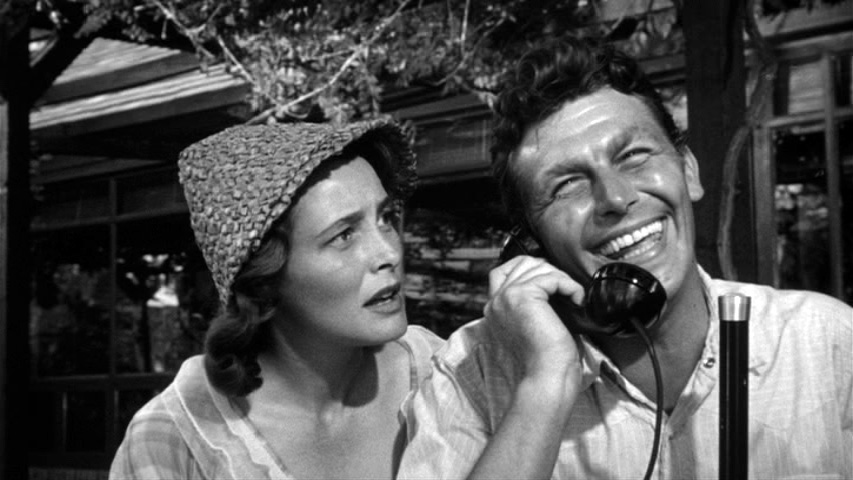
The first shots in the movie show small town Arkansas residents of modest means, unpretentious, playing checkers and whittling sticks. The music we hear is folksy, featuring the sounds of a strumming guitar and whistling. There is no whiff in the air of intellectual urban American culture here. These are the citizens that will become the fuel which propels Lonesome Rhodes (Andy Griffith, in his powerful film debut, nothing like benign Andy Taylor in his future TV role) to stardom. At this point, he is a traveling, hard-drinking bum, who avails himself of the nightly accommodations supplied by county jails. He is “discovered,” similar to a movie star, by radio journalist Marcia Jeffries (Patricia Neal), who gets the local sheriff, Big Jeff Bess (the actor’s real name), who we learn is attracted to her, to allow her to record prisoners in the Pickett County jail as part of her interview program. It is called “A Face in the Crowd,” because the movie was based on a story in a collection of short stories entitled Some Faces in the Crowd. But the title is significant, because it encapsulates what a democracy is, the emphasis on the individual amid a larger entity consisting of many people. It also hints at the perversion of the democratic system, as that “face,” when projected out of proportion to its place in society, can sway that collection of individuals acting as one massive organism.
Marcia just wants the captive men to tell personal stories. They react as many do; they shun being in the spotlight. When she mentions that maybe someone can sing a song, they suggest a man named Larry Rhodes (the last name suggests someone who wants to keep moving, and is not prone to committing to anyone, or anything, else). He is sleeping after the police arrested him for drunk and disorderly conduct, behavior he generally never relinquishes in the story. He is hostile at first. When Marcia explains what she is doing in the jail, his first response reveals his selfish, narcissistic personality by saying, “What do I get out of this?” Marcia says that she studied music at prestigious Sarah Lawrence College, in the state of New York, where she learned that one can appreciate real American music by listening to it “from the bottom up.” One can understand from this condescending attitude why common rural folk would resent conceited intellectuals.
 
Rhodes makes a deal as a condition to performing: the sheriff will release him in the morning. In her introduction, it is Marcia who gives him the nickname “Lonesome,” which conjures up sympathy, but suggests the American worship of the rugged individualism of the western cowboy. Rhoades is rustically poetic (talking about how darkness “douses” the daytime), and charismatic as he tells stories about his relatives in the Arkansas town of Riddle (a name which implies hidden truths about its purported ex-resident). Marcia can see how he can connect with an audience emotionally, as he says how a man one dislikes earlier in the day becomes a best friend in the loneliness of the night. He offers up a passionate rendition of a blues song as he accompanies himself with his “Mama guitar.” He says that the instrument, an object, means more to him than any woman he encountered. This statement is telling, because we learn that he views people, especially women, as being disposable.

Marcia plays her recording for her uncle, J. B. Jeffries (Howard Smith), the radio station owner, who wants to hire Rhodes for a spot on the air. They have to track him down after his release from jail. Rhodes is not enthusiastic at first, saying the offer sounded too much like a job, which means it was too much like work. He, like many Americans, wants his freedom from anything that will tie him down. He is headed for Florida, where he will do some fishing. Jeffries admits to a yearning to go fishing, but when asked by Rhodes why doesn’t he go, says he can’t afford to. These two men at this point illustrate the opposing elements in the American mythos – the respect for hard work and responsible behavior, and the lust for unencumbered, self-satisfying freedom. Marcia reels Rhodes in with the capitalistic lure when she tells him he can make enough money to fly to Florida if he does the show. Rhodes easily says goodbye to his traveling companion, Beanie (Rod Brasfield), who just as nonchalantly shrugs off his fellow traveler’s departure, since both men know the solitary code of the vagrant. But, at this point, Rhodes doesn’t want to get rid of his old clothes, always looking for that quick getaway.
Rhodes’s on-the-air persona connects with people, because he instinctively knows how to provide what they want to hear. The masses work hard every day, so he says that they are pushed by bosses to “hurry,” which is always associated with jobs. But, he had a cousin named Harry, who rushed around, so he was nicknamed “Hurry.” One day, while running quickly, he tripped, and killed himself. His relatives put a sign on his grave which said he was in a hurry to get there. With such a story, he wins over his audience by sympathizing with their plight, but doing so in a down-to-earth humorous way. He woos female listeners by saying how the men in their lives don’t appreciate them (which is, as we see, exactly how Rhodes mistreats women).

He receives a great deal of fan mail. Advertisers want to buy time on his program. As Marcia says, they love his voice, his guitar, his songs, his ideas. But when she asks him if his stories are true, he admits that Riddle doesn’t even exist, and that his father was a con-man (as we see Rhodes is a chip off of the old swindling block), who deserted his family. His mother dragged him from place to place (thus both parents instilling the desire for wandering), and his real family consisted of “uncles,” men his mother took up with. In a way, as a character, he is a predecessor of Mad Men’s Don Draper, a man running away from his real sordid past, inventing a new one, and who is so good at fabrication, he goes into advertising. But, unlike Draper, Rhodes appears to be happy. Marica comments that he puts his whole self into his loud laugh. He says that he puts his whole self into everything he does, and that exuberance is appealing to a country that admires all-out energy.
Early on, Rhodes realizes his ability to be a Pied Piper, manipulating the behavior of those listening to his voice. He gets into a bar fight with jealous Sheriff Big Jeff, (who is running for mayor), because of how much time Marcia spends with Rhodes. He says the sheriff’s name is a joke, and notes where he comes from, they find out who should be spared useful labor because of their limitations. So, to see if Big Jeff would make a better dogcatcher than a mayor, he says on the air that the townspeople should bring their dogs over to Big Jeff’s house. The citizens fill the sheriff’s yard with their dogs in what for them is a humorous activity, but which shows the seriousness of Rhodes’ potential influence. He tells the children of the town on a hot day to go over to the studio owner’s house, without Jeffries’s knowledge, so they can swim in his pool. This action makes him appear to be a sort of champion of the downtrodden, revolting against those more fortunate than themselves. Marcia asks him what it feels like to be able to say anything which can change peoples’ behavior. He first seems not to realize this power, but then there is a look of epiphany on Rhodes’s face as he says, “yeah, I guess I can.” He makes advances on Marcia, and when she responds coolly, he says she is putting up a front, because all women want the same thing underneath. So, he shows how he wants to reduce everyone to his baser level. She implies that he has not lacked company, because many of the local women have sought him out.

Rhodes begins to get wider press attention. Then others come calling, looking for a way to cash in on his budding notoriety. He acquires an entertainment agent, who gets his percentage by landing Rhodes an offer to appear on a Memphis television station. Rhodes is a good negotiator, and gets his price, bringing Marcia with him. So, she, too, is benefiting from his success. At the Pickett train station, the whole town comes out to say goodbye. On the surface, he acts like they are his family, but as soon as he turns his head away from the crowd, he says how he is glad to leave this “dump.” When he sees the scowl on Marcia's face, he covers up by saying he was just kidding, and she should “know better than to believe everything I say.” But, that is precisely the problem with his audience – they don’t know him enough to realize that underneath that big smile and laugh, he is not always telling the truth. 
One of the writers at the Memphis station is Mel Miller (Walter Matthau), who Rhodes disdainfully calls “Vanderbilt ’44,” referring to the year Mel graduated from that college. We again see the contempt toward the educated, probably coming from an inferiority complex which derives from a deprived upbringing, a disdain which Rhodes champions among those who share his background. He rejects scripts, and ad-libs. The audience can identify with his lack of sophistication about TV cameras. Not only does he control what is said on the program, he even gives the cameraman direction, telling him to do a close-up on him. The camera becomes a perfect instrument to focus on and magnify his narcissism and desire for power (similar to what some politicians, past and present, use TV and other media to do). The studio wants to package him their way, building on the cliché populist image he presented in Pickett. But, what Marcia admires, initially, about Rhodes is that “he is his own man.” He, instead of telling folksy stories, says he went walking the first night in Memphis, and encountered a black woman, whose house burned down, which she cannot rebuild because she couldn’t afford insurance. He brings her onstage, a courageous act at the time to bring an African American on camera in a southern state, as Mel points out. He urges each viewer to contribute twenty-five cents, no more, since they can’t afford it (relying on their charity without exploiting it). Plenty of money is received, but Rhodes grandstands the generosity by having staff bring in wheelbarrows full of coins. But, this use of his popularity shows how it can be used for a beneficial purpose. He even spouts a humanitarian belief, when he says there, “ain’t nothing you can’t do when you let the best part of you take over.” Unfortunately, as he becomes more famous and wealthy, he does not practice what he preaches.
At this point, though, Rhodes is still in maverick mode, and is more concerned about acting independently, even if it does not appear to be to his benefit. He makes fun of the mattress sponsor for his program, owned by a man named Luffler (Charles Irving). When Rhodes refuses to “kowtow” to a wealthy man’s interests, it appears Luffler will fire him. He stops by Marcia's hotel room to say goodbye, saying they got a good ride for their money, and shook things up for a while. She is so moved by his strong individualism, that she kisses him and invites him into her room to spend the night.
But, Rhodes has become so influential that the public won’t allow him to be fired. People picket in front of Luffler’s company, and burn his mattresses. At the same time, an ambitious office worker, Joey DePalma (Anthony Franciosa), pretends to be Rhodes’ agent and pitches him to a New York advertising agency to help save a faltering client of theirs, a company that makes an ineffective vitamin named Vitajex. DePalma is the guy who told Rhodes he should mention products and places to eat in his broadcast so he could get free stuff. When Marcia questioned the legality of this practice, his response was, “Nothing’s illegal if they don’t catch you,” to which Rhodes laughed in agreement. The unethical DePalma becomes Rhodes new mentor into the ways to work the con on the large stage. He finds Rhodes in Marcia’s room, and tells him the news that he’s going to New York where he will do his show live while viewers watch it across the nation. 
In New York, one ad executive wants to have dignity in promoting Vitajex. Rhodes displays his innate marketing skills by saying if someone is too dignified, where he comes from, people think that person will steal your watch. Again, we have the disdain for anyone who is not seen as ordinary because then the extraordinary is considered a threat. He says the pills look pale, and should be yellow, to reflect the energy of the sun. He says they should repackage the fake vitamin to make people think it will boost the male libido (sort of the first Viagra), with no basis in fact, mind you. Perception is what sells. He takes some of the Vitajex, and then chases women around the room. He makes up a song on the spot with the catchy line, “Vitajex, what you doin’ to me/You fill me full of ecstasy.” Rhodes likes bringing everything down to shared, primal, nonintellectual drives. The ad campaign that follows puts into effect his vision: scantily clad girls sing the jingle; a sexy woman sprawled out on a bed shows a huge bottle of the vitamin while she says she bought her boyfriend a year’s supply; a cartoon features a bashful pig (supposedly representing most males) who, after taking Vitajex, is aggressive with females; after someone takes the pills, there is a picture of a thermometer reading going up, like an erection, mirroring the heat of passion that supposedly the pill produces; Rhodes audience chants out, “Jex, jex, jex!” instead of the word “sex,” as they reach an vocal orgasmic climax. The film shows, satirically, but presciently, how the media can whip susceptible audiences into a frenzy. We then get a close-up of Rhodes mouth, with his braying laugh, supposedly sharing the viewer’s joy, but also sounding harshly demonic, as if laughing at the people he has fooled.

The head of the company that manufactures Vitajex, General Haynesworth (Percy Waram), sees Rhodes as a potent tool to mold public opinion. He tells Rhodes that he wants to promote the entertainer as an American institution. He compares him to the Washington Monument (to which some would say, how far we have fallen?). He tells him that, as usual, "the masses had to be guided with a strong hand by a responsible elite," which is not what Rhodes had been preaching. He is now being a traitor to the very people his followers scorn by controlling the masses so they will follow the dictates of the “elite.” He appeals to Rhodes’ ego by telling him he has at his disposal the most powerful instrument for persuasion - television.

Rhodes becomes what Haynesworth said he can be, an American force to be reckoned with. He is everywhere. His picture appears on Life magazine. He has a mountain named after him, as well as a battleship, that he christens. His popularity continues to snowball, as he appears on a fictionalized version of the TV show “This is Your Life,” where he is reunited with his derelict friend, Beanie. He hosts telethons, where he presents the appearance of a philanthropist. (Later, Kazan emphasizes the reality aspect of his story by inserting real news people into the film, including Walter Winchell, and Mike Wallace). Rhodes is given the penthouse floors of a luxurious New York apartment building to live in. He entertains women there, but one night he feels empty, despite his success. He craves more than the transient women he has enjoyed. He calls Marcia, and she goes to him. He says she is the only one he can trust, who is honest with him. Of course, it is all about him, as he doesn’t show any concern for her feelings after he had numerous affairs after she spent the night with him. He now asks her to marry him, and although she is drawn to him, she knows about his ways, and pleads that he not hurt her. Her concerns are well founded, since Rhodes estranged wife (Kay Medford) appears, to whom he is still legally married. She wants a monthly income to keep his past quiet. She says he “takes a bite out of every broad he comes across.” She even says that he beat her. We hear this history while, ironically, we hear Rhodes singing his folksy, amicable music in the background.

 When Marcia goes to confront him, we see how Rhodes’s phoniness is starting to peak. Three musicians are rehearsing a song they wrote that Rhodes will say is his own. DePalma is trying out a laugh-track machine that also provides recorded applause, so that whatever Rhodes does can be met with manufactured enthusiasm, real people no longer being needed in his narcissistic world. When she angrily tells Rhodes that she knows that he is married, he says that he tried to divorce his wife in Mexico, but the judge turned out to be a phony (like everything in his life). He says he will make a trip to Mexico to terminate the marriage right after he judges a baton-twirling contest back in Arkansas. She sees Mel, who is now in New York, and he has feelings for Marcia. He never trusted Rhodes, but wishes her well.

On the surface, the baton-twirling competition looks like pure, wholesome Americana. But, there is a dark underside to the proceedings. The young girls, around seventeen years of age, are wearing skimpy costumes, and we see the older men ogling them, one actually licking his lips. Ironically, the people sing about reading the bible while male sexual appetites are whetted. The girls act like groupies, swarming all over Rhodes. Close-ups of Rhodes show him to be exhibiting a lascivious smile as he watches the girls manipulate their phallic-symbol batons. He focuses on one beauty, Betty Lou Fleckum (Lee Remick, in her film debut), who returns the flirtatious looks, and tells him later, with sexual innuendo, that she placed his picture above her bed. Rhodes picks her as the winner. Everything Rhodes does now is amplified by the opportunistic media, so this event is televised. Mel and Marcia watch the show, and Mel comments on how difficult it is to resist how seductive TV can be, when he says, “You gotta be a saint to stand all the power that little box can give you.” And, Rhodes is anything but a religious icon. Betty Lou personifies that temptation which is impossible for a narcissist like Rhodes to decline.

So, when Rhodes comes back to New York by way of Mexico, he not only acquired his divorce, but also married Betty Lou there. The devastated Marcia proclaims his new wife’s symbolic nature, when she tells him, “Betty Lou is your public, all wrapped up in yellow ribbons into one cute little package. She’s the logical culmination of the great twentieth century love affair between Lonesome Rhodes and his mass audience.” (Remember how Rhodes wanted the Vitajex pills to be “yellow,” because for him the color meant sexual energy). She tells him how he has become what he used to “harpoon,” namely the big shots who pulled the strings, controlling average people. He moans about how the bigger he becomes, the smaller she makes him feel, which for an egomaniac such as Rhodes, this process is intolerable. When he called her to the penthouse before when his rise to success seemed overwhelming, he said he couldn’t live without her. Now he says he can’t live with her, because of her judgmental attitude. Marcia becomes all business in her bitterness, demanding a large percentage of his enterprise, which she believes she deserves, as she reminds him that she was the one who made up the whole “Lonesome Rhodes” persona. In a way, she is Dr. Frankenstein, and Rhodes is the monster she created.
Probably the most chilling scene for current viewers of this film, because what it predicts has come to pass, occurs when Haynesworth recruits Rhodes to help sell his candidate, Senator Worthington (ironically not “worth” much) Fuller (Marshall Neilan) as the next president. The fact that the rich Haynesworth is choosing the future national leader stresses the undermining of the democratic process. His group of political groomers watch a film in which Fuller gives a dignified, factual speech. But, Beanie, Rhodes’ old pal, yawns, and it is this type of person, who Rhodes calls a “bush monkey,” is the voter Fuller needs to win over. Rhodes basically tells Fuller that he must compromise his standards by reaching out to the uneducated to be victorious. The senator is a “product” to be sold, which today we would call his “brand.” Rhodes says Fuller needs “capsule slogans” (sound bites?) to quickly and simply get his sales pitch across. Rhodes says Fuller has to create a whole new personality, basically putting up a public façade which has nothing to do with his private self, much the same way Rhodes has done.  He needs to have a nickname, and calls Fuller “Curly,” because of his receding hairline, which shows he has a sense of humor, and is not above making fun of himself. He tells Fuller to relax his jaw, because a tight-looking mouth makes him appear as a “sissy,” which implies that he must project traditional heterosexual manliness. Rhodes says that people don’t buy something they “respect,” they buy what they can “love.” He wants to take the mind out of politics and replace it with a sentimental appeal to the emotions. Basically, what he is advocating is a dumbing down of America, where leadership is achieved through a conglomerate of political shrewdness, big business, and celebrity. 

DePalma sees Rhodes as being in the next administration’s cabinet, which shows how far he sees the man’s reach can extend. But even a supporter such as Haynesworth, who wants to be the power behind the curtain, is wary about Rhodes’ tendency to, what we call now, “going rogue.” In fact, we see Rhodes telling Haynesworth to “shut up,” when he is in the middle of cooking up his latest TV show, where he will be the “Voice of Grassroots Wisdom,” spouting his philosophy on stage with a bunch of cornpone yes-men. Rhodes shows his egoism when he tells Marcia, “I’m not just an entertainer. I’m an influence, a wielder of opinion, a force … a force!” (What we now call an "influencer").

On the new show, Fuller appears, acting like he is just one of those good old boys on the stage. Rhodes stops him whenever the senator uses a big word, making him substitute a simpler one. Fuller is now proclaiming the anti-Federal government stance of rural conservatives, saying that the American people have become used to being “coddled” from cradle to grave. He says that Daniel Boone didn’t need unemployment compensation. This rugged individualism, that Rhodes endorses, actually compromises his base of followers, although they don’t realize it because of Rhodes’s charisma. It doesn’t take into account lay-offs, catastrophes (both natural and man-made), illnesses, and other afflictions that befall average folk who don’t have the resources that the rich have to endure hard times.
Mel finds Marcia in a bar watching Rhodes’s TV show. He says that he left the TV station in Memphis, and has written an exposé on Rhodes, entitled Demagogue in Denim. He has found a company that will publish his book. He tells Marcia, who Mel sees still is drawn to Rhodes, that she is allowing herself to be used. Rhodes and she are making money though, even selling a line of “Mama Guitars” modeled after the one owned by Rhodes, which demonstrates how marketing can take something meaningful, and trivialize it. He says that she has allowed herself to be Rhodes’ “shock absorber,” cushioning the possible jarring effects of his ex-wife and ex-girlfriends. But, Mel says he didn’t spare himself in his book, since he lost part of his soul having worked for Rhodes.

Rhodes finds DePalma coming out of Betty Lou’s bedroom. He wants to fire him, but he tells Rhodes he does not have the moral high ground, having cheated on Betty Lou. DePalma also owns 51 per cent of Rhodes Enterprises, so he is really the boss. DePalma also says that all he has to do to destroy Rhodes is to leak what he knows about him to the press. This scene shows how celebrities, even though they have money, power, and influence, lead a fragile existence because others prey upon their popularity, and their fame makes them a very visible target for those who want to undermine them. Betty Lou tries to take a page from Rhodes’s book, acting innocent, but Rhodes wrote the book, so he sees through her. Since she has no corporate sway as does DePalma, he basically fires her as his wife, equating her to any employee who “flops.” She has caught the fame bug from him, saying she is supposed to perform her baton act on the Ed Sullivan Show. He will pay her severance, but he says she must remain back in Arkansas; he, thus, denies her chance at stardom won off of his name.
In a type of entitled rebound move, Rhodes goes to his default woman, Marcia, starts to take off his clothes, and assumes she will provide him with sex, while calling himself “the king.” He tells her that Fuller will create a special cabinet post for him, “Secretary of National Morale.” Because of his way with the masses, his job will be to sell whatever the administration wants to pursue. He spells out his agenda to her, based on his messianic view of himself. He calls the American people his flock of sheep: “Rednecks, crackers, hillbillies, hausfraus, shut-ins, pea-pickers – everybody that’s got to jump when somebody else blows the whistle. They don’t know it yet, but they’re all gonna be ‘Fighters for Fuller.’ They’re mine! I own ‘em! Marcia, you just wait and see. I’m gonna be the power behind the president – and you’ll be the power behind me!”
Because she recognizes the horror she has engendered, Marcia runs out on Rhodes. In her absence, preparations for the next show fall into chaos without Marcia’s coordination. Rhodes is manic, yelling at his staff and belittling everybody on the set. He says he is used to ad-libbing, and goes on live, as usual, hypocritically saying that the family that prays together stays together. Marcia shows up and, at the end of the show, when the credits roll, and the sound is supposed to be turned off, she broadcasts Rhodes’ contemptuous words that he speaks to his onstage rednecks. He calls his audience “morons,” and says that he can “take chicken fertilizer and sell it to them as caviar. I can make them eat dog food and think it was steak … Good night you stupid idiots. Good night you miserable slobs. They’re a lot of trained seals. I toss them a dead fish and they’ll flap their flippers.” We then see his followers at home, watching their TV sets, and turning on the man they thought was their champion. DePalma, a despicable fellow who is just more quietly selfish than Rhodes, is already pitching someone to replace Rhodes. It is ironic that the instrument that created the Lonesome Rhodes phenomena, television, is used by Marcia to bring about his downfall. Kazan provides us with a metaphor for Rhodes’ fall (a sort of tarnished version of the expulsion from the biblical paradise), as we witness the audience’s rage at the same time he goes down an elevator, the camera focusing on each successive descending floor number.

Mel shows up at the studio, and tells Marcia that she will not be free of Rhodes until she tells him that it was she that destroyed his career. They go to his penthouse where multiple no-shows have turned his party to launch his “Fighters for Fuller” venture into a failure. Rhodes is now on the verge of a breakdown, even bellowing racist remarks at his African American servants who snicker at his ranting. He is shouting out into the night as Beanie plays the applause machine. He sees Marcia, and again, tries to suck her into having pity for him, threatening to jump off the building. But, Marcia won’t succumb this time, and admits to her deed. He says he’s not through. Mel says that after a while he probably will be on TV again, but his huge following will be lost. There will be new names and fads to follow, and soon people will be saying whatever happened to “What’s-his-name?” As Mel and Marcia get a cab on the street, Rhodes continues to yell into the night, but now nobody is listening. Mel says that the one saving grace is that people learn, and now they’re on to him. The last shot, appropriately, is that of a large Coca Cola sign, a symbol of the influence of salesmanship.
This film is in a great tradition of movies, including All the King’s Men, The Candidate, and All the President’s Men, which show in a democracy, powerful people must act responsibly; otherwise, if they exploit a free society’s vulnerability to demagoguery, all of its members are in danger.

The next film is American Beauty.