SPOILER
ALERT! The plot will be discussed.

The title of this 1985 film directed by Peter Weir suggests both
secular and religious meanings of the word “witness.” On the one hand a witness
may testify as to observing actions in association with a legal investigation.
On the other hand, an individual may go public by bearing witness to one’s
religious faith or conviction. Both meanings pertain here. This story depicts
how two worlds clash, and the question posed is whether the characters from
those different societies are better for having encountered each other.

The first image is one of fields, calm, pastoral, implying
innocence, as in the Garden of Eden. We know that we are in Amish country by
observing the horse-and-buggy transportation and the old-fashioned manner of
the dress of the inhabitants. We are told we are in Pennsylvania in 1984. The
fact that these people still often speak a foreign language, dress differently,
and avoid modern technology after so many generations of having lived in the
United States demonstrates how much they want to remain separate from American
culture. The emphasis on community among these people is stressed immediately
as a large number of the Amish are attending and contributing food at a funeral
gathering. Even in death, the community is present to support each other. And
contrary to some misconceived notions, these people have a sense of humor. Some
of the men there talk about how the deceased, Jacob, was not a good horse
trader, pointing out that the father of one of the men in attendance, Daniel
Hochleitner (Alexander Godunov) sold Jacob an animal with one testicle. Daniel
counters with, “That horse had one good ball. That’s all it takes!” The
deceased, Jacob, was the husband of Rachel (Kelly McGillis) and Daniel goes out
of his way to offer his sympathies, but he is wasting no time in showing he has
a romantic interest in Rachel.

There is a shot of a slow-moving buggy carrying Rachel, her son
Samuel (Lukas Haas), and his grandfather, Eli (Jan Rubes) to emphasize their
pace of living as they leave their community. Behind them, in contrast, are a
truck and car that must decrease the speed of their journey, probably seeing
these off-the-grid people as impediments to their progress. The quick scene
illustrates how the Amish culture is out of step compared to the American
civilization at large, and is in no hurry to catch up to what they consider to
be its dangerous ways. The family is now heading to the bustling population of
Philadelphia as Samuel will be visiting the city for the first time. Daniel
shows up and tells Samuel he will see many things, but he doesn’t say it in an
ominous way, most likely understanding the boy’s natural excitement
encountering something new. As it turns out, he will see some horrifying
things. Daniel gives him a gift, a carved wooden replica of a cow, which is
sort of a reminder of the world of nature he comes from. The grandfather tells
the departing Rachel and Samuel to be careful among “the English,” as if there
is a denial of all the time that has passed since the Amish first arrived and
the changes that occurred which constitute current American society. Those
outside of the Amish community are still thought of as foreigners.

At the Philadelphia train station people are condescending, the
different Amish appearance fostering a sense of separateness, as people comment
on how “cute” Samuel looks. To the city’s residents, the boy’s oddness
classifies him as an object to be looked at in a museum, not as someone who can
exist among them. In that way, the population at large adds to the division
between the two groups that the Amish seek. Rachel has a three-hour layover
before going to Baltimore. The curious Samuel plays with the water fountain,
and starts to wander, thinking he sees a similarly dressed man who may be
Amish. He turns out to be a Hassidic Jewish man, which shows that outward
appearances can be deceiving, as we later learn about the criminal act that is
to occur. Samuel sees a huge religious statue, entitled the “Angel of
Resurrection,” which depicts Michael the Archangel lifting up a fallen soldier.
Although religious in nature, the sculpture is a sort of joining of the
concepts of church and state by showing the spiritual redemption of one who
sacrificed himself in war for his country, a concept that is not part of the
Amish belief system, since they see themselves as not owing military allegiance
to the land in which they reside.


Samuel goes into the men’s restroom and enters a stall. He
passes by a young man there who appears frightened. Two other men enter. One,
Fergie (Angus MacGinnes), puts a hood over the frightened man’s head and the
other, Officer McFee (Danny Glover) cuts his throat with a knife. They make it
look like a mugging, taking items from his pockets. McFee is cool, taking time
to wash his hands. Samuel saw what happened and lets out a stifled sound. McFee
investigates, but Samuel, although an innocent in this fallen world, is quick
enough to move from one stall to another, grabbing his hat just in time so as
not to be seen, and stands on the toilet so his legs are not visible.

The police arrive after the killing is reported. Policeman John
Book (Harrison Ford) tells Samuel that the man who was killed was a policeman,
and he wants Samuel to tell him everything he saw. Samuel said there were two
men, but he only saw the face of one of them. Samuel points out that the man
looks like Book’s partner, Carter (Brent Jennings), who is black. But Samuel is
so ingrained in farm life that he uses a Pennsylvania Dutch word for “runt of
the litter,” to distinguish Carter, who is small, from McFee, who is large.
This exchange again stresses the divide between the cultures. They take Rachel
and Samuel in a police car to hopefully identify a suspect. Rachel is
indignant, saying they have no right to cart them around. Book (whose name can
imply doing things by the “book,” and thus according to secular law) says that
he does, since Samuel is a material witness in a homicide investigation. Rachel
says they don’t want anything to do with their laws. Book’s remark is “Doesn’t
surprise me,” which is a satiric reflection on the sad state of the legal
system by one of its own. When Book tries to introduce himself, Rachel, fearing
moral contamination in proximity to outside society, says that they don’t need
to know his name or anything about him.

Instead of setting up a formal line-up, they drive to a club,
and Book manhandles a black man and shoves his face into the car window, asking
Samuel if he recognizes the man. Book’s actions are insensitive concerning
Samuel’s situation, and Rachel is incensed at having her son exposed to the
violence of the “English” world. Samuel says the man was not the person in the
restroom. Book decides to take them to stay with his sister Elaine (Patti
Lupone). It appears he is concerned Rachel will escape if they are placed in a
hotel. Book, preoccupied with the requirements of his job, seems unsympathetic
to the feelings of others as he disrupts the lives of those around him. It’s
interesting that the secular Book (whose name also suggests “The Good Book,”
although Book does not particularly follow the bible’s teachings despite
wanting to do the right thing) exhibits moral indignation that his sister has a
man in the house while her two children are there. Elaine doesn't want to hear
his “holier than thou” speech, which does suggest there may be a hint of the
religious existing in Book’s nature.
The next day Samuel participates in a typical lineup at the
police station. He doesn’t recognize any of the suspects. They go to a
luncheonette and Book feels awkward as he does not say prayers before eating.
Rachel is quite frank, having no experience with editing the truth, and says in
a detached way what Elaine told her, probably in confidence. Book’s sister said
Book has no family, so he parents Elaine’s children instead. She thinks Book is
“afraid of the responsibility” of having his own family. Elaine also told her
that he thinks he likes to be a policeman because he is in control and feels
that he is always right, the other cops being inept. Book is speechless at this
outpouring of personal information from a stranger, not something he is
accustomed to in his world. When Samuel burps while eating his hot dog, he does
not have to excuse himself. Instead Rachel says, “good appetite,” like it’s a
normal bodily act after eating, which highlights in a small way the difference
in the cultures.

At the precinct, Book shows Samuel mugshots. A pretty female
office tempts Samuel with a chocolate chip cookie (an Eve reference as to the
temptations of the material world?). A criminal handcuffed to a chair gets
Samuel to approach him, but then rattles his cuffs, getting a thrill out of
scaring Samuel. The scene shows how alien and upsetting this world can be to
the innocent young boy. Samuel recognizes McFee, (a name suggesting money is at
the heart of his character), a narcotics officer, in a newspaper picture in the
police station. McFee, a killer, is ironically honored for his actions in
connection with a youth project. One can’t always tell a book from its cover,
with Book being the exception here. Book covers Samuel’s finger as he points to
the picture, realizing he must protect his witness from his own organization.
As the story proceeds, Book becomes the one ethical person fighting corruption,
as did the main character noted in Serpico
a couple of weeks ago.
Book goes to the home of his boss, Paul Schaeffer (Josef
Sommer), to maintain secrecy, and tells him the boy identified McFee. There was
a drug raid which supposedly confiscated a supply of the substance called P2P,
worth $22 million, which is used to make methamphetamine. When Book checked
into the case, he found there was no P2P in the inventory. Since McFee ran the
operation, and now he is identified in a killing involving the death of a
policeman, Book believes the two cases are related. Book tells Schaeffer that
Samuel is staying with his sister and they are the only two who know about it.

As Book goes to the elevator in his sister’s apartment building,
McFee shows up and starts shooting at him. Book escapes but knows he must hide
Rachel and Samuel. He tells his sister to deny knowing anything about the Amish
people and to say that Book just wanted to borrow her car. They drive off, with
Book admitting that he was wrong about how he, representing the law, could keep
her safe in his city, Philadelphia, the birthplace of American laws. He stops
to call Carter, and since he knows that Schaeffer is involved, having given
McFee information about Samuel staying at Elaine’s place. Book tells Carter to
get rid of all the information about Rachel and Samuel so Schaeffer and McFee
can’t find them. From the documents the partner removes, we know that Samuel
lives in Lancaster, Pennsylvania.

Schaeffer, McFee, and Fergie break into Book’s car, and McFee
finds a towel that shows blood on it, establishing that McFee wounded Book.
Schaeffer tries to intimidate Elaine, but Schaeffer realizes that she doesn’t
know where Book took Rachel and Samuel. Book drops Rachel and Samuel off at
their farm. He tells Rachel there won’t be a trial, knowing, as did Serpico,
that there is no one to protect the people when those who are supposed to
uphold the laws begin to break them. Book tries to drive off, but his wound
overcomes him, and he crashes. He doesn't want to go to a hospital since the
gunshot wound will be reported, and the crooked cops will find him, and Samuel,
as well.

In this case, Book, a man from a large, socially interconnected
culture, is in the best place given the need for secrecy because the Amish are
used to being cut off from outside society and are mostly self-sufficient. The
man they call, Stoltzfus (Frederick Rolf) says he is not a doctor, but
prescribes a salve and medicinal teas. Eli worries that they will be charged
under the laws of Book’s world (like it’s a foreign land) if they are
discovered. Stoltzfus says he must speak with the elders since the effects of
the actions of individuals on the community as a whole are the primary concern
in the Amish settlement. Rachel nurses Book through delirious fevers brought on
by infection. In a way, she is exchanging her hospitality for the one supplied
by Book’s sister, and as she administers to him, she becomes more attached
emotionally.

Schaeffer calls the Lancaster police department but gets little
help since so many Amish people are named Lapp (Rachel’s last name). When
Schaeffer suggests telephoning, the policeman jokingly says who should he call
since the Amish don’t have phones. Schaeffer sarcastically thanks the cop for
the “education,” but the short scene emphasizes how the Amish live in a very
different, separate world within the larger society surrounding them. When Book
wakes up there are a number of serious looking men, the community’s leadership,
staring at him, his predicament being of public concern. To us, this culture
seems alien, and we feel the way Book does, like their presence is an invasion
of privacy since he is in bed. Rachel says that they didn’t know what they would
have done with him if he died. She sounds like he is just a problem that the
community would have to deal with, as opposed to worrying about his loss as a
human being. It shows the Amish emotional detachment from mainstream society.
The elders, as they leave, say they want Book to depart as soon as possible,
hoping for the threat of his presence to vanish quickly.
Not being familiar with the danger of firearms, and letting his
curiosity control him, Samuel takes Book’s pistol out of a drawer. Luckily, Book
sees the boy and has him freeze immediately, taking the gun, and telling him
how dangerous it is. His gruff manner probably reveals Book’s guilt that he
allowed the boy to find the pistol. He takes the bullets out and then says he
can now safely handle it. Unfortunately, just having him hold it is against
Amish beliefs, and Rachel walks in on them. She demands that he shows respect
for their ways, and Book quickly agrees, telling her to take the gun and
bullets and put them where Samuel will not find them.

Alone with Samuel, and with the gun and bullets on the table,
Eli tells boy that the weapon is meant to take human life and they “believe it
is wrong to take life. That is only for God.” Eli says that wars have occurred
and the government has asked the Amish to fight, saying it was the only way to
preserve what is good. But, Eli says there is always more than one way. When he
asks Samuel if he would ever kill someone, Samuel says only a “bad man.” Eli
asks how can he tell a bad man by looking at him, (more about appearances being
deceiving) and how can one see what is in the man’s heart and mind? Samuel says
he can see bad actions, and he has seen that, as he is referring to the train
station. Eli says by seeing the badness you become part of it, and what he
takes into his hands (the gun) he takes into his “heart.” Eli’s lesson preaches
total separation, as if just being in the outside society that contains evil
makes one evil. It does not allow for a person like Book, who tries to fight
the wrongdoing from within the tainted culture. Eli quotes scripture by saying
be “separate” and stay away from the “unclean” thing, that is, the gun. He
shows how the Amish use what is in the bible to justify their removal from the
general society, as opposed to allowing one to be exposed to wrongdoing,
rejecting it, and opposing it.
Rachel gives Book her husband’s clothes, which for Book seems
awkward. From a practical point of view, Rachel is glad they can be put to some
use. Book’s clothes have blood on them, and while wearing the Amish clothes he
will not stand out, which means his individuality is muted. She talks about how
the clothes counter vanity, advocating how their dress is “plain.” She comments
on how tourists come right up into their yards, being very rude, and just stare
at them. She says that they think they are “quaint” which Book, still out of
his element, jokes, “Can’t imagine why they’d think that.” He insists that he
go with Eli and Samuel to town so he can make a phone call.

Rachel laughs when she sees Book in Amish clothes, as if the
look just doesn’t fit his personality. But the laughter stops when he asks for
his gun. When he wonders if he looks Amish she nods and says he looks “plain,”
which is a compliment in her community, but would be an insult in any American
city. In town, Book calls Carter, who says it’s too “hot” for him to come back
to Philadelphia. Carter looks very nervous and scared. Back at the farm, Book
gives the bullets back to Rachel as she cans fruit, and jokingly says don’t put
them in the peaches. She is attracted to his sense of humor.
Samuel likes Book and maybe sees him as a father substitute. He
takes Book around the farm, showing him how the water wheel works and listening
to the echoes heard in the grain silo (a foreshadowing of what’s to come). He
even introduces him to his cats. Book, from the world of machines, tries to get
his broken car to start. Eli says Book can help him milk, but that means
getting up at 4:40 in the morning. Eli tells him to squeeze the utter, and Eli
says that it looks as if Book never had his hand on a teat before. Book jokes
by saying, “not one this big,” which elicits a huge laugh from Eli, showing
that his people are interested in a good joke. He finally gets some milk from
the cow, as he begins his initiation in the workday of the Amish. They eat a
big meal, but Book says he is not used to eating “in the middle of the night.”
Eli says he’s not used to working hard which builds an appetite. Eli has a desk
chair that he glides back and forth to the stove, which is a funny
juxtaposition making it look as if he is adapting a piece of American society
for his purposes. To show how he’s not in sync with where he is, Book takes a
sip of the coffee and imitates a TV commercial by saying, “Honey now that’s
great coffee.” They don’t know what he’s talking about since they don’t watch
TV, and also the use of the term “honey,” is too familiar.
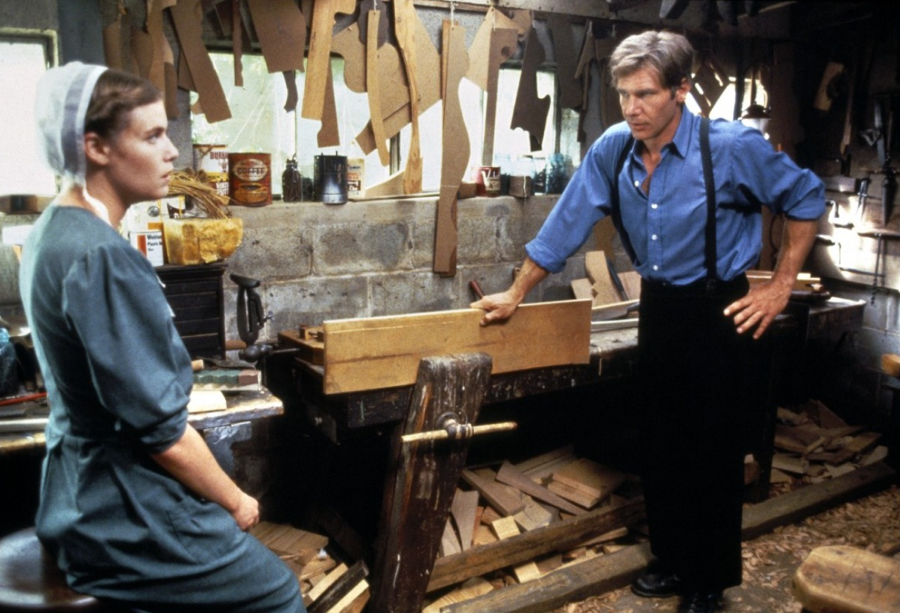
Daniel meets Book, and sees him as a threat to the community and
to his romantic plans concerning Rachel. Since he knocked over the birdhouse on
his first day after being shot, Book tries to repair it since Eli said he could
use his tools. Rachel brings him some lemonade and he drinks it down in one
gulp, which seems to impress Rachel. Besides carpentry she asks if has other
skills. He repeats what she said about how, as a policeman, she feared that he
was used to “whacking” people. He now says he is good at “whacking” people, and
she smiles, as they indulge in a bit of flirting.

The next scene is at night, establishing a romantic setting, as
Rachel holds a flashlight for Book as he works on the car. She says that Eli
thinks that he should attend the next barn raising, and he responds only if he
is still there. She looks a bit disappointed thinking about him leaving, as she
has become used to his male presence following the loss of her husband. He gets
the radio working and the song that plays is Sam Cooke’s “Wonderful World”
(chosen by Ford), which is appropriately Amish, because it talks about not
needing to know anything worldly, only love. They dance, and Rachel and he
laugh, which does not happen much during her workday. They do not kiss but come
close. Eli interrupts them, and Rachel says she has committed no sin. He warns
maybe not yet, but she may. By letting Book into their lives, Eli argues there
is the dangerous chance that others looking for Book will come with their guns.
He says that she may be shunned, meaning Eli can’t go to worship with her,
can’t eat at the same table, and can’t receive anything offered from her hand.
Their rules are harsh if there is any individuality expressed that deviates
from the community’s dictates. She is defiant in almost a feminist way, saying
that she is not a child, and he shames himself by not respecting her behavior.

Schaeffer talks with Carter saying the police are a cult, like
the Amish, a club, with their own set of rules, and Book broke them just as
Carter is breaking them by not disclosing where Book and Samuel are.
Schaeffer’s “cult” consists here of banding together to do harmful and illegal
actions. This scene contrasts with the next one which shows a barn raising
where the Amish men work together to do something beneficial by building a barn
for a neighbor as the women provide food and drink, in stereotypical sexist
fashion. Daniel, smiling but with menace behind his words and sometimes in his
looks, asks how Book is feeling. Since he says he is doing well, Daniel says he
will be able to go home soon, his departure coming none too soon for him. Everyone sings at the end of the day and Book
is introduced to the man and woman whose barn they built. They were just
married, so Book can appreciate the good act performed by the community, and of
which he was a part.


Book is sexually aroused as he watches Rachel through a door
taking a sponge bath. The rain outside adds to the wet, clean sexuality of the
scene. Rachel turns, facing Book, revealing her naked breasts, in a type of
wordless, open, unembarrassed invitation to join her. But it is Book’s shame
coming from the fallen world which brings embarrassment to Rachel. He looks
away, and finds that he can’t cross the line between their two worlds in such
an intimate way, worried about the repercussions to both of their lives. He
sees her the next day, and they are physically and figuratively separated by a
fence. He sums up the impact on their getting involved by saying that if they
had made love, he would either have to stay or she would have to leave, and
neither of them is prepared to do deal with that.


In a confrontation with tourists, onlookers rudely approach the
Amish, wanting pictures of them. Book makes a phone call to contact Carter and
finds out he’s been killed in the line of fire. Book then calls Schaeffer and
tells him he’s now out to get him, not the other way around. Book is in an
angry state, and moves toward a confrontation with some people making fun of
Daniel and Moses (Viggo Mortensen). Eli says it’s not their way, but Book says
it’s his way, and that sums up the differences between the pacifist and aggressive
lifestyles indicative of their two cultures. Some may get satisfaction from
what Book does, and it may hinder further harassment, but it is morally
repugnant to the Amish person to resort to physical violence. Book explodes and
breaks the nose of a harassing young man. It’s implied that it’s bad for the
local businesses since tourists won’t come if they encounter resistance from
the Amish to the visitor’s intrusive, belittling ways. The fact that an Amish
fought back gets back to the local police and we assume that Schaeffer gets
wind of the commotion.

Eli tells Rachel that Book is leaving the next day because he
belongs in his world, even though Rachel says that there is nothing for him in
that life. She probably feels she can give him more than the job he temporarily
left behind. She sees him securing the birdhouse he rebuilt, which is a sort of
symbol of his reaching the end of his stay. She comes out to the field and they
kiss passionately, knowing that it is their romantic goodbye.


Over the hill, danger comes in the form of the three policemen
who have tracked Book down. Book’s violent outburst brought more violence to
this land of pacifism, a sort of demonic invasion into the Eden of these
people. It is misty out, befitting the shady doings of these criminals. They
break into Rachel’s house without warning. Eli shouts out to Book just before
he is hit and knocked down. Book tells Samuel to run. Book climbs up the ladder
of the silo and drops all the grain on the searching Fergie, burying him. Samuel
comes back to the house, but Schaeffer doesn’t see him. Eli gives him a yanking
signal. Book goes into the silo and retrieves Fergie’s rifle just in time to
shoot McFee. Samuel is ringing the house bell that is an alarm that calls the
community. Schaeffer has the gun pointed at Rachel’s head and gets Book to
release his weapon.


But with all of the locals assembled there, Book asks what is
Schaeffer going to do? Shoot all of them? There are too many people, so many
witnesses to his violence and law breaking. Schaeffer stands down. The story
implies that when non-aggressive people comprise the overwhelming majority of
the population and won’t tolerate injustice, they can stop the violence.


In the last scene, Book and Rachel feel they must do what they can
in their own worlds. They look at each other in silence as they part, their
smiles showing that they know that they gave the best part of themselves to
each other for a brief time. Eli says
that Book should be careful out there “among them English.” Since the “English”
are the “others” for Book, too, now, he is considered part of the Amish
community. As he leaves Daniel walks toward Rachel’s home, telling us he will
probably be her future husband, which may be the right choice, unfortunately,
given the conflicting state of the two worlds.
The next film is The Year
of Living Dangerously.