Sunday, May 17, 2020

The Words


SPOILER ALERT! The plot will be discussed.


The Words (2012) is a story within a story within another story. It focuses on what is real and what is imaginative, and how this line can blur when an author creates characters that are so real they become more important than actual people in the writer’s life. It also deals with the talent to create a truly inspired work of art, and someone who would appropriate the work of another to make up for a lack of that unique ability. 

Writer Clay Hammond (Dennis Quaid) is doing a reading of his recently released novel, The Words. The question as the story unfolds is whose words are they? Hammond is telling us about a tale within the movie in which Hammond is a character. The film dramatizes the narration as Hammond says that there is an Old Man (Jeremy Irons, terrific in this role) watching in the rain as Rory Jansen (Bradley Cooper, in a fine but not well known performance) and his wife, Dora (Zoe Saldana) exit a building in New York City. It appears to the Old Man that the couple was able to avoid the water drops, implying they were blessed by fate. At his dreary apartment, the Old Man looks decrepit, using a cane, and his medicine cabinet is filled with medications. In contrast the Jansens look picture perfect in their fine clothes as they ride in a limousine to a ceremony awarding Rory a prestigious writing award. 


Rory starts his acceptance speech by making an interesting statement, saying, “I simply tried to set down the truth as I imagined it.” Fiction’s connection to facts can be remote, as in fantasy stories. It is more aligned to them when dealing with tales that approach reality. But, even there, it is “imagined.” By insightfully portraying what people experience and feel, and how they behave, the author can demonstrate the “truth” about human existence. Rory says he hopes he can come up with something for his next book, an ironic statement, we later discover. There are cuts to the Old Man as he scans Rory’s novel, which implies that there is a connection between him and Rory’s story.
There is a cut back to Hammond who shifts the narrative to five years earlier so as to provide a backstory. The early part of Rory’s life as a writer is like those of others trying to be successful. Rory and Dora moved to Brooklyn after college. He starts out like most novelists, creating a story, doing the revising, and submitting his manuscript. But, in the meantime, he and Dora have little money. Rory approaches his father (J. K. Simmons) for some funds, and we discover it isn’t the first time he has gone to his dad for help. Rory doesn’t want to ask for cash since, like most people, he wants to make it on his own. He reminds his father that two years ago there was a decision to give the writing career a chance. His dad, like other parents in a similar situation, tells him the writing should now be a “hobby,” and he should work at something that brings in a steady income. His father gives in and writes him a check, but tells him it’s the last one. He tells Rory that part of being a man is to accept one’s “limitations.” That is a tough reality to accept because most young people have dreams that they want to live up to. But when is it okay to accept that not all hopes become real, with the possibility that prematurely failing to apply oneself means giving up too early? 

Hammond relates how Rory received nothing but negative responses to the submissions of his novel, or worst of all, “silence.” This last form is the worst kind of rejection because it implies that a writer’s work didn’t even warrant a comment. Rory gets a low-level job delivering mail and packages at a large publishing company in order to foster literary connections. He sort of half-jokingly tells a fellow worker, also an aspiring writer, that he writes “angry young men” fiction, which most likely mirrors his frustration at not getting published. 
Dora wonders one evening if Rory is going to write that night. He isn’t feeling like it, and so he may be accepting those “limitations.” Hammond says, “without even knowing it they had settled into their lives.” The operative word here is “settled,” which means no longer trying to strive for something more fulfilling. The couple marries and honeymoons in Paris. They stop to take a picture of a plaque which notes that Ernest Hemingway stayed at that spot. Being where one of the world's most famous writers lived brings with it awe and also envy on the part of another author. They stop at an antique store where Rory discovers an old soft leather briefcase. Dora loves it and buys it for him, and it eventually changes his life.

Rory continues to write, but there is disappointment on his face as he sits in front of his laptop. He has been at the publishing house job long enough that he is instructing trainees. He is overjoyed, as any hopeful author would be, when a literary agent, Timothy Epstein (Ron Rifkin), sets up a meeting with him and tells Rory that his book is very accomplished, and that he sees “so much truth” in his writing. But Epstein says the work is “interior,” subtle, and is a work of art, which, ironically, makes it too literary to be marketable coming from an unknown writer. It is the book business Catch-22 (which of course is the title of a famous book), that one can’t get published if the author isn’t already published. 

The movie itself comments on the writing process by showing us the difference between a successful story and one that isn’t. Up to this point, except for the mysterious Old Man, which keeps us invested, Rory’s story is not noteworthy, certainly not one that we would recommend reading. But that changes with what happens next. Rory finds a manuscript in the old briefcase that Dora bought him, which he reads. (IMDb notes that the first page is from Hemingway’s A Moveable Feast. Hemingway’s ghost haunts this film). Hammond narrates that Rory could not stop thinking about what he found, and that “he had been confronted by everything he had ever aspired to be, and the reality of what he would never become.” Despite the fact that Epstein praised his work, Rory is humbled by encountering a level of achievement that he knows he can’t reach. And he is infuriated by finding out, as he says to Dora, “I’m not who I thought I was.” He has the love and devotion for writing, but not the talent (which is a similar theme in the play and movie, Amadeus). It is crushing to believe that he is not the great writer he thought he was, and he has no other aspiration, so he feels lost. Dora, understandably, is hurt by his words since she thought their love in the nonfiction world was the cornerstone of their lives (which, of course is also not real, because Hammond made it up, who was also created by the co-screenwriters and co-directors, Brian Klugman and Lee Sternthal. Many layers here). 

Rory escapes his limitations by copying the found novel in an attempt to channel the revered anonymous writer through his typing. Hammond says Rory just wanted “the words to pass through his fingers, through his mind.” He even keeps the spelling mistakes. He places his thumbprint over the one on the original manuscript’s page, as if trying to be part of the tale’s uniqueness. Dora comes across his retyping on the laptop and believes her husband wrote the story. She is overwhelmed and tells him he is everything that he wanted to be. She says the new words show that he “stopped hiding. They're fuller, they’re truer, they’re more honest.” Rory’s own work was artistic, but an empty vessel, devoid of the emotional depth that, according to Dora, he shows in life. But Rory is not happy choosing a happy, though circumscribed life, over what a piece of accomplished fiction can bring him. Rory starts out by trying to clear up the misunderstanding, but after seeing how moved and adoring Dora is, he finds that he can’t disappoint her. Rory knows he can’t receive recognition for his own writing, so he decides to go for half of the dream by being the recipient of the praise of another’s work. His copying of the novel turns into replicating just the fame of a successful author. He submits the novel, called The Window Tears, about “A young man’s journey through love and loss in 1940’s Paris.” The book becomes a number one best-selling novel and garners critical acclaim. (It is interesting that the number two book on the best-seller list is entitled Buried Lies, an obvious echo of what is happening in the movie). He could have been honest and accepted his “limitations” honorably, but as Hammond says, “Rory Jansen had made his choice,” to become a fraud. The backstory concludes and Hammond says, “And then he met the Old Man.” Quite a teaser, as the author announces the end of part one. 


There is a break in the reading and we are now in the primary part of the story which deals with Hammond. While signing books, a beautiful young woman, Daniella (Olivia Wilde), approaches the author and obviously knows things about him, such as his favorite wine. He invites her to spend some private time with him during the intermission. She shows that she knows a great deal more about Hammond, including food preferences, and music and TV show favorites. She also knows that he is separated from his wife, but he still wears his wedding ring, probably because he has been married for quite a while, and clings to that past reality. Daniella sounds like a groupie, but she reveals that she obtained her backstage pass from her college professor, and she herself is an aspiring writer, having won the same literary award as did Hammond when he was younger. Is she similar to Rory in Hammond’s novel, a writer who hopes to be great at some point, admiring the work of another storyteller?
When the break is over and Hammond returns to the stage, the center of attention, which is where Rory hoped to be and found his way there under false pretenses. The Old Man rides the bus that Rory takes to New York City’s Central Park, and sits near him on a park bench. Rory is reading a book and the Old Man says he met the author, who they both agree should have been better appreciated, which is probably what Rory feels about his own writing. When Rory wonders out loud, “What happened?” to the author, the Old Man says, “life,” which also fits what happened to this stranger. He knows who Rory is as he pulls out a newspaper article that is about winning the writing award. The Old Man asks him how it feels to be so well known. Rory says it’s good to have one’s work recognized, but the irony is that it isn’t his. The Old Man says with a hint of sarcasm that God looked down on Rory and said there is a writer. Rory says that he wrote two other books that wouldn’t have been published if it hadn’t been for The Window Tears, which helped him get over that Catch-22 glitch that guarantees that nothing breeds success like success. The Old Man says that he read Rory’s book and felt like he was right there, tasting the wine, sitting in the cafe, making love to the girl, hearing the child crying, and longing for his distant home. After the man praises his writing, Rory feels a bit uneasy with this enthusiastic man, possibly out of guilt. He says he has to leave, and the Old Man asks Rory to sign his copy of the book. Rory doesn’t have a pen and the Old Man comments, “a writer without a pen,” which has the subtext that he is an author without the words.

The Old Man says he has “a story.” He says that if he told it to Rory and he wrote it he might be able to give the Old Man some credit. Rory’s response is, “Well that wouldn’t be fair, would it?” But that is exactly what Rory has done, and he starts to leave since The Old Man is cutting close to the bone now. The Old Man then drops the bomb which shows he is the writer of Rory’s novel when he says his story is “about a man who wrote a book then lost it, and the pissant kid who found it.” Rory sits down next to him.


The Old Man now is the narrator as we get to the third story of the film (so Hammond is narrating what another narrator is saying). He says there was a Young Man, a soldier (Ben Barnes), in Paris in 1944 who hadn’t seen action in WWII. The young man worked to rebuild sewer pipes after the German occupation, stressing how lowly his life was literally and figuratively. But he was happy doing these details with fellow soldiers. He became best friends with a scholarly fellow who lent him books that opened his mind up and planted the desire to be a writer. He then meets Celia (Nora Arnezeder). They only knew each other's word for “Yes,” which the Old Man says made it “the perfect relationship.” Here the Old Man suggests that when it comes to love, words, essential for a story, can become a problem when one chooses them over real people, as we shall see. The verbal communication between the two comes later as they rejoice in their time together. The Young Man was then discharged from the army and went back to his American home, working at a market. Back there, “nothing had changed,” but he had. His old life felt “small” after seeing other parts of the world, meeting Celia, and acquiring the desire to write. 


So, he started to write but he was not successful (like Rory?). He left America and went back to Paris and Celia. He started to be a journalist for one of the many publications hiring ex-patriots and the Old Man says it was “a good place to learn.” Perhaps writing about real people gave the Young Man the training to connect to others on a genuine level, which Rory’s writing does not achieve. (Here we have another reference to Hemingway and how he was a journalist in France, and also the time Rory saw Hemingway’s house in Paris). Even some of the shots of how the Young Man kisses Celia mirror Rory’s actions with Dora and both couples married after moving in together. Unlike Rory, the Young Man and his wife had a child, which adds more experience to his story as their two paths diverge.

When the Old Man hesitates, Rory wants him to continue, drawn into the story as he was by the Old Man’s novel, as we are drawn into Hammond’s book, and the story of the film as a whole. He says that the baby cried all the time, and they found out “my daughter” was hopelessly ill. So we now know what we suspected, that this story is what really happened to the Old Man. The grief from the death of the baby damages their marriage as Celia becomes numb and distant. She leaves to stay at her mother’s home. With another allusion to Hemingway, the Young Man reaches for his copy of The Sun Also Rises. It is Hemingway’s first novel which he wrote after quitting his journalism job, taking time alone, away from his family, in order to put all his effort into his fiction. 

The Young Man at first starts to toss stuff in his apartment in anger and despair. But on the back of Celia’s farewell note he starts to type his own work of fiction. His use of the other side of the piece of paper symbolically shows how he turns a negative into a positive, using his writing as a way to purge his pain and turn death into a creative birth. We even see the ink thumbprint that Rory noticed on the found manuscript page. The Old Man says words flowed out of the Young Man (himself) and, “The words became form, the form became whole,” and he completed the novel in only two weeks. After performing this healing process of the imagination, the Young Man slept and then went to be with his wife and gave her his book. But, she wasn’t ready to reunite and sent him back to Paris. She put the pages in the briefcase (the one Dora bought) and a little later decided to return to Paris and “start life over.” But she left the book on the train, which removes the possibility of beginning again for the Young Man, who felt the book “saved him.” The implication here is that he has lost a second child that he helped to bring into the world. 

He becomes angry with Celia and searches for the lost work (which is another connection to Hemingway, since his wife lost a collection of the author’s stories). The young man eventually left to go home, as Celia did when they lost their child. But, the Old Man says, he couldn’t write anymore because, “he was never able to set down one word that looked right to him.” The suggestion here is that he had written his book when there was a flood of emotion that channeled all of his feelings into the words on his typewriter, and after that, the inspiration receded. As the Old Man says, maybe he didn’t want to go “that deep again,” into the depths of that tormented ocean. He eventually found a sort of “peace.” But, just like a storyteller, he adds that’s when his tale became even more interesting. He says the Young Man was now the Old Man, himself, and he read Rory’s novel and knew that it was his words in the book. He says that he wanted Rory to know the story behind the story and maybe he now has the makings of another book (which is the one Hammond is telling), but the Old Man’s statement is sarcastic, implying Rory may steal from him again to write about the first theft of “the words.” 


The Old Man walks away and Hammond ends his reading at this point to draw the audience into buying his book (and the filmmakers hook us as we want to know what comes next). It also allows the movie to further develop Hammond’s character. Hammond sees Daniella waiting by herself, smiling, and the writer, who seduces others with his work, is also being seduced. He takes her to his elegant apartment, but he hasn’t unpacked since becoming separated from his wife. He is adrift, like the characters in his book. (Daniella picks up a baseball off of Hammond’s desk that Babe Ruth supposedly hit for a home run. IMDb notes that a similar ball is pictured on Rory’s desk. Has Hammond just used an object he owns as a prop in his story or does this coincidence suggest that maybe Hammond also stole another’s work earlier in his career and his current novel is a sort of confession?). He wonders why Daniella wants to be something “silly” like a writer, and says words “ruin everything,” which suggest how harmful they can be when they become more important than real life. He echoes what he says in his book about the perfect relationship being devoid of them. Yet his living uses words, so he is a living contradiction, revealing an almost self-loathing. She doesn’t have the patience to read the book and wants Hammond to tell her how the book ends.

He continues the narration to his one-person audience. Rory gets drunk so he can tell Dora that he didn’t write the book. He wants to know why she loves him because he is afraid that she really committed to him when she thought it was his story. He wants her to admit that she knew all along he couldn’t be that good a writer in order to assure himself that the book isn’t why she is still there with him. But she loved him before the novel and her pain and anger derives from his dishonesty. 

He even confesses his plagiarism to his publisher, Joseph Cutler (Zeljko Ivanek), and says he wants to take his name off of the book. The furious Cutler says a public admission will destroy Rory and him. He proposes a cover-up by saying Rory can pay the Old Man whatever he wants to ease his conscience, and assures him that writers have committed this crime before. Rory initially dismisses that notion, implying that just because someone does something wrong it doesn’t justify another to do the same. When he asks if the subsequent book that Cutler published, that was his own, is as good as the Old Man’s, Cutler’s silence tells Rory what he already knows about his limited talent. 


Rory discovers the Old Man working at a plant nursery, where things still live, as opposed to what happened to his child and his writing. Rory says he wants to make things right by removing his name from the book and give the Old Man the royalties. But the Old Man is angry about what Rory did in the first place, taking a part of his life, the “joy and the pain that gave birth to those words,” for Rory’s own benefit. The Old Man will not allow Rory a way to dispel his guilt. But, he is still a writer at heart, and feels compelled to tell Rory, an eager listener, like us all, that part of the story that is not in the book. He says he saw his wife one more time, and there is a scene which shows him as the Young Man on a train that stops at a station. A man, holding a child, approaches and kisses Celia, and the Young Man realizes that she has been able to move on, unlike him, and start a new family, a new life. Their eyes meet and they tentatively wave to each other as he pulls away from her forever. The Old Man says she looked happy which gave him pain, but also some relief since he discovered that he hadn’t permanently hurt Celia. He says that allowed him to not keep looking back. Rory feels the Old Man would have had a better life if he continued to write. But the Old Man responds with something that is significant to the theme of the movie. He says, “my tragedy was that I loved words more than I loved the woman who inspired me to write them.” Rory has made a similar choice, as have many artists who chose their creations over those important people that were in their lives. Maybe the art connects with others, maybe even changes them. But, the sacrifices can be awful. The Old Man tells Rory that everyone makes choices, but they, like Rory, have to live with the consequences. Before he goes, Rory tells the man, “I do love your book,” which personally acknowledges the Old Man’s ownership and talent with no selfish attempts to lessen Rory’s guilt. Hammond concludes by telling Daniella that Rory continued living his lie, and the Old Man died a couple of weeks after Rory visited him. There is a shot of Rory dropping the original manuscript into the Old Man’s open grave. Hammond says, “It was as if by locking off the secret of one man’s life forever, he had unveiled another much deeper and darker secret within himself.” The implication is that Rory enjoyed his success that was not earned, and lived with the more awful truth that he was the kind of person who allowed himself to benefit from such a deception.

Hammond says there is no moral attached to his story, and that someone can make a terrible mistake in life, and even live well afterwards. Daniella says that is “bullshit,” because everyone must deal with guilt. We then get images of Rory and Dora, but they are not from anything written, and seem to spring from Hammond’s mind. Daniella wants to know what Hammond really believes would happen if the circumstances in the story actually occurred in real life. Here is where reality and imagination begin to blur. Hammond angrily says she has manipulated herself into being with him and getting him to talk. After all, she, too, has a selfish agenda as she wants to further her career. He turns the question back onto Daniella, and wants to know how she thinks it would play out if the story was genuine. 

She gets her jacket to leave and says about Rory, “He’s fucked,” because even though he may continue to write, “he’ll never, ever believe it. He’s robbed himself of the chance to find out” if he will ever really be accepted on his own merits since he already achieved fame under false circumstances. She also suggests that “maybe his marriage falls apart because for him and his wife to look at one another is for them to look at the truth” about the lie they are living. Rory might, in public, be able to “wear that mask of confidence and sophistication, but back when he’s alone late at night, he can’t sleep, because when he closes his eyes he still sees the face of that old man.” Hammond encourages her as she speaks, as if mentoring her writing, and then contributes the possibility that, “maybe he sees his own face, and the old man is just a story he made up.” Hammond is now talking about himself. He has written his book because he has the same struggle as the Young Man and Rory. He continues by saying, “At some point, you have to choose between life and fiction. The two are very close, but they never actually touch.” 
 Hammond tries to have that real “touch” by kissing Daniella passionately, but, despite what he just said, Hammond pulls back as an image of Dora holding Rory’s face in her hands appears. Hammond moves away and says Daniella should leave. She understands and says that Hammond “never let her go.” He conjured up Dora, and he can’t give up that fantasy of her, since he created in fiction what he can’t have in life. He couldn’t write an unhappy ending for Dora and Rory because he is living through his fiction and thus he would also experience a sad finish. She throws his words back at him, asking what does he want, “life or fiction?” We then get flashbacks of romantic moments between Rory and Dora, and we know that the writer chooses the words. 

The next film is Laura.

Sunday, May 10, 2020

Saving Private Ryan


SPOILER ALERT! The plot will be discussed.
Just as in the recent movie 1917, the mission in Saving Private Ryan (1998) is an ironic one. In the middle of a war, where soldiers are usually sent out to kill, the goal here is to prevent death. It may seem odd to bring up Star Trek, but that film franchise raised an idea that fits here: Sometimes the need of the one outweighs the needs of the many. And this film implies that sometimes they are one in the same.
Director Steven Spielberg again explores (as he did in Close Encounters of the Third Kind, E. T., War of the Worlds, and others) how ordinary people must deal with extraordinary circumstances. The film opens with an old man walking slowly through a military cemetery followed by a number of people (similar to the ending of Schindler’s List). The man is with his relatives and he begins to sob as he remembers the waves crashing on D-Day on Omaha Beach in France on June 6, 1944. The replication of the invasion that changed the course of WWII in this film has been considered by many, including those who experienced it, as possibly the most authentic rendition of the courageous and horrific nature of war. Captain Miller (another Oscar-nominated performance from Tom Hanks), although he shows that he can be cool and intelligent under pressure, reveals the effects of the stress of combat as his hand shakes while trying to drink from his canteen before the landing. During the story, Miller is at war with himself, as the trembling symbolizes, between what he considers is the right action to take, and what his orders command him to do.
The camera is right in the middle of the men, and we can almost experience their nausea as Miller’s boat rocks back and forth. Miller barks out orders as they approach land, telling the men to keep space between soldiers since groups of men provide a “juicy opportunity” for the enemy, while an infantryman by himself means firing to hit only him is “a waste of ammo.” Many soldiers don’t even get a chance to set foot on the sand as they are shot as soon as their boats open their ramps, which are called “murder holes” because they offer concentrated targets. Some soldiers try to go over the side of the craft and are weighed down by their gear. If the water doesn't drown them, bullets kill them in the water. Spielberg (winning his second directing Oscar here) gives us Miller’s point of view, and that of others, which makes us experience the devastation as if we are there on the beach with them. The camera literally bobs up and down below and above the surface of the water, simulating how it would feel if one of us was trying to stay afloat. Visual slow motion and sound muting adds to the feeling of confusion and disorientation. Bullets ring around the men (and the audience) and bombs explode everywhere. Some men are engulfed in their own napalm as a flamethrower explodes. Soldiers scream in agony. The craziness and barbarity of battle is evident through several shots. A soldier picks up the arm he just lost and tries to carry it with him. There is the futility of Miller trying to drag a wounded man to safety when he realizes after a bomb blast that he is now only holding onto the upper half of the soldier’s body. One moment can be lucky because a bullet glances off of a soldier’s helmet, but in the next moment, he is hit and killed. Medic Wade (Giovanni Ribisi) stops chest bleeding in one man only to have him shot in the head a second later. Such is the chaos that rules here. 
Hardly anything goes as planned. Miller’s attempts to communicate that the first wave was unsuccessful in taking the beach are thwarted, since the signalman is dead and his radio is destroyed. Most men are not where they are supposed to be as multiple companies have dispersed in a random manner. The armored division can’t make it to the beach. The Americans must take out an enemy machine gun nest that sits atop the seawall and is killing soldiers as if they are targets in a shooting gallery. Miller’s men use extended piping to set off grenades up the beach wall to clear a path toward the gunners. Miller shows his improvisational skills by attaching a mirror to a bayonet with some gum to identify the German men and their weapons. Miller sends up small groups of soldiers at a time, but Sergeant Horvath (Tom Sizemore) comments, “Why not just hand out blindfolds,” since it’s like facing a “firing squad.” But Miller says unfortunately it is their only option and otherwise, “All we can do here is die.” The film has many instances where there are no good choices.
Private Jackson (Barry Pepper) is the crack marksman under Miller’s command. Miller tries to give him a chance to reach a firing position by courageously running in the line of fire to provide a distraction. When he regroups with Horvath, the sergeant asks what Miller’s mother would think if she saw him be that reckless. Miller responds, “I thought you were my mother.” That they can use humor in this situation is remarkable, but also one of the few tools they have to cope with what’s occurring. Jackson has a crucifix that he kisses and prays to God before shooting. Later, he even says his deadly ability is a gift from the Almighty. It gives him strength to rely on his religious beliefs, but it is ironic that he calls on a supposedly benevolent entity to help kill others. 


Others also pray as they make their last confessions or plead to live. After Jackson is successful in taking out enemy soldiers, Miller and his men follow up with supportive fire and they can now shoot their way through to exit the beach. Another example of how the situation can change quickly in battle occurs when the shooting gallery metaphor is now reversed as American soldiers attack trapped German men as they come out of a bunker. Those that are left inside are incinerated with a flamethrower. The vengeful violence of war is seen when one soldier says not to be merciful toward the Germans by shooting them, but instead urges, “Let ‘em burn!” One enemy soldier raises his hands to surrender, but an American kills him anyway. Horvath and another soldier shoot two others that raise their hands. The irony is that they are not speaking German and are Czechoslovakian prisoners forced by the Germans to be soldiers. The film suggests that war is an immoral action, and decency and ethics many times are pushed to the side. 

Private Caparzo (Vin Diesel) hands a Hitler youth knife to the Jewish Private Mellish (Adam Goldberg), who says it is now “a shabbat challah cutter.” The satisfaction of the soldier feeling a sense of justice in getting this souvenir off of a dead Nazi is evident here. But, he then immediately feels shaken as the effects of all the killing washes over him. Horvath fills a small tin with sand and labels it “France” to be added to the ones that read “Africa” and “Italy,” which shows how much combat he has seen and illustrates how this conflict is truly a world war. As they take a break from the hostility, Miller’s hand is shaking again as the violence catches up to him while he looks down at the carnage on the beach of death. The camera then focuses in on one of the dead soldiers whose backpack reads, “Ryan. S.,” which brings us to the central plot of the story.
The scene shifts to a typing pool of women preparing the numerous condolence letters to be sent to the families of dead soldiers. One typist realizes that there are several Ryans killed in action. Three of the men turn out to be brothers. The fourth brother, James (Matt Damon), parachuted into Normandy and he is the youngest of the siblings. His whereabouts and condition are unknown. The mother lives on a farm in Iowa and a sense of dread reflects on her face as she sees the military vehicle approach her front door, and an officer and a priest approach her. She collapses on the floor before she even realizes the extent of her loss. 
The news reaches to the level of the U. S. Army Chief of Staff, General George C. Marshall (Harve Presnell). He has a difficult decision to make (another one here), since he is advised that the parachutists were scattered all over the place, and even if Ryan survived the drop, he was probably killed in action. Also, anybody traveling through enemy territory to find the man would probably be KIA too. Marshall has a letter written by Abraham Lincoln to a mother who lost five sons in the Civil War. Marshall was so moved by the sacrifice of that one family that he recites the contents by heart. Marshall believes that Private Ryan is alive, and he is sending a rescue team to find him and “get him the hell out of there” before his mother loses her last boy. He feels that her family has sacrificed enough on what Lincoln called, “the altar of freedom,” a joining of a religious image with a secular abstract one.


In the second act of the movie, Miller reports to his superior officer, Lieutenant Colonel Anderson (Dennis Farina). While waiting, Miller observes officers shaving, and enjoying coffee and a large sandwich. He must feel bitter that these men are experiencing such comforts after he and his men went through hell to allow these officers to make themselves at home. Anderson tells Miller he gets tough assignments because he can handle them, so he assigns Miller’s squad the job of rescuing Ryan. To acknowledge Horvath’s concern about the difficulty of the detail, Miller wittily admits it will be like looking for “a needle in a stack of needles.” Miller needs an interpreter and seeks out Corporal Upham (Jeremy Davies), who speaks French and German. It is immediately evident that Upham does not have the stomach for combat. He is a nerdy type whose first response is to tell Miller he has not been part of the fighting and has not fired his weapon since boot camp. Even after what he has been through, Miller is still able to politely dismiss Upham’s reservations and tells him to get his gear. Miller actually finds Upham’s bumbling amusing as the corporal grabs a German helmet by mistake and juggles his typewriter, which Miller tosses since Upham must replace it with a weapon for this assignment. 
The squad is not thrilled with the newcomer’s presence and the assignment in general, since it seems to them that they are risking their lives for a public relations stunt. Upham is awkward as he tries to connect with the others, saying he thought soldiers should bond like brothers (which can apply literally to Ryan but also to the connection between combat comrades). Caparzo laughs off making a personal connection, saying that Miller won’t even tell them anything about his past. There is even a pool set up as the men guess Miller’s background. Later Private Reiben (Edward Burns) jokes that Miller was assembled out of dead body parts at Officer Training School. The feeling here is that they must rely on each other, but the closer they become, the harder will be the effect of losing a comrade. 

Reiben questions the logic of risking eight men for one private. Wade rightly points out the terrible impact on Ryan’s mother, but Reiben says they all have mothers. The bookish Upham quotes the famous lines from poet Tennyson’s “Charge of the Light Brigade,” by saying, “Theirs not to reason why/Theirs but to do and die.” The sarcastic Mellish considers it gibberish, but Miller says Upham is right. As soldiers it is their duty to follow orders, even if they are “fubar.” (It takes a while, as a sort of initiation prank, before the squad lets Upham know that the acronym means “fucked up beyond all recognition”). The questioning here gets at the central theme of the movie, which is, whether there is any time that soldiers can question the authority of those in higher positions. In the midst of battle, there is little time to be democratic. But, suppose the command is to do something considered irrational or even immoral? People have committed atrocities based on the reason that they were “just following orders.”

In this dangerous world even the drops in a pouring rainstorm hitting puddles seem like bullets landing. Miller’s squad reaches a town under fire from the Germans. Sergeant Hill (Paul Giamatti) is disappointed that the arriving men are not backups to offer support. But in order to proceed with the mission, Miller has to aid the other soldiers. A German on a loudspeaker says, “The Statue of Liberty is kaput.” Miller’s response is, “That’s disconcerting.” It is an example of using dark, understated humor to deal with a dire situation. Mellish ‘s character, as seen before, is more forthright in his comic remarks, and yells at the man on the bullhorn, “Your father was circumscribed by my rabbi, you prick.” These short lines illustrate the ability of the script to establish the differences in characters. Even small actions accomplish these distinctions. Under fire, Caparzo picks up fallen fruit from the ground, which not only shows calm while ducking a barrage of bullets, but also the need to eat, which is especially important to an Italian (which I can personally attest to). 


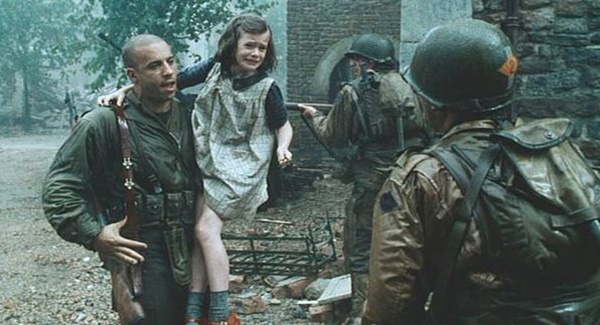
They come across a French family whose home now is the second floor of a building without a facade. As Upham translates, the father says he wants to give up his little girl so the soldiers can protect her. War literally rips apart the home and the members of a family. Caparzo, saying that the family’s little girl reminds him of his niece, takes the child and gives her his rosary. Just like Jackson’s crucifix necklace, here is another contrasting mingling of religion in the midst of violence. Miller yells at him, saying that he must leave the civilians there. Caparzo says taking the children to the next town is “the decent thing to do.” Miller says, “We’re not here to do the decent thing! We’re here to follow fuckin’ orders!” They are in the middle of a war, and Miller here argues that decency is not left to individual determination. 
Coming under the cynical axiom, “No good deed goes unpunished,” a sniper wounds the compassionate Caparzo. The enemy creates sympathy so that other soldiers will expose themselves to danger and try to rescue their comrade. In the upside-down existence of war, human caring is used as a tool to do more harm. Caparzo has a letter in his pocket that he wants sent home to his father which will act as a prayerful goodbye. But this farewell literally and figuratively has blood on it. The camera then shifts to the viewpoint of the German sniper. Through his telescopic sight he can see Caparzo talking to someone, so he knows where American soldiers are taking cover. He can’t act on this knowledge because the marksman Jackson, again invoking divine influence, shoots him. But, the damage is done as Caparzo is dead. The young French girl goes back to her family, hitting her father for having exposed her to danger, but here again he had no good choice to make given the harrowing alternatives. Miller says, as if summing up a lesson, that the death shows how they can’t take kids with them. He gets his men to move on quickly from this loss by yelling out orders. Because they have sacrificed one of their own for one man who is a stranger, Reiben curses Ryan, and, thus, the mission for which he and the others must risk their lives. 
 Hill sends a soldier to get Captain Hamill (Ted Danson) to see if the officer knows anything about Ryan. Hill sits down near a building just to check his boots. He accidentally knocks over a wooden beam that crashes through the wall of the building, revealing that German soldiers are hiding inside. One moment there is something trivial happening that then leads to a lethal situation. The scene again demonstrates how fragile and shifting existence is in war. The Americans and the Germans shout at each other, but nobody really wants to break the standoff which will cascade into annihilation, showing how aggression begets more aggression.  Luckily for the Americans, Hamill and some of his men have arrived at a spot above the confrontation and eliminate the Germans. Again, we have humor to offset this most dismal of circumstances. Horvath says, “it’s enough to make you old,” implying rapid aging. Miller counters with “Let’s hope so,” offering the hope to live a long life. 
What follows is a different form of cruelty perpetrated by the misunderstanding that results in the chaos of combat. Miller tells a soldier named Ryan (Nathan Fillion) that his brothers have died. The man breaks down crying and asks how it happened. When Miller tells him they were killed in action, he says that’s impossible because his brothers are in grammar school. He’s James Ryan from Minnesota, not Iowa, and has a different middle name. But Minnesota Ryan is so shaken that he wonders if it’s really his brothers who are the ones that are dead, and starts to repeat that he must get home to make sure his siblings are fine. Again, from one moment to another, lives can become undone. As Miller questions soldiers in Hamill’s camp, he finds that the mayhem is widespread, since parachutists fell far from their targeted landing sites. Hamill says they could use Miller’s squad, but he admits he understands Miller’s mission, which surprises Miller. Hamill says he has brothers, too, and he tells Miller to find Ryan and get him home. There is no definite right or wrong way to respond here. A viewpoint depends on one’s own experiences.

The squad spends the night in an empty church, with candles burning, as if a service is going on. It is another religious image that can mean many things: Is God on the side of the Americans?; Has the deity abandoned humankind because of its destructive ways?; Has the waging of war left a void of spirituality that is symbolized by the abandoned church? Horvath notes Miller’s shaking hand and humorously says that the captain needs to go into another line of work. Wade copies Caparzo’s bloody letter so he can send a cleansed version to the dead soldier’s dad (the letter eventually passes to Miller, and finally to Reiben as the wartime band of brothers is respected). Miller and Horvath laugh about the antics of a soldier named Vecchio (which in Italian means “old,” suggesting combat ages people, as Horvath noted). The name reminds Miller of another person of Italian heritage, Caparzo, and the mood shifts. Miller says with a grim reaper look on his face that he has lost ninety-four men under his command. But he says he tells himself that those lost saved so many others (in a way comparing the sacrifices to what Jesus did). He then gives a smile and says, “and that’s how simple it is,” admitting to the way he needs to justify his actions. Miller says that’s how he rationalizes “making the choice between the mission and the men.” His line sets up Horvath’s response that the situation now is different because “this time the mission is a man.” Ryan is one person so the only way to justify the mission is by what comes of him later. Miller says, “This Ryan better be worth it. He’d better go home and cure some disease or invent a longer-lasting lightbulb or something.” But as things stand at this point, Miller may continue to carry out his orders, but inwardly he feels, “I wouldn’t trade ten Ryans for one Vecchio or one Caparzo.” Horvath adds an “Amen,” which continues the need to attach some form of religious truth in a desperate situation. 

Jackson does not seem to have any conflict in his beliefs since, as Reiben observers, Jackson can fall asleep immediately. Mellish observes that he must have a “clear conscience,” implying that Jackson knows he is righteous in what he is doing. Reiben, referring to how Jackson must feel, paraphrases a religious quote by saying, “If God’s on our side, who the hell could be on theirs?” The scholarly Upham provides the exact line, “If God be for us, who could be against us?” Although most would agree if there ever was a justifiable war, it was this one that stopped Hitler and his Nazi agenda. But, the film here is talking about war in general, and there have been many fatalities because leaders said God was on their sides. 

Miller walks among the talking men, telling them to get some sleep, tucking them in as if they are children under his paternal care. Miller asks how the untested Upham is doing. His response surprises Miller. The man says that what he is undergoing is good for him, and again uses a quote that advocates that war can strengthen a man’s resolve. In the absence of real experience, Upham turns to books which can inform but are no substitute for actual immersion in the horrors of war. We realize that Miller is an educated person since he knows the lines are from Ralph Waldo Emerson, and says the writer was probably just, “finding the bright side” in an otherwise unpleasant situation.
The squad arrives at a rally point where a glider went down. The craft was too heavy because extra metal was welded on to protect a general who was a passenger. The pilot wasn’t told of the extra weight. We have here an incompetent military action that is a counterproductive attempt to shield a high-ranking officer. It also shows a parallel attempt to save one life at the expense of others. The comparison to their mission is not lost on the squad. However, Miller’s team is trying to save a man whose average family has already suffered great loss due to the international conflict. The squad sorts through the dog tags of all the dead soldiers at this outpost to see if Ryan’s is among them. They make jokes, saying they can use them as poker chips. As airborne servicemen look glumly on, the compassionate medic, Wade, who has had to treat the wounded and those who he could not save, is outraged by this cold activity, and grabs the tags. Out of desperation, Miller calls out to the marching men if any know anything about Ryan. He finds out that the private is at the town of Ramelle, which is strategic because a bridge there allows tanks to cross the river. 
On their way they encounter another enemy bunker housing a machine gun. The men feel that they should just go around the threat since they see it as an unnecessary risk to engage it. They throw Miller’s words back at him, saying it is not their mission. But Miller, after seeing all of the casualties along the way, appears to want to look at the bigger picture now, and worries about the next group of soldiers that have to deal with this German military obstacle. He now says their mission is “to win the war.” But the assault ends in Wade’s agonizing death. 

There is one German alive (Joerg Stadler), and the others, except for Upham, want to kill the soldier. Miller wants him alive long enough to dig Wade’s grave. Upham wants to know if Miller is going to allow the others to kill the German. He tells the captain, “This is not right, sir.” Here again the film presents the difficulty in determining what is the “right” thing to do in a situation where all of society’s restrictions have been pushed aside. Miller, most likely feeling guilt and a desire for revenge, does not give Upham a straight answer. Upham, the outside observer here, asks out loud, “What is happening?” His disorientation is evident as the rules he lives by are not in play here. 

Miller’s hand is shaking more now and he sobs in private, allowing himself to feel the loss of Wade, and his culpability in the man’s death. As the German digs, Upham, trying to hold onto his humanity, offers water to the prisoner, but Reiben stops him from showing any kind of mercy. A little later Upham allows the enemy soldier to take a break and smoke a cigarette. The German seems to be trying to exploit Upham’s sympathy, joking about Mickey Mouse. When the other Americans arrive, the German acts desperately to delay any execution by wanting to keep digging. He says he likes America and spews out several American slang expressions. He even tries to sing “The Star-Spangled Banner,” and says, “Fuck Hitler.” Would an American soldier captured by the Germans try the same ploys? 

Upham pleads that the man is a prisoner-of-war and they can’t just execute him. Miller allows the soldier to keep his blindfold on, walk a distance away so he won’t know where the Americans are going, and then surrender himself to an Allied patrol. Reiben, Mellish, and Jackson don’t understand how Miller could let the man go. Upham says it’s against the “rules” to shoot a P.O.W. Reiben says that the “rules just walked off,” which shows how war’s suspension of life’s laws can lead to losing one’s soul. A brief mutiny occurs led by Reiben who questions angrily Miller’s orders to attack the German bunker and release the prisoner. He wants to know why Ryan “is more important than two of our guys!” Horvath attempts to discipline Reiben, throwing the man to the ground for being “out of line.” For Horvath, whatever is the decision of the commanding officer, a soldier must follow the direction of that “line” set forth by the leader. But what if the order is morally compromised, or what if the view of the subordinate is warped? Again, the movie does not offer easy answers. Reiben says he is through with the mission. Horvath tells him if he leaves he’ll shoot him. 

As shouting and arguing breaks out among the soldiers and Horvath points a gun at Reiben, Miller is at first quiet in the mayhem. He then diverts and diffuses the situation by asking his men what the pool is up to on him. He discloses that he has been a schoolteacher for the past eleven years. He teaches English composition in a small town in Pennsylvania, and was also the baseball coach. His background seems unsuited to lead men into battle, but it is obvious that he has stepped up to serve his country as an officer. He admits that he has been changed by the war to the point he wonders if his wife will even recognize him or believe what he has undergone. He doesn’t care about Ryan, he says, but if he can save him, then maybe it earns him a better chance to return to his wife, because killing only takes him “farther away from home.” Here is where the film suggests, as some religions do, that saving one man can save others. He offers Reiben the chance to leave, but after all of the men bury Wade, he sticks with the squad.
On the road, they take cover when a German armored vehicle rides by. It sustains a bazooka attack and Miller’s squad shoots the German soldiers trying to get away. On the other side of the road are soldiers who disabled the German half-track led by Corporal Henderson (Max Martini). With Henderson is the elusive Private Ryan. After Miller tells Ryan about his brothers, besides having to deal with the loss, he also feels he is abandoning his post. His orders are to hold the bridge in the bombed-out town until reinforcements arrive. Ryan finds out that Miller’s squad has lost two men on the mission to bring him back. These additional deaths for which Ryan had nothing to say about makes him sum up what war is when he says, “It doesn’t make any sense.” He tells Miller that they should tell his mother that he remained “with the only brothers I have left.”  Here again we see how the individual is inextricably intertwined with the fate of others.

We have entered the third act of the story. Miller has to decide as to whether to let Ryan stay and the squad leave, or help him out in the current predicament. Miller asks Horvath, who says maybe they can look back and be able to say, “that saving Private Ryan was the one decent thing we were able to pull out of this whole god-awful, shitty mess.” Thus, the mission incorporates more sacrifice but also a broader fight to do “the decent thing,” which Miller earlier said was not what they were there for. But since Miller has become convinced that saving Ryan may morally grant him passage home, he is onboard with what Horvath says. Miller sets up a strategy to have marksman Jackson go up a tower and shoot the enemy from above. He wants to bring German tanks down the main road toward the bridge and disable their treads with “sticky bombs.” They are placed in socks and covered with grease that will attach to the tanks. Reiben, again coping with humor, says, “now we have to surrender our socks.” If the Germans get past them, then they must retreat and blow up the bridge, which will not be a victory but will stop the enemy from using it.
Mellish says the soldiers will be moving around a lot and he gives Upham the task of carrying and feeding the others ammunition since he is the novice when it comes to combat. The sad singing of Edith Piaf plays, fitting the mood, but the soldiers joke to cope during this calm before the storm prelude. Horvath sways his handgun to the music, an image combining creation through art and destruction through violence. Ryan talks with Miller, and says he can’t picture the faces of his brothers, which shows how war can wipe out all that is good about life. Miller tries to help him, saying when he thinks about home, he pictures what gave him solace, such as a “hammock in the backyard, or my wife pruning the rose bushes in a pair of my old work gloves.” These are the simple things that are reminders of how things were, and contain the hope of returning to what it was like after the current horror ends. Ryan remembers a crazy, funny incident that involved him and his three brothers, one of which was literally trying to have a roll in the hay with a girl. After laughing, the grief sets in again, and Ryan says that event was the last time the four were together, which was two years prior. 
From fond nostalgia, to quiet melancholy and now to imminent danger, war again shows how quickly it disrupts the timeline. The rumbling of armory ruptures the tranquility and the soldiers disperse to their positions. Jackson in the tower signals that there are a couple of tanks coming and the Americans are very outnumbered by the approaching German infantry. During the ensuing battle, the camera, like it did at the beginning of the film, puts us at ground level, and makes us feel like we are soldiers, running through a firestorm of bullets. Miller tries to keep Ryan out of danger as much as possible. But the surprise here is that Reiben, who almost led a revolt against continuing the mission, rescues Ryan from an explosion. It seems saving Ryan has become the goal of the whole squad to achieve salvation amid the hell of battle. 


But there will be tragic sacrifice for that atonement. Despite hitting many of his targets, Jackson misses a couple, which is an omen of what is to come. A German tank zeroes in on his position above, fires, and the blast kills Jackson. Upham cringes in hiding and hesitates bringing ammo. Mellish gets into hand-to-hand combat with a German soldier in one of the buildings. Upham, ironically wearing belts of bullets but who is only fit to handle a typewriter and not a weapon, ascends the stairs slowly instead of rushing to Mellish’s aid. The German kills Mellish with a bayonet to the heart. The enemy soldier heads down the stairs, walks past the terrified Upham, and doesn’t bother with him. He knows that Upham is not a threat. This image is a damning one since the enemy soldier is telling Upham that the American is impotent in the presence of his own fear.

Horvath is wounded in an exchange with a German, and grabs the frozen Upham as the Americans must retreat to the “Alamo” spot, the bridge that must be destroyed to prevent the Germans from using it. Upham hides again while the others scramble. He is like a ghost and the Germans pass over him, which, ironically, saves him, although he is spiritually dead. Horvath is shot multiple times. His tough stoicism is in evidence as he says he just had the “wind knocked out” of him. As Miller prepares to blow up the bridge, an explosion knocks the detonator out of his hands. There is symmetry at this point as Miller experiences the same disorientation that occurred on Omaha Beach, as the camera again slows to jerky movements and the sound is muted. Miller sees Ryan crying over a lost comrade and he realizes that Horvath is dead. In an ironic moment, the captured German who Miller set free is here and shoots Miller as he tries to retrieve the detonator. Even though he is dying, Miller refuses to give up, shooting at an approaching German tank with his handgun. The tank explodes and Miller sees that an American plane has destroyed it. More planes fly overhead attacking the Germans. The timid Upham survives and comes out of hiding to capture a group of Germans, including the one for whom he asked for mercy and now has shot Miller. Upham uses his rifle just this one time and kills the German soldier, probably out of revenge and guilt. But he contradictorily allows the other Germans to leave. The film suggests that war is irrational, and it creates conflicts not only between others but also within individuals.

Reiben’s attempt to help Miller is futile. He calls for a medic as the still alive Ryan kneels near Miller. The airborne soldier tells Miller that the American planes are P-51’s, known as “Tank-busters.” Miller continues the film’s seemingly conflicting mingling of violence and religion by calling them, “Angels on our shoulders.” Miller’s last words are to Ryan as he wants him to play forward the huge sacrifice made to save him. Miller says, “Earn this. Earn it.” 


The words written by General Marshall to Ryan’s mother assuring her of the return of her son who distinguished himself in combat are spoken, as he repeats Lincoln’s words. Ryan’s young face transforms into his older self (Harrison Young) who was in the first scene of the movie. Ryan visits the grave of Miller. He addresses Miller by saying he has led his life the best he could and hopes he earned what they did for him. His words speak for everyone who owes a debt to those who fought and still fight for the lives of others. 

Since words are important, the next film is appropriately titled, The Words.