SPOILER ALERT! The plot will be discussed.

Director/writer Adam McKay takes on subjects
that are complicated - economics, politics (Vice) - and is able to make
them entertaining. In The Big Short (2015), a seemingly contradictory
title, he focuses on the factors that led to the financial collapse in 2008 in
the United States. He uses a bag of tricks that includes having characters
speak directly to the audience, including celebrities playing themselves, in an
attempt to explain what happened during this Great Recession. He has a number
of quick edits that keep one’s attention from drifting off which can happen
during stale discussions about money. The movie doesn’t show anybody as a hero,
because there was none. But it does show there was a range of culpability among
the participants.

The film opens with a quote from Mark Twain: “It
ain’t what you don’t know that gets you into trouble. It’s what you know for
sure that just ain’t so.” It sounds enigmatic, but it suggests that putting
your trust in something that is obviously a lie creates a house of cards that
will crash down on you. Twain’s first line grants a pardon for ignorance. The
second line assigns blame for knowingly letting bad things happen. The image
that the quote is superimposed upon is that of a man balancing a child on his
shoulders. Could this imply how regular people were impacted by Wall Street’s
big money scammers? Or could the balancing child also point to the precarious
nature of our economic health?
The story begins with the movie’s narrator, the
sleazy Deutsche Bank employee Jared Vennett (Ryan Gosling), talking directly to
us saying that banking used to be boring and bonds were something you gave your
kid and, “Maybe when he’s 30 he makes a 100 bucks.” Lewis Ranieri (Rudy Eisendopf)
invented a type of investment called mortgage-backed securities which bundled
large numbers of mortgages together which generated income through fees by
selling what seemed like a safe investment because most people were paying
their mortgages. Basically, what happened was that greed on steroids kicked in,
and there was the granting of home loans to people at risk for paying mortgages
back. The inevitable result was that there were defaults and the whole system
crashed.


We then switch to outraged, loud, stressed out
Mark Baum (Steve Carell, who is over-the-top hilarious and emotional in this
role). He hates banks since he lost his brother to suicide. Baum believes the
financial institutions destroyed him. He enters a grief counseling session late
and proceeds to “hijack” the meeting, ranting about how a bank delayed telling
its customers that they had overdrafts in their accounts in order to collect
large amounts of penalty fees. He asked a bank executive how he could “sleep at
night” for what he was doing. Baum is a character who wants to make money in
the capitalist system, but doesn’t wish to “screw” over average working people.
Vennett describes Baum as a man who wants proof in order to believe in
something, as opposed to those who don’t want to see the writing on the wall.
Vennett says the cynical Baum “never believed that any company was legit
without proving it.” Humorously, there is a flashback to Baum’s childhood where
his rabbi tells Baum’s mother that her son is exasperating because he is
“looking for inconsistencies in the word of God.” Yes, Baum didn’t even trust
the Almighty. Vennett says that Baum started his own fund on Wall Street, and
had a nose for deceit, or as Vennett humorously puts it, Baum knew when the
Wall Street bull “had gone number two.” After the death of his brother, he felt
everything was a “lie.” His wife Cynthia (Marissa Tomei) is worried about him
and says he should quit his job. Baum is torn in two, both loving his job when
it’s done ethically and hating it when he sees people getting ripped off. He
masochistically loves being the man angry at the way the system is run. As he
later says, “I am happy when I’m unhappy.”

As Burry analyzes the data he sees that the
mortgage loans were granted to people with poor credit ratings who either
already defaulted on their loans or would do so soon as these “subprime”
adjustable rate mortgages were scheduled to shoot up their interest rates in
2007. As he looks at the information, there are cuts to people who are thrilled
about owning the dream houses they can’t afford, and then there are sale signs
posted on lawns to drive home that theme of denial about what’s really
happening. Burry calls his boss, Lawrence Fields (Tracy Letts) about “shorting”
the housing market, that is, betting against the housing market prospering.
(“Shorting” is a gamble. It means to borrow, not purchase, a stock or bond from
a lender, quickly selling it, and if it’s value declines, buying the item at a
cheaper price, while pocketing the difference at the specified time of return
to the lender. If the value of what is borrowed goes up, the borrower loses
money by paying for a more expensive investment that must be returned to the
lender. Hey, I’m not an economist, I just looked it up). Fields perpetuates not
wanting to see the truth when he says to Burry, “bubbles are regional, defaults
are rare.” Bale is funny, showing Burry’s quirks as he repeats strings of
words, cleans the blinds in his office, and brushes and rinses his teeth while
trying to speak on the phone.

Vennett continues to narrate saying that Wall Street loves to invent jargon like “mortgage backed securities, subprime loans. Tranches.” He says they are meant to confuse people, make them feel “bored” and “stupid,” and present the appearance that only the investment workers “can do what they do.” To entertain conveying this information, McKay gives us actress Margot Robbie, playing herself, in a bubble bath to comically explain some of the economic terms. She drinks champagne as she relaxes in her bathroom, which mirrors the greed of the wealthy. She says Ranieri’s idea was a good one, making billions for banks by getting 2 percent fees selling the bundled mortgage bonds. But then the lenders ran out of mortgages, since there are only so many homes to sell to qualified borrowers. So, the banks filled the securities they sold with very risky mortgages called “subprimes,” which Robbie says are “shit.”
Burry contacts large investment banks, including
Goldman Sachs, to create “credit default swap” products which bet against the
mortgage loan business. The banks, only wanting to believe what they want to
believe, see Burry’s willingness to buy these “swaps” (and pay premiums on
insurance to make sure his investment will be forthcoming if the banks go belly-up),
as easy money for them. The song that plays with the line “Shake your money
maker” mirrors how these myopic banks believed they received 1.3 billion
dollars from a foolish investor. Eventually Fields, Burry’s boss, severely
questions Burry’s action and wants “his money back.” But Burry insists when the
variable rate mortgage interest rates skyrocket in 2007, homeowners, whose
incomes have flattened, will default on their mortgages in massive numbers.


Baum and his crew meet with Vennett, who is a
pushy salesman as he says he “smells money.” This guy is not an idealistic
fellow. He just looks for places to acquire wealth. (As Baum says later he
wouldn’t buy a used car from him). Vennett tried to sell Burry’s idea to the
banks themselves, but they laughed him out of the office because they felt that
Burry’s idea was nutty. So, Vennett tries to get Baum’s outfit to buy those
“swaps.” He uses a Jenga tower with segments labeled with the credit ratings
assigned to the mortgages, with the “shit” loans on the bottom, propping up the
tower. “Tranches” (a portion of something - McKay spells out the definition for
us) comprise layers of these various-rated non-government backed loans
supporting a large portion of the market. These loans were given to people with
bad credit ratings and no verifiable income. The default rate on mortgages has
risen to four percent and the prediction is that it will rise to eight percent,
which will cause, according to Baum, “Armageddon.”
More humorous diverting entertainment is
inserted when Vennett says he is certain about the math as he points to his
numbers guy, Jiang (Stanley Wong). He says the man is so Chinese, he can't
speak English. Of course, arguing someone is great at mathematics just because
he’s Asian is racist, as Baum points out. Jiang then addresses the audience in
English and says Vennett likes to add authenticity to the smartness claim, and
he really finished second and not first in a Chinese math competition, as
Vennett claimed. There is dishonesty it seems, in every Wall Street
transaction.

Vennett says inviting them to invest in these
swaps is like he’s, “standing in front of a burning house, and I’m offering you
fire insurance on it.” A good metaphor as he’s making the argument that it’s a
sure thing that the housing market will disintegrate into ashes. The banks,
even his own, are getting large fees selling the bundled bad mortgage loans.
So, greed has blinded them from seeing anything going wrong. The bonds are
getting great credit ratings and thus are erroneously propping up this aspect
of the economy even though they are based on nothing. Vennett says when the
banks discover a bond is “too risky to buy,” they “repackage it with a bunch of
other shit that didn’t sell and put it into a CDO, or Collateralized Debt
Obligation.” McKay has Vennett interrupt the film again, telling the audience
the late chef, Anthony Bourdain, will explain CDO’s. This sequence mirrors the
Margot Robbie bit of getting a celebrity to humorously explain a complex
investment term. Of course, our humor comes from outrage as Bourdain
demonstrates in a kitchen that CDO’s are similar to making a new stew out of
old fish that didn’t sell. The exterior is different, but what’s underneath is
the same rotten product. And, they get AAA ratings. Fraud anyone?
After Vennett leaves, Baum says he wants him to
be right because he is angry about his brother and wants to profit off of the
bank’s “stupidity.” He justifies betting against the banks as a sort of revenge
for the institutions charging 25 percent interest on credit cards and burying
young people with student debt. But is this the ethical way of getting back at
the banks, making money from the greed of others? Doesn’t that compound the problem?
Why not just expose it? These guys are not as unscrupulous as those at the top
of the financial food chain, but they are still in the capitalistic game to
make money. Baum says to find out if what Vennett said was true they actually
must go out into the field and check to see if there is a problem with the
housing market. They are willing to do that, as opposed to others who fiddle
while the economy burns.

The focus shifts to Charlie Geller (Johns
Magaro) and Jamie Shipley (Finn Wittrock) as they hope to pitch to JPMorgan
Chase. (By the way, except for Burry, all of the names here are fictitious
although based on real people). Geller and Shipley are young and have just
arrived in New York from Colorado. But they have grown their investment company
from working out of a garage and starting with $110,000 to the point of
handling about 30 million dollars in investments. Not good enough, though. They
need an ISDA Agreement, which McKay spells out as an authorization to sit at
the “big boy table” and its’s not “available to stupid amateurs.” The film
implies that considering how dumb the “big boys” were handling the mortgage
loans, it is ironic that these young men can’t even have a real meeting with a
large institution. There are notes on the screen that say comically that trying
to do high level trading without an ISDA “is like trying to win the Indy 500
riding a llama.” The condescending attitude of the company is shown as a
low-level employee basically dismisses them in the lobby and they are told by
security they must leave.
The two could not get anywhere with any other
banks. There are proposals on the lobby coffee table by other people who did
not sell their proposals to the bank. They pick one up and it’s Vennett’s
pitch. Geller’s character talks to the audience here saying how they didn’t
really discover Vennett’s housing bubble analysis in the lobby. It was more a
word of mouth thing and they read it in a publication. Director McKay is
transparent about how film distorts some of the facts for brevity and dramatic
purposes. It’s funny and unusual to have a filmmaker own up to this fact right
in the middle of the story. There is more speaking to the camera to help move
the story along and draw in the audience to what is being said. Shipley says in
a flashback to their early business days, “People hate to think about bad
things happening so they always underestimate their likelihood.” Vennett
narrates that “the markets will sell options very cheaply on things they think
will never happen.” There is a little cartoon of a slot machine on the screen
in the lower left corner to stress the gambling aspect of investment work.
Since these two men invest little money on long-shot failures, if they are
wrong, they don't lose much. If they're right, it pays off big. So, the
products that Burry first noticed and Vennett promulgated about worst-case
scenarios that people don’t think will occur is right up their financial alley.

They contact Ben Rickert (Brad Pitt, looking nerdy and older with scruffy long hair and a beard) to help work the credit default swap angle. Vennett narrates that Rickert was a trader in Singapore for Chase, but “quit the whole game in disgust.” We get a flashback of Rickert and Geller as neighbors in Colorado walking their dogs. The movie suggests that sometimes sheer coincidence can change one’s world. Rickert thought “the whole world was going down.” He sort of went off the grid, growing his own vegetables, and is so paranoid he has multiple phone lines to weed out the government listening in on his conversations, even though he is no longer in the brokerage business. We see a flashback shot of Geller and Shipley eating at his table as Rickert says one ingredient to getting the soil ready is to add “urine.” There is a funny shot of Geller hesitating before putting a forkful of salad into his mouth. If it wasn’t for these amusing, quirky aspects of the movie, a story about mortgages would make breathing exciting.
So, it’s the outsiders, those who hate the
system for what it has become (like Baum and Rickert), are rejected by the big
shots (Vennett, Geller and Shipley), or are unorthodox (Burry, who says he
doesn’t know how to be “funny,” or “sarcastic” or “to work people”) that are
willing to look behind the curtain and see what is really playing out. As
Groucho Marx once said, he didn’t want to be part of a club that would have him
as a member. Being on the outside can bring objectivity and clarity.
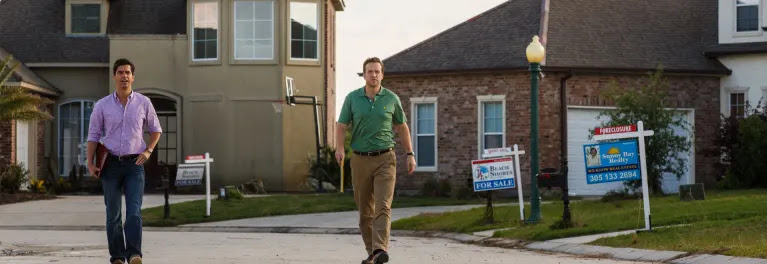
Moses and Collins investigate what’s happening
with the housing market by actually going on the ground per Baum’s
instructions. The images presented make the case for the widening economic
disaster. What they discover in a housing development near Miami are rows of
“for sale” signs, and homes with newspapers piled up outside, showing that the
residents left in a hurry without even canceling their subscriptions so they
could avoid dealing with foreclosures. There is a renter who has been paying
his rent but who doesn’t know he could be evicted soon because the house owner
is defaulting. There is another house with past due notices, and the
inhabitants only took the TV without even cleaning out the cat litter in their
quick getaway. One house that has been abandoned has an alligator in the pool.
Scary and funny, a hard combination to make work, but McKay pulls it off
here.

Baum joins Moses and Collins and they hit the
bricks and see for themselves how over-invested people are in mortgages on
high-priced real estate. They meet two young, smirking, swaggering real estate
mortgage brokers who say that in one year the number of mortgages they granted
went from ten to sixty. One boasts that he was a bartender and now owns a boat.
Ninety percent of the mortgages have adjustable interest rates. They laugh when
they are asked if any loan applications are rejected, saying that would mean
that they weren’t doing their jobs. They call the mortgages “No income, No Job”
loans, since “Corporate doesn’t care” about the viability of the mortgages.
They target immigrants who don’t even understand what they are signing but are
happy to get a home. One broker says that he can make five times as much
signing up a subprime (remember that means “shit”) adjustable rate mortgage on
secondary markets. Aside, Baum says he doesn’t understand why these two guys
are “confessing.” He has a professional ethical standard he follows. Moses and
Collins explain to Baum that the two brokers are really “bragging.” The thrust
here is that making money in the moment is all that matters, and there is no
thought about consequences for the individual home owners or the economy at
large.
The brokers say they sell properties to
strippers. A very funny scene follows with Baum buying time with a stripper who
writhes around him, but all he wants to know is her mortgage situation. She
says that people where she lives have multiple loans on their houses and only
had to put down five percent. Baum tells her that when the “teaser” interest
rate balloons she will be paying 200 to 300 percent more each month. She says
her broker said she could refinance. Baum calls the guy “a liar.” She is
stunned by Baum’s comments, and even worse, admits to owning five houses and a
condominium. She didn’t want to believe the proverbial warning, “If it’s too
good to be true, it probably is.” Baum is convinced that there is a housing
bubble that is ready to burst. He calls Daniel to contact Vennett and buy the
swaps.
Geller and Shipley talk to Rickert, who verifies
that what the men sent him was frighteningly accurate about the housing market.
They want Rickert to get them the ISDA so they can get at the “big boy table”
to trade on a large scale. The disenchanted Rickert says that “It’s a pretty
ugly table, guys.” What we have learned about the unscrupulous dealings going
on, Rickert’s description is spot on. Rickert agrees to help them. (There is a
shot of the paranoid Rickert on an escalator at an airport wearing a N-95 mask,
which is like an eerie prescient image of the current pandemic).
We get several shots of people going about their
daily mundane activities as an overheard quote at a Washington, D.C. bar
appears on the screen: “Truth is like poetry. And most people fucking hate
poetry.” (IMDb notes that McKay wrote the lines). These words tie in nicely
with the opening reference to Mark Twain which stresses the central theme that
people don’t want to know what’s real if it’s not what they want to hear. So,
despite the fact that, as Burry predicted, mortgage delinquencies are soaring,
the subprime bond prices are rising and Moody and Standard and Poor are still
giving the “shit” loans AAA ratings because big finance doesn’t want to
acknowledge the collapse of the house of cards they are living in. In fact,
pressure is applied to sell the swaps as they still (erroneously) appear to be
high risk investments.
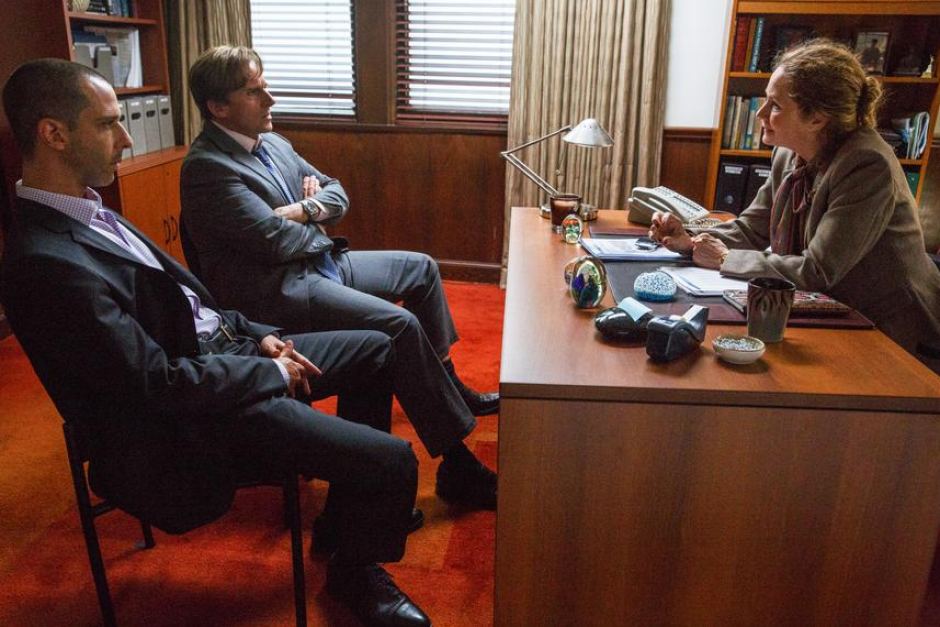
Baum and Daniel confront Georgia Hale (Melissa Leo) of Standard and Poor about still giving high ratings to bonds that make up the risky mortgage packages. Hale, at first, is wearing these large, dark tinted glasses because of an eye condition. Be alerted that anytime eyes and vision are noted in a film, it is a metaphor, usually for characters being morally blind (Chinatown, Bonnie and Clyde, Blade Runner). When Baum asks if the S&P ever gave poor ratings for the bond applications, she says that if they did, companies will go to competitors, like Moody, and pay them fees to get what they want. Greed in the driver’s seat again. Baum and Daniel are outraged. However, Hale questions their motives since she knows that they own substantial swaps and they will profit by the collapse of the mortgage market. She rightly accuses their attacks on her agency’s desire for profits as evidence of Baum’s group’s moral hypocrisy.
Burry’s fund, Baum’s group and Shipley and
Geller have invested heavily in the swaps, and are being told to put up more
collateral to back up their investments because, as Shipley says, the banks
either are “clueless” of the true value of these crappy mortgage instruments or
are covering up their culpability in disastrous investments. It could be they
are both, as Rickert on the phone says that he talked to someone at Bear
Stearns who didn’t know what a CDO was. (In this enigmatic discussion we get
humor, as Rickert says he’s late for his yearly “colonic” which suggests he
needs to flush out the poisonous elements invading him physically and
mentally). Despite the lack of a payoff, Vennett and Shipley say that they
should buy more swaps, which is greeted by dissension from the partners.
Vennett and Rickert tell their partners to go to Las Vegas to attend the
American Securitization Forum. In order to keep Baum’s outfit committed,
Vennett says there will be in attendance “every bond and CDO salesman, subprime
lender and swap trader.” He says if they are betting “against the dumb money”
then they should learn “how dumb that money really is.”


Geller meets with a woman who works for the
Federal Government's Securities and Exchange Commission which is supposed to
police the financial sector and prosecute illegal activity. At a Caesar’s
Palace pool, to emphasize the affluent bubble the deniers live in, she says
that they don’t investigate mortgage bonds, and since there was a budget cut,
“we don’t investigate much.” More being asleep at the wheel going on. She isn’t
even there officially and is actually looking for a job with one of the big
banks. Geller questions the legality of her “working for a financial
institution right after you’ve been working in financial regulation.” She says
there's no law against it, and runs off to network with someone who works for
Goldman Sachs, which shows how vulnerable to exploitation the economic system
is.

Even Burry has doubts about his mathematical
logic paying off. He admits that he may have underestimated how fraudulent the
system had become. At dinner, Shipley says they should “short” AA rated bonds,
knowing that they will go down. Rickert says they can pull it off because the
adoption of that “clueless” attitude that Vennett noted would cause the banks
to go along with the deal because they would see the bond prices going up and
would think Shipley and Geller were suckers. As the two men celebrate what they
think will be a killing in investments, Rickert brings outraged perspective by
saying how many millions will suffer from what is coming because people will
lose jobs, homes, and pensions. Since they like numbers, he tosses out a lethal
statistic that says for every 1 percent unemployment goes up, 40,000 people
die. They are making a fortune by “betting against the American economy,”
which, when one thinks about it, shouldn’t even be allowed, because then one
has a vested interest in failure. So, Rickert says, “just stop fuckin’
dancing.”

To add to the unbelievable selfishness of
investment managers, we have Baum talking to a man named Chau (Byron Mann) who
sells CDOs for Merrill Lynch. He claims to represent the customers and says
that the CDOs he sells are of the highest quality. But, he states that he
personally assumes “no risk for these products.” Basically, no matter what
happens to the people taking out these loans, which they don’t realize they
can’t afford, or those investing in these worthless mortgages, he will get his
fees and not be hurt. In other words, I’ve got mine, who cares about you. Baum
can’t believe his ears as Chau starts talking about CDOs derived from other
CDO’s, some of which are called “synthetic CDOs,” which contain more investing
in bad loans. This stuff is so unbelievable it gets funny just hearing about
how convoluted all of these crazy monetary terms are. From another table,
Vennett adds more humor by saying that Baum’s face looks like it’s boiling like
the villain in Dune.

McKay once more uses a celebrity, Selena Gomez,
along with “the father of behavioral economics,” Dr. Richard Thaler, to help
decode synthetic CEOs. They sit at a card table, appropriately in Vegas,
because all of this investing is speculation and gambling. Gomez has been
winning and is holding a good hand right now. She thinks she can’t lose, and
everyone wants to get in on the action. It is fallacious reasoning, says
Thaler, to think past winnings translate into continuous future success. That’s
what happened with the housing market. Two people now want to make side bets on
Gomez’s future hands. That would be the “first synthetic CDO.” Then another
couple bet on whether the first two people will win or lose, which comprises
the “second synthetic CDO.” And so on, until an original investment mushrooms
into a great deal of money in several pots. However, if the initial investment
is a bad one at the outset, you are talking about a whole lot of losers.

After talking with Chau, Baum feels ill from the unscrupulous machinations that are going on. Chau wants to compare how much he is worth with how much money Baum has, as if that is the only measure to show how worthy one is. Baum tells his team to short all of Chau’s investments, betting against him, and says he will try to find a little redemption playing roulette. Small time gambling seems virtuous in comparison to what he just heard. Baum back home tells his wife that things are so much worse than he ever could have imagined. He feels guilty that the first thing he did concerning his brother when he was depressed was to offer him money, which probably he realizes was like rubbing salt into a psychological wound.

Burry bangs out his frustration and anger at how
broken the system has become on his drums. He has special prerogatives in his
authority over his fund, and takes the extraordinary and daring move of writing
to his investors preventing them from withdrawing their money. If he is wrong
about his projection, many would suffer financially.
We get another quote, this time from the novel IQ84
by Haruki Murakami: “Everyone, deep in their hearts, is waiting for the end of
the world to come.” If one is honest, the film suggests, all of us have
apocalyptic thoughts. If not, why are there so many books and films on the
subject? Here it is the economic “Dark Ages” coming, as Shipley puts it. The
financial news broadcasts how the housing market is crashing and lenders are
going bankrupt. In order not to deal with the situation, the large investment
banks fake power outages or computer problems so they will not have to deal
with Burry’s claims. Shipley and Geller realize that the banks are trying to
dump their lousy CDOs on unsuspecting buyers as they try to recoup some money
before the prices on those investments tumble. Shipley calls his mother to warn
her about the coming crash, and the two want to warn everyone by way of the
press. But their contact at the Wall Street Journal won’t touch the
story because he doesn’t want to burn the bridges he built with investment
banks based on what he calls Shipley and Geller’s “hunch.” The problem about a
“Big Lie” is that if voiced loud enough and by those in authority, it tends to
become believed.
Baum’s group now learns that the swaps that
nobody thought were worth anything are now the hot item to purchase. Baum finds
out from Kathy (Adepero Oduye) who works for his umbrella company, Morgan
Stanley, that the company sold a ton of swaps which means Morgan Stanley owes a
tremendous amount of money on these bets that mortgages would fail. So, Baum
realizes he was betting against Morgan Stanley which means he was betting
against himself. Because Morgan Stanley is $15 billion in the hole, all of
Baum’s company’s “accounts go on their balance sheet,” according to Daniel. The
point here is if you bet against the whole economy, one gets sucked into the
black hole that results. Baum says he doesn’t want to sell the swaps yet
because he wants to see the banks “bleed” before selling them life rafts. But
he is putting his own company at risk if he waits too long and Morgan Stanley
goes bankrupt.
Shipley and Geller are in a similar predicament
since they bought 80 percent of their swaps from the tanking Bear Stearns.
Unlike Burry, who protected himself in case the banks went out of business,
these two are at risk. They need Rickert’s help to unload their investments.
There is more humor as Rickert is in a pub in England that he says smells like
“sheep” with hardly any wi-fi service and is trying to sell 200 million dollars
in securities on his laptop. The customer in the bar says Rickert is either a
drug dealer or a banker, and he has more respect for the former, which we can
understand, given what’s happening. Rickert is able to net them 80 million just
in time before the economies of many countries froze assets and were on the
brink of failure, so expansive is the economic meltdown.
Vennett, addressing the audience, holds a bonus
check for $40 million dollars. He says he never said he “was the hero of this
story.” He was the narrator because, besides tying the plot together, he is the
right selfish person to show how there are no heroes here. Mark Baum is the
only “Big Short” (thus the film’s title) who delayed selling. (As IMDb points
out there is also a visual pun in the film as there is a large billboard shown
with comedian Martin Short’s face - thus a “big Short). Baum speaks at a
financial summit meeting and says people in America reside in a world of “fraud
in banking, government, education, religion, food, even baseball.” He says this
time deception flourished, and he thought we were better than that to let it
happen. And, “average people will have to pay for all of this,” since they
always do, he says. The eventual bailout of the banks proved him to be right.
Even as he speaks, the false optimism previously voiced by a Bear Stearns
executive rings false as the stock of the company drops 38 percent in the short
time they spoke. Everyone starts to bail out of the auditorium, most likely to
try to salvage what’s left of their wealth.

Investment giant Lehman Brothers’ stock went to
zero and was not rescued by the government. People who lost their jobs there
leave in droves. Shipley and Geller walk through the decimated headquarters of
the institution, stressing the catastrophic results of greed and the denial of
truth. Burry says that his work wasn’t what he expected. He narrates, “This
business kills the part of life that is essential.” As we see those strutting
Florida real estate brokers now looking for jobs, Burry says that unfortunately
people don’t choose who to listen to based on facts, but upon what “seems
authoritative and familiar.” In other words, it’s easier and more comforting to
listen to the well-known person with the big microphone who is in power than to
question what is being said.
After Burry’s fund gained 48 percent, with a
profit of $2.69 billion, he closed it down and retired. The bailout is coming,
and Daniel believes that as part of that action the government will have to
break up the banks and send people to jail. Baum says no, the banks always knew
they would get rescued and in the end they’ll find a way just to blame
immigrants and poor people for our economic problems, implying that those
marginal groups will be portrayed as the leeches that drained the economy
because they couldn’t pay their mortgages.

McKay has Vennett be satiric as he says hundreds
went to jail, the SEC was overhauled, and Congress broke up the big banks and
regulated the mortgage industry. He follows that with, “Just kidding.” With the
bailout, Vennett says, the banks took the money, paid themselves bonuses, and
lobbied against any major reforms. “And then then they blamed immigrants and
poor people,” he adds. As it turns out only one guy went to jail. Baum finally
sells the firm’s assets, but he felt like he was one of the bad guys. Daniel
says they were kicking the real bad guys in the teeth for selling people out of
the American Dream. But, Baum’s group contributed to the depletion of funds
that added to many employees losing their jobs and possessions.
The notes at the end of the movie sum up the
economic fallout: five trillion dollars was lost in real estate values, pension
funds, 401k accounts, and bonds; eight million people lost jobs; six million
lost their homes. Burry contacted the government several times to show how he
predicted the collapse, most likely to prevent another one. Nobody responded to
him, again emphasizing the desire not to want to hear the truth, no matter how
disturbing it is. And, to show how pointing out flaws in the system is a threat
to that mindset, Burry was audited four times. At the time the film was made,
banks were selling a new form of CDO.
The thrust of this movie is that every human
system is subject to corruption, and to protect the powerless, there must be
vigilant policing to protect a country’s citizenry.
The next film is Picnic.


