Sunday, March 7, 2021

The Slender Thread

 SPOILER ALERT! The plot will be discussed.


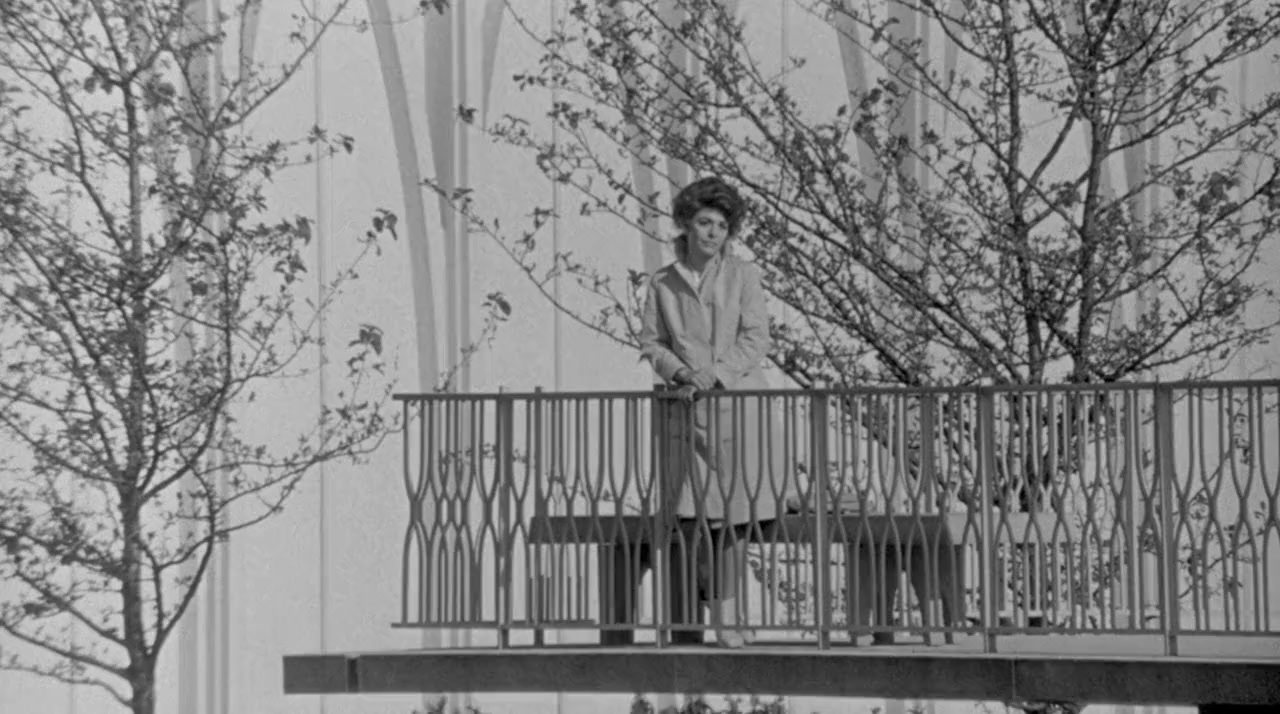
The Slender Thread (1965) is future Oscar winner Sydney Pollack’s motion picture directorial debut. The screenwriter is Stirling Silliphant, who will go on to write the Oscar winning In The Heat of the Night. The movie’s establishing shot is an aerial view of Seattle (the Space Needle tells us the city). The camera moves from the general to the specific by zeroing in on one individual, Inga Dyson (Anne Bancroft). (Does her last name sound like “die soon”?). The implication is that there are many stories in the city, and here is one of them. The music changes from soothing sounds to jazz-like instrumentals that sound somewhat discordant, which fits the sad look on Inga’s face as she stands alone next to an outside fountain. The soaring water and the rising elevator on the Space Needle contrast with Inga’s depressed mood.


The camera pulls back to its original height and the placid music returns until the shot pulls in on Alan Newell (Sidney Poitier). (His last name could suggest that he will try to help someone break away from old feelings and make her a “new” person who feels “well” again). He is a psychology student who is leaving classes at a university. The music switches back to jazz as Alan walks past protestors with pickets announcing a union debate. It appears that the film is saying that things may appear fine from a distance but when we look closely, we see that problems exist. He drives in his car away from the campus to his volunteer telephone position at a “crisis clinic” that has a suicide hotline.


The camera pulls away once more to introduce another character, Mark Dyson (Steven Hill), who is at the city’s pier. He hands over some documents to a harbor official and we see in his wallet a photo of Inga, which portrays her smiling broadly, a sharp contrast to the woman we have just seen. Mark is her husband and a commercial fisherman. 

 Inga is driving erratically on the same road as Alan, which is an indication of how their separate paths will merge that evening. Inga’s car has a plastic flower attached to its radio antenna. Could it be that with this image of the flower coupled with the reckless driving we have something hopeful that encourages one to hang onto the “slender thread” of life and works to fend off the impulse to seek oblivion? The happy feeling the flower suggests contrasts with the desperate look on Inga’s face. 


 At the clinic Alan encounters Dr. Joe Coburn (Telly Savalas), who wants to leave to have some time with his child (his desire to be with his family will contrast with Inga’s estrangement from hers). Alan juggles several books and is hoping for a quiet night so he can study for his finals which take place the next day. No such luck. Even secretary Marian (Indus Arthur) leaves after she finishes preparing coffee for Alan. Marian tells him that it has been a silent night. But Alan can’t settle in as a drunk barber calls who is just using the clinic to complain. Then Alan receives a call from Inga who says she needs to talk to someone. Alan can tell immediately by the somber sound of her voice that she requires his attention. He tries to get information from her as he puts her voice on a loudspeaker system so he can perform other actions when he isn’t using the handset. She does indicate that she is a “Mrs.” not a “Miss,” is thirty years old, and mentions Mark’s name. He tries to gently coax information out of her, and Inga says he seems adept at handling “disturbed” people. She says she can make that disturbed state go away with the right amount of “pills.” He is concerned now and asks if she is thinking of taking “barbiturates.” She says she isn’t thinking of taking them. He seems relieved at that remark, but she says she has already swallowed them. The story now introduces a ticking clock which builds suspense as we become invested in the race to save Inga. 


Alan has Dr. Coburn’s phone number in case of an emergency, but Inga is saying “Goodbye” so he must act on his own. Alan says he needs to talk to her, just like she called because she needed to talk to someone, so he asks if they can deal with those needs together. He admits he is just a student volunteer, which lets her know that he is not a jaded shrink who uses standard psychiatric techniques, and that he actually wants to connect with her. After being frank, he pretends to need a cup of coffee, and goes to another line to trace the call. He tells the telephone operator to contact Dr. Coburn for him so he can stay on the line with Inga. He gives the phone company authorization to locate Inga (this is 1965, so finding the location of someone on the line is time-consuming given the existing technology. The behind-the-scenes look at the telephone machinery here is repeated in Pollack’s excellent Three Days of the Condor). 


Alan is again truthful when he says he really doesn’t know how to handle the situation despite training to develop a “rapport” with the caller. He has made a rudimentary sketch of her so he can better relate to Inga in a more concrete way. She admits he has a nice voice but is still ready to hang up. He pleads with her to stay on the line and asks why she wanted to end things that day. Instead of just talk, Pollack dramatizes her words. She says it wasn’t anything significant that happened. She was going to work that morning, carrying flowers (that symbol of hope), and she was smiling as she left the elevator at her office where she is employed. She puts the flowers on a tray with coffee for her boss, but he calls her and says he is extending his skiing vacation. It’s a disappointment, and she seeks to have lunch with a colleague, Jinny (Kay Doubleday), who adds to the negativity by saying she is supposed to meet someone else. 


Alan’s frustration is mirrored in his pacing around the room like a caged animal. He is incredulous that the circumstances she recalled would cause her to want to kill herself. Inga says it was just that she was trying to keep busy so she wouldn’t have to “think,” which means she was already precariously troubled. She questions how he knows her name, but she did tell him during her narration of what occurred earlier in the day. Nevertheless, she is suspicious that he is trying to trace where she is. He lies when he says he doesn’t know anything about tracing. He is dishonest at the same time he is asking for trust because he instinctively thinks the deception is for the greater good of trying to help this person. He asks when she took the pills, most likely to ascertain how much time she has left. She wonders why he cares. After all, she is just the disembodied voice of a stranger. Alan again is honest as he admits he doesn’t know why, just like she can’t state the exact cause of why she chose that day to end her life. Finding the cause of each effect is not an easy task.


The phone company finds the call is coming from a spot close to the airport, but they need to send a person there to verify the trace. An operator calls Alan and gives him the above information, along with the fact that Dr. Coburn’s phone is busy. Alan tells the operator that they should have a police car go to Coburn’s house. Alan is in the stressful position of jumping back and forth between phone connections to get help and still keep Inga on the line. She is suspicious why he was so short with the other caller, and he again alternates between truth and lies. He makes her laugh and says she would like to have met him under other circumstances. He asks that she tell him where she is so they can become acquainted, but the only response he gets is resigned silence. He tells her how much it upsets him that she should die, but she says she is not afraid and feels “wonderful,” her voice almost sounding elated due to being liberated from her worries.


 He presses her for more context as to why she has made this choice. As she tells her story we again get a dramatization which shows Inga going home and seeing her twelve-year-old son, Chris (Greg Jarvis), outside. When Inga goes inside the house her husband looks dejected and is angry because an inheritance check was sent to Chris from his dead “father.” We realize Inga was involved with another man and Chris isn’t Mark’s son. Inga is stunned that this secret was revealed. She says she was seeing another man just before marrying Mark, and pretended that the child was his but was born premature. (Inga is worried about Alan being truthful with her because she knows from her own actions how deceitful people can be). Mark is furious and, before he storms out of the house, says that a person is owed the truth. Yet we see that in this movie that sometimes total honesty may hurt others.


Inga, probably feeling as if she has lost her family, walks to the edge of the beach and heads into the water, trying to drown herself. But, a young couple who are making out see her and prevent her death. Inga is then hospitalized and medicated. When Mark visits her, she is sarcastic when he says he went to church and she asks if he informed the “congregation” about her suicide attempt. She wonders if she should apologize for “not dying.” When he starts to go, she drops the attitude and asks him to stay. She says they could start to make things right by him bringing her flowers. They are again a symbol of life and hope for her here. She says in time Mark can forget about the paternity problem since nobody has to know, not even Chris. She is employing here what Alan does which is to tell a falsehood for the general good. But the religious Mark wonders what rules she lives by. He says to her, “Do you think that not getting caught in a lie is the same as telling the truth?” (The same line is delivered by the moral character played by Robert Redford in Three Days of the Condor). For Mark, it’s a matter of personal ethics, not just how things appear. 


Inga cries after telling that segment of her story, and it sounds as if she drops the phone. That sound energizes Alan as he calls out to Inga because he probably thinks she passed out due to the medications. She hasn’t, but was just reaching for tissue. She says it’s not “natural” that he’s “so kind.” That is a viewpoint of someone who has become very cynical about humanity. He again is forthright with her, saying he’s not kind and that he sits by the phone at the clinic because it’s part of the curriculum. She laughs about how he can use what’s happening to write about the “crazy” lady who killed herself. It’s gallows humor she is employing, which is the default type of joking when there is no hope in sight.


 Dr. Coburn arrives, but doesn’t want his presence revealed since it would interrupt the trust that Alan is developing with Inga. He says that if he starts talking to Inga she will hang up. So, in a way, his pretending not to be present is also a deception. Coburn says Inga’s “capacity” for dying is greater than their ability at the moment to keep her alive, and Alan has been able to have her hold on up to this point. Coburn tries to gather information on another line while he listens to what Inga is saying on the loudspeaker. She has put on the TV and there is a laugh track heard. Inga wonders about the lack of sincerity in getting paid to laugh, which brings up the problem about honesty again. (The prompting to have a person laugh on command comes up later). She says the laughter of a person can live on after the individual dies because he or she was recorded. It’s as if she is searching for some type of life after death, or she may be being sarcastic about how the expressed joy is tarnished since the employed laugher eventually dies. 


The phone company and police department investigations continue. Based on the information Coburn provided, Sergeant Harry Ward (Paul Newlan) calls the clinic to inform them of Inga’s last name. Also, Detective Judd Ridley (Ed Asner) volunteers to search for Inga based on facts relating to her identity and where they have traced the call thus far. There is a medical technician (Jason Wingreen) who has arrived at the clinic to monitor Inga on the phone connection, and Marian returns to help out. They hear an airplane that is either landing or taking off on the speaker, which tells them Inga is near an airport, which seems fitting since she wants to escape from her life.


 Inga sounds sleepy as she says she can’t visualize her own death. She tells Alan that she feels numb and it's dark. These are physical observations, but they can also reflect her mental state. Alan gets loud, telling her time is running out and that she can’t think her decision is the right choice for her. She tells him not to deliver a sermon, because that was what Mark made her listen to. There is a flashback to when Mark took her to church, and during the mass she says it seemed like she was a child being spanked, which suggests that she felt as if her husband was belittling her. She says her family looked like a “picture of togetherness,” but the surface appearance was deceiving. The priest’s sermon talks about one being “shipwrecked” if there is no “pilot,” which means one's moral compass must rely on God to set the direction. Mark looks pensive as he hears these words and exchanges glances with Chris. Mark is probably thinking about what he should do concerning his wife’s secret and the knowledge that he is not the true father. The mass ends but Inga remains in the pew alone, which shows her isolation from her family. Mark approaches her and she asks why he brought her there. He says it’s a place of “faith” which he hoped would help them both. She obviously is not a churchgoer and he is, but neither have received the help that he hoped for. He can’t forgive her, even though that is what his faith preaches, and she can’t forgive herself, as she says she feels “evil,” an attitude Mark has fostered. With that belief, is it a wonder that she became suicidal? As he leaves the church, Chris tries to give him a departing hug, but Mark is not warm toward the boy he raised but does not see as his own. Mark goes off to his job as a fisherman (St. Peter was a fisherman who initially turned away from Jesus after the crucifixion), leaving Inga with her primal doubts about her worth as a person.


Back in the present, the medical technician says Inga’s breathing is decreasing and he gives her thirty minutes to live, which increases the tension in the story. Inga is philosophical now, as she wonders if there is an afterlife, which in this context means she is looking for justification for ending her present life. Alan is frustrated and his anger comes out as he berates her for giving up because she made a mistake like so many others do. She is upset with his preaching, and Dr. Coburn warns Alan that he will lose her if he continues “moralizing.” Even though he put his hand over the phone, Inga thinks she heard another voice, and he must lie again to reassure her that it is just the two of them. She shows her dark humor by saying they just had their “first fight,” making them sound like a couple under these morbid circumstances.


The police know where Inga lives and they go to her house but find she asked someone to stay the night with Chris while her husband is away fishing and she may be driving to Portland, Oregon. Mark’s boat is called The Provider, which fits in with the traditional role of the man being the primary earner in the family. But, it also ironically shows that he hasn’t been an emotional “provider” for his wife, who subsequently seems to be psychologically out to sea. 


Alan is sweating now as Inga’s respirations are almost half of what they should be. He says she is making the situation like a game, but her winning the smaller contest will mean she will lose the bigger one involving her life. He isn’t getting anywhere with her as she says he must be tired of repeating the same argument. She just wants him to be “sweet,” but he says he can’t give up, because he now has come to care about her. She has given up on others while he will not give up on her, which suggests that type of caring may be the reason that makes life worth living. She asks if he would have forgiven her for her past mistake, and says when Mark came back from his fishing run he “almost” forgave her. We have another enactment, as Inga waits for Mark’s boat at the pier. She bought a “soft” dress, (to fight his hardness?) which is white (to suggest the innocence of a bride?). They try to joke, but it seems forced. He suggests going with fellow fisherman Charlie (Dabney Coleman) and his wife, Edna (Janet Dudley), to a club, where there is rock music and wild dancing. The people there are full of life (the opposite of Inga’s present state) as they gyrate along to what the band plays. Inga is enjoying herself, but feels as if she can’t go on the dance floor, probably for feeling she doesn’t deserve to have fun, even though Charlie and Edna join in, and Mark suggests the two of them dance also. His doubts about Inga show on his face again. There is a daydream on Inga’s part as she sees herself and Mark in silhouette as they appear to be ready to make love. She is caught between what she hopes for and what is.


Back home, Mark hesitates before entering the house, not sure if he is ready to go in. The two wordlessly go to the bedroom. He changes into his pajamas and robe in the bathroom, and she has bought a nightgown for this night. She turns to him to unzip her dress, but he doesn’t react sexually to her. As she goes into the bathroom to change, he sits on the bed, looking tense, unsure as to what he should do concerning his resentful feelings toward Inga. He gets into bed with his hands behind his head, implying he will be keeping them off of her. Her face as she leaves the bathroom goes from hopeful to disappointed. After she is in bed, he says, “I’m sorry,” and turns away, so she is left with his quiet condemnation of her.


We are back in the present, and Inga is fading as she says her legs feel like “anchors,” she can’t wiggle her toes, and she slurs her words. She tells a joke, but there is a hopeless slant to it. Alan doesn’t laugh, and she says she wants to hear his laugh. She seems to want to have a fun, positive moment with someone who is a stranger but with whom she has made a meaningful connection in life just before her death. He is put into the position of those paid to laugh for soundtracks. At first he can’t, but then becomes hysterical, as if letting out all his frustration at the absurdity of the situation. The others in the room start to quietly chuckle, as we know laughter can be contagious. But because it goes on, Inga’s stern voice orders Alan to stop, perhaps because she feels as if her situation is being ridiculed, or that the extreme response contrasts too sharply with the fact that this conversation may be her last. 


 Detective Ridley finds Inga’s car and Art Foss (Steven Marlo), a telephone company employee, arrives at the station on the city's outskirts to verify the trace. Inga says Alan will be a “celebrity” on campus the next day for trying to talk down a “stupid” person. Inga’s words continue to mirror her husband’s and her own view of her worthlessness. Alan personalizes their link by saying he doesn’t have many “friends,” thus admitting he feels she is now one of them. He goes on to tell her that she will have no legacy, because there will not be any “history,” or “love” or “beauty” connected to her life, and her story will not be heard. Even though it isn’t explicit, his being an African American connects her to him because he expresses that he knows what it’s like to be marginalized. He calls her a “good” person, and says the world needs more of those. He offers her how he still celebrates the smallest aspects of life and wants her to join him in that perspective, which suggests she could then hold onto that “slender thread” of life.


 She relates that earlier in the day she was on the beach and children showed her a dying bird. The flashback shows her going to the liquor store to get some brandy and is honest with the shopkeeper that it is for a bird, hoping that her humanitarian act will be appreciated. But she is greeted with sarcasm by the shopkeeper, and she becomes angry as she leaves saying to him that he doesn’t seem to care “if something dies.” She wishes Alan had been there because he obviously does care about keeping an imperiled creature alive. She returns to the beach but she finds the children gone, and they made a small grave for the now deceased bird. They placed a flower on it, another appearance of that object. Is it meant to show sympathy for the dead, or is it also an ironic symbol of lost hope, given the use of flowers in this story? She pours the brandy over the marker, and then stomps on the grave, showing the futility of trying to make a difference by doing a good deed. She goes to the pier to be with her son and sees Chris sailing a model version of Mark’s boat, with the “Provider” name on it. He hands the model to her because he is going to play a baseball game, abandoning her to her loneliness. The boat probably reminds Inga of how Mark thought of Chris as his son, and now that her secret has been discovered, that bond has been weakened. 


We then return to the opening shot of the film. Inga tells Alan that there were coins in the water fountain that stood for all the people who made wishes on them. She most likely sees those hopes dashed. She says she had no place to go and even tried to get arrested by driving erratically to gain some kind of attention, but nobody noticed her. That includes Alan, who was on the road at the same time, so he was an unknowing accomplice to her desire to end it all. She kept looking for help as she went to the hospital where she was treated for her suicide attempt, but the doctor who treated her no longer worked there. The nurse offers to have the on-call resident, Dr. Morris (H. M. Wynant), see her as she is desperate to grab onto a mental lifesaver. (Flowers are again seen in the background, suggesting the reaching out for hope). When he arrives he says he can’t treat her unless she commits herself. She says she just needs somebody to talk to immediately, but instead finds herself placed on bureaucratic hold. It is ironic that the only way she does get somebody to listen is by the extreme act of attempting suicide. 


There is a scene that shows her emptying pills on a bed in a motel room as she tells Alan she wondered how she could swallow all of them, but she did. She writes a note to Mark saying she hates him, but then tears it up, probably feeling guilty about her anger at his lack of forgiveness. She sees the phone number for the newly opened crisis clinic in a news story and that is how she came to talk with Alan.


In the present, Alan yells at her that his love for her as a human being isn’t enough to pull her back to the living. He says she has to act to save herself and threatens to hang up the phone. Before he does, she begs that he not leave her. At the same time, the police establish the motel where Inga is staying. Mark is notified and he gets a ride on a helicopter to the shore. Detective Ridley heads to the motel address. The information is sent to the clinic, and Alan is overjoyed as he tells Inga he loves her, and she returns the sentiment. He is thrilled, but Dr. Coburn deflates his hopes (a lot of that is happening in this film) when he says that Inga is not registered in her name, is not using the motel telephone operator, and there are two hundred rooms to search. 


There is a party in the lobby of the motel and the jubilant people contrast with the life and death search going on. Inga is not staying as a single guest because the authorities checked out all of those rooms. Inga registered as a couple, maybe not wanting to lose her husband, even in death. She is about to pass out, but she does tell Alan that she is not on the ground floor. As that “slender thread” is about to be severed, she finally asks for help in an attempt to hang on. She falls out of the bed with the phone off of the hook, and passes out. Mark arrives at the clinic, takes the phone and calls out to Inga. They hear the police break down the door to the room and they tell Alan and the others that Inga is still breathing. The line goes dead, but luckily Inga is not. Alan can finally hang up. Mark smiles in relief and tells them he will let them know how Inga is doing when he gets to the county hospital. It appears that he is committed at this point to being there for his wife. 


 Alan says he feels good and beats his chest in triumph. Coburn says he’s going to the hospital to follow-up on Inga, and says he knows Alan will be fine by himself, acknowledging his confidence in the student-volunteer. He asks Alan if he wants to see Inga. He thinks about it for a moment, smiles, and says “no.” He did his job to keep that slender umbilical thread intact in the moment of crisis. It is now time for others to help her strengthen that connection to her life.


The next film is A Few Good Men.

Tuesday, March 2, 2021

Reservoir Dogs

 SPOILER ALERT! The plot will be discussed.


A major theme in Reservoir Dogs (1992) revolves around trust (and its betrayal), loyalty, selfishness, and whether humane behavior can exist, even among criminals. (The title of the film, suggested by IMDb, may come from someone misunderstanding the title of Louis Malle’s Au Revoir les Enfants. Or, it could be a term for unsolicited scripts).


 Before the credits, there is an extended opening scene where there are several men around a dinner table at a restaurant talking about Madonna’s song, “Like a Virgin.” Many of them wear jackets and ties, as if they are at a business meal. We don’t realize until afterwards that this social gathering conceals the fact that they are part of a planned robbery. Director and screenwriter Quentin Tarantino’s first film sets a style that he repeats in his later works by having people in extreme situations carrying on extraneous conversations. He said in an interview that he takes stereotypical genre characters and rounds them out by having them talk like real people about subjects other than the plot. What he adds is a comic flair to the dialogue, and he said, “Outrageous stuff rings the most true,” and dark stuff can be funny.  His writing ranges from the crude to the philosophical. We start out with the former here as Mr. Brown (Tarantino) sees the song as purely sexual while another man, Mr. Blonde (Michael Madsen) says it’s about a woman who has been misused by men in the past. (The use of colors to keep identities anonymous in a criminal act was employed earlier in The Taking of Pelham, 1,2,3.) Joe Cabot (Lawrence Tierney), the person organizing the heist, says he prefers Madonna’s earlier work. Through this process, Tarantino creates distinct characters by what they say and do.


The camera rotates around the table to show all the participants and keeps the angle at chair level, making the audience feel as if they are part of the gang. Mr. White (Harvey Keitel) is annoyed by Joe’s droning on about an old address book and grabs it away from him. Joe is quickly portrayed as the elderly, stubborn guy who wants things to go his way. As he later says, it’s “my way or the highway.” Joe shows he’s ticked off by telling Mr. Blonde to shoot White. Blonde jokingly makes his hand look like a gun and pretends to shoot White. White shows his tough comic sense when he says, “You shoot me in a dream, you better wake up and apologize.” Blonde’s sensitive take on the Madonna song and his humor here hides the evil that we see in the man later in the story. His blonde name denotes something attractive, but here its use is ironic. “Nice Guy” Eddie (Chris Penn), who is Joe's son and is not nice at all, talks about hearing golden oldies on a radio program, K-Billy’s Super Sounds of the ’70’s. (Tarantino is already thinking about making his Kill Bill movies which he hints at with the program name. In fact, Blonde’s real name is Vic Vega, and Tarantino was going to make a prequel to this film and Pulp Fiction, about the Vega brothers with Madsen and John Travolta. Tarantino thinks like a novelist who writes sprawling sagas). 

 Joe says he’ll pick up the tab but the rest should leave the tip, which is only a dollar each. Mr. Pink (Steve Buscemi) says he doesn’t believe in tips because he shouldn’t be forced by society to automatically leave extra money unless extra effort is shown. Joe makes him throw in the tip because he paid for the meal, showing his need for control over the actions of others. Pink’s stinginess points to his selfish actions later and his aversion to cooperate with rules in general. Eddie criticizes Pink’s attitude by using a Jewish racial stereotype. (Tarantino has been attacked for using the “n” word often as well as other racial slurs, and his inclusion of prolific profanity. Indeed, if one is sensitive to this usage, Tarantino is not the filmmaker for you. Those who defend his content argue that it is a realistic depiction of the characters in the stories). White doesn’t go along with the good-natured teasing of Pink, and he is seriously critical of Pink’s lack of empathy for the poorly paid waitresses. Could he be named White because out of this bunch of criminals he has a code of ethics he wants to cling to? It is interesting that Mr. Orange (Tim Roth) has his arm resting on White’s chair, and attentively listens to what the man says. This fact points to the closeness of the relationship the two later share, and the hidden truth that threatens their bond. 

 Tarantino’s narratives are not linear. His jumbled timelines are infuriating for some, but he relies on the audience’s mental ability to figure out what is happening. Also, the out-of-sequence form of storytelling generates interest as one must actively participate in fitting the pieces of the tale together. So, right after the credits we have Orange in the back of a car writhing in agony after being shot. There is blood smeared on the seat while a supportive White tries to offer hope. He holds Orange’s hand, which literally and figuratively shows the connection between the two. Even though the scene is emotionally fraught, White is still able to be funny as he tells the pessimistic Orange that he didn’t know the wounded man had a medical degree, so how does he know he is going to die? 


 They go back to the “rendezvous point,” which is an abandoned warehouse. White holds Orange like a nurturing parent and assures him that Joe will get the man a doctor. Orange wants to be held and despite the macho posturing the men displayed earlier, White is compassionate enough to show some tenderness and complies with the request. White even whispers something that makes the bleeding Orange laugh. White takes a comb and runs it through Orange’s hair, which is both sweet and ridiculous given the bloody circumstances. Despite caring about Orange he says he can’t drop the man at the hospital. Orange pleads to be left outside of the medical facility and swears that he will not divulge any information. Loyalty and trust are at issue here, but the irony is that Orange is really an undercover cop. So, he is lying and will probably betray the man who is showing concern for him. White wants to avoid the authorities getting involved and assures Orange that being shot in the gut is very painful but it takes a long time to die from that type of wound. 

Pink shows up and believes they were set up since the police secretly appeared in force to upset their plans. (The robbery isn’t shown since the emphasis is on the characters, not the plot to steal from a jeweler). White says the police killed Brown. White and Pink go into the adjoining bathroom and try to recreate what happened. But just like Akira Kurosawa’s Rashomon, there are differing accounts of the same crime based on subjective impressions and motivations. When Pink asks if he killed anybody, White says just cops, whom Pink classifies as “no real people.” Pink’s callousness comes through here as he sees the police as allowable targets since they are paid to stop men like him, and he dehumanizes them to justify them as targets. White says the police showed up when the alarm was tripped. Pink says the cops didn’t let their presence be known until Blonde started shooting. We have here evidence of Blonde’s lethal capacity. White asks, perhaps suspiciously, how Pink was able to escape. The idea of mistrust was planted and starts to grow. Pink says he blasted his way out, and there is a short recreation of Pink running at full speed near people on a sidewalk with the bag of diamonds in his hand and cops chasing him. He shoots some of the officers as he drags a woman out of her car and uses the vehicle to escape. This successful carjacking contrasts with the disastrous one that is dramatized later. Tarantino does not have long action sequences here. He instead expends time on interactions between characters. 


Both men agree that Blonde acted like a maniac, shooting everywhere, not just for protection. (IMDb notes that there is a small yellow sink next to White, which suggests Blonde is still alive, but it may just indicate that he is the subject of their discussion). White is upset, showing his emotional side, when he notes that Blonde killed a young black girl, supposedly an innocent bystander. He goes on to call Blonde a psychopath, which is unexpected considering how easygoing Blonde was at the restaurant. The two men make the distinction between the indiscriminate way Blonde acted and the need for necessary professional violence. They feel that criminal actions must be proportional, which seems a rationalization since once entering a potentially dangerous situation there is the strong possibility for lethal outcomes. White now washes up and combs his own hair, implying that he is trying to pull himself together as he did with Orange. They wonder what happened to Blonde and Mr. Blue (Eddie Bunker), and White is thinking about what happened to the diamonds, which again displays suspicion about his comrades. But Pink is honest here and reveals that he has the diamonds. However, he suggests that he and White take the diamonds since the deal about sharing is “null and void” once there is a “rat” involved as they can’t trust anyone now. Even though he was once betrayed by an undercover cop in a robbery, White sticks to the idea that there should be honor among thieves and rejects Pink’s cynical feelings about everybody. When Pink considers that Orange is the informant, it is ironic that the uninformed White comes to the bleeding man’s defense. Pink says about being a snitch, “I can say I definitely didn’t do it because I know what I did or didn’t do. But I cannot definitely say that about anybody else ‘cause I don’t definitely know.” Loyalty and the trust on which it is based, along with a sense of certainty, melt away once the threat to the individual is present, and then one retreats to the fortress of the self.

 There is a brief flashback entitled “Mr. White,” where Joe informs White of the details of the robbery which is high risk because it is during the day when there are many people around. White knew someone who could fence the stolen gems, but he is now serving twenty years because of “bad luck.” The assumption is that no matter how well planned a heist is, something can go wrong. When it comes to illegal actions individuals are fighting against the rules of society, which is a formidable obstacle. 


Back at the warehouse, White confirms that the unconscious Orange is still alive. White says that Joe could get Orange to a doctor, but the dubious Pink isn’t sure they can trust Joe since he hasn’t shown up yet. That feeling of betrayal is now a constant presence. White admits that Orange was shot because of him, and he is feeling guilty. He tells Pink that the wounded man begged to go to a hospital. Pink is ready to go along with dropping Orange off for medical attention until he learns that White revealed his first name (Larry) and where he is from to Orange. That human connection interferes with antisocial unlawful activity. Because White has a criminal record, Pink says that the cops could narrow down what suspects to show Orange, who could identify him. Pink’s attitude is survival is the number one priority which leaves little room for helping another. He echoes White’s statement earlier which is that some people are “lucky” and some aren’t, which relinquishes the individual from responsibility as to outcomes. White is not willing to accept that attitude now because he feels responsible for the wounded man, and reacts by attacking Pink for the same callousness he himself showed earlier. In effect, he has projected the anger he feels for himself onto Pink. The two pull guns on each other and Pink is logical in his self-preservation argument, as opposed to White’s emotional response, as he tells White once Orange compromises White, then that is one step closer to Pink being caught.


Blonde appears during this confrontation, and he is as cold as the ice in his drink that he had the composure to buy during this episode that would rattle the average human. He echoes Joe’s assessment of the juvenile way that the other two men are acting when he says, “You kids shouldn’t play so rough. Somebody’s gonna start cryin.’” Pink and White have the smell of a rat lodged in their nostrils and demand to know what happened to Blonde and Blue. Blonde’s response to their suggestion about getting out of the possibly compromised warehouse is to order that nobody is leaving. He talked to Eddie who said to stay put and he was coming to the rendezvous point. Blonde is dedicated to Joe and Eddie, so even a psychopath can show allegiance. Blonde’s scary calm contrasts with White’s ranting about Blonde’s bloodbath at the jewelry store. Blonde is quietly menacing when he says to White, “Are you going to bark all day, little doggie, or are you going to bite.” Pink stops them from fighting and says he absolutely knows that Blonde is not an undercover guy for the police because he’s too “homicidal to be workin’ with the cops.” When on the other side of the law, extreme violence strangely reassures loyalty. Blonde laughs and says that his heart was beating fast as if he enjoyed getting excited about a confrontation with White, and attributes their behavior to being fans of actor Lee Marvin. Is Tarantino revealing the influence of another actor’s roles on his movie, or maybe he is also stressing that these are actors pretending to be violent as did other performers before them. 


Blonde has a surprise for Pink and White in the trunk of his car which turns out to be a police officer named Nash (Kirk Baltz) who he grabbed to shield his escape. We get a shot outward from inside the storage area of the vehicle which puts us in the position of being a captive in the director's movie, just like the cop Blonde has captured. The men laugh at the “not real” person that has been caught like a hunted animal. They seem to relish in defeating the representative of law and order. Blonde says that they can interrogate the policeman to get information about the “rat.”

 The next flashback is labeled “Mr. Blonde.” Joe is in his office and there are elephant tusks on either side of his desk. The image suggests primal masculinity that promotes dominance through force over other living creatures. On the phone he makes a reference to J. P. Morgan about overcoming adversity, which associates survival of the fittest in the animal world with what happens in big business. He is told that Vic Vega has arrived, who we do not see at first, and when Joe tells his associate to have Vic come in, the employee looks over his shoulder and says to the camera, “Come on in.” It is Tarantino inviting the audience into this world he has created, and identifies us as possible criminals, a Hitchcockian technique. Vic has just been released from prison and is very grateful for the packages Joe sent him while inside. Joe is grateful that Vic took the conviction connected to a previous job and never implicated Joe. This fact shows Vic’s loyalty to the criminal boss. Vic’s parole officer is tough on him and Joe makes a racist comment about how African American ex-convicts are treated better, an argument impossible to make outside of his office. Eddie shows up and Vic teases him about how his father said the son was ruining the business. The two wrestle like little boys and Joe, the stern father, makes them stop, after which Eddie makes homophobic remarks. We have overcompensating testosterone on display. Eddie tells Vic that they can get him a job as a dock worker where he will just be on the payroll, make money, and not have to work, and that way get his parole officer off his back. Again, Vic is grateful to the Cabots and can’t wait to do some jobs that aren’t on the up and up. Eddie convinces his dad to add Vic to the list of men to rob the jewelry store. Illegitimate business can seem attractive because of how it removes problems most have to deal with every day and score large amounts of money, but there can be a price to pay, as we are seeing, when those “jobs” go sideways. 

 The anger and frustration of a robbery that became deadly erupts as Pink and White beat up the captured cop back at the warehouse. Blonde secures him to a chair with duct tape. The scene is intercut with Eddie channeling the exasperation with the chaos that the robbers have precipitated as he says on the car phone that he doesn’t know who is dead, who is arrested, and where the diamonds are. Eddie is echoing Pink’s lack of certainty about anything, which reminds us of what happens to those best laid plans. When Eddie arrives at the warehouse everyone shouts out grievances and accusations. Again, the only calm one is Blonde, who says he shot the jewelry store staff for tripping the alarm. While Eddie wants the diamonds, White wants to make sure Orange is taken care of, which shows the different priorities of the two men. 


 Eddie decides that he, Pink and White must get rid of the stolen cars in the lot and travel to where Pink stashed the stolen goods. Eddie leaves Blonde to babysit the cop. Bad idea. Blonde’s sadism surfaces in what follows, which is not for the squeamish. He admits that he isn’t interested in information, but instead thinks it’s “amusing” for him “to torture a cop,” and will not give him the mercy of a quick death. He plays the song “Stuck in the Middle,” and dances to it, contrasting light entertainment with torture, thus accentuating the atrocities in which he is engaged. He cuts off Nash’s right ear with a straight razor as the camera pans to the message over an archway which reads, “Watch your head,” which is funny but definitely sick. The song’s lyrics talk basically about being caught between a rock and a hard place, which is where these characters exist given their actions. Actor Madsen, who was reluctant to do this grisly scene, improvised talking into the severed ear, a bit of very dark humor. (Blonde’s mixture of song and dance with violence may remind one of Malcolm McDowell’s scene in A Clockwork Orange where he commits an act of “ultraviolence” while performing “Singin’ in the Rain”). 


Blonde’s depraved sense of humor is also seen as he first pretends to act like he will use the razor to shave himself instead of using the instrument on the man, and also when he tells the bound and gagged cop to not go anywhere as he goes to his car for some gasoline. The camera follows him. There is no music and children are heard as Tarantino shows us how just outside the chamber of horrors, peaceful, everyday life goes on, unaware of the hidden atrocities that are taking place right under society’s collective noses. Blonde throws gasoline onto the groaning, suffering policeman. He pours a stream of gasoline that he is ready to light that will travel to the cop and ignite the man. But Orange wakes up and empties a clip of bullets into Blonde, killing him. Nash knows that Orange, whose real name is Freddy, is a cop (which is when the audience first discovers that Orange is undercover) because they met several months prior. Yet, the brutalized policeman courageously did not divulge Orange’s identity, which reminds us of Blonde not informing on Joe. Loyalty is thus shown on both sides of the law. Orange says that the cops are close by waiting for Joe to show up so they can arrest the big shot crook. Nash is incensed that he is sitting there beaten and mutilated while waiting for the arrival of the police. Nash must be wondering at this point whether his trust was misplaced. Orange yells back at him, saying the two have to sit it out. Perhaps the police are also being portrayed as cruel here for not coming sooner to help their comrades.

The next flashback segment is entitled “Mr. Orange.” The scene is a diner where Orange meets with his police handler, Holdaway (Randy Brooks), and tells him that he had a meeting with Joe and a Mr. White, who likes the Milwaukee Brewers. So, they assume White is from Wisconsin and Holdaway can narrow in on armed robbers who come from Wisconsin so that Orange might be able to identify who White is. Orange says something complimentary about a source named Long Beach Mike, but Holdaway tells Orange to not admire a “scumbag” who sells out his comrades. It is revealing here that Orange has positive feelings for a criminal, which shows he can exist in areas of gray where the lines between the legal and the illegal blur. Also, Holdaway is using Long Beach Mike for information but at the same time has contempt for his cooperation. Yet, he wants Orange to establish trust and then betray it. Many contradictions are revealed here in just a few words of dialogue. 


 On the roof of the building, where they can have privacy, Holdaway wants Orange to memorize “the commode story,” which is a fake “amusing anecdote about a drug dealer” that Orange will pretend actually happened to him. It is a quirky and exact tale that will ingratiate Orange into the company of the other criminals who will buy into Orange’s phony criminal past. Tarantino, through Holdaway, tells us about acting and writing here. Holdaway says an undercover cop has to be “Marlon Brando” to be convincing. He says the covert policeman must be “naturalistic,” which means conveying reality to the extreme. That also means that the writing must be detailed, so a screenplay written for such a story must provide that type of exactness. So, as Holdaway says, the person telling the story must know what the bathroom smells like, what type of soap is there, if a stall has a missing door, if there is a blower or paper towels, etc. He says, “it’s the details that sell the story,” which must be personalized. So, Tarantino gives us the actor, Tim Roth, learning his lines for his role as a cop who is preparing to act as another character he is playing, Mr. Orange. 


We then shift to Orange telling the story to White, Eddie, and Joe at a club. We then have the dramatization of Orange’s tale, a scene within a scene, both imaginary, since, after all, we are watching a piece of fiction. The drug-carrying Orange goes into a public bathroom where there are four cops with a German Shepherd, who barks at Orange, implying he is a felon. One of the cops is telling a story. That part mirrors what Orange, the crook, is doing, linking a type of behavior between the law enforcer and the law breaker, showing that underneath they have similar traits. The cop’s story could be a fake, too, which of course it is, because it is part of the staged scene. Orange says that despite the precariousness of the situation, he has the courage to make the air dryer drown out the policeman’s story, thus metaphorically, giving the finger to the cops. That bit of defiant coolness under pressure wins over his audience. We have here a specific rendition of how art must imitate life to be believed, and thus, be meaningful for the audience. 

 Before riding with White, Eddie and Pink, Orange looks at himself in his apartment mirror attempting to convince himself that he is that cool crook which will prevent him from getting hurt. We know that no matter how much preparation there is, one can’t control all the possibilities of how things can go wrong. The men talk about 1970’s Pam Grier movies (she later stars in Tarantino’s Jackie Brown. This type of dialogue about pop culture becomes a signature of what crooks discuss in the director’s films, reflecting Tarantino’s interests, and also developing the characters). We again have racist, crude comical stories and comments from Pink, Eddie and White, which are offensive but believable given the white criminals depicted. 


 The laughter of the men contrasts with the next scene which is another flashback of the stern, Joe reprimanding his crew for their adolescent behavior. He has a blackboard drawing of the crime plan and the scene reminds one of an older teacher trying to control and instruct his students. He assigns them their colorful names, and Pink complains like a disagreeable child about his designated shade. Joe insists that the only topic his gang can discuss, so that nobody can inform on another, is each person’s part of the job. Afterwards, White and Orange do just that, as Orange recites all of the steps of the burglary. He listens to White giving him pointers on how to deal with any resistance from customers or workers, and there is a smile on Orange’s face as he appreciates White’s experience. Orange must be deceitful by lying about who he is, but his dishonesty is in the service of the law. However, he is made to participate in a robbery, so he becomes part of a criminal act. Because he is “caught in the middle,” as the song says, he later finds it difficult to betray the trust he has established with Mr. White. 


There is a jump forward where Brown, who was shot, crashes the car he is driving with Orange and White onboard, and dies soon after. Orange helplessly, and in shock, watches as White, the man who has become his mentor, brutally shoots two policemen in a cop car as they approach the crooks. Orange can’t stop him because his job is to get Joe. When Orange and White try to carjack a vehicle, the female driver pulls a gun out of her glove compartment and shoots Orange, who then shoots the innocent woman in self-defense. His make-believe role as a felon now becomes horrifyingly real as he has turned into a killer, which again shows the crossover between the worlds of those that abide by the law and those who break it. 


We now return to the aftermath of the crime taking place at the warehouse. Eddie, White and Pink return to find Blonde dead. Orange says Blonde was going to burn the cop. Eddie then executes Nash, who could have identified them, wiping out Orange’s attempt to save the officer, and any drop of humanity in the situation. Orange says that Blonde was going to kill him, too, and then steal the diamonds. Eddie Doesn't buy it since Blonde took the blame for a robbery and spent four years in jail without implicating Joe, which shows Eddie valuing the loyalty of a sadist, a sad state of affairs. White doesn't trust Eddie and Joe for hiring Blonde, the “psychopath.” Joe shows up, tells them Blue is dead, and says he wasn’t “100%” sure of Orange, saying the bleeding man is the one who set them up. He is right, of course, but White defends Orange. There is a great deal of misplaced trust here. Joe threatens to shoot Orange, and White, Eddie and Joe pull out their guns. Joe shoots Orange, White shoots and kills Joe and Eddie, after Eddie shoots White while Pink hides. He then grabs the diamonds and runs off. (Tarantino says that in the background Pink is shot by the police, but lives and is apprehended). As White cradles Orange, presenting us with a mobster version of the Pieta, Orange decides to make a last confession and admits that he is a cop. White is in anguish at being so deceived and points his gun at Orange. The police show up, and White finishes Orange off before being riddled with bullets as the screen goes black.

 The film implies that wrongful actions beget more of the same, as the violent dominoes fall and crush everyone in their path, and loyalty may not be possible where people’s lives are ruled by deception and self-interest. 

 The next film is The Slender Thread.