Wednesday, February 23, 2022

BlacKkKlansman

 SPOILER ALERT! The plot will be discussed.

Spike Lee won an Oscar for adapting the screenplay for BlacKkKlansman (2018) based on the true story of Ron Stallworth. He was a Black policeman who, with the help of others, infiltrated the Ku Klux Klan during the time when African Americans were discovering Black pride and power in the civil rights movement. Even though the topic of the movie is serious, there is humor and satire in the film, and the story shows how Stallworth was caught between the radical agendas of the racist right and the black revolutionaries since he was part of the law-and-order system.

Lee, a former student and now sometime instructor at the prestigious Tisch film school at NYU, makes references here to movies that, although studied for their cinematic influences, portrayed racist subject matter. The film begins with a scene from Gone with the Wind, a multiple Oscar winner, that portrays slave-owning Southerners during the Civil War sympathetically and Blacks stereotypically.

There is then a shift to a speech by Dr. Kennebrew Beauregard (Alec Baldwin) ranting about how African Americans and Jewish people are ruining the United States for white Christian Protestants, turning the country into “a mongrel” nation. The film stresses how this twisted idea of “purity” is at the heart of segregation and the desire for ethnic cleansing, and how religion is warped to justify racism. The movie ridicules Beauregard by showing him make loud, strange noises as he clears his throat to record his tirade. Lee intercuts scenes during Beauregard’s speech from another film revered for its filmmaking breakthroughs, Birth of a Nation, depicting a white man in exaggerated blackface, accosting a white woman who prefers suicide to being touched by a Black man. Lee is stressing how the film industry was guilty of spreading the stereotype of the Black man as a sexual predator of white women.

The story then moves to Colorado Springs, CO, and Stallworth (John David Washington) enters the police station for an interview. The sign on the building says that “minorities are encouraged to apply.” Well, not until then. Chief Bridges (Robert John Burke) and an African American, Mr. Turrentine (Isiah Whitlock, Jr.), grill Ron, making sure he doesn’t have any negative issues regarding his past. Turrentine says he will be the first black officer on the force, the “Jackie Robinson” of that police department, which places a great deal of responsibility on Ron to be able to withstand bigoted remarks.

Ron gets the job, but he is put in the records section, hidden away from any meaningful work, which means he an ethnic token on the force. He expresses his discontent to Chief Bridges and Sergeant Trapp (Ken Garito), and wants to go undercover, but Bridges turns him down. The cops asking for files call each Black person they investigate a “toad.” Ron shows his resentment for the derogatory classification by saying there are no toads there, only “human beings.”

Bridges changes his mind and assigns Ron to go undercover. He uses him as a Black spy to infiltrate those associated with Black activist Stokely Carmichael, who changed his name to Kwame Ture (Corey Hawkins). Bridges thinks Ture will create unrest among the African Americans in the city. So, Ron is in the compromising position of informing on those with the same racial background as his own.

Two detectives help him prepare for the assignment, Flip Zimmerman (Adam Driver, who received an Oscar nomination for supporting actor) and Jimmy Creek (Michael Buscemi, who reminds one of Steve). Ron meets the person who invited Ture, the President of the Colorado College Black Student Union, Patrice Dumas (Laura Harrier), and tries to ingratiate himself to her to gather information. Ture gives an energized speech that urges black pride. Lee frames shots of Black persons which stress the beauty of Black people that does not conform to white ideas of what is attractive. He emphasizes how Black Americans were taught to hate their heritage and says when he was young and watched the white Tarzan beat up Africans, he cheered him on. He now realizes that he was taught to urge violence against himself. Ron hears the passion if the audience as they respond to the speech, and he gets caught up in the emotional moment. Ture says cops continue to shoot down black people in the streets and urges African Americans to retaliate. He says, “Power to all the people,” which includes those who are white and have been oppressed. After the speech, Ron, wanting to know if violence will occur, asks Ture if a race war is coming, and Ture urges Ron to arm himself because a revolution is approaching.

Ron meets Patrice later at a bar. She tells him that the cops pulled the car with Ture in it over. Instead of just narration, we see an impactful dramatization as racist slurs are heaped upon the passengers, and they are threatened to make sure Ture leaves town soon. In a briefing, Ron tries to mitigate the effect of Ture’s speech, calling it “rhetoric,” and Flip and Jimmy agree. When Ron says that Carmichael changed his name, Bridges says that he doesn’t care if he changed his name to Muhammad Ali, “that draft dodger.” Negative feelings toward Blacks exist in the police department here based on a belief that a leader of the African American community is not patriotic even though Ali was expressing the general anti-Vietnam War stance prevalent among whites.


Bridges transfers Ron to the “Intelligence” division. Here is the turning point of the story. Ron decides to call the KKK, asking for reading material. He gets a call back from Walter Breachway (Ryan Eggold). Ron improvises an exaggerated hate rant about hating Blacks and Jews, using ethnic slurs, which is funny as the other cops in the room listen in surprise. Ron tells Walter what he wants to hear, and Walter says that Ron is just the type of person they are looking for, which is humorous since we know that Ron is Black. Flip points out that Ron gave his real name, a major mistake, and the others laugh calling it the “amateur hour,” referencing a TV show back then. Ron goes with Trapp to see Bridges about using a white cop for a meeting with Walter. Bridges, again showing prejudicial views, says the KKK guy will know the difference between the way a white person and a Black person speak. Ron says some people can speak the “King’s English,” and others can talk “jive.” Luckily for Bridges, Ron is bilingual when it comes to this problem. Ron is following up on what Ture said about how white people believe that African Americans can’t do anything without white people helping them. However, in this case, although Ron can talk “white” on the phone, he needs a white man to pull off the investigation.

Flip is going to play white Ron, and the meeting between Ron, Flip, and Jimmy to rehearse is very funny. Flip talks about how all of his heroes are Black. (A similar scene occurs in Lee’s Do the Right Thing). So, Ron jokingly says Flip can now get his dream and play a white version of Black Ron. He wants him to sound somewhat like Ron. But he ironically makes Flip repeat words that a civil rights protester would say in “jive” to stress the differences in speech. Jimmy tells Flip to lose his “Jewish necklace,” and Flip corrects him saying it is “the Star of David.” Ron says he didn’t know Flip was Jewish. Flip interestingly responds by saying, “I don’t know, am I?” Flip reveals here that he hasn’t associated himself with his Jewish background, but that will change as he witnesses the antagonism against those of his background.

Instead of Walter, Flip, wearing a wire, meets with Felix Kendrickson (Jasper Paakonen), an unstable, nasty guy, who puts Flip in a tight spot when he sees someone (Ron) following his truck. He makes Flip load a shotgun, but luckily, he isn’t asked to use it. They meet Walter, the “Organization’s” chapter president, at a bar which advertises its stance with a Confederate Flag in its window. Walter has a personal axe to grind, saying he was shot by Black men who also assaulted his wife. They complain about how African Americans are all over the TV now, when it used to be just Uncle Ben and Aunt Jemima. A man there, Ivanhoe (Paul Walter Houser) says he is okay with those Blacks because he likes rice and pancakes. He’s saying that if African Americans comply with subservient, Uncle Tom roles then it’s okay with the KKK. Ivanhoe implies that there are going to be “fireworks” soon, suggesting that bombings might occur. Walter plays down that talk because Ron (Flip) is new and Walter says they are nonviolent just like Martin Luther King, an ironic statement. Ivanhoe calls the last name of the civil rights leader “Coon,” to add to the derogatory attitude about Blacks and, thus, nonviolence. Felix is suspicious of Flip, suspecting that he is Jewish, and undercover because Flip asks many questions. Walter is more accepting. It is funny when Flip must fill in application forms and receives a membership card, and must pay dues, with robes and hoods costing extra. It’s as if he’s joining an organization that’s as safe as a local choir group.

Ron has dinner with Patrice, who keeps calling cops “pigs,” so, even though she doesn’t know it, she is calling Ron a pig. She notices he is quiet, and he admits that he doesn’t like using that word, and asks her if she thinks all policemen are racist killers. She then asks him if he is a “pig,” and he lies saying he is in construction and just wants to forget the politics. He gives her a necklace, and he is stepping outside of his assignment here because he is obviously interested in Patrice romantically.

Trapp says that the Grand Wizard of the KKK, David Duke (Topher Grace), is making the face of the Klan more appealing as he always wears a three-piece suit and is called the “national director,” instead of the intimidating traditional title. Even Felix said that nobody calls them the Klan, so as not to evoke the same scared response. The movie appears to be equating this past time with political leaders of today who look presentable but harbor hatred underneath their phony appearance. Trapp says to Ron that Duke is looking to get elected to public office by using hot button topics as “affirmative action, immigration, crime, tax reform” to sell hate. The film suggests that these issues provide cover for racists by hiding their bigotry. The hope, Trapp says, is that eventually the racists will get “somebody in the White House that embodies” that bigotry. Ron can’t believe that America would ever elect a man like Duke as President, but Trapp says he is naïve and should “wake up.” Director/writer Lee is obviously referring to how he views Donald Trump as the realization of this prophesy.

Flip goes to a meeting at Felix’s house, where his wife, Connie (Ashlie Atkinson) espouses as much racist talk as her husband. But Felix doesn’t like his macho standing being undermined by a woman, and dismisses her. Felix invites Flip downstairs where he has a gun called a “Jew killer,” and tells Walter he wants to make sure Flip is not Jewish. It is interesting that Walter says that there is no “Star of David” hanging from Flip’s neck, which is exactly what Jimmy warned him to remove. Felix waves a gun at Flip and wants him to take a lie detector test. Felix is unfortunately not alone when he says he believes the Holocaust didn’t happen and is just a Jewish conspiracy. Felix asks Flip if his penis was “circumstanced,” which is the type of malapropism that Archie Bunker would say on All in the Family. Just before Flip has to take the test, the eavesdropping Ron flings a rock through the house window to interrupt Felix’s plans. Connie sees the back of the fleeing Ron and shouts that a “lawn jockey” (they can’t seem to refrain from using ethnic slurs) was on their green lawn. Flip grabs the gun out of Felix’s hand and fires at Ron’s speeding car, calling out some racist names but preventing from Felix from shooting at the fleeing Ron.

Ron and Flip have a private talk where Flip expresses his fear that he was almost shot by Felix for what Flip considers some jerks setting sticks on fire (crosses) and playing dress up. He says that for Ron it’s a “crusade,” but for him it’s only a “job.” He says it shouldn’t be “personal.” For a white man it may not be, but for a Black person, how could it not be? Ron argues that Trip should be dedicated to the operation because he is Jewish, and the KKK hates him just as much as African Americans. The contemplative Ron says he has been “passing” as a WASP, suggesting he is like those Blacks who are light-skinned enough to pass for white and thus deny their own heritage. Ron says he will get Flip the KKK membership card so he can go to the cross burning that the KKK members were talking about. Flip walks out, unhappy about his role at this point, but not pulling out of the assignment.

Ron calls up the central number of the KKK to get his membership card. He actually gets David Duke on the phone, It is hysterical to hear Ron talking about how few white America heroes are left in the country, and saying “God bless white America.” 

Master Patrolman Landers (Frederick Weller) knocks into Ron and causes him to spill documents as he speaks condescendingly to Ron. Flip confirms that it was Landers who pulled over Ture and harassed him. So, Ron must deal with racism outside and inside the police department, the place that is supposed to protect all people from harm. Flip says Landers is a bad cop who killed a Black kid who, despite what Landers said, was unarmed. Jimmy says that they tolerate him because the police must stick together. Ron points out that another group feels the same way, suggesting that the police have some characteristics in common with the Klan.

The Klan members, with Flip, do target practice. Ron, tailing Flip, goes to the location afterwards, and the targets depict black people running. It is a chilling moment as Ron sees the violence inherent in the racism of the group.

Patrice tells Ron how films such as Coffy and Cleopatra Jones, released at that time, were fantasies about empowered black women, but that in real life, cops continued to kill Blacks. She also doesn’t like depictions in motion pictures that have Black men as pimps, saying it promulgates negative stereotypes. Lee, again referencing films, is making a comment about Black exploitation movies that let African Americans vicariously feel strength, but which drained the desire for power after the films were over. Ron, covertly referring to himself, says maybe an African American cop can change things from the inside. Patrice says that can’t happen because the system to too corrupt, and white people will not give up their power to dominate the society. Patrice says that Blacks in America, quoting W.E.B. Du Bois, live a double life as Blacks and Americans which creates an irreconcilable inner war. That is what Ron is experiencing.

Felix hasn’t given up on his suspicions about Flip. He looked up Ron’s name and went to the address associated with it. He finds Ron there with Patrice. Felix, Walter, and Ivanhoe confront Flip, who thinks quickly, and says his number is unlisted, and states another address as his own. Felix points out that Patrice was there, who has the reputation as a Black leader in the area. The investigation is safe for the moment, but the coincidence of a Black guy having the same name as Flip who is with a Black activist could lead to more questions.

Ron receives the KKK membership card and hands it to Flip. He admits that he grew up not even thinking about his Jewish heritage. He didn’t even have a Bar Mitzvah. Now that he sees the hatred of others because of his background up close, he has become preoccupied with “rituals and heritage.” He admits that he has been passing.

The night of a cross burning, Flip is with Ivanhoe, but Ron, monitoring the situation, has a number of police cars go by, so the Klan must cancel the plan. Ivanhoe asks Flip if he knows about C-4, so we know the Klan has been thinking about using explosives. Flip has found out that there are Klan members in the military, another instance of defenders of democracy being hypocrites as they wish to attack citizens of their own nation who do not share the same white complexion. In the background Duke’s civilized voice tries to convince others in a broadcast about what he sees as the moneyed Jewish conspiracy that bankrolls the ethnic cleansing of white European culture.

In a phone conversation between Duke and Ron, Duke says, all indications to the contrary, that the Klan doesn’t hate Blacks, but just feels that they want and should be with their own kind, a feeble attempt to justify segregation. He relates how he had a sort of “mammy” like Hattie McDaniel in Gone with the Wind. Here is another reference to film history, with the stress of how Blacks were portrayed as slaves. McDaniel received an Oscar for supporting actress, but could only do so by playing a stereotype. Ron talks about how as a boy he played with a black kid until the white kid’s father stopped him. Most likely, Ron is talking about a white child who played with him, but then the white boy’s father put a stop to it. Duke comments that Ron’s father was an admirable man, the opposite of what Ron is really saying. Duke admits to the need to have people who think like they do to be in public office. Duke says that America needs to find its greatness again, and there is no doubt that Lee is referencing the current MAGA movement.

Walter thinks the chapter needs new blood and he wants to make sure “loose cannon” Felix doesn’t become the leader. He wants of all people Ron to take over, ironically based on the phone conversations he has had with the real Ron. At a meeting Flip almost messes up when he says he must take care of his sick father in Dallas, although Ron had said El Paso on the phone. He recovers just in time. Felix and Ivanhoe are against the appointment of Flip, having met him only recently. Ron also has been talking to the approving Duke who is visiting to be present at Ron’s initiation. Ron pushes it by asking how does Duke know if he isn’t really talking to a Negro. Duke says he knows Ron isn’t Black by the way he talks. Obviously not an accurate system.

Felix calls Ron at the police station, because he used that direct number when he first called. The audience shares Ron’s uneasiness when hearing Felix’s voice talking to the real Ron Stallworth. He wants Ron to meet him at his house with others. Flip shows up and Felix, amid guns in his basement, says ominously that the war is coming the next weekend. Felix talks with his wife, Connie, about cleansing the country by killing Blacks and Jews. He ironically quotes King by saying, “Free at last, free at last,” and then the Bible by saying that good things come to those that wait. Connie says their actions could be the start of a ‘new Boston Tea Party.” The reference here is connecting the current Tea Party to the American Revolution one, but the meshing of racists with the conservative political movement throws scorn upon the current Tea Party.

Ron receives information from an intelligence worker who says that two of the Klan members work at NORAD, thus placing extremists in a Federal agency whose goal is to protect the citizens that they actually hate. He also tells Ron that explosives have been stolen from the Army that may be linked to the Klan. He is frightened for Patrice, and tells her to stay away from a protest. He confesses to her that he is an undercover detective working in an investigation of the KKK. Patrice is unforgiving and does not appreciate that he must keep his actions secret for them to be effective. He tells her, “Just because I don’t wear a black beret or a black leather jacket, black Ray Bans, screaming ‘Kill Whitey,’ that I don’t care about my people!” The film here shows that when people become radicalized, objectivity can be lost, and unfairness may result.

Bridges assigns Ron to protect the visiting Duke who has received death threats, an assignment that Flip says is dangerous (as well as ironic, since Duke is there for the Ron/Flip initiation), because Duke may recognize Ron’s voice. A fellow Klansman, Walker (Nicholas Turturro), who stole the C-4 from the Army, gives to Connie the explosives and a switch to detonate them. The target is Patrice and the Black Student Union, just as Ron thought. It is very strange to see Ron and Flip, who is supposed to be Ron, in the same place, and especially weird for a Black man to be Duke’s bodyguard. Apparently, Felix does not recognize Ron from when he went to his apartment, looking for Flip as Ron. It may be because Ron is wearing dark sunglasses. Or, maybe because in Felix’s warped mind, all Blacks look alike. Overheard is a Klansman saying, “Make America great again,” an obvious linking of white supremacists with the Donald Trump campaign slogan.

What follows are intercut scenes between a Black activist Jerome Turner (Harry Bellefonte), talking to the Black Union about judicial injustice against African Americans, relating how all-white juries sentence innocent people of color followed by mob torture, and Duke speaking to his fellow Klansmen about Christianity, espousing what is really a perversion of the religion. The Klan leader quotes a scientist who says that the white race is superior. The movie implies that prejudiced people cherry-pick the few bits of statements which are unsubstantiated by evidence and use them to support outrageous theories. Ron then must suffer through his name being initiated into the community of white supremacists. Turner states that Birth of a Nation brought about a “rebirth” of the KKK, where even President Woodrow Wilson showed the movie at the White House and praised it. As he says these words, the Klan watches the film, justifying Turner’s claim. Lee again is indicting the movie industry for its part in fueling racism. The Klan members chant “White Power” which contrasts with shouts by African Americans for “Black Power,” except the film suggests that whites have always had the power. Duke adds patriotism to try to legitimize the KKK by saying they put “America first,” which stresses a white dominance over the countries of color. The effect of these contrasting scenes condemns the Klan for their hatred which is propagated under the guise of professing Christian values.

Walker recognizes Flip, saying to Felix that his name isn’t Ron Stallworth, but is really Phillip Zimmerman. He arrested Walker in the past. Felix hears the name and is incensed that there is a Jew infiltrating their organization. Walker says it could be worse if Ron were Black (he uses the “n” word). Of course, Ron Stallworth is Black, and so the irony thickens.

Ron sees Connie drive off and he alerts the police department to be on the lookout for her car. At the KKK dinner, Felix introduces Flip to Walker and says they are acquainted, and he calls Flip by his real name. When Connie gets to the Black Union rally, she sees many cops there and calls Felix, who tells her to go to Plan B. Due to Connie’s situation, Felix, Walker, and Ivanhoe leave. Flip tells Duke that he was in prison with Walker, and there he had the nickname of Flip. He then excuses himself to evade further scrutiny. In the background are posters of President Richard Nixon with the words over his picture that read, “Now More Than Ever.” Quite an indictment of the former President, associating him with racist mentality.


Ron finds out at the rally that Patrice and Turner left, so he goes to Patrice’s place where Connie is there to deliver the bomb. He wrestles her to the ground. When white cops show up they automatically believe that the Black man is assaulting a white woman, and beat Ron, even though he tells them he is an undercover policeman. The scene stresses the prejudice that exists in the job against a fellow police officer just because of the color of his skin. In the background is a radio broadcast from Duke spouting his white power manifesto which adds to the feeling of hatred to the events depicted. Felix, Walker, and Ivanhoe drive up and Felix flips the switch to detonate the bomb. Luckily, Connie couldn’t fit the explosives inside the mailbox, so she places it in Patrice’s car after the latter arrives home. The bomb goes off right next to the KKK car, killing Felix, Walker, and Ivanhoe. Flip, probably hearing that the police are arriving at Patrice’s home, calls the racist white cops off of Ron.

Ron wears a wire at a restaurant where the racist cop Landers is and he gets him to reveal his threats of killing Blacks, saying it would have been better that they would have been killed instead of the KKK men. Bridges is there and arrests Landers. Despite these wins against racism, Bridges later says there are budget cuts, and he closes down the team’s work, saying there are no longer any “credible threats,” an obvious denial of the remaining KKK’s mission against anyone who is not a white Christian. He says that they must destroy all files relating to their operation, so as not to incite the public. What really is happening is a coverup so that there will be no fueling of outrage among the Black community.

Ron does get in one last shot at Duke as he calls him up and reveals that the Black cop guarding him was the real Ron Stallworth. He calls Duke a “racist, peckerwood, redneck, inchworm, needle-dick, motherfucker” before hanging up and stunning the clueless Duke. Ron subjects Duke to slurs the way that he as a Black man has had to endure.

Patrice tells Ron that she can’t be with him because it would be like sleeping with the enemy. She still can’t see him being a crusading Black man while working in what she considers a pervasive racist law enforcement system. Ron, most likely thinking she is being unfair, says he always wanted to be a cop and does not want to resign. There is a knock at the door and they both draw guns. Lee then employs a signature camera shot used in his other films that makes the two seem like they are gliding forward, their plight taking on an unreal, scary quality, as they approach a door that may have danger on the other side.

There is a cross-burning depicted, and then Lee gives us footage of the events of the “Unite the Right” rally in Charlottesville, Virginia, on August 12, 2017, where Nazis clashed with police. One Nazi ran over and killed Heather Heyer, to whom the film is dedicated. There are also shots of then President Trump saying how there were “very fine people” on both sides of the event, and of the real David Duke feeling encouraged by Trump’s election in 2016. Lee is not a subtle filmmaker when it comes to his themes, but, like Oliver Stone, is adept at presenting the images supporting his argument. This real footage is meant to show how Ron’s earlier statement about how the country would not elect a racist was as naïve as Trapp said it was.

The last image is that of an upside-down American flag, suggesting that the judicial idealism of the United States has been inverted, and injustice and hatred have the upper hand.

The next film is Closely Watched Trains.

Friday, January 28, 2022

Roman J. Israel, Esq.

SPOILER ALERT! The plot will be discussed.

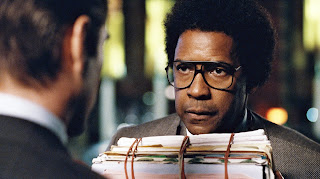
Roman J. Israel, Esq. (2017) is not just about a stereotypical crusading attorney trying to do good, although his name suggests the establishment of laws in ancient Rome, and the struggle for freedom by the Jews in their own country. He always stresses, the “Esquire” because, as he says latter, it’s a title of dignity, “slightly above ‘gentleman’ and below ‘knight,’” probably a designation he would like his profession to be worthy of. The main character does want to accomplish judicial reform, but he is a conflicted man who is capable of succumbing to the pessimism of fighting a broken legal system and willing to give into his selfish needs. The film examines the internal conflict between the angels and demons inside a person, and the hope for redemption.

We know right from the beginning that Roman (Denzel Washington) is a flawed person because he is writing up a legal brief suing himself, stating he should be disbarred for being a hypocrite and betraying everything he stood for. But, the fact that he is indicting himself shows that he is aware of his violations. IMDb notes that the letters are in all caps except the word “he,” implying that Roman is a servant of something greater than himself, possibly the righteous intention of the law. The typing with Roman’s voice-over allows for backstory to be introduced. Roman worked in a two-partner law firm in Los Angeles, and his job was “drafting briefs, motions, and pleadings.” But his partner took care of the courtroom activities.

The story then jumps backward three weeks. Washington looks more like Professor Cornell West than The Equalizer, appearing pudgy, with a medium Afro haircut (which shows his sympathies for the protest movements in the 60’s and 70’s) and large glasses, which stresses he is a thinker, not an action figure. However, his partner, William Jackson, has a heart attack, leaving Roman to clean up the pending cases. The legal assistant, Vernita (Lynda Gravatt), tells him to just ask for continuances as a delay tactic.

Roman is behind the times with what is happening in the present, as he doesn’t even know that another attorney retired a few years ago. He is afraid to go through security, saying the detection equipment will wipe out the songs on his early generation iPod. He carries a flip phone. The prosecutor in the first case doesn’t even know that Roman was the partner. Roman tells her that he doesn’t have the temperament for what happens in a courtroom. He shortly shows why since he is sarcastic about what he considers is the severity of the charges against a seventeen-year-old for breaking and entering. She says the defendant was caught wearing a gang member’s insignia. Roman’s sharp response is that’s like wearing “a flag pin in a lapel.” He is saying the display of an affiliation does not mean it should finalize a judgment of someone. He is confrontational, accusing her of just trying to advance her career. She says her conviction rate is “one hundred per cent,” which is a warning, but also sounds like a boast, which justifies Roman’s view of her. He argues that the youth has one minor prior offense, his dad is in jail and his mother is a drug addict. He joined a gang for protection given circumstances beyond his control. Roman says, “Each of us is better than the worst thing we ever did.” His remark indicates that Roman sees a person as a complex creature and should not be judged in his or her entirety by one action. (Washington said that he saw Roman as being on the spectrum, which would account for his lack of social skills).


The young man, Langston Bailey (Niles Fitch), is scared, thinking he would be remanded to juvenile detention. Roman’s crusade is that those being charged with crimes don’t usually get to have their day in court. He tells Langston that private companies build and run prisons, and the workers get paid overtime, so they scare the accused into accepting plea bargains, increasing incarceration which is a profitable enterprise for some, and career-building for others.

In another case involving the sale on three occasions of cocaine, Roman, instead of accepting the judge’s offer for a continuance, argues that his client was denied bathroom usage and not issued his Miranda Rights. The judge overrules Roman, who continues to show his combative nature by arguing, despite warnings to cease. The judge then cites Roman for being in contempt, and the firm can’t afford the fine.

Roman is at war with the world around him because he feels it does not follow the intent of the law. He calls in complaints about construction nose near his apartment since the work is being done outside of legally prescribed hours. He makes many of these calls. In his home he has many jazz record albums that he plays on his turntable showing his inclination for older versions of technology. He doesn’t take care of himself, since he is eating a peanut sandwich with numerous jars of Jiff in the background, the image succinctly conveying the message. He carries around a large briefcase that could be used for weight training. He has a bulging file of typed papers, held together with rubber bands and clips, with no laptop or electronic storage devices in view (we later learn what this huge file contains). On his walls are mementos of 1960’s sayings and images, again illustrating his dedication to civil rights causes.

Roman meets with Lynn Jackson (Amanda Warren), his partner’s niece and power of attorney, and learns that his partner is in a “permanent vegetative state.” Also present is George Pierce (Colin Farrell), a prominent lawyer, who Jackson designated to take over if the occasion arose. Roman wants to handle the workload, but Lynn tells Roman that the firm was doing pro bono work and had been in the red for many years. The plan is to conclude existing cases which George would handle and then liquidate the firm. Roman is devastated emotionally and worries about his financial survival. George shows his admiration for the Jackson, and wants to get hold of the records on existing cases. Roman has it all on cards, not on data bases, which is what George expected to get things moving. Roman has a photographic mind and knows a case that George handled eight years prior (he is like a high-functioning Rain Man). He accuses George of being part of the system of plea-bargaining that short-changes justice. George gives Roman a ride and says he was his Jackson’s law student. He later threw work toward Jackson’s firm, and he received a kickback for each case he referred. It may not have been ethical, but it kept Jackson’s firm running to take care of the social justice cases the firm wanted to pursue. George’s admission reveals to Roman that his boss was a realist, not just an idealist. He says he can use Roman’s keen mind and he’ll pay him double, but the purist Roman declines the offer.

Roman goes to an organization that does civil rights work so he can work as their attorney doing big headline cases, and he states their current work is too limiting. But the worker there, Maya Alston (Carmen Ejogo), tells Roman they are all volunteers, but he can give a talk to civil rights activists about legal matters. She respects Roman as she tells her colleague that his fight for civil rights was initiated by a man like Roman.

Roman continues to search for employment and is continually rejected. His frustration leads him to act as he does later, including working at George’s office. George has him meet Felicity Ellerbee (Elisa Perry), saying he will be working with her to defend her brother who was involved in a robbery and is charged with first degree murder of a shop clerk. The brother was not the shooter and was not complicit in the killing. Felicity has mortgaged her home for the defense, which points to the burden placed on the non-wealthy to mount a decent defense. For that reason, Roman agrees with her that he also doesn’t like the way most lawyers practice law.

George assigns similar cases that will pay little to Roman. George gives these clients the same canned reassurances about getting the best defense possible as he attempts to appear as if the firm is handling cases for people on the economic fringe. However, he does not utilize full resources on these cases. Roman hears a Latino lawyer, Salinas (Tony Plana), telling an unfeeling joke about a domestically abused woman, and then states an ethnic slur which offends Salinas. The attorney doesn’t like it when he is on the receiving line of nasty comment. Roman then says that lawyers like Salinas are “tourists,” as if to say they are just visiting the lives of the clients, but not emotionally committed to the defendants’ plights.

George later chastises Roman for insulting the number two man in the firm, Salinas. Roman’s reluctance to embrace modern times is again shown when he says he didn’t respond to George’s email by saying, “I’m sorry, when people send an email, they seem to think it goes straight to your brain.” Roman says George brought him onboard, “to put your feet to the fire ‘cause you’re tired of treating low-income clients like dollar signs, and maybe because you remember what it was like to actually care.” Roman is giving George credit, which George doesn’t want to accept, probably because he knows the prime function of most law firms is to “make a buck.” Roman then reveals what that huge collection of paper documents he carries consists of. He has 3,500 names for a class-action suit to reform the plea-bargaining system, where, he says, “guilt or innocence is being completely replaced by fear of having your day in court where people are being forced … to plead guilty under the threat of overly harsh, coercive sentences.” He adds that reforming the system is a job for a “legend,” which may be an attempt to persuade George to take up this fight. Or, Roman may also be showing his ego as the squire who wants to be a knight in shining armor. In any case, he urges George to use his resources to reform the legal system. Despite the impassioned speech, George just wants Roman to handle the cases assigned to him.

Roman sees Derrell Ellerbee, Felicity’s brother, and tells the inmate that he can be charged with second-degree murder for aiding and abetting since he knew the accomplice carried a gun to the robbery that resulted in the death of the victim. Derrell wants to make a deal, saying he will testify against his partner, Carter Johnson (Amari Cheaton), and will divulge where he is hiding. Faced with no hope of acquiring help to fight the rigged system, Roman first tries to reduce the charge against his client. But the persecutor will not go below a ten-year sentence and refuses to hear any more debate from Roman. Her response pushes Roman’s anti-establishment button as he condemns her by saying, “I’m sorry for taking a nanosecond off of your assembly line rubber-stamp existence.”

Roman, who doesn’t even have a car in the automobile-dependent city of Los Angeles, which also points to his outsider existence, still attends the meeting that Maya invited him to. He is there to speak about the rights of those arrested for civil disobedience. Roman starts out with an urgency for protesting the wrongs of society, and the cost for opposing the powers in command. But, his old-fashioned ways get him into trouble with a couple of young women in the group who consider what he calls “chivalry” to be sexist when he says that men should let the two females sit down. (We again get a reference to the way Roman sees himself as a knight, like Don Quixote, fighting against a corrupt world). The women are belligerent and Roman argumentative, and he walks out. Maya follows him, and he admits to saying the wrong things. He admits to his outsider way of being, saying he was not meant for this world, being a forceps-delivered baby. As the two talk, Maya notices a homeless man sprawled out on the sidewalk. Roman thinks the man is dead as a police car stops close by. Roman puts his card in the man’s pocket, but the cops tell him not to put anything on the body. The man comes to, and stumbles away. Roman wanted to be contacted by the coroner so he could pay for the funeral. He tells the cops he gave his information so the man “doesn’t end up as just some body. He’s a person.” The scene shows how Roman’s desire to treat even the dead with decency contrasts with the resistance of the law enforcement system.

Roman’s holier-than-thou attitude backfires on him since his attempting to bargain for his client and then rejecting the prosecution’s offer without informing his client allows for an attack on Derrell Ellerbee to take place. The youth is killed before being put into protective custody. George is furious with Roman, saying it opens them up to a lawsuit. He says he will retain Roman until his work is done and then will fire him. If Roman doesn’t go along with the plan George will have him disbarred.

Roman is mugged on the way home at night and he fights the man off saying, “You’ve got the wrong guy.” His statement refers to the fact that he has no money, but more than that, ironically, it means he is being attacked by the kind of social outcast he has been trying to help. He then visits his comatose partner. He shares his disillusionment with Jackson’s wife. He tells her that there are places where people sit on beaches and enjoy life, and he now implies that he is going to drop out of an irretrievably broken system and take care of his own needs.

Since he no longer has a client to bargain for, Roman anonymously calls in the whereabouts of Carter Johnson, the shooter of the shop clerk, to collect the $100,000 reward. He has the cash dropped off in an alley in a dumpster, which symbolically shows that Roman’s ethics have been trashed. He looks at himself in the mirror, a traditional symbol to reflect the other side of a person, which is usually negative. He goes to the Santa Monica seashore, eats doughnuts, buys new clothes, stays at an upscale hotel, and enjoys the beach. He even rents a luxury apartment, greases down his large afro and is now able to text and order an Uber. He is becoming part of the modern tech “me” movement.

When he returns to George’s firm, he looks cool in a new suit. George informs him that his partner died, and George is apologetic about how harshly he treated Roman. Jackson’s niece, Lynn, told George how vital Roman was to her uncle’s firm, and that Roman was only used to being in the background. That made it difficult for him to be thrust into courtroom proceedings. George also says they picked up three clients because Roman always hands out his business cards to others. George validates Roman’s worth by saying that it will now be a standard practice for his attorneys to hand out cards. Also, there will be no lawsuit about what happened to Derrell Ellerbee, since the man’s sister felt Roman was doing what he could for her brother, which eventually turned out to be Roman doing what was best for himself. Roman wants to stay on at the law firm. He says, “I’m tired of doing the impossible for the ungrateful.” He is feeling no satisfaction at this moment for his crusading for the underprivileged.

His new stance of thinking about his own needs seems to be paying off. George starts up a new pro bono program that Roman will head. This proposal seems ideal since Roman will be helping poor people but through a rich law firm that can pay him a good salary. Also, Maya calls to ask him out to dinner. He takes her to a fancy restaurant whose expensive menus contrasts with Maya’s talking about how Roman’s progressive activism on behalf of others was a real inspiration to her just as she was having doubts about achieving justice for the disadvantaged. He seems to justify her skepticism and his own by saying that “purity can’t survive in this world.” He says something that is illegal, like stealing a car, can be a tool for escape. He is justifying doing something unlawful, like taking the reward money based on his client’s information, which allowed him to get away from his failing attempt to right the wrongs of the justice system. Maya is acting as his conscience, reminding how “blessed” it is to believe in a cause.

At Jackson’s funeral, the minister talks about the long arc of justice that Roman’s partner was invested in. Roman has his head down, which appears to reflect his mourning, but it also suggests that he feels the push back against his current revised path away from his mentor’s. Lynn, Jackson’s niece, urges Roman to speak at her uncle’s memorial. Roman declines because his now cynical attitude places the blame for society’s problems on the individual, not the institutions. He tells her, “The real enemies aren’t the ones on the outside, they’re on the inside.” Maya gives Roman the ceramic bulldog which belonged to her uncle, a symbol of the need for stubborn persistence in the face of unfair opposition. Roman places it in his office, and as he stares at the object it becomes a reminder that he has relinquished his convictions.

George confesses to Roman that he was not going to be a lawyer until he had a class with Jackson who showed the possibilities of making positive changes for the good in the legal system. George then committed to the law, but he says that one has to make a living and now owns several offices. Jackson saw his mercenary ways as “drowning in the shallow end” of a pool, a nice metaphor to point to the lack of meaningful depth in George’s work. George is even ready to help Roman with his long struggle to attack the plea-bargaining problem that denies the opportunity for trials. Now that Roman is there, George’s desire to connect with the disadvantaged community is renewed, and it is ironic that George’s capitalistic ways have had the opposite effect on Roman.

George meets Roman for a new case at the correctional institution, and Roman learns that it is a capital offense involving Carter Johnson, the man Roman anonymously turned in based on Johnson’s now deceased partner, and Roman’s former client, Derrell Ellerbe. When George turns the discussion over to Roman and leaves, Carter tells Roman he knows he’s in prison for life and that it was Roman who turned him in by breaking the law regarding privileged information. He then tells Roman, “you broke your own law,” and says he will reveal the lawyer’s crime so that he can be in jail. In any event, Carter is out for revenge. Roman is scared by the threat and, in a panic, calls for the guard to get out of the prison he fears he may be placed in.

Outside, Roman tears off his suit jacket, as if he needs to breath, and the piece of clothing has become a monetary straitjacket that he traded his values in for. He receives a call at work from an unidentified source and no one speaks on the other end before hanging up. Back at his old apartment he fluffs up his afro, as if to change his appearance, but it also seems like he’s rejecting his new way of life. He rents a U-Haul truck to help him flee the scene. He is paranoid that he is being followed. He takes a desert road (suggesting the desolate nature of his current life?) and a car comes up quickly behind him, causing Roman to veer off the road and head out of his vehicle. The other car comes back, and its occupants ask if he is okay. He says, “I was running. It was a mistake.” He could literally mean his going into the desert on foot, but he really refers to how he is running away from his problems.

He receives a call from Maya who is sad because a volunteer quit saying that he was just there to improve his resume. Roman’s comment is, “The ability to have conflicting ideas in one’s head takes effort.” He may be talking about the worker, but he could be referring to himself, torn between his idealism and skeptical selfishness. He says he is in a desert, and she thinks he means the barrenness that can exist in one’s mind. Of course, she is also correct. Her advice is to move oneself out of that lonely place, and that is what Roman literally and figuratively does.

Roman goes back to the firm and uses its legal resources to continue his epic plea-bargaining suit. We now return to the beginning of the film as we see him preparing the petition against himself. As he is typing, a worker says he heard that Roman accepted the reward money for the case he was working on and asks if the rumor is true. Obviously, Carter has publicized Roman’s crime. He tells his assistant he is leaving and that the man can handle the workload. He meets Maya at a bar and gives her the bulldog, as if passing to her the torch of what’s “vital” in the practicing of the law.

George saw Roman on the street and followed him to the bar. George heard of the accusation about the reward. Roman says he doesn’t care about the money, and he is heading to the police station to turn himself in. He says he had an epiphany that he is, “the defendant and the plaintiff simultaneously.” He goes on to say that he convicts himself, and “the only thing left is forgiveness, and I grant that to myself. An act doesn’t make the person guilty unless the mind is guilty as well.” It is a controversial statement, since although true forgiveness must eventually come from within, one can be objectively guilty while believing what one has done is a righteous act.

Roman tells George that the young lawyer can have a “shining” future, which may again hint at the “knight in shining armor” he envisions a great lawyer can be. As he walks off a car stops and a man with a gun gets out. Roman receives a call and says he remembers who the caller is, since he gave him his business card. He is in the act of serving someone again when George hears a shot. We do not see Roman, but George approaches and finds Roman’s thick briefcase on the ground, and we know that Roman is dead, as he has paid the price for his loss of faith in his quest.

The next scene shows George opening Roman’s briefcase and reviewing the documents. Maya instructs followers concerning legal protests as Jackson’s bulldog sits above her meeting, watching over her. After having the law firm prepare the argument, George submits the documents in Federal Court. He is honoring Roman’s legacy, as is Maya. Roman mailed back the reward money, minus five thousand dollars, which he had hoped to repay. He says in his letter, “We are formed of frailty and error. Let us pardon, reciprocally, each other’s follies. That is the first law of nature.” His last words transcend written statutes and suggest practicing compassion is what would prevent human transgression.

The next film is Black-k-Klansman.

Monday, January 10, 2022

Recent films - 2022

 SPOILER ALERT! The plots will be discussed.

Here are some thoughts on films recently released.

BELFAST

Written and directed by Kenneth Branagh, the story has its basis on Branagh’s childhood in the Irish city in 1969 during the turbulent confrontation between Protestants and Catholics. By centering on the upending of the world of a Protestant child and his family, the events the movie depicts gain power by personalizing the chaos and violence occurring. We sympathize with how the young boy, Buddy (Jude Hill), is shocked by the violence perpetrated by the Protestant majority on the nurturing neighbors on the street where he lives, where Catholics and Protestants were living in harmony. Buddy’s father (Jamie Dornan) is caught in the middle between the Protestants, the police, and the Catholics, and Protestant criminal/revolutionary Billy Clanton (Colin Morgan) who is trying to recruit Buddy’s Pa through intimidation. Pa works in England, and the family eventually must leave their beloved country to escape the violence tearing their city apart.

The film, shot in black and white with shades of color, has numerous camera angles at ground level to immerse the audience in the action, but also to provide the viewpoint of a child. The cinematography is beautifully done as it evokes a gritty beauty on the streets of Belfast. Branagh adds numerous pop culture elements to recreate the time and place of this period in history, and the songs by Irishman Van Morrison provide texture to the tale. The movie is a stunning accomplishment.

DON’T LOOK UP

Writer/director Adam McKay gives us an apocalyptic story that, although containing some sharp satire, tries to hit too many targets. What results is an unfocused movie. He did better in his previous outings (The Big Short, Vice) because they were based on actual events, the economic meltdown of 2008 and the political clout of Dick Cheyney, which made the satire in those films upsetting because they were real. Here he takes a hypothetical event, the planet destroying approach of an asteroid, and shows how even such a catastrophic event becomes politicized given the current divisiveness in the United States. (Of course, McKay is referencing films such as Armageddon, and Deep Impact). People want to do something to avert the disaster, others say the reaction to the threat is out of proportion, and some deny the problem exists. Climate change and also COVID come to mind. The film most likely is arguing that climate change is similar to the approach of the asteroid, but the impact of the lethal heavenly body is more immediate.

That chunk of space matter is discovered by Kate Dibiasky (Jennifer Lawrence), and she and her mentoring professor, Dr. Randal Mindy (Leonardo DiCaprio), go on a quest to warn the world of the cataclysm that approaches. They encounter President Orlean (Meryl Streep) who only cares about how to spin facts that will increase her popularity. Her son, Jason Orlean (Jonah Hill), is her shallow Chief of Staff. He says at one point that his mother is hot and suggests that he would make a play for her if he wasn’t her son. His comment is an obvious reference to Donald Trump’s incestuous remarks about his daughter, Ivanka. As IMDb points out, when they try to get the citizens to ignore the coming crisis as a type of “fake news” they get everyone to chant “don’t look up,” which sounds like a reference to Trump’s chant of “lock her up,” referring to Hillary Clinton.

Mark Rylance’s Peter Isherwell is a nerdy tech CEO who has zero social skills and is an egomaniac. His character is a shot at Mark Zuckerberg. But the spaceships that Isherwell wants to use to harvest mineral riches from the asteroid look like Jeff Bezos’s penis-shaped rocket, linking billionaires’ arrogance with male sexual preoccupation. There is also a car pictured in space which reminds us of Elon Musk’s launching of his Tesla car, which again stresses how the ultrarich believe they are like the gods in the heavens. The worship of wealth is referenced by Jason, who says a prayer even at the imminent destruction of everything as he mourns the loss of “stuff.” IMDb points out that during the closing credits the Wall Street bull floats in space, a reference to the biblical warning about worshipping “false gods.”

There is also a jab at the public’s preoccupation with fame and celebrities as reported by TV hosts played by Tyler Perry and Cate Blanchett. Mindy has an affair with the latter, and is seduced by becoming the center of attention on TV as the spokesman for the end of times. Don’t Look Up is an interesting film, but again, it’s all over the place.

THE POWER OF THE DOG

This film, written and directed by Jane Campion, takes place in Montana in 1925. The setting is important since we are dealing with a macho-cowboy-oriented story at a place and time when being gay was condemned. Given that context, the story explores repressed homosexuality in the person of Phil Burbank (Benedict Cumberbatch, in a riveting performance).

Phil is ranch partners with his brother, George (Jesse Plemons). The two couldn’t be more different. George is softspoken, and neat, always wearing a bowtie. Phil is loud and sarcastic, and always looks like he climbed out of the mud. In fact, he prides himself in the fact that he smells. For him, that odor emanates manhood. But, appearances are deceiving in this movie. Phil has not married, and it is his brother that weds Rose (Kirsten Dunst). Rose has a tall, thin son named Peter (Kodi Smit-McPhee), who looks as if the wind could blow him over. He creates paper flower arrangements, which to the cowboys is an effeminate activity. Phil is nasty as he says to Peter, “Ain’t them purrdy? I wonder what little lady made them?”

Phil is hostile to Rose, and can’t abide being in the next room when he hears lovemaking sounds coming from his brother’s bedroom. The hostility eventually drives Rose to becoming an alcoholic. Phil had a mentor named Broncho Henry, who he often references as being a great cowboy. He starts to teach Peter about the skills that he believes a man should know. Peter learns how to ride a horse and Phil is impressed that the youth can look at a hill and see the shape of a dog that other cowboys have not been able to discern.

Even though he may appear weak, Peter is studying to be a doctor, and is not squeamish about dissecting animals as he learns about diseases. When he and Phil are mending a post, they come across a lame rabbit, and Peter has no problem breaking the animal’s neck to put it out of its misery. The turning point in the plot is when Phil masturbates while holding Broncho Henry’s handkerchief, and Peter discovers magazines of nude men in Phil’s hiding place that have Broncho Henry’s name on them. Phil tells Peter a story about how Broncho Henry saved him from the cold by using their body heat to keep warm. Peter asks if they were naked, but Phil just smirks and says nothing. It appears as if it is an admission of his gay nature, and the two then intimately share a cigarette.

Peter, out alone, uses a scalpel to cut some hide off a steer that died due to disease. He gives that cowhide to Phil to finish a lasso he was making for the boy. Phil had cut himself earlier while skinning a rabbit, and does not wear gloves while finishing the lasso. He becomes sick from an infection and later dies. We see Peter, wearing gloves, pushing the lasso under his bed, and he sees a revitalized Rose with George outside his window. The implication is that Peter infected Phil with anthrax so that his mother would no longer be threatened by the toxic Phil.

The title comes from the Book of Psalms, which reads, “Save my soul from the sword, and my darling from the power of the dog.” The dog is considered a tormentor to King David. Perhaps the rock formation that Peter recognized as a “dog” may represent the danger in succumbing to the overcompensating masculine mentality that drove the self-denying Phil.

BEING THE RICARDOS

Writer/director Aaron Sorkin zeroes in on one episode of the hit 1950’s TV show I Love Lucy, but then does some time jumping to give us a sense of what Lucille Ball and husband Desi Arnaz were like behind the cameras. The story focuses on the adversity that Lucy encountered when she was accused of being a Communist during the McCarthy witch hunt era, and how the couple lied by saying Lucy just filled in the wrong block on a questionnaire. The truth was that she cared and respected a relative who belonged to the Communist Party. She did not want to be deceptive about what really happened. Lucy (Nicole Kidman) was a tough, shrewd woman before it was inspirational to be such a person. She is also a perfectionist when it comes to the show’s episodes. Despite the series depicting farcical situations, she argues against any illogical elements in the scripts, and adds funny material. The couple fights back at not being able to say the word “pregnant,” and the two not sharing a bed, despite their characters and themselves being married. Desi (Javier Bardem) is very supportive and respectful of his wife when it comes to the work, but Lucy does discover that he has been frequenting prostitutes on the side. The two come off as witty and intelligent members of the show business community.

Sorkin’s script is sharp, as usual, and the performances of Kidman and Bardem are very good, as are those of J. K. Simmons as the abrasive although well-meaning father figure, William Frawley, and Nina Arianda as Vivian Vance, who is close to Lucy, but who sometimes feels she must appear unattractive so as not to upstage the star.

SWAN SONG

This movie has a sci-fi context, but it is mostly an idea and character driven story. Cameron (Mahershala Ali) has a terminal illness. In this future time period, there is an innovative way to basically replace oneself with a duplicate. It is not cloning since the scientists, headed by Dr. Jo Scott (Glenn Close), upload all of one’s memories and feelings onto the double, and can make small physical variations to tell the original from the copy. Ali also plays his duplicate, Jack. Cameron agonizes over the course of the story as to whether he should go through with this action. The catch is that the family and everybody else must not know of the illness so as not to raise suspicion that the duplicate has been substituted. The purpose of this deception is to allow Jack to easily slide into Cameron’s life. If Cameron goes through with the procedure, he will live out the rest of his time at the medical facility where the swap is taking place.

The story deals with identity in a way that writer Philip K. Dick did in several stories. Questions rise as to what defines an individual, and what makes each individual unique. Another great performance by the Oscar-winning Ali.

The next film is Roman J. Israel, Esq.