SPOILER ALERT! The plot will be discussed.
Peeping Tom (1960)
came out the same year as Psycho, and both films show up in Roger
Ebert’s book, The Great Movies. They are both daring artistic
psychological works that explore homicidal behavior linked to parent-child
dysfunction. They also implicate the audience in wishing to participate in the
main character’s perversion through voyeurism. Peeping Tom is even more
focused on the connection between filmmaking and watching the private and
sometimes gruesome experiences of others.
The first images of the film are of a target with
arrows shot at a bull’s eye. We immediately have a weapon present and a phallic
symbol in the form of the arrow that penetrates and, in this case, is also linked
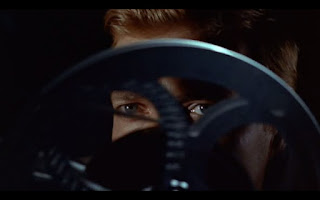
to danger. We then see a human eye (remember Janet Leigh’s dead accusing look
at Hitchcock’s audience), which adds to the theme of voyeurism, amplified by
the man who is secretly filming a woman in front of a shop window. The sexual
aspect is evident when she announces her price, which reveals her to be a
prostitute. He follows her to her place, and we see things through the viewfinder
of the camera which stands in for the view of the predator (not the first time
we see events from the killer’s perspective and certainly not the last in
films). We hear the sound of a knife (the same phallic weapon that Norman Bates
uses) being unsheathed and then witness the horror of the woman as she is
attacked.
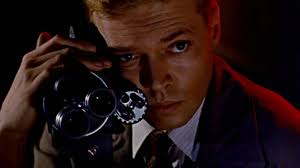
The killer is Mark Lewis (Carl Boehm), and he returns
to the scene of his crime, filming the aftermath, pretending to be a
photojournalist. He records his excursion (he later says he is making a
documentary) into this dark realm of fear as the police are there, removing the
victim from her home, appropriately covered in a red blanket. He works at a
store that contains adult material where he photographs young women in sexy
outfits. He repeats what the proprietor has told him that magazines that sell
are “those with girls on the front covers, and no front covers on the girls.”
So, voyeurism is a business that is profitable, and part of society, although
people may not want to acknowledge its presence. Thus, a customer receives his
nudie pictures in an envelope marked “educational material.”When Mark goes into a backroom to do his work one of
the models says that her fiancé caught her with another man, and she tells Mark
to make sure that her bruises don’t show in the photos. The film shows the
seedy side of life and how we try to cover it up, which is what the mainstream
movie industry has done in its past. When he takes a while to take her picture,
the model, Milly (Pamela Green) asks if he has a girlfriend hidden under the
camera’s drape. She is kidding, but she is correct because Mark’s lover is the
camera, and his intimacy presents itself in a voyeuristic fashion.
The other model we see only in profile at first. She
looks lovely, but then she turns to face Mark and reveals a facial deformity on
her right side. She wants the disfigurement to stay hidden, but Mark takes out
his own camera and says he wants to shoot her as she is. He does not shrink
from the unpleasant side of things. The film may be saying we may kid ourselves
that life is not tainted, but that is not reality.
The next scene is at Helen Stephens’s (Anna Massey)
apartment where she is celebrating her twenty-first birthday with other
tenants. She is attractive and one would think innocent, although her blind mother
(Maxine Audley) grunts when a guest expresses a compliment about Helen. Those
present see Mark peering in from outside a window. He looks like, well, a
Peeping Tom. The lattice work of the window looks like a viewfinder, adding to the connection between film, Mark, and us. Mark lives upstairs, and Helen greets him in the hall, inviting in
the outsider, but he declines.
Later there is a knock at Mark’s door, and he
immediately does what we all do, try to make the place look presentable, not
wanting others to see that we don’t live in a messy home. Only Mark’s dirtiness
includes his tapes of his sordid activities. He’s an extreme extension of
everyday people. Helen is bringing him a piece of cake. He is awkward with
others because of his anti-social personality. He reveals that he has lived in
that building his whole life. He inherited it from his father, so, he is the
landlord, although nobody knows this fact. As the model Milly noted, he is a
puzzle. He seems so shy and gentle on the surface (like Norman Bates, whose
name sounds like “normal”). He asks if the rent is too high and is willing to
lower it. When she says not to tell the others that he is willing to lower the
cost, she says the renters will give him no “peace.” He repeats the word, as if
not knowing what it means, implying he has had none.

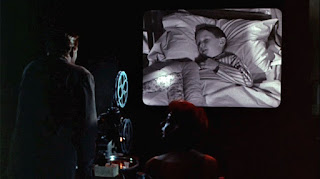

As Helen questions him about what this all means, Mark
strokes the camera, a masturbatory action again linking how he can only get
excited by way of his voyeurism. There is the image of Mark’s young stepmother coming
out of the water on the beach, scantily clad in a two-piece swimsuit. We have
arousal in an inappropriate way displayed here by means of observation. He
calls her the “successor,” as if this woman dethroned the queen in Mark’s life
only six weeks after his mother passed away.
After Helen sees how disturbed Mark is, she tells him
to turn off the camera. She moves him away from the dark room, as if she is
getting him out of his dark state of mind, into the lit outer room, where she
wants to shed light on what she saw. Mark tells her his father was a biologist
and wanted to know how fear registered on the nervous system, especially with
children. We see volumes of his father’s books on the topic. Mark says he had
no privacy since his father was always filming him. Thus, he has no problem
invading the privacy of others based on his upbringing. Mark seems to
rationalize that his father learned from him, and some benefitted from his
father’s work. However, Helen doesn’t buy the excuse.
There is then a quick cut to a film set (called The
Walls are Closing In, a foreshadowing) where Mark works, but the impression
is that we have stepped out of the story and are witnessing the filming of the
movie we are watching. It is a deliberate attempt to link imaginary reel life
with actual reality. There is a discussion of whether a movie is commercial
enough to be made, which fits the making of this controversial work we are
watching. There was a criticism of Powell using himself and his son for the characters
of young Mark and his father given the disturbing material of the story. The
movie takes the joining of fictional and actual characters to a daring level.

Mrs. Stephens is a despondent woman who drinks alcohol
to excess. However, even though she is blind she senses the suspicious nature of
the photographer living upstairs. She says, “I don’t trust a man who walks
quietly,” and that his footsteps are “stealthy.” She does condone Helen visiting
him. Mark gives her a pin and when she moves the placement of where she might
affix the gift, Mark moves his hands to the same places on his upper body. Ebert
says Mark here becomes a camera himself, recording what he sees through his own
lenses. Again, he seems to only exist by way of what he observes. She tells him
she is a librarian working in the children’s section of the library and has had
short stories published. She recently had a book accepted about a magical
camera and wants him to help her add photos as part of her story. He is thrilled
but adds a chilling note that sometimes he photographs some things for no
charge. The contrast of the innocence of children and Mark’s dark side is implied
here.
While shooting on the movie set, an actor must move a
trunk, which is especially heavy. We realize from the deadly encounter with
Mark that Vivian’s body is in the trunk, which is discovered in short order. The
police, who are also investigating the prior murder of the prostitute, notice
the same look of terror on the body of Vivian as they saw on the hooker. As
they interview those involved with the making of the film, Mark photographs the
proceedings. Mark talks with a fellow worker and says that he is filming the
police as part of his “documentary.” The other man jokingly questions whether
they will catch Mark recording them. He answers in the affirmative, but he is
talking about arresting him for the killings. It implies that he feels that he
will be apprehended eventually. When the man asks jokingly if he is crazy, Mark
says, “Yes. Do you think they’ll notice?” He is admitting to his deranged
mental state, but he is cloaking it in a humorous exchange.
Chief Inspector Gregg (Jack Watson) interviews Mark,
who offers his camera as a way, most likely, to show that he is cooperating
with the police as to any filming that may prove useful to the investigation.
But he constantly reaches out for it during the scene, like a man reaching for
his lover, or even a part of himself. Mark photographs the removal of the body
from the rafters. As he leans over, objects fall out of his pocket, but he is not
discovered, at least not yet. All the above takes place on the movie set,
sealing the emotional connection between the fictitious moviemaking and actual events.
The sightless Mrs. Stephens again shows her perceptive
abilities as she can feel Mark looking in on them again through the window. She
jokingly says, “Why don’t we make a present of that window?” When she shakes
his hand she says that he has been running. He says he was hurrying to see
Helen, but we know he was escaping the movie studio. Mrs. Stephens asks Mark
about the dead actress, but he claims he didn’t know her. The look on his face
shows that he registers the mother’s suspicious nature.
On their way to dinner, Helen suggests that Mark
doesn’t need to take his always-present camera with him that night. He is
defensive at first, but admits that he trusts Helen, and they lock it in what
was once Mark’s mother’s room. Mark seems genuinely happy to be with Helen.
But, as they head out, he sees a couple kissing, and he instinctively reaches
for where his camera would be slung over his shoulder, ready to capture the
passion between the man and woman vicariously.

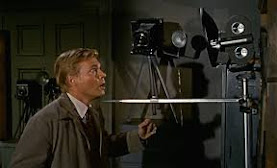
While looking at the film he made of Vivian, Mrs. Stephens
surprises him. This is a fascinating scene. We have a blind woman at home in
the photographer’s dark room. She has heard him every night running his camera.
She can keep him at bay with her pointy cane, a version of his knife-like
tripod. He is on the defensive here at first. She asks what he is looking at
and says he can lie to her, but he perceives her intuition and knows she would know
the truth. Vivian’s projected image is partially on the screen and also on his
back, visually implicating him in her fear. The film ends and he lunges toward
the white film screen, arms raised. It appears as if he has been crucified by
his own obsession. He says that the light ends too quickly, and he needs a new
opportunity. He is talking about what he has filmed but what his words imply is
that he feels compelled to seek another victim. It appears it is going to be
the mother. However, Mark relents. The two continue to speak in a code as if
they are talking about film. But what Mrs. Stephens says is that he needs to
seek help and doesn’t want him to see her daughter until he does. He says he
will never “photograph” Helen, which means he would not harm her. She says they
would move away if he became a threat to Helen. He escorts her back to her place,
and she warns him that he will have to tell someone about his problem, a
confession really, and the implication is that it will either be a psychiatrist
or the police.
Back on the movie set, there is a psychiatrist there
to aid the traumatized lead actress. Taking Mrs. Stephens’ advice, Mark asks
the shrink, who knew about Mark’s father, if he had insight on someone being a “Peeping
Tom.” The technical term is scopophilia according to the psychiatrist. Mark is
hopeful, symbolized by his raising the stage elevator as he talks to the
psychiatrist. When he hears that it would take a few years of continuous
analysis to cure, Mark becomes despondent, as he lowers the lift appropriately.
The Chief Inspector is on the set and the psychiatrist mentions to him that Mark
was asking about voyeurism, which piques the policeman’s interest. The fellow
worker he spoke to before gives Mark a photo of a beautiful woman, which Mark
says gives him “an idea.” He then speaks to the man who employs him to shoot
sexy photographs. The audience may suspect that he may make one of the models
his next victim.


The store proprietor informs the police that he found
Milly’s body. So, Mark is allowing himself to get caught. He is driven to
commit his crimes, but he is also a sympathetic character because he realizes
his mental illness and wants to end his lethal actions. He reveals to her that
his father had the whole house wired for sound. and he plays back his screams that
his father recorded. She sees his torment and wants to understand what he actually
did. He tells her he let his victims see their fear being recorded in a
distorted reflection as the tripod knife penetrated their throats. He acts out
but does not consummate the crime with Helen. He records his own fear, as his father once did, as he
kills himself with his own weapon. The police burst in right after his suicide
as a film reel stops rolling, reflecting the end of the movie.
The film has shown us that we are getting our thrills
by also being Peeping Toms. At the end of the movie, we hear Mark’s father
saying to his young son that there’s nothing to be afraid of. Despite the fact
that we are watching a piece of fiction, our fear is real.