Sunday, October 25, 2015

I Want to Live!

SPOILER ALERT! The plot of the movie will be discussed.


This 1958 film based on journalist Edward S. Montgomery’s coverage of prostitute-crook Barbara Graham’s life is probably one of the earliest feminist and anti-capital punishment movies.


Susan Hayward, in an Oscar winning role, portrays Graham. The acting may seem a little over-the-top to us now, but she does convincingly convey the toughness of this woman who can be seen as both a criminal and a victim. The opening scenes establish the world in which she inhabits, which is one where the acceptable rules of society are broken. It is one that flows far from the mainstream. There is a wild party taking place where there is excessive drinking of alcohol. A band plays jazz (definitely the alternative sound of the time), and the musicians share a joint. The camera angles are skewed, emphasizing the out-of-the ordinary lifestyles of those present. Barbara is first seen rising up from a bed in a slip, followed by the form of a man with whom she has slept for money. We see the family picture of her client. She goes out of her way to protect the man from being convicted of the Mann Act, which prosecuted men who took women across state lines for sexual purposes. Barbara says she paid for the room they used to lessen his involvement. Right from the start we see how she helps men get away with crimes.


The image of the bongo drums being played at the party are replaced by a judge’s gavel as Barbara is convicted of prostitution. She later is maneuvered into providing an alibi for some crooked male friends, and is convicted of perjury. She then falls in with some male criminals, and helps them fleece victims using her seductive abilities. She also drives their getaway car after robberies. There is a scene where one of the crooks is building a house of playing cards. It is symbolic of Barbara’s life, which comes tumbling down on her.

She tries to “get out” by getting married and having a child. But, her attempt to join the straight world is thwarted by her continued wrong choices involving men. She weds a junkie who drains her financially and emotionally. Another image of her failed attempt at living the normal life is depicted when we see her baby playing with poker chips. Desperately in need of cash, she leaves her child with the husband’s mother and joins up with the thieves again. When a woman associated with Barbara’s mob is killed by one of its members, the cops come to arrest the crooks. One of the gang members says she sold them out, and he beats Barbara before they are all arrested. More physical brutality at the hands of men is revealed when Barbara is examined in jail and cigarette burns are found on her body. The other convicts pin the murder on Barbara. Her cellmate, another woman looking for help from men, cuts a deal and frames Barbara by recommending a guy who will provide an alibi for a price. He turns out to be an undercover cop. Even her lawyer turns on her at this point, asking to be excused as her attorney. Her husband’s drugged state of mind prevents him from being an alibi at the time of the killing.


Although she has been railroaded, Barbara doesn’t help her situation because she is insulting and uncooperative to everybody. But her attitude shows her unwillingness to accept the unjust situation she is in. Even though she is labeled a “party girl” and considered a slut, she embraces her sexuality when she refuses to wear the prison pajamas, and wants to feel sexy in her black slip. She strips down and says she would rather be naked than wear the drab sleepwear. Her dual nature of being tough and wanting to have a family is emphasized by her wanting to keep her daughter’s stuffed toy, which happens to be a tiger, showing the sweet and dangerous sides of Barbara.


A few men are on her side. There is a psychiatrist who says she is not violent. He also points out that she is left-handed and the killing was most likely done by someone who led with the right hand. The police also refused to allow Barbara to take a lie detector test, which would have helped her defense. The journalist, Montgomery (Simon Oakland), on whose writings the film is based, changed from one who exploited Barbara’s story, to becoming one of her supporters. When someone questions whether she may have been framed by the male convicts for the murder, a prison worker says, “What was she doing shacking up with them in the first place.” That statement shows the sexist discrimination involved in Barbara’s conviction. It’s as if she was condemned because of her sexual activity rather than for convincingly being found to have committed murder.


There are two women who present mirror images of how Barbara’s life could have gone. Her party friend, Peg (Virginia Vincent) left the fast lane world and married and had kids. She becomes part of the community. But, it is still the husband who calls the shots, giving her permission to see her old pal in prison. The other woman works at the prison, and her other-side-of-the-coin existence is stressed because her name is Barbara, too. Even she says, paradoxically, that the only way to live with men is being separated or divorced from them.


Besides the story arguing against the death penalty by showing an innocent person executed, the film presents the agonizing process the inmate must endure as she is led numerous times to the gas chamber only to get last minute reprieves, with no true hope of a commutation of the death sentence. The process of preparing the chamber for the dropping of the cyanide into buckets of sulfuric acid is presented in chilling detail, making the activity feel like a premeditated act of killing. The San Quentin Captain tells Barbara, “When you hear the pellets drop, count to ten. Take a deep breath. It’s easier that way.” Her damning response to this executioner is, “How would you know?” The cyanide is shaped in the form of eggs, ironically showing that the objects which appear to represent the beginnings of life are, in the hands of an unjust system, tools to end it.


The next movie is North by Northwest.

Sunday, October 18, 2015

Julia

1977 was a very competitive year for Oscars. Nominees for best picture included The Turning Point, The Goodbye Girl, Star Wars, Annie Hall (the eventual winner), and this film directed by Fred Zinnemann (High Noon, From Here to Eternity, A Man for All Seasons).


The movie is based on one of the stories told in Lillian Hellman’s Pentimento. The opening of the film explains the title of the author’s memoir. We see the elderly Hellman (literally – it is the writer in the boat here and at the end of the story), and we hear Jane Fonda, who plays the author, talking about how a painter may alter what he was going to depict, and painted over a previous work. But, sometimes the earlier images are seen through the later work. Here are Hellman’s words:

Old paint on canvas, as it ages, sometimes becomes transparent. When that happens it is possible, in some pictures, to see the original lines: a tree will show through a woman’s dress; a child makes way for a dog; a large boat is no longer on an open sea. That is called pentimento because the painter “repented,” changed his mind.

Hellman uses this artistic term as a metaphor for memory. Old thoughts and images mentally buried under other experiences are excavated and brought to the surface by the writer. She says, “I wanted to see for me what was there for me once, and what is there for me now.” Zinnemann then shows a cinematic representation of this artistic effect by presenting a train pulling out of a station against the water on which Hellman’s boat floats. The train will later be part of Hellman’s journey to Berlin. In fact, the entire movie depicts flashbacks to emphasize the resurgence of memories. Hellman admits that memory can be faulty, but she absolutely trusts what she remembers about her friend, Julia.


The two were friends since adolescence. Lilly would visit Julia at her rich grandparents’ mansion around the holidays. Julia’s elderly relatives are unapproachably stiff and formal in their strict adherence to etiquette. Julia’s mother is never around, associating with affluent types in Europe. When Lilly asks her about one of Julia’s visits to Scotland, her friend says she doesn’t “remember.” There were just many “fancy” people.  It is noteworthy that in a story about memory we are shown was is forgettable – the kind of people F. Scott Fitzgerald labeled as the careless rich in The Great Gatsby.

One of the flashbacks shows a young Julia incensed by the apathy of her relatives toward the sick in Cairo, and the unhealthy living conditions of the poverty-stricken workers in her mother’s home in Scotland. This early concern for the physical well-being of the oppressed is probably why Julia studies to be a doctor. She became an example for Lilly to follow. When they were young, Julia crosses a rushing river by walking over a twisty tree trunk. Lilly is afraid, and Julia tells her to go below and find a safe passage. Lilly tries the difficult way, stumbles, and is rescued by Julia. She tells Lilly that she will be able to make it on her own the next time. 


The “next time” appears when Lilly is an adult. The main narrative of the movie is set at the time of the rise of Nazi Germany. When she visits Paris on her way to a play festival in Moscow, a Nazi resistance associate of Julia confronts Lilly at her hotel. The man, Mr. Johann (Maximilian Schell), tells her that her friend wants Lilly to secretly transport Julia’s money to Berlin on her way to Russia. The cash will be used to secure the release of Jews and political prisoners through bribes. It can be dangerous for Lilly, since she is Jewish. Julia had once told Lilly to “work hard, take chances, be very bold.” But just as she told her that she didn’t have to take the dangerous way across the water, Julia told Johann to warn Lilly that sometimes “she is afraid of being afraid.” So, he tells Lilly if she feels that she “cannot do it, don’t do it.” Her confusion over knowing the depth of her courage is noted by her lover, writer Dashiell Hammett (played by Jason Robards in a supporting Oscar winning performance) in an earlier scene when he tells her that she is really the neighborhood bulldog but thinks she is a cocker spaniel. She hesitantly agrees to transport the money. While running toward the train, she stumbles, just like she did when she tried to cross the river. So, that earlier crossing is echoed here where she must find the courage to make this more meaningful crossing into dangerous territory.


Lilly succeeds in her task, but she is definitely not a convincing covert operative. She has the help of two resistance passengers, but must be reminded of when to wear the hat that contains the money and what to do with the box of chocolates she is given. When she has a brief rendezvous with Julia at a restaurant in Berlin to drop off the money, it is a heartbreaking scene. It amplifies the feelings between the two. Julia lost her leg in an attack by the Nazi youth at the college in Vienna. She tells her friend that she now has a baby, who she has significantly named Lilly. She plans on going to New York for a new leg and wants Lilly to take care of her baby, who is currently in Alsace with a baker’s family. But this is not a happy tale. Julia is murdered. Lilly tries desperately to find out about the baby, but her attempts to find her through Julia’s resistance contacts end in failure. Hammett tells her that her comrades only used Julia for her money and didn’t care about the baby, who was probably dead.


Lilly has an on-again, off-again relationship with the older and famous Hammett (The Maltese Falcon). The story begins with her living with him on Cape Cod as she is working on her first play, The Children’s Hour. The movie is effective in showing the ups and downs of the writer’s life, mostly in very quick images. Lilly rips pages out of the typewriter, throws the machine out of the window, talks to herself while walking along the beach, and is told by Hammett to throw away an early draft. She eventually becomes famous, but is reminded by Hammett that notoriety is just “a paint job. It has nothing to do with writing.”


Despite Hammett’s help, the men in this film are not as reliable as are the women. Hammett tells Lilly to go to Paris without him to work on her play, and later does not travel with her to Europe and Moscow. He is not there for the opening night of her play on Broadway. It is suggested that he has affairs with other women. The father of Julia’s baby is not important to her and didn’t want anything to do with the child. Although the relationship between the two women is shown as platonic, in Lily’s narration she says that Julia had “the most beautiful face I have ever seen.” She hugs her and tells her that she loves her.

This film is primarily a story about the empowering, loving relationship between two women, and overcoming one’s fear to find the courage to unselfishly commit to helping people in need.

Next week’s movie is I want to Live!

Sunday, October 11, 2015

On the Waterfront

SPOILER ALERT! The plot of the movie will be discussed.

We worry today about children caving into peer pressure to commit wrongful acts, and being bullied. Well, this movie, released in 1954, shows that these issues carry into adulthood and how the results can be deadly. The theme here is about either choosing to survive in the existing situation, no matter how oppressive, or making a sacrifice to change the way things are for the good of others.


The controversy surrounding this film centers on whether it is a defense of director Elia Kazan’s decision to “name names” during the Senator McCarthy anti-communist witch-hunts. But let’s put that aside since that real life era existed in a different context than what is presented in this story. Here, on the docks of Hoboken, New Jersey, the longshoremen union has been corrupted by the influence of the mob. The union boss is Johnny Friendly (Lee J. Cobb), whose name is ironic since he is anything but a nice guy. (His actual name is Skelly). He and his goons decide who will work on any given day, and whether they will have to do backbreaking work or pull easier assignments. These exploiters skim money off of the union dues, take a cut from the payment for work done, and keep the workers impoverished so that they must borrow money from the union and pay loan shark interest rates. There is an ironic scene early on where Friendly throws one of his workers out for taking money for himself. Johnny says he can’t tolerate “skimming,” yet he is the ultimate skimmer. There is a telling scene where one of the goons tosses the tokens which allow work for the day in the air. The laborers fight among themselves so they can earn their meager wages, instead of battling the bosses who control their right to work.


The film starts with ex-professional boxer Terry Molloy (Marlon Brando in an Oscar winning performance) luring Joey Doyle to a rooftop where they keep their pigeon coops. He was ordered to do so by Friendly, but Molloy believes that the bosses are only going to “lean on him” a bit because Joey was ready to expose the corruption to the Waterfront Crime Commission. Instead, Joey is thrown off of the roof. Terry’s conscience, long dormant, starts to awaken after this incident involving the murder of a friend. The conflict within him is intensified for three reasons: one, his brother is Charlie the Gent (Rod Steiger), Friendly’s right hand man; two, Terry develops feelings for Joey’s sister, Edie (Eva Marie Saint, another Oscar winner for her role) who he knew when they were in school together as children; three, Terry is goaded into action by Father Barry (Karl Malden).


Barry is shoved in the right direction by Edie, who knows a few things about the Catholic faith. Her father sent her away to study with nuns and become a teacher so she could escape the depressing world in which her father and brother toiled. After Joey’s death. Barry tells Edie that if she needs him, he’ll be at the church. She says with anger, “Did you ever hear of a saint hiding in a church?” The priest holds a meeting in the lower church chapel to urge the discontented workers into action. One of those present says that they were made to be “D and D,” “deaf and dumb,” when it came to the strong-armed tactics of the union leaders. Barry says that “We protect murderers with our silence.”

Terry is ordered to attend the meeting to inform on those present. But, when the workers attending are attacked, he rescues Edie. At this point Brando did a bit of improvisation in a scene with Eva Marie Saint that Kazan left in because it worked so well. Saint dropped her glove. Brando picks it up and handles it tenderly. It shows the gentler qualities of a man that has been used to living a life of brutality. He, like Rick in Casablanca earlier on in that film, feels that that the only side to be on is your own. But, here, Brando puts the glove on, in essence exchanging the boxing glove that he used to wear literally and has worn figuratively, for a feminine item that symbolizes his desire for loving intimacy with a moral, caring woman. She says, “Shouldn’t everybody care about everybody else?” He is cynical about her philosophy of winning people over with kindness and patience, but he admires her and it elevates him to a higher ethical level.


Let’s get back to those pigeons. In a way, Terry’s association with these birds mirrors his own predicament. They can fly, which allows them to rise above the human turmoil below them. But, their freedom has been restrained because they are caged in coops. This becomes a symbol for the loss of the workers’ control over their own lives. There are bars on windows of apartments, too, and fences all around showing how the laborers are imprisoned in their poverty. The workers are boxed in the holds of ships, again stressing the prison theme. Terry also feels confined in his life of being a lackey for Friendly and his brother. But he likes being above it all, on the roof with his birds. He admires the pigeons for mating for life, which shows their commitment to each other. He says the city is full of hawks, and, unfortunately, he must cage the pigeons to protect them. He is shown to care for the underdog, or, in this case, underbird. Of course, the pigeons also are associated with the phrase “stool pigeon,” a term Terry does not want applied to himself. Another bird, a canary, is also a name used to mean someone who informs on others, because they “sing.” The corrupt union men say about Joey, after he is murdered, that he was a canary. One of them says, “Maybe he could sing, but he couldn’t fly.” Terry wants to do both.


Beside Father Barry and Edie being taught by nuns, there are other religious references in the movie. The TV antennas on the roofs resemble crosses. Kayo Dugan (Pat Henning) is killed on the ship after he tells Barry that he will testify against the bosses. (Terry tries to warn him, showing his movement to a moral high ground). The priest gives a speech on the ship about how Dugan’s death along with Joey Doyle’s were crucifixions, and those allowing the deaths to occur share in the guilt. Later, when Charlie defies Friendly by allowing Terry to live, Charlie’s body is hung up on a hook in another crucifixion image. The priest says if you hurt one person, you hurt all others. He echoes what Edie told Terry about caring for everybody, which is basically what Christ taught. As part of his being sorry for his sins, Terry confesses to Barry about his involvement in Joey’s death. The priest tells him he must confess to Edie, too. When he does, all we hear is the blaring sound of a ship’s horn, almost as if the angel Gabriel is sounding his instrument, announcing Judgment Day. Jimmy Doyle’s jacket is given to Dugan, and is then passed on to Terry, like a relic from martyrs. When Terry breaks the glass on a door window to protect himself and Edie from Friendly’s henchmen, he bleeds from the hand like Christ being nailed to the cross.


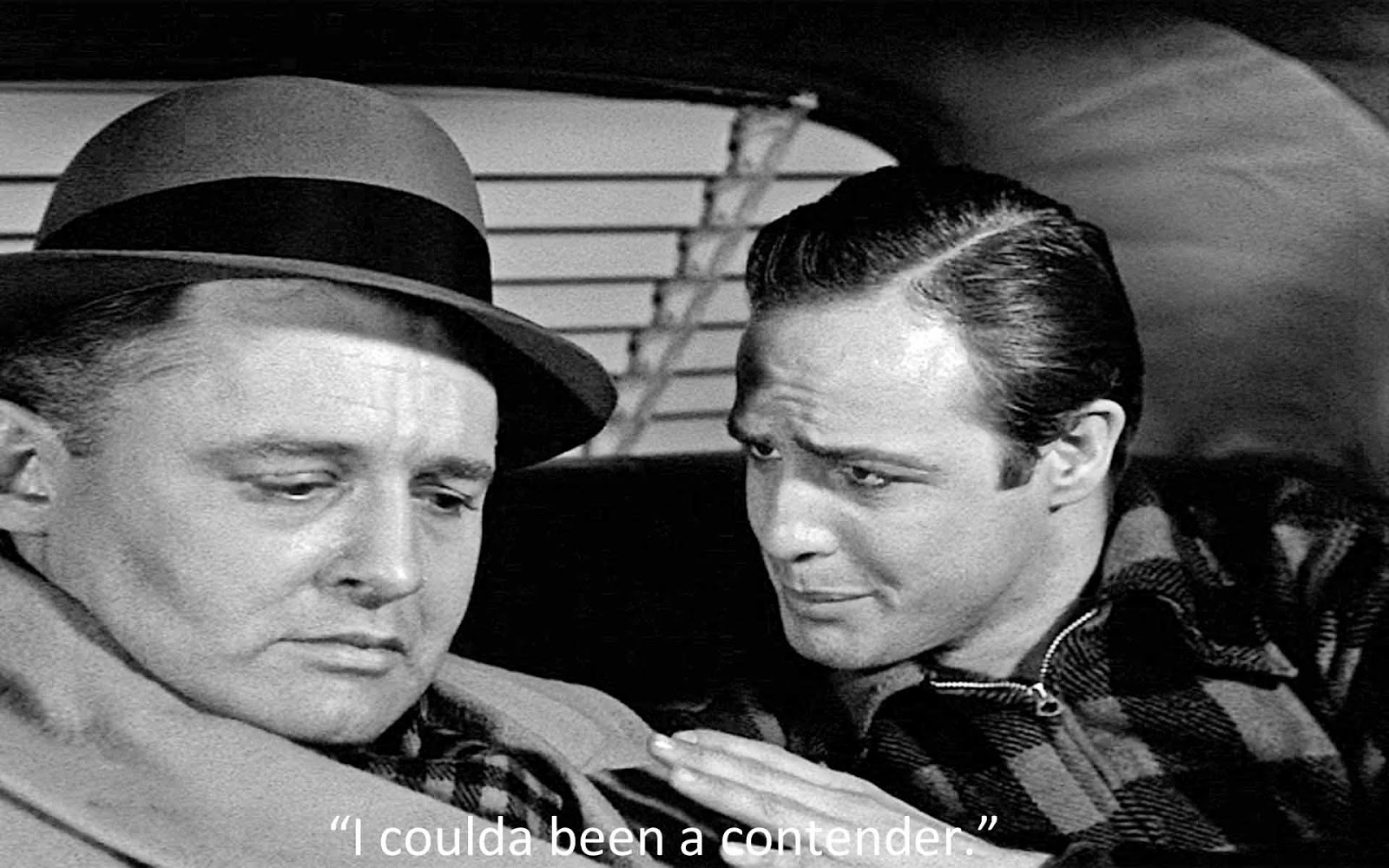
The most famous scene in the movie is the one with Terry and Charlie in the back seat of a cab. During filming, they had difficulty shooting through the back window from inside the vehicle. Someone said they rode in a cab with blinds in the rear. They used that suggestion. The result created an intimate setting for the exchange. Charlie has been told by Friendly that if Terry couldn’t be convinced not to testify, then Charlie would have to kill him. When he tells Terry he has to make up his mind by the time they reach their destination, Terry understands what is really happening: that his own brother has been ordered to kill him. Instead of anger and violence following this realization, we have a quiet scene of disappointment and heartbreak. Terry doesn’t grab the gun or knock it out of his brother’s hand. He gently just pushes it aside with his fingers. His sadness is palpable. When Charlie tries to place the blame onto someone else for Terry’s failure as a fighter, Terry lets him know that it was Charlie’s fault for making him take dives. Terry tells him that he should have looked out for him. That is what a brother should do – love and care for his sibling. Instead Terry makes him understand that Charlie has been betraying him for a long time. When he tells his brother, “It was you, Charlie,” the truth is almost unbearable for the both of them. Charlie then realizes he can’t kill his own brother, and by letting Terry go, he must join the list of those sacrificing their lives to bring about moral change.


Barry convinces Terry that he must fight in a court instead of a boxing ring. After he exposes Friendly, he does not run and hide. He goes to the docks to claim his right to work, and lead by example. The others finally defy Friendly, and say they will only work if Terry does. Even though he is beaten up by Friendly’s goons, he drags himself to the loading dock to put in his day’s work. His fellow longshoremen follow him, pushing Friendly aside. Terry may have lost his actual brother, but he has now become part of an army of kindred souls. As Edie said: everybody should care about everybody else.


Next week’s movie is Julia.

Sunday, October 4, 2015

Casablanca

SPOILER ALERT! The plot of the movie will be discussed.

“Here’s lookin’ at you, Kid,”; “Round up the usual suspects”; “Louis, I think this is the beginning of a beautiful friendship.” These are a few of the famous lines from this Oscar winning best movie of 1942 who many consider among the top five best American films ever made.


My favorite line from the movie is delivered by Rick (Humphrey Bogart). When he is asked why he came to Casablanca, he says it was “for the healing waters.” When it is pointed out that the city is in a desert, Rick responds by saying, “I was misinformed.” In that one line we sense the mystery that surrounds Rick. The film provides a slow reveal of who he is. We hear people talking about his club and what his past might be. Even the first shot of him has the camera move from his hand signing a note, up the white jacket sleeved arm to finally rest on his face. His enigmatic response about his being in Casablanca shows the wall he has erected between himself and others. His line is also funny, and there are many of them in this film that has a dark edge to it.


Who is the true hero of this story? Many could say it is Victor Lazlo (Paul Henreid). He is a Czech resistance fighter who has rallied multitudes with his moral leadership to battle German tyranny in Europe. He was incarcerated in a concentration camp before escaping. He is in Casablanca, as are numerous others, hoping to get letters of transit so that he can fly to Lisbon with his wife, Ilsa (Ingrid Bergman), and then reach America. But, even in Casablanca he puts his life at risk. He defies the German officers when he orders Rick’s house band to play La Marseillaise to remind the French in Casablanca of the need to preserve their country against the compromises yielded by the Vichy government. He meets with the local resistance members to encourage them to keep up the fight against the Nazis.


Rick is the main character in the plot, but is he a hero? We learn that in the past he helped in the fight against fascism, always siding with the underdogs. But, he felt betrayed by the love of his life, Ilsa, when she didn’t show up at a train station in Paris on the day they were supposed to leave the city to flee the Nazi onslaught. Perhaps he chose Casablanca, not for “healing waters” but for just the opposite reason – because its desert and the hopeless people staying in the city reflect the barrenness of his cynical soul. He has become a person who says he sticks his neck out for nobody and that “I’m the only cause I’m interested in.”  He has no allegiance to any country. This fact is illustrated when Major Strasser asks him his nationality, and Rick responds by saying “I’m a drunkard.” He now collaborates with criminals, such as the one played by Peter Lorre, and corrupt officials like Captain Renault (Claude Rains), who collaborates with the Nazis and takes advantage of women seeking escape from Casablanca.


But, even though he is angry at Ilsa, he still admires Lazlo. The latter says that he tries to help the cause. Rick says, “Many try. You succeed.” It’s as if Lazlo’s presence and actions in Casablanca awaken in Rick the importance of self-sacrifice and the nobility of working for a cause. After Rick finds out that Ilsa thought her husband was dead when they were together in Paris, and only left once she found out Lazlo was alive, he sees that she still loves him. His cynicism melts away. He is the one who allows the band to play the French anthem. He then rises to Lazlo’s level by sacrificing his love for Ilsa, putting her on the plane with her husband because he knows that Lazlo needs her. Rick is willing now to join the resistance. As Lazlo says to Rick, “Welcome back to the fight.” That is why Rick says that their lives don’t amount to “a hill a beans” in the larger context of the world’s problems.


So, one could say that Lazlo is the model others must emulate to become heroes. You can see Ilsa’s admiration for him in her eyes. But ideals are abstractions, and hard to touch. For example, Ilsa never kisses him on the lips. Rick is more like the type of hero that the rest of us hope to become. He is someone who feels love, anger, hurt, and jealousy, but he can transcend his self-centered life to perform heroic actions when the chips are down. Perhaps he is symbolic of the United States, which has had to overcome the comfort of isolationism to join the world in the fight against totalitarianism.


Lazlo’s heroism flows to others in the film, including those singing at Rick’s club, and the other resistance fighters. Even Captain Renault catches the patriotic fever, joining Rick at the end to form their “beautiful friendship.”


Next week’s movie is On the Waterfront.

Sunday, September 27, 2015

Identity

SPOILER ALERT! The plot will be discussed.

I know that this 2003 film was not well received by critics, but I believe it has some interesting psychological elements, as well as being a thriller with some intriguing plot twists.


A killer is being brought in a raging rain storm for a last minute plea for a stay in his execution before a judge. It is the defense's argument that the dissociative (or multiple personality) killer, Malcolm Rivers (Pruitt Taylor Vince), after being treated by psychiatrist Dr. Malick (Alfred Molina), should not be given the death penalty. We then switch to Ed (John Cusack), a chauffeur, driving a movie star (Rebecca De Mornay) in the storm. After being distracted by the actress, he runs over a woman who is with her husband and a child, Timmy (Bret Loehr), who is mute following the accident. Cell phones are not working in the storm, and Ed drives everybody to a dilapidated motel.  There he meets Larry (John Hawkes), who is the manager. It is curious that Ed has a gun.  He is able to stitch up the mother's neck wound, but she lays prone in a reception area. A young man and his wife show up, as does Rhodes (Ray Liotta), flashing a badge. He is transporting a murderer, whom we believe is the one who is to show up at the late night hearing. When Ed drives to get help, he meets a young woman, Paris (Amanda Peet).  Since the roads are washed out, they return to the hotel. Larry immediately slanders Paris, saying she is slutty looking. Paris finds out that Ed was a cop, but he left the force after not being able to give a pregnant AIDS infected druggie suicidal jumper a reason to live.  (The book on the car seat next to Ed is Sartre's Being and Nothingness, a good indication of his existential belief in the lack of objective meaning in life).


Deaths start to occur. The movie star's head is found tumbling in a dryer, and the young husband is stabbed to death. The murderer, Robert Maine (Jake Busey), has broken loose, and everybody suspects him in the killings. After being captured, he, too, is found dead, with Larry's baseball bat shoved down his throat. Before dying, the murderer states that he believes that Larry is hiding something, and says he also has a secret. We find that Larry is hiding a dead body in the freezer, whom he says was the proprietor he found dead when he first arrived.  He simply took over his position, taking the guests' money.  The others suspect him of the deaths, and when he escapes, he accidentally runs over the father who pushes Timmy away from the oncoming truck. The guests start finding room keys on all the dead bodies, and question how a murderer could have arranged a car accident. Ed tells the young wife to take the boy and drive away. However, the car explodes into flames. Now the story really veers into the unrealistic, because all of the dead bodies are now missing, with no trace of blood at the death scenes. And, we find that Larry, Paris, Rhodes, and Ed were born on the same day.


We now switch to the hearing again, and the real murderer arrives strapped into a wheel chair. It appears to be Ed, but Dr. Malick gives him a mirror, and it is Rivers’ face that he sees. The psychiatrist says that he is just one of Rivers' personalities, and that all of the events at the motel are in his head (thus the same birth date for the characters). Rivers was traumatized in his youth, and one of the personalities he developed was a killer lashing out in anger. Malick's therapy was to eliminate the extra personalities, including the one that is the killer, so Rivers' personality can be reintegrated. Back again inside Rivers' head, Paris finds in the glove compartment of Rhodes' car the dead killer's secret – he and Rhodes were convicts being transported, and there is the body of the policeman who Rhodes killed en route in the trunk. Rhodes pretended to be him. Rhodes kills Larry as Paris escapes. As Malick talks in the real world to the Ed personality, he hunts down Rhodes in Rivers’ mind. We first think that his character will be Rivers' surviving personality, but he is only a catalyst.  He kills Rhodes, but is killed in the process. The only survivor is Paris. She had told Ed that she wanted to return to her home in Florida and grow oranges. The defense convinces the judge that the killer personality is now dead, Rivers' death sentence is commuted, and he is remanded to a psychiatric hospital.


On the way there, with Malick and a policeman driving the vehicle, we see inside Rivers' head. Paris is in sunny Florida, among the orange groves. But, while digging she finds her motel key, the sign of death in this story. Did everyone share the same birthday?  No, not the young boy, Timmy.  She turns around, and standing over her we see the boy holding a sharp tool. We, as does Malick, hear Rivers' voice, and the audience hears it coming out of the boy's mouth. He says that whores don't get a second chance, and he slashes at the young woman at the same time that Rivers strangles the psychiatrist and we assume kills the driver. We see flashbacks in Rivers' head that it is the boy who has done all the killings, including suffocating his resting mother. What was the abuse he suffered as a child? The references to sluts and whores may refer to a sexually abusive mother. It makes sense that it is the child in Rivers that remains as the killer personality, taking revenge for the pain he suffered as a helpless youth.


Admittedly, the dialogue is not sharp here, and the rationale for many of the killer's personalities is not substantiated. However, the film is inventive and different in having a murder mystery take place inside the mind of a character in a movie.

Next week’s movie is Casablanca.

Sunday, September 13, 2015

The Graduate

SPOILER ALERT! The plot of the movie will be discussed.

I just stated college when Mike Nichols’ film was released nationally. The senseless Vietnam War gave the country a feeling of dread. Many post-secondary school students, like myself, had military draft deferments, but weren’t sure how long they would last. But, there were wars being fought in the U. S., too, at the time. There was the fight for civil rights for African Americans. There were protests at universities against the war in Asia. There were riots in Chicago at the Democratic National Convention waged by people who thought the country was a democracy in name only.
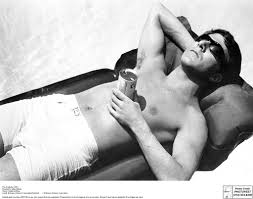

The Graduate tapped into all of the anti-establishment feelings that were being felt at the time, but the film itself is surprisingly absent of references to the current events. There is no mention of the Vietnam War. We do not hear Martin Luther King’s name mentioned. The University of California at Berkeley, the epicenter of student unrest at the time, appears sedate in the overhead shot of the campus. Only actor Norman Fell’s concern about “outside agitators” reminds us of the tumult that was going on there. But it is in the non-specific exposure of the affluent society that created the country’s ills, and the depiction of youth wanting a meaningful and unique destiny, that makes this movie a timeless story.


Even though this motion picture, with its exclusive zeroing in on Benjamin Braddock (Dustin Hoffman), makes us identify with this young man in transition, Nichols does not exalt him as a generation’s hero. Does he petition against fellow youths being sent to war? Is he at rallies protesting racial discrimination? The answer to these questions is “no.” As was pointed out in a film class taught by filmmaker Andrew Karasik, he is depicted from the very first scene as a passive individual being transported through upper middle-class America. He arrives home on a jet plane. His luggage, like himself, is moved along on a conveyor belt. (Although his exiting the terminal through the wrong doors hints at his future nonconformity). He is given an expensive sports car for travel around his affluent world as a graduation gift. He is like an early version of Forrest Gump, where the focus is on the main character as a vehicle to show the audience the significance of what’s going on around him.

Nichols shows us with biting humor the superficial world closing in on Benjamin. His graduation party is filled with material minded people confronting him who only want to tell Ben how his future can be like their present. There is the famous line of advice about going into “plastics.” Ben can’t break through to anyone else because no one is listening. There is no communication in this world. Mr. Robinson doesn’t listen to him when he asks Ben what he likes to drink, and, at one point, he can’t remember Ben’s name (an ad lib because actor Murray Hamilton forgot the character’s name, and Nichols left it in). The shot of Benjamin looking through his aquarium makes it appear as if his world is claustrophobically enclosed. He looks like a fish in a tank in one of the last scenes, banging against the glass at the top, rear part of the church where Elaine is to be married, trying to escape his prison. There is a plastic (see, everything is made of plastic) frogman in the aquarium in his room, which foreshadows the scene where his father makes him wear the underwater gear. All we hear is Ben’s breathing in that scene. There is no communication again. He is submerged in the pool, underwater, trapped like a fish in a tank. He literally and figuratively drifts in his circumscribed pool that summer, with no direction. When his father asks him what was the point of all his education, his reply is “You got me.” Many of us at that time felt the same way given the type of world the system produced. Earlier, when asked why he is avoiding the guests at his party, he says he is worried about his future. He says he wants it to be “different.” This statement sums up Benjamin’s rebellion, which is a personal, not a political, one.


There is one person at the party who sees right through to Benjamin’s angst. The camera provides us with a telling quick look of a woman observing Benjamin, assessing him. It is Mrs. Robinson (Anne Bancroft), the wife of Benjamin’s father’s partner. When she asks Ben to drive her home, she throws the car keys into the aquarium, as if offering him a way out of his mental prison. However, the way she allows him to be anti-establishment is through a self-serving act of adultery. Why does she try to seduce Benjamin at this particular point? Is she just manipulative, and sees that he is vulnerable enough so she can use him to satisfy her wants? Certainly there is an argument to be made for this viewpoint. She dresses in animal print underwear, emphasizing her predatory nature. Even her enclosed patio is covered in plants, making it appear to be a jungle in which she rules. But, isn’t she finding a kindred soul whose life is as empty as hers? As opposed to the superficial talk of the friends of Benjamin's parents, she candidly admits to being an alcoholic, a condition that disqualifies her from being a model for the suburban world she inhabits. In a later scene when they are in bed together, she admits to having been an art major, and now has lost all interest in it. She let her youthful passion slip away. Possibly she seeks out a younger person to recapture that feeling of hope for the future. She was a rebel herself, having premarital sex and getting pregnant with her daughter, Elaine (Katharine Ross). But, she capitulated to the world of the affluent suburbs, and settled for a loveless marriage of convenience. However, once she does seduce Benjamin, he is now seen as corrupted. This corruption is symbolized by Benjamin, an athlete in college, beginning to smoke once the affair begins, an act which shows his thumbing his nose at the compliance to the rules had had lived by. She, as the mother figure, in an oedipal manner, has initiated him into defilement. She is already a fallen woman, but she does not want her daughter to be sullied by being romantic with a man with whom she had extramarital sex.


It can be argued that Ben’s anemic act of nonconformity is the unethical decision to have an illicit affair with an older woman. And what kind of rebel winds up with Elaine, who is the girl his parents wanted him to be with in the first place? But Ben is not seeking sexual gratification with Mrs. Robinson at first. He says to her, “Maybe we could do something else together. Mrs. Robinson, would you like to go to a movie?” He just wants to make a connection with someone who is as unfulfilled by life as he is. Since she does not want to have a meeting of the minds, it is appropriate that we hear the song “The Sounds of Silence” in the background during their lovemaking. To blame Benjamin for breaking up the Robinson’s marriage, well, it was a hypocrisy to begin with, a “for appearances only” arrangement. As far as choosing Elaine, she is, as is Benjamin, as are we all, our parents’ children. Do we become duplicates of them, or are we capable of seeking out individuality?


When Benjamin finds something he is passionate about, Elaine, he converts from being passive to being active. He pursues her at college, runs after the bus that is taking her to her fiancée, and runs to the church after his car breaks down. The image of Ben heading toward the camera, however, makes him appear as if he is running in place, getting nowhere. He is depicted as making an effort, but it is almost Sisyphus-like in showing how difficult it is to struggle against society’s entrenched establishment. Nichols depicts him as a Christ figure with hands raised in the long shot of the back of the church, as if crucified by these perverters of freedom. It is at this point that Elaine makes her decision to not give in to her mother’s conformity. In older movies, this type of scene would happen before the bride and groom are married. This scene takes place after the vows. Thus, the defiance is emphasized as Elaine tells her mother, “It’s not too late for me.” Ben literally fights off Mr. Robinson and the others who want to perpetuate their kind of submission, wielding, blasphemously, from the churchgoers’ viewpoint, and at the same time appropriately from Ben’s perspective, a crucifix. Whereas, earlier, doors are used symbolically to show him being closed in or locked out by others, he now closes the church door, locking in his adversaries.


But, at the end, even though Nichols has provided us a momentary feeling of exalted freedom, he then undercuts that euphoria with the shots of Benjamin and Elaine, her in her wedding dress, as the two sit at the back of the getaway bus, a kind of honeymoon conveyance. Earlier, when Ben runs after Elaine on the way to the zoo, he still winds up on a bus, taking him away, without him directing its motion. Here again, the two appearing contemplative, almost sad, not looking at each other, not really knowing each other, seem to be thinking, “Okay, what do we do now?” They are not driving the bus, but are being carried to who knows where? Is it possible to direct our own destiny, or are we just carried along by the currents of life?


Next week’s movie is Network.

Sunday, September 6, 2015

Long Day's Journey into Night

SPOILER ALERT! The plot will be discussed.


You might feel like you spent a whole day watching this film. It comes in just under three hours. Well, Eugene O’Neill was not known for being brief. Some critics have criticized this 1962 screen version of the play, directed by Sidney Lumet, for being “stagy.” I would have to disagree. Yes, we are talking about basically a four character story set at a beach house. But Lumet starts the story of the Tyrone family outside, near the water. The first object we see is the sun, its burning rays bearing down on the earth, hinting at the long day to come. To me the use of the illuminating sun as the first image presented is ironic, since this family doesn’t really want to see the truths surrounding their lives. At one point, the son Edmond (Dean Stockwell) says, “Who wants to see life as it is if you can help it.”


Lumet uses close-ups to zero in on characters as they are showcased while going through their ruminations. He says in his book, Making Movies, if you viewed close-ups of the actors at the start of the movie and then at the end, “you’d be shocked at how different they look. The ravaged, worn, exhausted faces at the end have almost nothing to do with the composed, clean faces at the beginning. It wasn’t only acting. This was also accomplished by lenses, light, camera position, and length of takes.” This effect emphasizes the toll this day (which is symbolic of the many days of their lives) exacts on the family members.


Let’s look at the individual characters. The matriarch, Mary (Katherine Hepburn) has been morphine-addicted since the birth of Edmund. She was institutionalized, and her husband and sons worry that at any moment she will relapse (which she does). Gong to the “spare room” is the signal that she is isolating herself from the family (a spare room is not used by family members) so she can shoot up. The drug addiction is a literal and figurative escape from reality. She, as do the others, blame their problems on other family members, instead of taking a hard look at themselves. Mary says it is her other son’s fault, Jamie (Jason Robards, Jr.) for having the measles that infected a third child, who eventually died. She says it was Edmond’s fault for bringing a birth too soon after the death of a child that led to her addiction. She refuses to accept the fact that Edmond has tuberculosis, and slaps him when he tries to make her realize he doesn’t just have “a summer cold.” She accuses her sons and her husband, James (Ralph Richardson), the traveling actor, for having lives outside of the home, leaving her alone. But, she has made the house a prison for herself. The fog at the beginning is symbolic of her inability to see the truth about her life. The fog horn is used repeatedly (for instance when they all are drinking alcohol) to show how the family is like a boat trying to navigate a self-imposed obscurity to the truth. Lumet says in his book that he used longer and longer lenses on Hepburn to show the character’s slipping “into her dope-ridden fog.”


The pretentious father, James, is also in a state of delusion. He was an actor of some note who invents statements about his theatrical abilities. He blames his sons’ wandering ways on their lack of commitment to the Catholic faith instead of taking responsibility as their father. He tries to limit the consumption of alcohol by the boys, but he drinks a great deal stating it is for medicinal purposes. He champions the importance of the family, but he was absent much of the time and was unfaithful to his wife.


Jamie drinks to excess, visits brothels, and generally has no stability in his life. He wants to blame his father and mother for his cynical and pessimistic view of the world, but again, does not take any personal responsibility. Edmond became a sailor to escape the family. He talks of a nirvana-like experience while at sea. He felt part of everything else, achieving self-obliteration, and not feeling at home at any one place. It is appropriate that he is the one suffering from “consumption,” since his individuality has been wasting away. The father blames Jamie for corrupting Edmond, but the latter allows his brother’s influence to take hold of him.


In the end, the characters start to confront the truth about themselves. For instance, Jamie confesses his love/hate relationship with Edmond (which is sort of how they all feel about each other) when he tells him that he wanted to corrupt his brother. He didn’t want Edmond to be the preferred son of the parents. Lumet says, “As the scenes progress and the truth becomes more and more agonizing, the lenses get wider and wider, the camera gets lower and lower, the light harsher but darker, as the whole story of these people gets wrapped in night and the final terrible truths are articulated.”

As I said, a long day indeed.


Next week’s movie is The Graduate.