SPOILER ALERT! The plot will be discussed!
Fences (2016), written by
acclaimed playwright August Wilson, and directed by Denzel Washington, uses the
title of the story to convey various meanings. The main character, Troy Maxson (Washington),
was an aspiring baseball player. (Could the name referencing the epic by Homer
suggest Troy feels like the besieged city?) A batter in that sport “swings for
the fences” in the hope of hitting a home run. That means the player exhibits
the hope of accomplishment. Actual fences are barriers erected for physical safety,
but they can also be psychological shields that protect an individual
emotionally. They may imply the desire to prevent others from escaping the
control of the of one in power. Wilson richly employs the metaphor in various
ways.
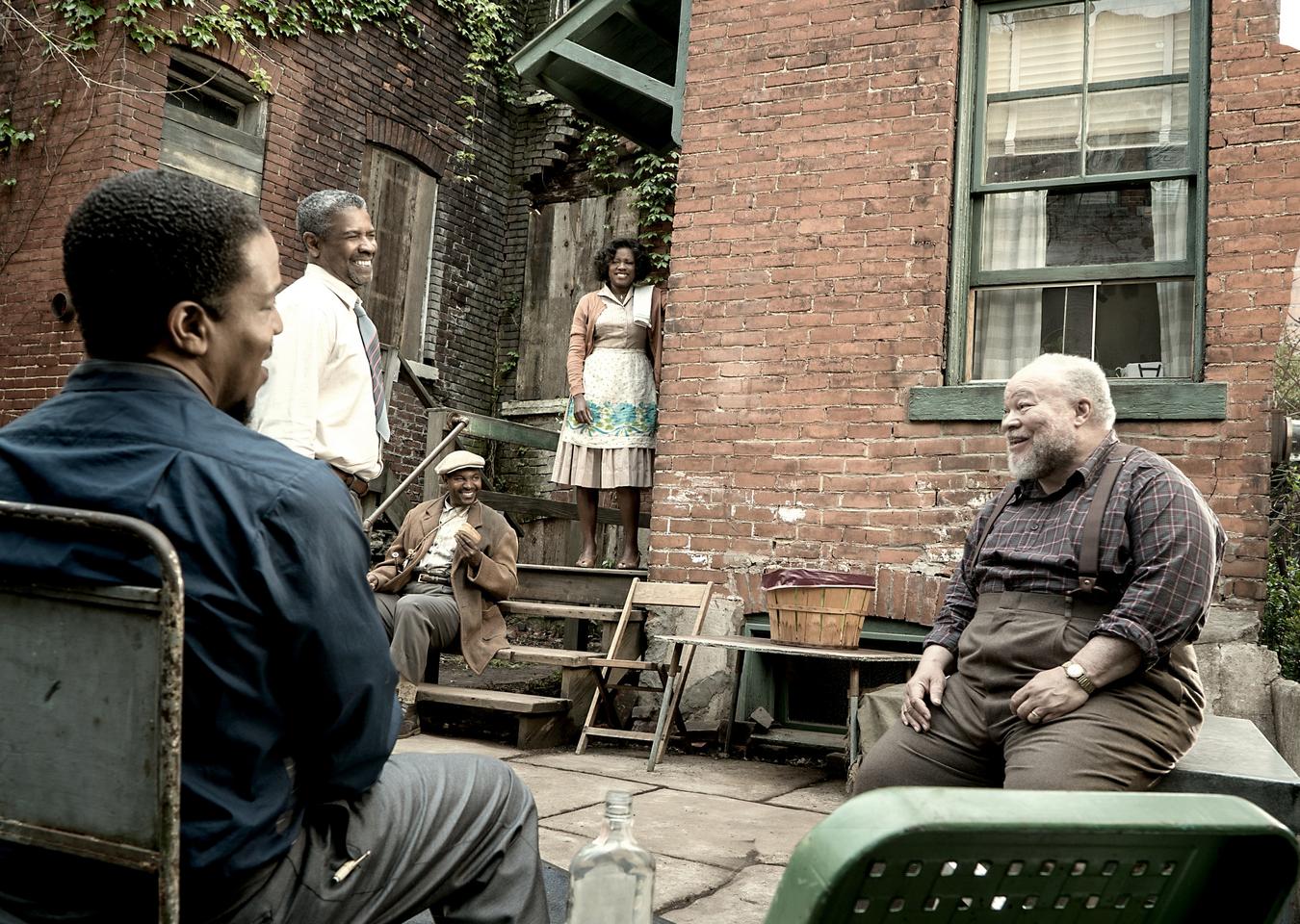
The film takes place in Pittsburgh, Pennsylvania, the
scene of many of Wilson’s plays. It begins in 1956. Troy is a trash collector,
and he works with his friend, Jim Bono (Stephen McKinley Henderson). The two
talk about Troy’s complaint that there are no Black trash truck drivers, and
Blacks always have to haul the refuse into the vehicle. Troy sees it as a
racial issue, which it is in general because of social deprivation. We later
learn that specific to Troy’s situation, he can’t read and does not have a
driver’s license.
The conversation turns to Troy having bought some
drinks for a woman who is not his wife, Rose (Viola Davis, an Oscar winner for
Best Supporting Actress for this role). The character’s name reminds one of Spring,
and rebirth, and she tries to get Troy to emerge from the dead past in which he
likes to dwell. Bono implies that his friend is not just being polite, as Troy
argues, when a man buys several drinks for a woman. Troy gets Bono to admit
that he has never known Troy to cheat on his wife. However, no knowledge of a
fact doesn’t make it untrue, as we subsequently discover.
They share a pint of whiskey (we find that Troy drinks
too much, since Bono teases him about hogging the bottle). They engage is some crude
sexual humor about a large woman from Florida. Troy says the woman’s girth
“cushions the ride” like “Goodyear” tires. Even if that type of joke might be
offensive to some, it fits the characters Wilson portrays. They are at Troy’s
house and Rose comes out of the house and appropriately asks what they are
“getting into.” She seems to have radar when it comes to her husband’s state of
mind. She offers her own sense of humor. Troy says that when they first met, he
told her he wanted to be her man, but didn’t want to get married. She said if
he wasn’t the “marrying kind” then he should “move out of the way, so the
marrying kind could find” her. Bono
shows the deprived plight of African American families when he talks about how
difficult it used to be to get a home without an outhouse, and he thought
indoor plumbing was reserved for white folks.

Troy is glad that his young son, Cory (Jovan Adepo),
works at the supermarket because he is able to contribute cash to the family. Cory
plays football in high school and Rose says a recruiter has approached him. Troy
again says that race will be a factor, and Cory will not be allowed to play
football because he is Black. He says that his boy should do something practical,
like car maintenance, so he “can make a living.” Rose points out that Cory
isn’t looking to make a career out of playing football; it’s just an “honor” to
be recruited. Rose and Bono point out that things have changed and that there
are many Blacks in professional sports now. Troy appears to be living in the
past, and he has put a virtual fence that keeps out thoughts of exalted aspirations.
He acts angry about prejudicial treatment, but feels nothing can be done about
it. He implies one must give up on dreams and accept the unfair life that
exists. It is at this point that we see where his anger derives. Troy was a
very good baseball player, but he tried to rise up when he was too old, and
failed to become a big leaguer. He will not admit he needed more time before
attempting to become a baseball star. He is bitter about his failure to succeed.
Rose tells her husband that his excessive drinking will
kill him. Troy says that Death visited him once when he had pneumonia, but he
beat Death in a wrestling match. He personifies the loss of life so he can feel
like he is in a contest between two men in which he can compete. He also talks
about confronting the Devil, and Rose comments that anything that Troy doesn’t understand,
he calls it the Devil. It’s as if Troy paints himself as a bigger-than-life
Sisyphus-like character, constantly battling overpowering forces.


Lyons (Russell Hornsby), Troy’s older son from a prior
relationship, arrives with his guitar. Troy sees him as another person who is
not practical, only wanting to pursue his music. Lyons sees music as the reason
for living; he says he needs a reason to exist, and music gives him that
reason. Lyons asks for money, which is the only reason Troy says he is there. Lyons
says his girl, Bonnie, is working and he’ll pay back the money. Troy says he
can get Lyons a job picking up trash, but Lyons wants something better than
that for his life. Many parents want their children to have jobs that are
better than how they make a living. However, Troy represents those parents who
feel their children look down upon the work that they do. Troy feels that he
must carry the weight of dreamers on his labor-inflicted back, and thus, he
begrudges the dreams of his offspring. He says that Lyons’s mother did a poor
job of raising him. Lyons counters by saying that Troy was not around, so he
doesn’t know how he was raised. He basically is indicting Troy’s hypocritical
action since he talks about being responsible but abdicated his responsibility
toward his son. Rose gets the complaining Troy to come up with the ten dollars
Lyons asked for.
It's the weekend and Rose sings a hymn as she hangs laundry
to dry. The words of the song ask Jesus to be a “fence” around her. Here is
where the title of the story involves the wish for protection. Rose talks about
playing the “numbers,” an illegal form of gambling before state-run lotteries
came into being. Troy calls the betting foolish. He again expresses his
contempt for seeking a dream-like impractical way to escape the plight of the
deprived.
Troy continues this rant by saying Cory wanted to
escape working on a fence on his property by going to football practice. Here,
the fence could be a metaphor for Troy trying to keep his son from escaping
Troy’s control over him, and thus, depriving Cory the luxury of holding onto
his aspirations. Rose tells her husband that he’s “off,” complaining about
everything. She takes the saying about getting up on the wrong side of bed and wittily
refreshes it by telling Troy to go back to bed and get up on the other side.
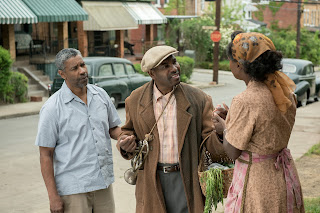
Troy’s brother Gabe (Mykelti Williamson) walks down
the street yelling about selling plums that he does not have. He acts child-like,
and it is obvious that he has mental deficits which we learn was due to
receiving a serious head injury in the military. Despite his impairment, Gabe has
religious visions about hellhounds, St. Peter, and Judgment Day. It’s as if he
is an uncomplicated vessel that carries a divine message about the evils around
him and urges preparation for the apocalypse to come (perhaps that is why he
has the name of the angel Gabriel who. with his trumpet. announces God’s wishes).
He wanders off urging others to get ready for God’s arrival. He recently moved
out of Troy’s house and Gabe says that he wanted to get out of Troy’s way. Gabe
is a gentle soul in contrast to his brother, and appears intimidated by Troy, wondering
if his brother is angry with him. Gabe received $3,000 when he left the service
and Troy used that money to buy his house. So, despite Troy talking about
having to earn one’s own way, he used his brother’s disability to get what Troy
wanted. Troy did take care of his brother until he moved out. Troy expresses regret
and anger that life is so unfair that the only way he could have his own place
was because of his brother’s life-threatening injury.
Troy says he is going to work on the fence, but he goes
to the local tavern and comes back drunk. He says he is going to fix things around
the house but escapes into his drinking instead. At the same time that he rants
about Cory not doing his chores, the boy is actually home ready to take care of
his responsibilities. Troy is always on the offensive about the way he sees the
world vexing him. What follows is a universal exchange between the self-indulgent
but life-enjoying child and the practical adult. Cory says his father should buy
a TV. Troy points out that the money that would buy a TV must go to fixing the
roof. Troy humorously says what good is the TV if the roof leaks water onto
Cory’s brand-new television.
As the two work on the wood for the fence, Cory talks
about the Pittsburgh Pirates. Troy, always wearing that chip on his shoulder,
says that Roberto Clemente isn’t allowed to play all the time because he is a
man of color. Cory corrects his father’s limited perspective by telling him
Clemente plays a great deal. Troy adds that the baseball leagues play mediocre
white men while Black players must be great to get a chance. Cory, trying to add
fairness to the argument, mentions exceptional white and Black ballplayers,
including Hank Aaron. Troy dismisses the great Aaron by saying any player can
do well once he gets his timing, and says that Troy had hits off the great
Negro League pitcher Satchel Paige. Troy appears to need to compensate for a
lack of success by knocking down the accomplishments of others.
From baseball the two move on to Cory’s football
aspirations, of which Troy again says his son has unachievable dreams. Cory
quit his weekday job at the grocery store, but will continue to work weekends.
The owner will hold his job until after the football season. Cory can go to
college because of his football abilities and good grades. That’s not enough
for Troy, who still views his boy’s hopes as a longshot because Troy interprets
his failure at sports as being due to a continuing systemic racist system that
will also affect Cory. He demands that Cory try to get his job back, or find a
new one, and give up his dream of playing college sports. Troy tells his son to
learn a trade so he will not have to haul trash like his dad. He wants his son
to succeed, but in a pragmatic sense.
A dejected Cory, trying to comprehend why his father
is denying him a chance at happiness, asks if Troy likes him. Troy reduces even
family relationships to practical transactions. He says there is no “law” that
says he must like Cory. He has a duty to take care of him because he is his
son. He said having him did not include in the bargain liking him. He tells a
now seething Cory that his son should stop worrying about being liked and focus
on who “is doin’ right by you.” Troy’s reducing family relationships to a
pragmatic contract involving duties not only leaves no room for liking someone
but also excludes love, the real glue that binds a family together.
Rose again tries to break through the “fence” of
Troy’s self-delusion that the only reason that he didn’t succeed in sports was
because of racism, and not his age. She tries to tell him that he is enclosed
himself in the bitterness of the past and doesn’t want to see that things have
changed, implying that there are more opportunities in sports for African
Americans at the time the story takes place.
Instead of getting fired for complaining about there
being no Black truck drivers, Troy instead becomes the first African American
trash truck driver (despite having no license). He celebrates with Bono and
Troy tells Rose the good news. That’s one instance of Troy being wrong about
how he sees the world. Immediately after that, there is a second example. Lyons
arrives and wants to pay him back the ten dollars he borrowed. Instead of acknowledging
his son’s responsible action, he tells him to hold onto the money for the next
time he needs a handout instead of coming to his father. Troy assumes his son
will continue to be a burden instead of admitting that maybe things can change.
Gabe shows up with more announcements about Armageddon
and the Devil, who Troy says he did battle with. Gabe calls Lyons, because of
his name, the king of the jungle and they both growl. However, for Troy, his
musician son is no force of nature. Outside, Troy (drinking again) says his
father cared about himself first and his eleven children came afterwards. He
did stick around when others left their responsibilities behind. Still, Troy says
his dad was “evil,” as he tried to take advantage of Troy’s girlfriend after
beating Troy. It was his mother who left the family because of the father’s
ways. Yet, he understood his father, saying his dad was caught in a trap,
working at picking cotton and having many mouths to feed. Troy sees life as a
trap. Troy ran away from home at age fourteen and turned to robbing people to
get by. He was in a confrontation with a man who shot him. Troy killed the man and
was in prison for fifteen years. That time in prison is the reason why Troy
started his baseball career too late. One can understand that Troy suffered
traumatic experiences that contributed to his view of how harsh life is. His
stories about the old times along with those of his old friend, Bono, affirm
what Rose says about him being ensnared in the past.
Lyons invites his father to hear him play but Troy
refuses. He can’t find it himself to take pride in his son’s impractical artistic
nature because he perceives Lyons as just another weight he must carry. Cory
comes home angry and throws his helmet which bounces off the house porch. Cory
says Troy told the coach he can’t play football anymore. Cory says something
that hits at the core of his father’s mindset when he says that his father is
jealous of his son succeeding when Troy couldn’t. In Troy’s mind, his son can
get a good job if he works hard, but he will not accept the possibility that
his son could hit the occupational lottery when Troy couldn’t. Troy uses a
baseball metaphor when he says that the thrown helmet was “strike one” because
it missed Troy. He warns his son that he better not “strike out.” He is
threatening Cory with physical violence at this point.
The next day Cory practices hitting a baseball hanging
from a rope on a tree with a bat. He tells Rose he will not quit football. Is
he metaphorically making sure he will not strike out against his father, the
seasoned ballplayer? Bona says that Troy is paying too much attention to
another woman. As Cory helps Troy and Bono saw wood for the fence, Bono,
referring to what he said about the other woman, announces the central theme of
the story when he says, “Some build fences to keep people out and other people
build fences to keep people in. Rose wants to hold onto you all.” The
implication is that Troy is divisive, and Rose works as a force to balance
Troy’s ways, so her song to God is echoed here where a fence is symbolic of
protection.
Bono takes Troy aside and tells him he has learned a
great deal from Troy and he knows whether or not someone’s telling the truth. He
says that he doesn’t want to see Rose hurt. Troy here admits to his
extramarital affair and says that he can’t shake this other woman loose. Troy
is breaking his marital vows, and Bono reminds his friend that he should
practice what he preaches about accepting responsibility.


After what Bono said, Troy is feeling guilty and he
decides to confess to Rose. But there is more to the story than what Bono
knows; he tells Rose he is going to be a “daddy” again. Rose gets hit with both
barrels at once concerning Troy’s infidelity. Rose almost falls to the floor
from the emotional wounds that Troy has inflicted on her. She runs outside
toward the existing metal fence, as if trying to flee the barrier that she
thought protected her. She drops the rose that Gabriel gave her, possibly
signifying the relinquishing of hope for the future that her name suggested. He
tries to defend himself by using extensive baseball metaphors, using the tools
he knows. He says that he was born with two strikes against him, most likely
being Black and poor. However, he avoided that third strike by getting married,
having a family and a job. But, he says the other woman gives him an escape
from the pressure of his work and family responsibilities, and he says he can’t
give up that feeling of freedom. Rose says that it’s her job to alive pressure,
and he shouldn’t be looking for someone outside the family. In baseball
language, that would mean the relief pitcher should be someone on the same
team. He says that he feels like he has been standing still. Her angry response
is, “Well, I’ve been standing with you!” She has been supporting him and has
given up moving on by committing to her life with Troy. Just like his boys,
Troy has tried to kill Rose’s wants and dreams. She says she buried her desires
“inside” her husband, hoping happiness would grow there, but she found she
planted her hopes on rocky soil. She calls him out on his selfishness since he
always talks about what he has sacrificed and forgets how much he has taken,
most likely implying how much he has deprived her of her wishes. He becomes
angry about being accused of taking and not giving back, and grabs Rose’s arm. As
she cries out that he is hurting her, Cory comes outside and slams Troy into
the fence, threatening that barrier of authority between father and son. Troy
says that Cory now has two strikes against him, and he implies there will be
violent retribution against his son if he gets that third strike.
We get a montage of images that show time passing as
the weather turns cold with snow falling. Troy continues to build the fence
alone; Cory works out in the basement as he keeps his dream alive of playing
football; Rose seeks refuge in the embrace of fellow females at her church;
Gabriel visits the grave of his mother who died young. The family members are
isolated from each other. At least until Rose shows up at Troy’s workplace and
tells her husband they must talk. He says it's been six months since she hasn’t
wanted to have a conversation with him. She wants him to come straight home
after work, implying he should not visit his lady friend, Alberta. After some evading,
Troy says he just wants to stop at the hospital because Alberta may be having
the baby early. Rose’s face reflects her anguish and criticizes Troy for
signing papers that would send Gabriel to an institution (something he said he
wouldn’t do) and would award him half of his brother’s disability check. Yet,
he would not sign the agreement to have Cory play football at a college. Troy
can’t read, so it’s possible he is truthful when he says he didn’t know
anything about what Rose reports, which again stresses how his lack of an
education has hindered him. Most likely out of guilt Troy feeds his brother at the
asylum, like a nurturing father giving food to a baby.
Rose answers the phone in the middle of the night. She
reports to Troy that Alberta gave birth to a girl, but she died during
childbirth. When Rose asks about what’s to be done next, Troy reverts to his
usual complaint about being burdened by life. After Rose leaves him alone, Troy
rants at Death, saying he’s going to finish the fence, to keep Death at a safe
distance until it’s his time, and then they will battle. He tells Death not to
come at him through others, like Alberta. We again have a mythological level to
the tale, as Troy addresses primal forces. It is as if he is delivering a
dramatic soliloquy, like Shakespeare’s King Lear. However, Troy’s speech shows
how he is an egotist, as if everything revolves around him.

The next scene has Troy coming home with his infant
daughter. He tells Rose she is an innocent child with no mother. He is asking
for help to raise her, but the suffering Rose says there is no point telling
her that. He goes outside and is quietly defiant saying to the baby he is not
sorry for what he has done because he felt his actions were right for him. He says
he was homeless before, but not with a baby. Rose hears Troy basically saying
that he will have to care for his child outside of his home. Davis shows Rose’s
anguish just from her back as she drops what she is holding into the sink and stretches
her arms as if to support her emotional heaviness. Troy now comes straight out and
asks that Rose help take care of the baby. Rose agrees, because she knows that
the child is innocent, and should not inherit the sins of the father. Rose has
always valued the other family members above her own needs. She says his daughter
is no longer motherless, but he is womanless, stressing that she has not
forgiven his sins against her.
A short time has passed as Troy comes home to find Cory
leave the yard as soon as he sees his father. Rose leaves to bring a cake to
the church and left Troy some dinner. He goes to the local bar and talks to
Bono who he hasn’t seen for a while because Troy is now driving in a white
neighborhood. Troy is losing his family and his friend due to his actions. He
sings about his dead dog, again seeking solace in the past. Cory stops at a
Marine recruiting office, so we know Troy has lost his son even though he tried
to keep him inside his fence.

When Cory comes home the drunken Troy blocks his
entrance, and Cory refuses to say, “Excuse me,” because he says his father, due
to his actions, doesn’t count anymore. Troy then reverts to the same list of
material things he has given his son, but Cory states how his father only made
him fear him, and was never supportive. They have a physical confrontation,
with Troy overpowering Cory, and taking the baseball bat away from him. Troy comes
close to choking and slugging his son. He kicks Cory out of his house, which
Cory reminds him is not really his since Gabriel paid for it. Troy says Cory’s
belongs will be on the other side of the fence, which emphasizes how Troy’s
world is shrinking as he alienates everyone around him. But Troy is defiant in
his emptiness, swinging his baseball bat, invoking Death again, saying he is
ready to fight the Grim Reaper. He is ready for death as an escape now, but he
will still deal with his demise as he has lived his life, kicking and
screaming.
The next scene takes place several years later, and
Troy’s daughter, Raynell (Saniyya Sidney - Could her name suggest a “ray” of sunshine and the hope for a better
future?), is a youngster taking care of a garden outside. The greenery may
represent the influence of Rose, the person with the regenerative name. Bono is
there with Lyons. They are dressed up in black, as is Rose. We know they are
going to Troy’s funeral. Cory shows up looking impressive in his Marine
uniform, wearing a corporal’s stripes, and has been in the service for six
years. He has been away since his father kicked him out, since Raynell doesn’t
know that he is her half-brother. Lyons tells Cory that he is finishing up a
three-year prison sentence for cashing other people’s checks (his father was a thief
when he was young), and the penitentiary let him out for his dad’s funeral. He
reminds the bitter Cory that Troy used to say, “you got to take the crookeds
with the straights.” He recounts how his father would strike out and then hit
the ball out of the stadium, and after the game two hundred people wanted to
shake his hand. Despite his shortcomings, Lyons is saying that Troy was a force
of nature. Lyons still plays music, keeping what feeds him emotionally in his
life. Troy’s sons may not have played baseball, but they played music and
football, and refuse to give into defeat.
In the kitchen are pictures of John F. Kennedy, Martin
Luther King, Jr., and Jesus, individuals that inspire and keep Rose going. She
tells Cory outside that Troy was swinging his bat at the ball tied to the tree
when he fell over and died. He went down swinging, as he said he would when
Death came for him. Cory tells Rose that he has to say “no” to his father just once
and will not go to the funeral. Rose is outraged and says that is not how she
brought him up, and he must put his animosity aside. She says her words with
the baseball hanging between them and the fence Troy built in the background.
These images show how Troy’s legacy of placing boundaries between people continues
to divide lives despite Rose’s wish to bring the family together.
Cory says that his father was like a “shadow,” suggesting
it was like a black plague that infested his life. Rose says that Cory can’t
escape his father’s influence, but he must deal with it. Troy was a man of
contradictions, but she believes he wanted to do more good than harm. Her words
show that conflict between wanting to help but not knowing how to deliver it. She
says that sometimes when he touched someone, he “bruised” them, and when he
held her, she might feel him “cut” her, both in an emotional sense. He most
likely wanted Cory to be far from what Troy was in his failures, but also to be
like him in his strength.
She says that Troy was a bigger than life character
who filled up the house and all the “empty” spaces in her. But, she admits that
didn’t leave much room for her own individuality to thrive. She does take
responsibility for choosing Troy, and she has turned the negative events that
brought Raynell into the world into a positive. The girl is a symbol of
rebirth, giving Rose a new energy, which refueled Rose, who is a life force
herself.
Raynell and Cory sing Troy’s song about his dog, Blue.
After they are done, she hugs him. The institution let Gabriel out for the
funeral of his brother, and he shows up with a trumpet, living up to the angel
whose name he carries. He blows one clear note, and the sun shines through the
clouds, which Gabriel takes as opening the gates of heaven for Troy. Raynell
holds Gabriel’s hand. Troy’s child is able to accomplish what he couldn’t do in
life, which is to bring the family together.
The next film is Stand by Me.